

HCPCS Code Q4175: Billing, coverage, and documentation guide
HCPCS Code Q4175: Code Description and Product Identity HCPCS Code Q4175 is the ...

Last Updated: Nov 20, 2026
92228 is the CPT code for retinal imaging read remotely by a physician or other qualified health care professional, for detection or monitoring of disease. The reader writes an interpretation and report, and one unit covers one or both eyes.
Images are captured at one site, often a primary care or endocrinology office, and read later by an ophthalmologist or optometrist elsewhere. In-office fundus photography is 92250, staff-reviewed remote imaging is 92227, and autonomous AI analysis is 92229. NCCI bundles these codes with 92228, so a patient gets only one of them per day.
Let Pabau's smart automation suggest the right codes, reduce claim denials, and keep your practice compliant—effortlessly.
Automate repetitive tasks and focus on what matters most—your patients.
Reduce coding errors and ensure compliance with the latest regulations.
Clean claims, fewer denials, and faster reimbursements.
Powerful insights and reporting to help your practice thrive.
HIPAA compliant SOC 2 certified GDPR-compliant Trusted by 4,000+ clinics worldwide

CPT code 92228 reports retinal imaging read remotely by a physician or other qualified health care professional, for detection or monitoring of disease.
One unit covers one or both eyes, and the service can be split between the capture site (-TC) and the reader (-26).
NCCI bundles 92228 with 92227, 92229 and 92250, so a patient gets only one of these codes per day.
Diabetes codes such as E11.319, E11.9, E10.319 and E10.9 carry medical necessity, but check your MAC’s covered list.
Medicare’s 2026 national rate for 92228 is about $30, before the GPCI adjusts it for your locality.
CPT code 92228 reports retinal imaging for detection or monitoring of disease, when a physician or other qualified health care professional reads the images remotely. Aetna’s retinopathy telescreening policy lists the current descriptor in full, word for word:
Imaging of retina for detection or monitoring of disease; with remote physician or other qualified health care professional interpretation and report, unilateral or bilateral.
Older coding references describe 92228 as monitoring of active retinal disease only. That wording predates the 2021 revision. The current descriptor covers detection too, so a diabetic eye screening read by an ophthalmologist or optometrist qualifies.
The model suits practices with a portable fundus camera and no eye doctor on site. Patients get screened during a routine diabetes visit instead of booking a separate eye appointment.
The fastest way to pick the right code is to ask who reviewed the images, and where. The table and the chart below set the four codes side by side.
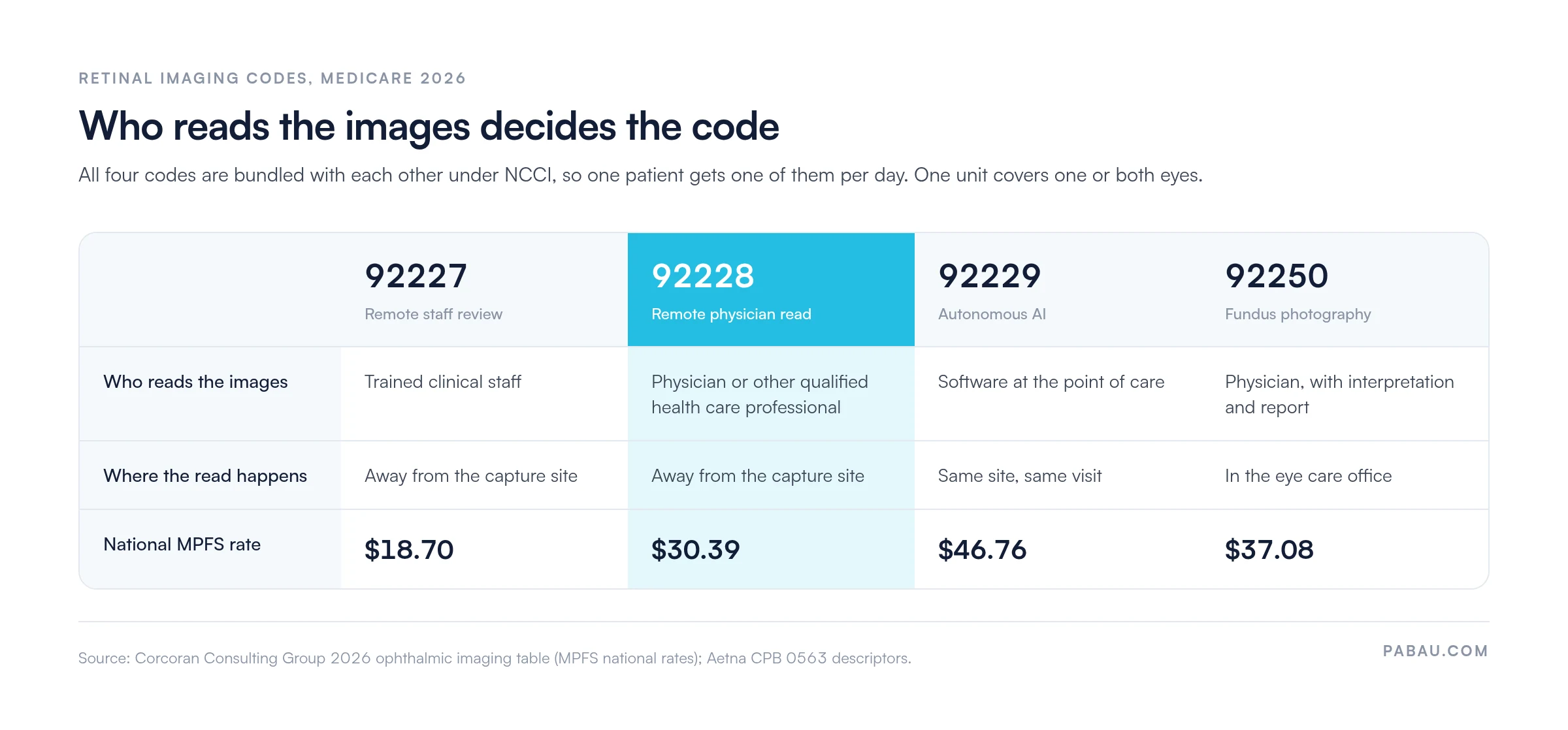
When trained staff grade the images instead of a physician, the claim belongs on 92227. Photos taken and read during an in-person eye visit go on 92250.
Corcoran Consulting Group’s 2026 table lists all of these pairs as NCCI edits. It also pairs 92228 with office E/M codes 99202-99215 and eye exam codes 92002-92014. Pick the one code that matches the service performed.
Scope questions cause most 92228 coding errors. The table sorts the common ones.
92228 can be billed globally or split. The CGS billing article for posterior segment imaging calls 92228 a global service with professional and technical components. It tells providers to use modifier 26 or TC when one party does not perform the whole service.
In practice, the reading ophthalmologist bills 92228-26 and the primary care office that captured the images bills 92228-TC. A reading center that owns the camera and does the read bills the global code. Never bill the global code from both sites.
Each step below leaves a record that a payer can ask for later. Treat the list as both a workflow and an audit trail.
Note the image quality check in the chart, for example ‘Images reviewed for focus and field; both eyes interpretable.’ It takes seconds and answers the first question an auditor asks.
A primary care office sees a patient with type 2 diabetes and no eye exam on file for 14 months. A medical assistant captures two images per eye on the office camera and uploads them.
Two days later, a contracted ophthalmologist reads the images and finds no retinopathy. The signed report recommends a repeat screen in 12 months.
The primary care office bills 92228-TC with place of service 11 and E11.9. The ophthalmologist bills 92228-26 with the same diagnosis. Had the reader found retinopathy without macular edema, both claims would carry E11.319 instead.
A 92228 claim needs an ICD-10-CM code on your MAC’s covered list. Without one, Medicare denies the claim for medical necessity, however good the report is.
The diagnosis follows the read, not the order. A screen ordered under E11.9 that finds retinopathy moves to the matching E11.3- code. Cross-check every code against your MAC’s Local Coverage Determination (LCD), because covered lists differ by jurisdiction.
Post-payment reviews of 92228 focus on the record, so build these elements in before the claim goes out:
A clean claim for 92228 starts with a complete record at the time of billing. Rebuilding the chart after a denial costs far more time.
Medicare covers 92228 under the Physician Fee Schedule when medical necessity is documented. Your MAC’s LCD and billing article set the covered diagnoses and places of service, so read both before billing.
Commercial plans vary more. Some cover 92228 without prior authorization, and others want approval for any remote imaging. Run insurance eligibility verification before the imaging day, especially for Medicare Advantage patients.
The CMS Physician Fee Schedule lookup gives locality rates for the global code and each component. Rates reset every January 1, and the Geographic Practice Cost Index (GPCI) moves them up or down by locality.
The FastRVU 2026 RVU lookup breaks the rate into work, practice expense and malpractice RVUs. Use current-year figures for any financial modeling, since the conversion factor changes yearly.
Medicare fee-for-service does not require prior authorization for 92228, but many Medicare Advantage plans do. UnitedHealthcare, Aetna and Cigna plans may ask for it too, especially when imaging happens outside an eye care office. Get approval before image capture, because retroactive authorization is rarely granted.
Retinal imaging claims fail in predictable ways. Here is what each denial usually means and how to clear it.
Pull a weekly denial report filtered to 92228. If one reason accounts for more than a fifth of rejections, the workflow needs fixing, not the individual claims.
Remote imaging spreads one service across two offices, two records and often two claims. Billing teams end up chasing reports by email and retyping diagnoses into the claim form.
Pabau, a practice management platform with built-in claims management, fills the CMS-1500 from the patient record. The CPT code on the service lands on the charge line, and ICD-10 slots come from the recorded problem list. The claim cannot be sent until required fields, such as authorization numbers, are complete.
In the US, claims go out through the Claim.MD clearinghouse, with eligibility checks before the visit and ERA remittances posted back. Your team sees a missing authorization before submission rather than on a denial weeks later.

Pabau pre-fills the CMS-1500 from the patient record and blocks a claim until required fields are complete. US claims, eligibility checks and remittances run through Claim.MD.

Getting 92228 paid comes down to one decision and one habit. The decision is who reads the images, because that alone separates 92228 from 92227, 92229 and 92250.
The habit is billing from the finished report. Code the diagnosis the reader found, split the claim when two sites share the work, and send one unit. Practices that do this see few 92228 denials, and the ones they see are quick to fix.
If your team still retypes reports into claim forms, start there. Book a demo to see how Pabau turns a signed retinal imaging report into a complete claim.

Coding OCT alongside fundus imaging? CPT code 92134 covers retinal OCT and its bundling with 92228.
Struggling with claims denials across your practice? Denial management in healthcare sets out a repeatable process for working and preventing denials.
Want the bigger billing picture? What is revenue cycle management explains how encounters turn into collected revenue.
Want to understand the 837 file format for electronic claims? 837 file guide covers the EDI transaction payers require for electronic claims.
Yes, where state scope of practice allows it. The descriptor names a physician or other qualified health care professional, so an optometrist can be the remote reader. Credential the reader with each payer before the first claim.
The 2026 national Medicare rates are about $18.70 for 92227 and $46.76 for 92229, per Corcoran Consulting Group. Local rates shift with the GPCI. Neither code is billed with 92228 for the same patient on the same day.
Some MACs treat 92227 as screening. CGS, for example, denies it as non-covered and asks for modifier GY, so the claim can pass to the patient or a secondary payer.
Get an Advance Beneficiary Notice before image capture when you expect a medical necessity denial. A diagnosis missing from your MAC’s covered list is the usual trigger. Append modifier GA when a signed ABN is on file.
Not always. Medicare Advantage plans must cover what original Medicare covers, but they can add prior authorization and their own claim edits. Check each plan’s policy rather than relying on your MAC’s LCD.





