

HCPCS Code L0472: Hyperextension TLSO billing guide
HCPCS code L0472: Official descriptor and device definition HCPCS code L0472 des...

Last Updated: Nov 5, 2026
92227 is the CPT code for imaging of the retina for detection or monitoring of disease, with remote clinical staff review and report. It covers one or both eyes as a single unit, and the report is part of the service.
Trained clinical staff review the images at a site away from where they were captured. Medicare treats 92227 as a technical-only code, so modifiers -26 and -TC never apply. When a physician or other qualified health care professional interprets the images, report 92228 instead. Autonomous AI analysis at the point of care is 92229.
Let Pabau's smart automation suggest the right codes, reduce claim denials, and keep your practice compliant—effortlessly.
Automate repetitive tasks and focus on what matters most—your patients.
Reduce coding errors and ensure compliance with the latest regulations.
Clean claims, fewer denials, and faster reimbursements.
Powerful insights and reporting to help your practice thrive.
HIPAA compliant SOC 2 certified GDPR-compliant Trusted by 4,000+ clinics worldwide

CPT code 92227 is a complete service: retinal imaging with remote clinical staff review and report, unilateral or bilateral, billed as one unit per patient.
Medicare assigns 92227 PC/TC indicator 3, which makes it a technical-only code, so modifiers -26 and -TC cannot be appended to it.
Codes 92227, 92228 and 92229 are alternatives, chosen by who reviews the images: clinical staff, a physician or other QHP, or autonomous AI software.
The 2026 national Medicare rate for 92227 is $18.70, and the facility and non-facility amounts are identical.
Pabau, the practice management platform we build, checks eligibility through Claim.MD and validates every claim before it reaches the payer.
CPT code 92227 reports imaging of the retina for detection or monitoring of disease, with remote clinical staff review and report. It covers one or both eyes as a single service. Image capture, the staff review, and the written report all sit inside the one code.
The American Medical Association (AMA) revised the descriptors for 92227 and 92228 in the 2021 code set. The change named who reviews the images, which is now what separates the codes.
Three features define a 92227 service:
Wide-field and non-mydriatic cameras make this workflow practical in primary care and endocrinology settings. Noridian requires the device to be FDA approved for the intended use, and the person capturing images must be fully trained on it.
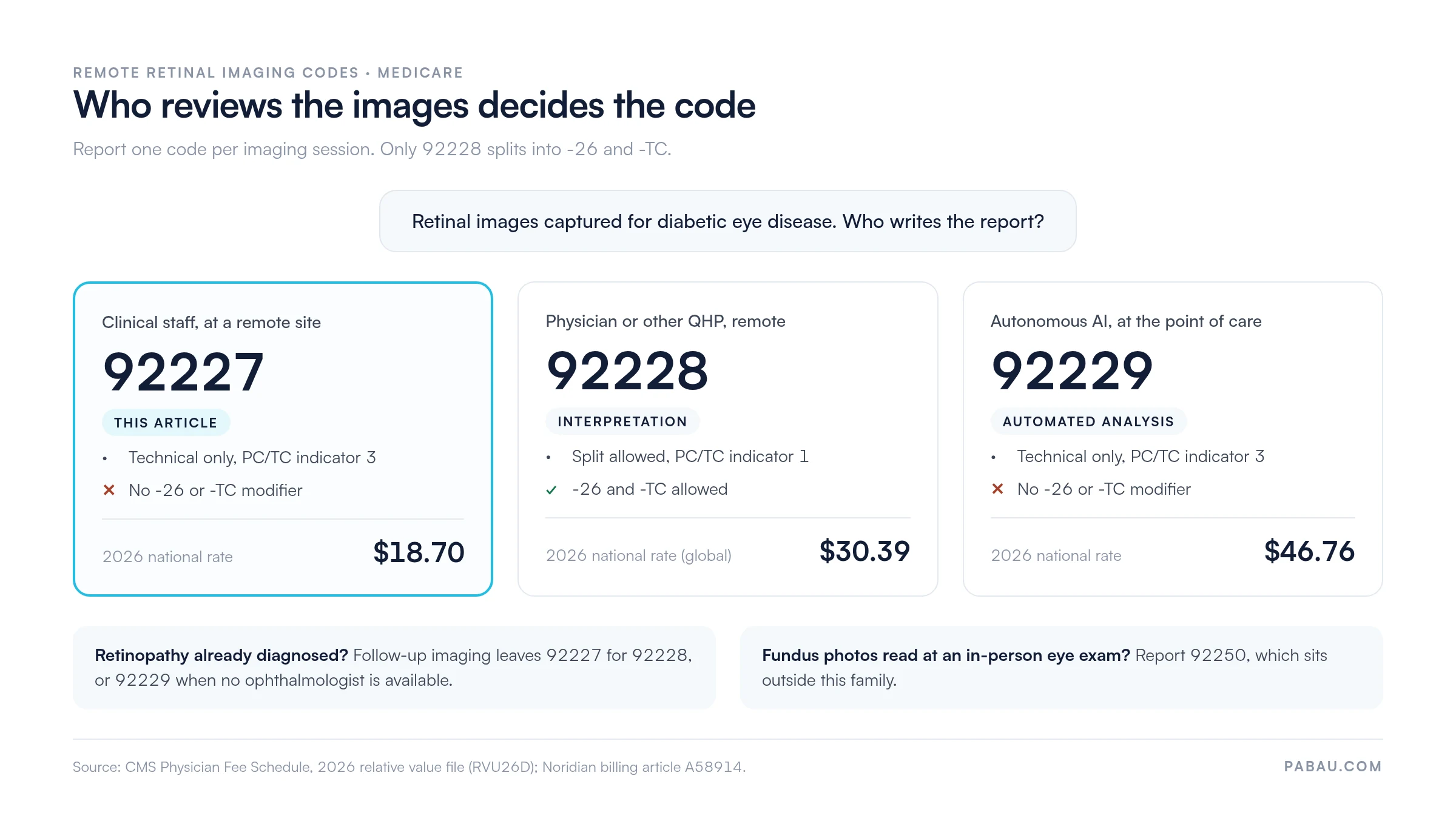
CPT 92227, 92228 and 92229 are three alternative ways to report the same kind of imaging, and the reviewer decides which one applies. Clinical staff review is 92227, and a physician or other qualified health care professional (QHP) is 92228. AI software at the point of care is 92229. Each is a standalone service, so a claim reports one of them for the imaging session.
92228 is the only code in the family that carries a professional/technical split. A reading physician can bill 92228-26 for the interpretation, and the capture site can bill 92228-TC. That split belongs to 92228 alone and never pairs with a 92227 claim. 92228 does not require a 92227 claim, and omitting it never causes a 92227 denial.
Noridian adds a clinical rule of thumb. Once diabetic retinopathy is diagnosed, 92227 no longer applies because the care is no longer screening. Follow-up remote imaging for that patient moves to 92228, or to 92229 when no ophthalmologist is available. The diagram below puts the whole choice on one screen.
CPT 92250 is fundus photography with interpretation and report, performed as part of an in-person eye care service. It is not a remote review code. CPT 92227 is the right code when trained staff review the images away from the capture site.
Billing 92250 for a teleretinal screening program misreports the service. The American Academy of Ophthalmology has advised against reporting 92250-26 for telemedicine reads under Medicare Part B. The remote imaging family exists for that work.
Medical necessity for CPT 92227 rests on a confirmed diabetes diagnosis documented in the patient chart. Payers will not approve the claim for a family history of diabetes or a risk of diabetes alone. For a patient with type 2 diabetes and no complications, the supporting code is usually E11.9.
All five codes appear on the covered diagnosis list in Noridian billing article A58914. Other MACs publish their own lists, so check the article for your jurisdiction. Codes such as E11.65 (hyperglycemia) or E11.36 (diabetic cataract) are missing from the Noridian list, so do not lean on them for coverage.
The 92227 workflow follows the same sequence whichever camera you use. Each step leaves a record that supports the claim.
If a physician or other QHP writes the interpretation instead of clinical staff, the service is 92228, not 92227. Match the code to the person who signed the report.
Medicare coverage for CPT 92227 is set by each Medicare Administrative Contractor (MAC), not by a single national benefit. The billing article that applies depends on the MAC jurisdiction where the service was rendered. Read the medical claims clearinghouse guide for submission steps, and confirm the active article with your MAC before billing.
Noridian billing article A58914 is a useful example of the parameters MACs set:
Other MACs word these limits differently, and commercial payers set their own rules. Check the frequency and exclusion language for each payer before you schedule screening.
The 2026 national Medicare payment for CPT 92227 is $18.70, before geographic adjustment. That figure is 0.56 total RVUs multiplied by the 2026 conversion factor of $33.4009, taken from the CMS Physician Fee Schedule relative value file. Because 92227 carries no work RVU and identical practice expense RVUs in both settings, the facility and non-facility rates match.
The 2026 rate uses the conversion factor for clinicians who are not qualifying APM participants. Qualifying APM participants use $33.5675, which puts 92227 at about $18.80. Geographic Practice Cost Indices (GPCIs) then adjust each figure for your Medicare locality.
Use the FastRVU reimbursement lookup to see the locality-adjusted payment for 92227 in your MAC jurisdiction. When you model a teleretinal program, price each patient at one code: 92227, 92228 or 92229, depending on who reviews the images.
Run a quarterly audit of your 92227 claims against the current CMS fee schedule. Rate changes take effect January 1 each year, and practices using last year’s expected payment amounts often discover under-collection only at year-end reconciliation.
Most 92227 claims need no modifier at all. The modifiers coders reach for by habit are either invalid on this code or apply only in narrow cases.
Report the place of service where the images are captured, which is usually POS 11 for a physician office. Check your MAC guidance before using POS 02 or a telehealth modifier, because the code descriptor already describes remote review.
Medicare generally does not require prior authorization for CPT 92227. The claim must still meet the MAC article criteria to survive a post-payment review.
Several commercial and managed care plans do require prior authorization for remote retinal imaging, and the rules can change between plan years. Verify the requirement with each payer before you launch a teleretinal screening program. Collect the following for any request:
Record the authorization number in the patient chart and on the claim. A missing number on a commercial claim is a common denial that cannot be fixed after the fact.
Most 92227 denials trace back to a coverage criterion or a coding choice that does not match the service. A denial management workflow for this code set prevents rework and protects revenue.
Reviewing the denial codes on your 92227 remittances shows whether denials cluster around one cause. One dominant cause points to a workflow fix. A spread of causes points to a training need.
Every 92227 claim should be backed by a complete record before it goes out. Submitting a clean claim means the chart holds all of the following:
If an auditor finds any one item missing, a paid claim can turn into a recoupment demand. A pre-submission checklist in the EHR stops that before the claim drops.
Rural Health Clinics (RHCs) are paid an all-inclusive rate (AIR) for qualifying visits, not through the Medicare Physician Fee Schedule. The AIR covers the professional services of RHC practitioners. The technical components of diagnostic tests sit outside it and are billed to Part B separately.
That matters for 92227, because Medicare classes the entire code as technical. Three billing routes follow from it:
Confirm the route with your MAC before you build it into the workflow. A 92227 line left on the RHC encounter claim is easy to lose without anyone noticing.
A teleretinal program spreads one claim across several hands. Staff capture the images, a reviewer writes the report, and the billing team later picks the code. If the person who signed the report is unclear, the claim lands on the wrong code in the 92227 family.
In Pabau, the diagnosis, consent and imaging notes live in the patient record that the invoice draws on. Pabau’s claims management software validates each claim for missing or invalid details before it leaves the practice. Claims go out as electronic CMS-1500s through Pabau’s Claim.MD integration, with eligibility checked before the visit.
Remittances come back as ERA files, so a 92227 denial surfaces in days. You can correct the code or the diagnosis while the screening is still fresh.
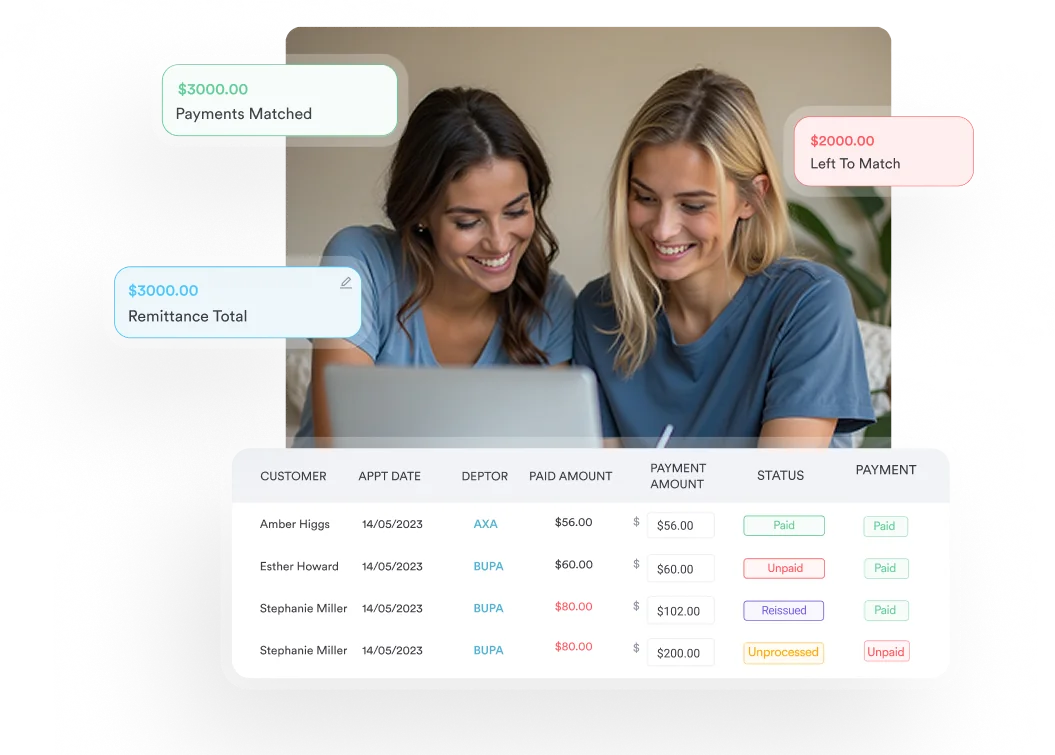

Pabau supports CPT coding workflows for eye care and primary care practices. Build claim templates, verify eligibility before the encounter, and submit through Claim.MD’s clearinghouse with built-in CPT and ICD-10 catalogs.

CPT 92227 is the code for remote retinal screening reviewed by clinical staff, and it stands on its own. Bill it as one technical-only unit, with no -26 or -TC and no 92228 alongside it. When a physician reads the images, or retinopathy is already diagnosed, switch to 92228 or 92229 rather than adding a second code.
Practices that code to the person who signed the report avoid most of the denials this code attracts. Book a demo to see how Pabau keeps diagnosis, documentation and claim in one record for your retinal screening program.

Need to understand how clearinghouse submission works for specialty codes? Our Claim.MD clearinghouse guide explains the end-to-end electronic claims process for US practices.
Seeing recurring claim rejections across your practice? Revenue cycle management fundamentals covers the workflow shifts that reduce systematic denial rates.
Need to read the remittance behind a 92227 denial? Electronic remittance advice (ERA) explained walks through how to read 835 remittance files and act on CARC denial codes.
CPT code 92227 covers imaging of the retina for detection or monitoring of disease, with remote clinical staff review and report, unilateral or bilateral. It is a complete service that includes capture, staff review and the report. It is billed as one unit per patient, whether one eye or both are imaged.
The difference is who reviews the images. Remote clinical staff review and report CPT 92227. A remote physician or other qualified health care professional interprets and reports 92228. They are alternatives, not a pair, so a claim reports one of them for the imaging session.
The 2026 national Medicare rate for CPT 92227 is $18.70, from 0.56 total RVUs and a $33.4009 conversion factor. The 2025 rate was $17.14. Facility and non-facility amounts are identical, and GPCIs adjust the figure for your locality.
Medicare generally does not require prior authorization for CPT 92227, though the claim must still meet the MAC billing article criteria. Many commercial and managed care payers do require it. Verify the requirement with each payer before you launch a teleretinal screening program.
The most common causes are a missing diabetes diagnosis code and screening more often than the payer allows. Claims also fail when 92227 is billed for a physician read, which belongs under 92228, or after retinopathy is diagnosed. An invalid -26 or -TC modifier on 92227 is another frequent cause.
CPT 92250 is fundus photography with interpretation and report, performed as part of an in-person eye care service. CPT 92227 covers retinal imaging reviewed by clinical staff at a remote site. Use 92250 for in-office fundus documentation and 92227 for teleretinal diabetic screening.



