HCPCS code J7190: Factor VIII billing, units and reimbursement
HCPCS code J7190 bills human Factor VIII by the unit HCPCS code J7190 describes ...

Last Updated: Nov 10, 2026
92201 is the CPT code for extended ophthalmoscopy of the peripheral retina, with scleral depression and a retinal drawing. It's used for disease such as a retinal tear, detachment or tumor, and it includes an interpretation and report. One unit covers one or both eyes.
The drawing and the documented technique are what make the service billable. Without them, a dilated look at the periphery belongs to the eye exam and isn't billed as 92201.
Let Pabau's smart automation suggest the right codes, reduce claim denials, and keep your practice compliant—effortlessly.
Automate repetitive tasks and focus on what matters most—your patients.
Reduce coding errors and ensure compliance with the latest regulations.
Clean claims, fewer denials, and faster reimbursements.
Powerful insights and reporting to help your practice thrive.
HIPAA compliant SOC 2 certified GDPR-compliant Trusted by 4,000+ clinics worldwide

CPT 92201 covers extended ophthalmoscopy of the peripheral retina, with scleral depression, a retinal drawing and an interpretation and report.
Report it once per date of service, with no RT, LT, 50 or 52 modifier, whether you examine one eye or both.
92202 covers drawings of the optic nerve or macula, and it can’t be billed with 92201 on the same date.
NCCI treats 92201 and fundus photography (92250) as mutually exclusive, so bill the service your record supports.
Pabau pre-fills each claim from the patient record and checks required fields, so 92201 claims leave complete.
CPT code 92201 is extended ophthalmoscopy of the peripheral retina. The full AMA descriptor sits at the top of this page. In practice, it gives you four things to prove before you bill.
The routine dilated fundus exam already belongs to the eye exam or office visit. 92201 starts where that exam stops, and the record has to show it.
The code took effect on January 1, 2020, when CPT deleted 92225 and 92226. Those older codes were paid per eye and split initial from subsequent exams. 92201 drops both distinctions.
The two extended ophthalmoscopy codes split by anatomy, not by eye or by provider. 92201 is for peripheral retinal disease and requires scleral depression. 92202 is for a drawing of the optic nerve or macula, as in glaucoma or macular disease, and needs no depression.
Two questions about the chart settle which one applies.
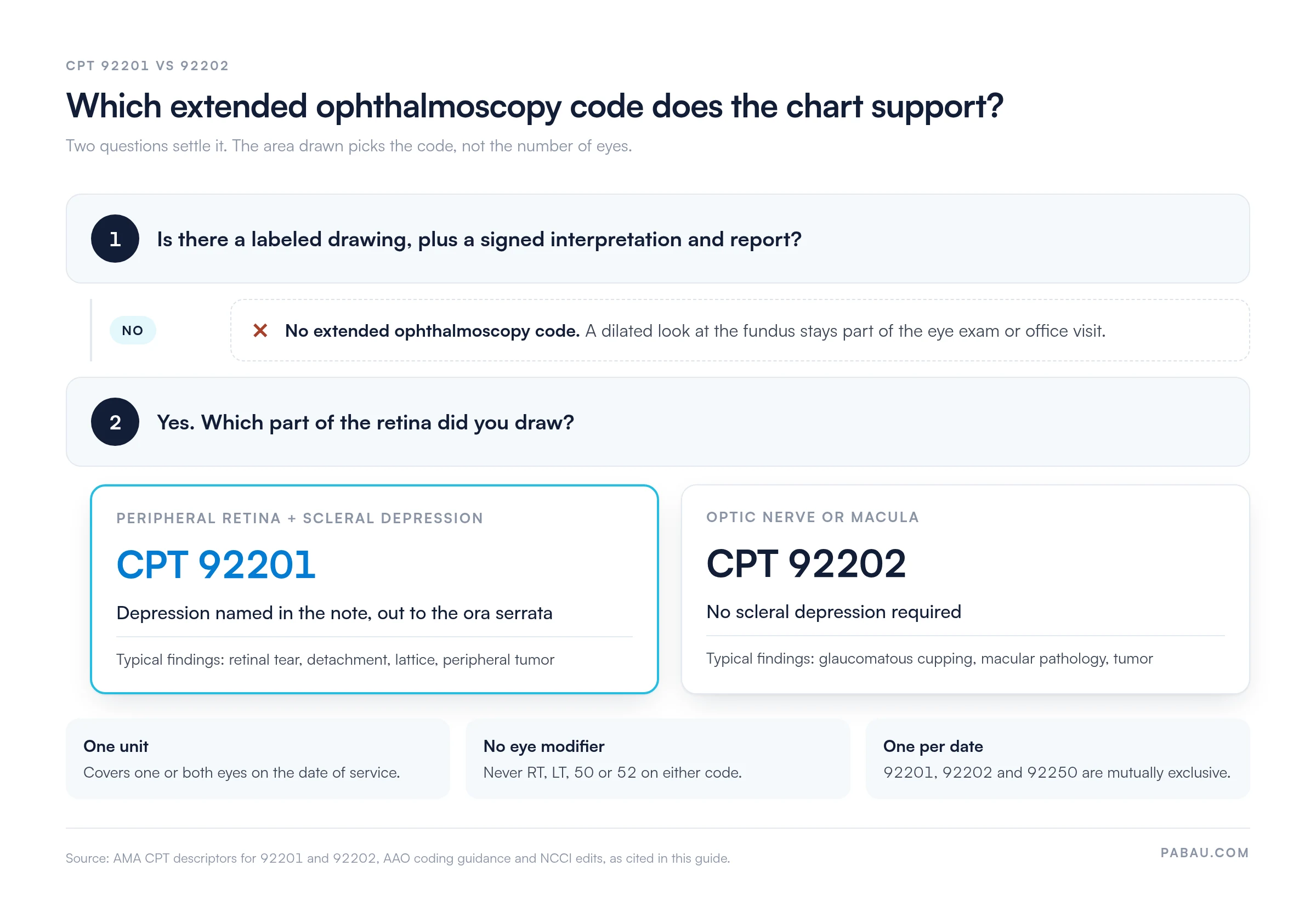
Both are bilateral codes reported once, and they’re mutually exclusive, so you can’t bill both on one date. When a patient has macular and peripheral findings, code the one that matches the main reason for the extended exam. The drawing and the linked diagnosis should point the same way.
Without scleral depression, the exam isn’t 92201. The American Academy of Ophthalmology’s coding guidance says the technique must be performed and documented. Name it in the note, as in “360° scleral depression OU,” rather than “periphery examined.”
Sometimes depression isn’t safe for the patient. The AAO advises recording the reason in the chart when that happens. Because the descriptor names the technique, check the payer’s policy before billing 92201 for that exam.
Build your extended-exam note so the technique, the eyes examined and the lens used are fields, not free text. A reviewer should find scleral depression in seconds, not by reading a paragraph.
Most 92201 problems trace back to one weak step. Here’s the path a clean claim takes.
Here’s an illustrative case. A 58-year-old established patient reports three days of new flashes and floaters in the right eye.
The ophthalmologist performs a comprehensive exam, then extended ophthalmoscopy with 360° scleral depression in both eyes. A horseshoe tear sits at 11 o’clock in the right eye, with no subretinal fluid. The left eye shows a small patch of lattice at 6 o’clock.
The chart holds a labeled drawing of both fundi, with the tear and the lattice marked by clock hour. The report records the findings and a plan to schedule laser retinopexy.
The coder reports the eye exam code and 92201 once. The 92201 line links to H33.311, a horseshoe tear without detachment in the right eye, and H35.412, lattice degeneration in the left eye. One unit covers both eyes.
Now change one detail. If the laser retinopexy, reported with CPT 67145, had been done the same day, the extended exam would bundle into the procedure. Unbundling it would need a separate, documented reason, such as an exam of the other eye.
Coverage follows peripheral retinal disease. Each Medicare Administrative Contractor (MAC) and commercial payer sets its own list, so check the policy before you rely on a code.
Diabetic retinopathy is the one to watch, because it can support either code. Macular edema points to 92202, while peripheral neovascularization or traction points to 92201. Whatever you link, the note still has to show why the extended exam was needed on that date.
A well-documented exam can still be denied by an edit. These are the pairings to know.
Eye exam codes such as 92004 and CPT 92014 describe a different service. 92201 is routinely reported alongside them when the extended exam stands on its own in the record. Still, confirm the current NCCI edit tables each quarter.
92201 carries one payment for both eyes. When it launched in 2020, its national average Medicare payment was about $26, less than the per-eye codes it replaced. Rates change every year and by locality, so check the CMS Physician Fee Schedule lookup for your figure.
Frequency follows medical necessity rather than a fixed count. A new symptom, a new finding or a lesion under active watch justifies a repeat exam. A stable, unchanged finding checked at every visit is what draws a payer’s attention.
Each of these has an easy fix once you know where it starts. A steady denial management workflow helps you spot which one keeps coming back.
When a denial does land, match its code to the row above before you rework the claim. Our guide to denial codes in medical billing explains what each remittance code means.
Many 92201 denials start well before the claim. The diagnosis on the claim drifts from the note, or someone retypes the charge and adds a second unit. Each handoff between the chart and the billing desk is a chance to lose detail.
With Pabau, our practice management software, the clinical record and the billing desk share one system. You can build your extended-exam note as a custom form with required fields for indication, technique and findings. The drawing then sits on the same patient record as the note.
When you raise the claim, Pabau’s claims management software pre-fills it from the record. The CPT code on the service lands on the charge line, and diagnoses come from the patient’s problem list. Required claim fields must be complete before the claim can be sent.
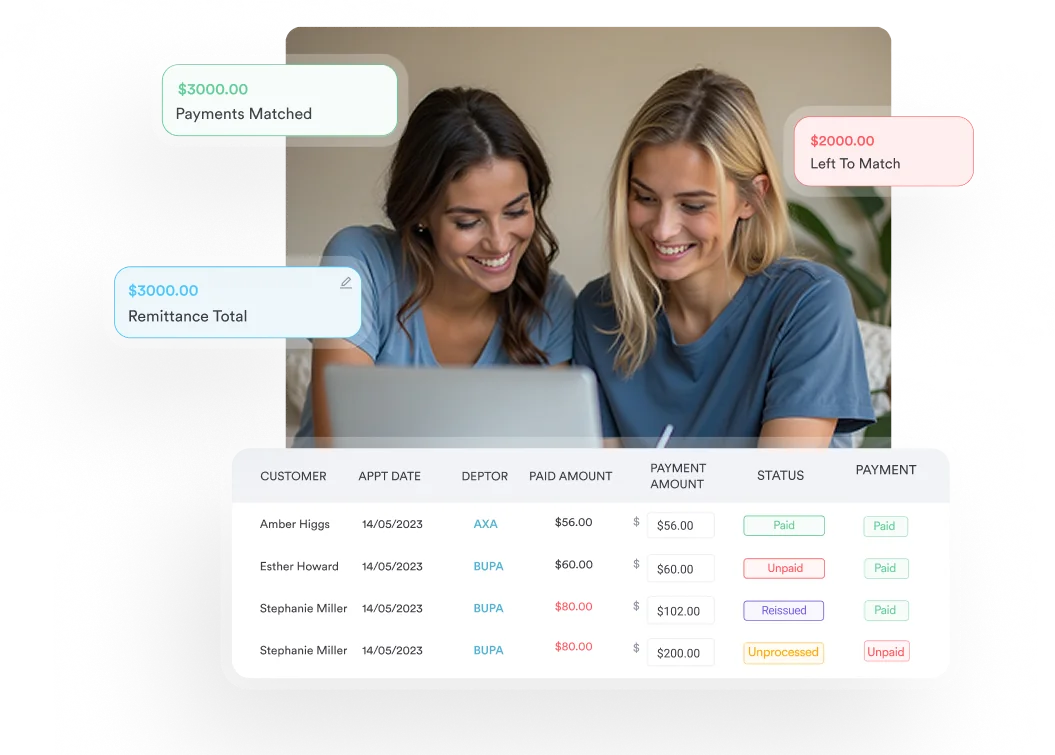
US practices submit through Pabau’s Claim.MD integration, with eligibility checks before the visit and electronic remittances posted back. A denied 92201 line shows against its claim, so your team can trace it to the step that broke.

Pabau pre-fills claims from the patient record, checks required fields before submission and posts remittances back, so 92201 denials are easier to prevent and trace.

CPT 92201 rewards a disciplined chart. When the note names scleral depression, carries a labeled drawing and links a peripheral diagnosis, the claim usually holds. When one of those is missing, the extended exam is just part of the visit.
Start with the drawing template and the bundling rules, since they’re the easiest to fix. Then audit a month of 92201 claims against the checklist above. Whatever pattern you find is the habit to retrain.
Book a demo to see how Pabau links your ophthalmology notes to cleaner, faster claims.

Billing fundus photos on the same patient? CPT code 92250 explains the fundus photography rules and why it never pairs with 92201.
Adding OCT to a retina workup? CPT code 92134 covers retinal OCT documentation, frequency and coverage.
Reporting the eye exam on the same date? CPT code 92014 sets out what a comprehensive established-patient eye exam requires.
Seeing the same remittance codes every month? Denial codes in medical billing maps common CARC and RARC codes to their causes and fixes.
Screening for diabetic retinopathy with imaging? CPT code 92227 covers remote retinal imaging with clinical staff review, a different service from a drawn exam.
Yes, where state scope of practice allows it. Medicare treats optometrists as physicians for services within their state license. Commercial payers apply their own credentialing rules, so confirm before you bill.
Generally yes, if it’s made at the exam, labeled and specific to the patient’s findings. A stock diagram with no annotations won’t support the claim. Some payers add size or color rules.
No. It needs a clinical reason, such as symptoms of a retinal tear or a known peripheral lesion under watch. A routine dilated check belongs to the eye exam itself.
92201 and 92202 replaced them on January 1, 2020. The old codes were paid per eye and split initial from subsequent exams. The new codes are bilateral and split by the area of the retina drawn.
Read the denial code first. A clash with 92202 or 92250 usually needs a corrected claim. A medical necessity denial can be appealed with the note, drawing and report.