CPT Code 22630: Posterior lumbar interbody fusion billing guide
CPT code 22630: Official description and procedure overview CPT code 22630 repor...

Last Updated: Nov 2, 2026
89320 is the CPT code for semen analysis; volume, count, motility, and differential. It covers a complete semen analysis, and the lab report must document all four parameters to support the claim.
Denials on this code usually come from three errors: the wrong ICD-10 pairing, a missing CLIA certificate for the performing lab, or confusion with 89321. That neighboring code covers only sperm presence and motility.
Let Pabau's smart automation suggest the right codes, reduce claim denials, and keep your practice compliant—effortlessly.
Automate repetitive tasks and focus on what matters most—your patients.
Reduce coding errors and ensure compliance with the latest regulations.
Clean claims, fewer denials, and faster reimbursements.
Powerful insights and reporting to help your practice thrive.
HIPAA compliant SOC 2 certified GDPR-compliant Trusted by 4,000+ clinics worldwide

CPT code 89320 covers the full four-parameter panel of semen volume, sperm count, motility and differential (morphology). A presence-and-motility check alone is 89321.
The performing laboratory must hold a CLIA certificate at the correct complexity level, and a mismatch is a leading denial trigger.
Z31.41 (fertility testing) and N46.x (male infertility) are the usual ICD-10 pairings, while post-vasectomy claims use Z98.52.
Pabau, the practice management platform we build, submits claims through Claim.MD and settles payments from ERA files for practices billing 89320.
CPT code 89320 is described by the American Medical Association as “Semen analysis; volume, count, motility, and differential.”
All four parameters must be evaluated and reported to bill this code correctly. A lab that reports only count and motility without the morphology differential cannot support an 89320 claim.
The test is performed in an andrology lab or a clinical laboratory. Urologists order it most often when evaluating male factor infertility, and reproductive endocrinologists order it as part of an initial fertility workup. Post-vasectomy follow-up also uses 89320 when the lab runs the full panel.
CPT code 89320 bundles all four analytic parameters into a single billable unit. Billing each parameter separately is a bundling violation under National Correct Coding Initiative (NCCI) edits.
Included in 89320: Semen volume (mL), sperm concentration (million/mL), total motility percentage, and morphology differential (percent normal forms). The lab report must document all four to support the code.
Always cross-check planned code combinations against current NCCI edits before submitting. The Centers for Medicare and Medicaid Services (CMS) updates NCCI quarterly, so a combination that was clean in Q1 may be an edit by Q3. Clean claim submission on reproductive lab codes depends on current edits and complete documentation.
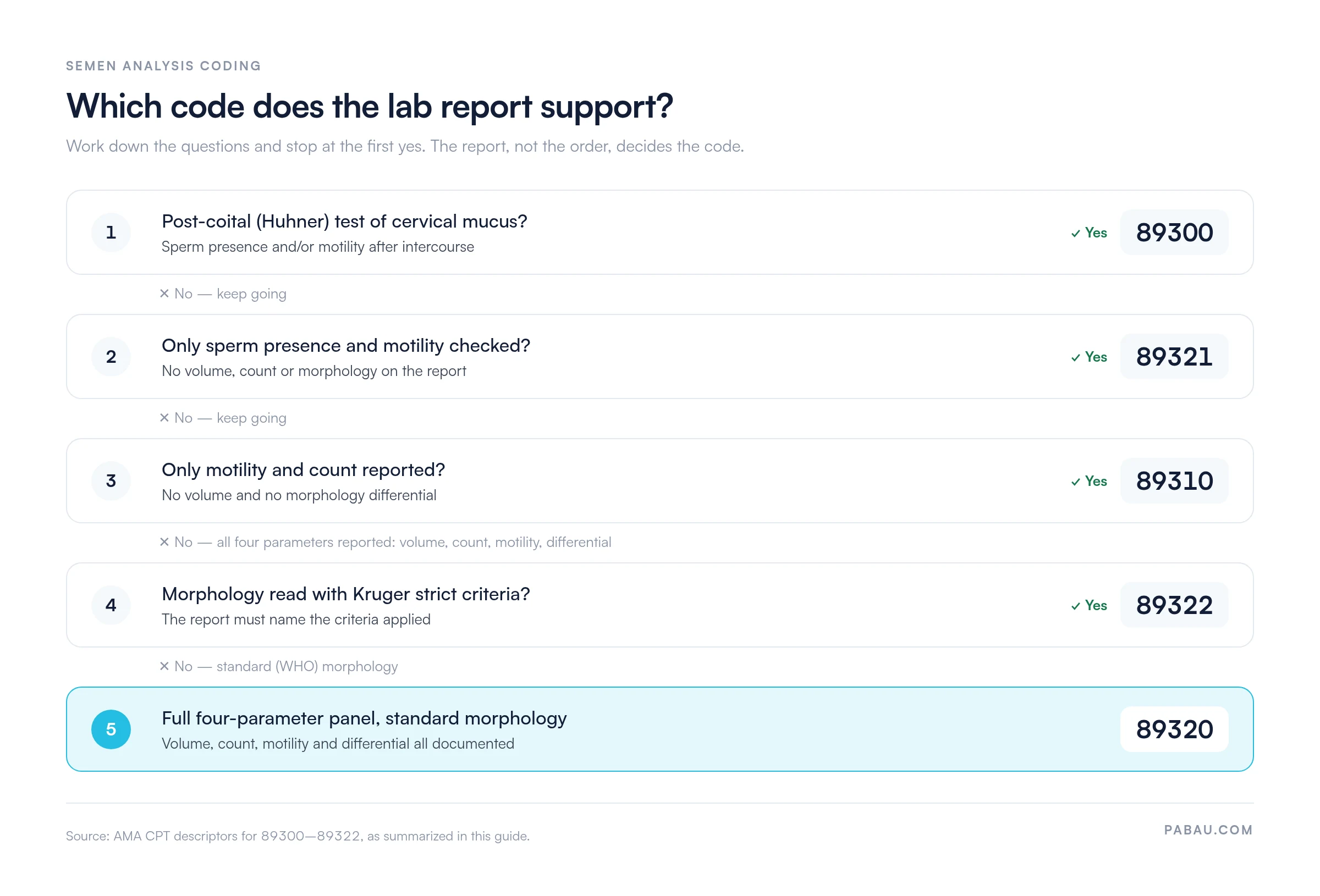
Five codes in this range describe a semen analysis. Choosing the wrong one is a frequent coding error in this family.
89321 covers sperm presence and motility only. It does not include semen volume, concentration, or the morphology differential. Bill 89321 only when the lab report documents a limited, motility-focused evaluation rather than a full panel. Upcoding 89321 encounters to 89320 is an audit risk, and downcoding full panels to 89321 loses revenue.
The 89320 and 89322 codes both cover all four parameters. 89322 also requires Kruger strict morphology criteria, while standard (WHO) morphology maps to 89320. The lab report must name the criteria applied, and the decision flow below shows where each report lands.
Payers require a medically necessary ICD-10-CM diagnosis code on every 89320 claim. The correct code depends on the clinical indication. Pairing 89320 with an unrelated or overly general diagnosis code is a frequent denial trigger, alongside CLIA mismatches.
Avoid billing parent N46 without a billable subcategory, because N46 alone is a non-billable header code. Use the most specific valid code the documentation supports, and check it against the ICD-10-CM code library. On fertility claims, 89320 often appears alongside IVF procedure billing codes.
Most 89320 claims submit without modifiers. When a modifier is needed, selecting the wrong one or omitting a required one causes an immediate denial.
Modifier 91 on clinical diagnostic lab codes follows the CMS NCCI Policy Manual. Check current NCCI edits for 89320 before applying it, as modifier indicator values can change with annual updates. Verify modifier QW against the CMS list of CLIA-waived tests. A full four-parameter semen analysis is generally moderately complex, so it rarely qualifies for QW.
Prior authorization requirements for CPT code 89320 vary by payer and plan year. No single rule applies across all commercial insurers, and Medicare’s approach differs from Medicaid and private plans.
Documenting the ordering clinician’s medical necessity rationale in the lab requisition supports authorization requests and later appeals. Route each 89320 encounter through the right authorization channel before the specimen is collected.
CPT code 89320 is reimbursed under the CMS Clinical Laboratory Fee Schedule (CLFS), not the Physician Fee Schedule (PFS). Lab codes carry no RVU-based payment. Medicare pays one national CLFS rate for each lab code.
The national Medicare CLFS rate for 89320 changes annually. For the current payment amount, check the CMS Clinical Laboratory Fee Schedule files. Rates published by third-party sites for prior years should not be used for current billing.
Submitting 89320 claims electronically through a clearinghouse lets the billing team check each CLFS payment against the electronic remittance advice (ERA). That check catches underpayments before they age past the appeal window. For self-pay patients, a good faith estimate form records the quoted price before the specimen is collected.
Pull a 90-day aging report on CPT 89320 claims by payer each quarter. A payer paying below the agreed CLFS-based rate without a documented contractual adjustment owes you the difference. Flag those accounts for ERA review before the timely-appeal deadline.
89320 denials usually fall into five categories. Mapping each denial code to its root cause tells the team what to fix before resubmitting.
Denial management workflows that sort 89320 denials by root cause cut re-denials on appeal. When appealing a CO-50 denial, attach the ordering provider’s clinical rationale and the lab result. Add any American Society for Reproductive Medicine (ASRM) or American Urological Association (AUA) guidance that supports the test indication.
The AAPC reproductive medicine code range lists every code in this family, which helps when an appeal turns on code selection.
Post-vasectomy semen analysis pairs with ICD-10-CM code Z98.52 (vasectomy status), not a male infertility code. Bill 89320 when the lab runs the full four-parameter panel. If the lab only checks for sperm presence and motility, the report supports 89321 instead.
The pairing matters because many payers that exclude infertility testing still pay for post-vasectomy follow-up. Its medical justification is confirming that the procedure worked.
Urologists usually order the first analysis 8 to 16 weeks after surgery and repeat it until the result confirms success. Billing frequency and covered intervals vary by payer. Check the applicable LCD or benefit policy before assuming repeat testing is covered at the same rate.
CLIA compliance is a prerequisite for billing CPT code 89320. The Clinical Laboratory Improvement Amendments (42 CFR Part 493) govern which facilities may perform and bill this test. The certificate type required depends on how the analysis is performed.
The certificate level has to match the test’s complexity. Billing a full panel under the wrong certificate produces a CO-B7 denial or, worse, a recoupment after a post-payment audit.
The CLIA number on the claim form (Box 23 of the CMS-1500) must be the performing laboratory’s active certificate, not the ordering provider’s number. Fertility practice billing teams should confirm every year that the lab’s certificate is current and at the correct complexity level.
Medical billing compliance for moderately complex lab codes rests on periodic audits of CLIA certificates, lab service agreements, and claim forms. The AMA’s CPT code set overview explains how the code set behind 89320 is maintained and updated each year.
Without a connected billing system, each 89320 claim is checked by hand. A biller compares the lab report with the code, confirms the CLIA number and re-keys the claim into a payer portal. Each manual step is a chance for one of the denials above.
Pabau keeps the order, the visit and the claim in one record. Its claims management software scrubs every claim for missing or invalid details before it leaves Pabau. US claims go out as CMS-1500 submissions through Claim.MD, and eligibility checks run before the visit.
Prior authorizations for fertility benefit plans are stored as cases against the patient. When a claim comes back rejected, Pabau flags it as needing action, so the team fixes it inside the appeal window. Payments settle straight from ERA files, which makes a CLFS underpayment visible on the remittance itself.

Pabau checks every claim for missing or invalid details before it reaches Claim.MD, then settles payments from ERA files. Fertility and urology practices spend less time reworking lab denials.

Code 89320 rests on the lab report. Bill it only when the report documents volume, count, motility and differential under standard criteria. When the report documents less, bill the narrower code it supports, and pair the diagnosis with the reason for the test.
Start with the CLIA certificate and the post-vasectomy claims, because both fail for reasons nobody sees on the claim form. A quarterly check of the two protects every 89320 claim the lab sends afterward.
Book a demo to see how Pabau’s claim validation flags missing details on 89320 claims before they reach the payer.

Need guidance on managing claims denials efficiently? Denial management in healthcare covers how to build a workflow that categorizes, tracks, and resolves claim denials systematically.
Looking to understand how clearinghouse submission works? How Claim.MD clearinghouse works explains the 837P submission path, real-time eligibility, and ERA reconciliation from a practice perspective.
Billing for IVF alongside fertility labs? IVF CPT codes billing guide covers the full code set for assisted reproductive technology procedures that often appear on the same encounter as semen analysis.
CPT code 89320 covers a complete semen analysis of four parameters: semen volume, sperm count (concentration), sperm motility and sperm differential (morphology). All four must be evaluated and reported to support the code. If only presence and motility are assessed, bill 89321 instead.
Three modifiers apply to CPT code 89320. Modifier 91 marks a medically necessary repeat panel on the same day. Modifier QW marks a CLIA-waived test, which a full semen analysis rarely is. Modifier 59 marks a distinct service when an NCCI edit applies and the documentation shows the distinction. Confirm modifier 91 against current NCCI edits before use.
CPT code 89320 is paid under the CMS Clinical Laboratory Fee Schedule (CLFS), at one national rate that changes every year. The current figure is in the CMS CLFS data files. Don’t use third-party rate listings from prior years for active billing decisions.
Medicare typically does not require prior authorization for CPT code 89320 billed as a clinical laboratory service. Commercial payers often do when the test is part of infertility treatment, particularly in states with insurance mandates. Medicaid rules vary by state, and fertility benefit administrators may run separate authorization pathways. When in doubt, verify with the payer before specimen collection.
Yes, when the lab runs the full four-parameter panel. Pair it with ICD-10-CM Z98.52 (vasectomy status), not a male infertility code. If the lab only checks sperm presence and motility, bill 89321 instead. Many payers that exclude infertility testing still cover post-vasectomy follow-up, because it confirms the procedure worked.
Required documentation includes the ordering provider’s medical necessity rationale and the lab requisition with the ordering provider’s NPI and the performing lab’s CLIA number. The claim also needs the lab report documenting all four parameters (volume, count, motility, morphology differential) and a valid ICD-10-CM diagnosis code. Post-vasectomy claims also need the surgical date and a reference to the vasectomy procedure.
Five denial codes cover most rejected 89320 claims. CO-B7 flags a CLIA mismatch, and CO-97 flags a parameter billed separately from the full panel. CO-50 means the ICD-10 pairing didn’t support medical necessity. CO-4 means a required modifier is missing, and CO-18 marks a duplicate claim. Checking each denial code against the lab report and claim form resolves most of them before an appeal.