

CCSD code G5100: Bypass of duodenum billing guide
CCSD code G5100 bills a bypass that leaves the duodenum in place CCSD code G5100...

Last Updated: Oct 16, 2026
89322 is the CPT code for semen analysis; volume, count, motility, and differential using strict morphologic criteria (eg, Kruger).
It covers the same four elements as 89320 but grades sperm morphology by strict criteria. Common denials come from billing 89322 when the lab report does not state strict criteria, or from a missing supportable ICD-10 diagnosis.
Let Pabau's smart automation suggest the right codes, reduce claim denials, and keep your practice compliant—effortlessly.
Automate repetitive tasks and focus on what matters most—your patients.
Reduce coding errors and ensure compliance with the latest regulations.
Clean claims, fewer denials, and faster reimbursements.
Powerful insights and reporting to help your practice thrive.
HIPAA compliant SOC 2 certified GDPR-compliant Trusted by 4,000+ clinics worldwide

CPT code 89322 covers volume, count, motility, and a morphology differential graded by strict (Kruger) criteria, which separates it from 89320’s standard differential.
ICD-10 codes N46.x (male infertility subtypes) and Z31.41 (fertility testing encounter) are the primary diagnosis pairings that support medical necessity.
89322 is paid under the Medicare Clinical Laboratory Fee Schedule, not the Physician Fee Schedule. Check the current rate in the CMS CLFS files.
A common denial reason is confusion between 89320 and 89322, so the lab report must explicitly state the morphology criteria used.
Pabau’s claims management software sends claims through the Claim.MD clearinghouse and tracks denials, so code-selection errors surface early.
CPT code 89322 takes its official descriptor from the American Medical Association (AMA) CPT Editorial Panel. The descriptor reads: Semen analysis; volume, count, motility, and differential using strict morphologic criteria (eg, Kruger). The Kruger reference signals how the morphology differential must be graded. Under strict criteria, a sperm counts as normal only if its head, midpiece, and tail each meet precise size and shape thresholds. CPT 89320 covers the same four elements with a standard differential, so the grading method is the only difference between the two codes.
The 893xx family covers the full range of semen analysis procedures within the reproductive medicine section of the CPT codes set. Code selection within it turns entirely on which parameters the lab measures and which morphology methodology it applies. For andrology lab billing teams, knowing exactly what each code includes is the starting point for clean claim submission.
The 89322 descriptor names four elements, and the lab report needs a result for each:
Many labs also report liquefaction, viscosity, and pH. Those results are clinically useful, but they are not elements of the 89322 descriptor and do not change the code. A report covering all four elements with a differential that was not graded by strict criteria supports 89320, not 89322. The report must state which criteria were used.
Misassigning codes within the semen analysis family is a common audit trigger for andrology lab billing. The table below sets out what each code covers.
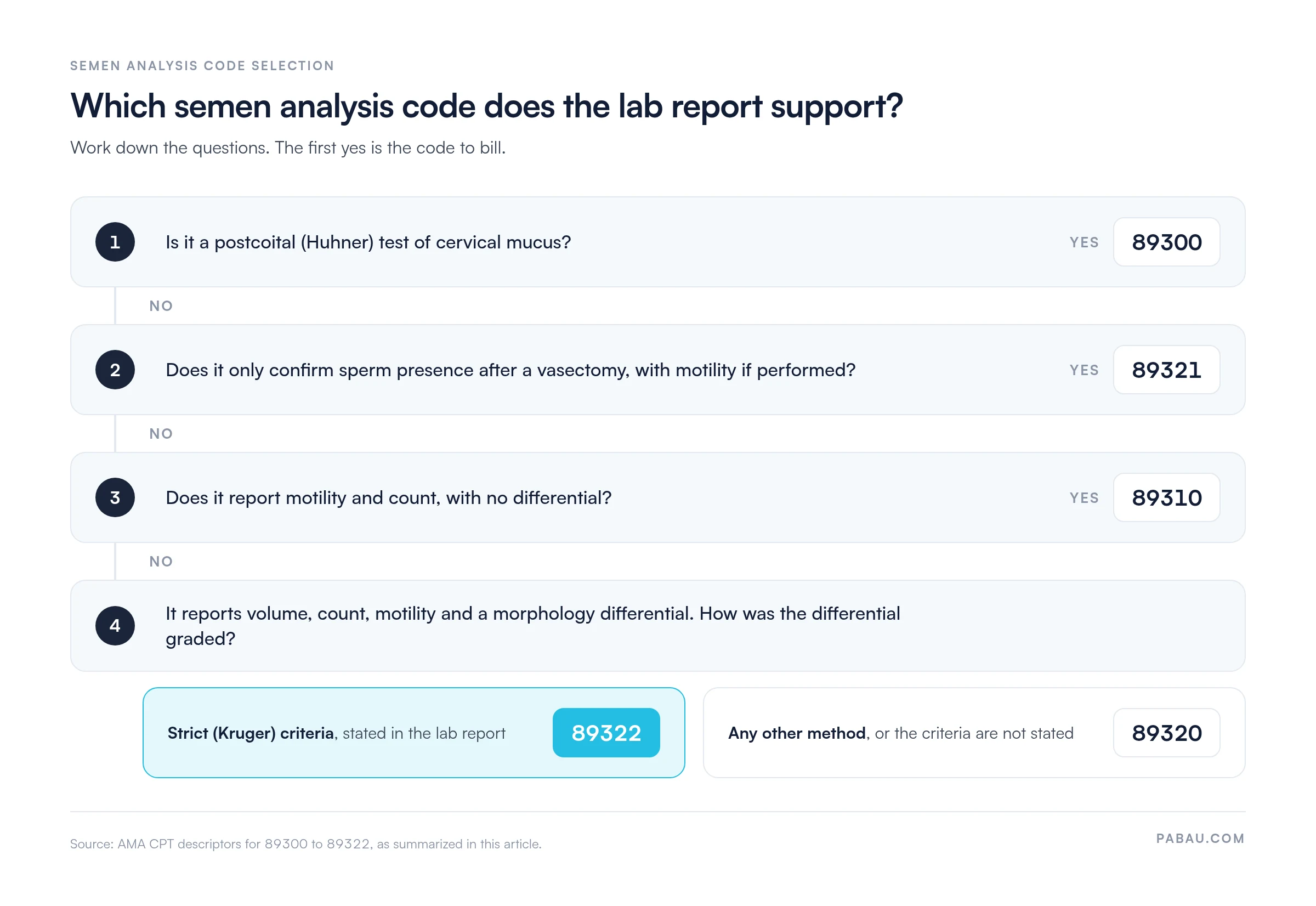
Selection rule: If the lab report states strict (Kruger) criteria and reports the percentage of strict normal forms, bill 89322. If the lab reports volume, count, motility, and a differential graded by any other method, bill 89320. If the test only confirms sperm presence after a vasectomy, with motility if performed, bill 89321. Reserve 89310 for motility and count without a differential, and 89300 for a postcoital Huhner test. The flow below puts the same rule in the order a biller should check it.
Every CPT code 89322 claim requires an ICD-10-CM diagnosis code that establishes medical necessity. The CDC/NCHS ICD-10-CM tool is the definitive lookup for current code validity. The table below covers the codes most commonly accepted by Medicare and commercial payers for this service.
Common pairing mistake: Z31.41 goes on the claim as the sole diagnosis when the patient already carries a confirmed N46.x diagnosis. Once an infertility diagnosis is established, code it directly. Z31.41 describes the encounter, not a chronic condition.
Document the specific ICD-10 subcode from the N46 family, not just N46.9, wherever the chart supports it. Some payers may query N46.9 on repeat claims when documentation supports a more specific subcode. A one-time chart review that maps existing diagnoses to their N46 subtypes can prevent those queries without extra clinical workup.
CPT code 89322 is reimbursed under the Medicare Clinical Laboratory Fee Schedule (CLFS), not the Physician Fee Schedule. The Centers for Medicare and Medicaid Services (CMS) sets one national CLFS payment amount for each code, with no locality adjustment. Because CLFS amounts can change each calendar year, look up the current rate in the CMS Clinical Laboratory Fee Schedule files.
Key billing facts for Medicare claims on CPT code 89322:
Commercial payer coverage for CPT code 89322 is less predictable than Medicare. Many commercial plans treat male infertility lab testing as non-covered unless the plan carries a fertility benefit rider. Coverage often depends on the plan’s definition of “infertility” and whether the employer has elected infertility coverage.
Because prior authorization requirements and fertility benefit structures change annually, practices should verify coverage for each patient’s specific plan, not just for the payer name. A large national carrier may exclude fertility testing on one employer’s plan and cover it on another employer’s plan.
The lab report is the documentation that supports CPT code 89322. Its contents determine whether the claim is defensible on audit. A report that meets the following requirements is the foundation of a clean claim submission.
The place of service (POS) code on a CPT code 89322 claim must reflect where the analysis was performed. The specimen collection site does not decide it. Mismatching the POS to the specimen collection site rather than the analysis site is a billing error that can trigger an audit.
For Medicare, only the performing laboratory bills CPT code 89322. There is no professional component, so a physician does not separately bill for interpreting the result. The ordering physician may write an interpretation beyond the structured lab report. That work belongs in a separately documented E/M or consultation service, not an additional laboratory claim.
Effective denial management for CPT code 89322 starts with knowing the most common triggers before the claim leaves the practice. The table below maps each denial pattern to its corrective action.
Understanding medical billing workflows at the lab level, not just the front desk, is what prevents most of these patterns. The morphology methodology question should be resolved before the claim is created, not after a denial arrives.
Several andrology and reproductive laboratory codes may be billed on the same date as CPT code 89322. Each service must be separately and completely performed. Always verify the current National Correct Coding Initiative (NCCI) edit tables on the CMS NCCI edits page before submitting same-day combinations. NCCI edits update quarterly, so compatibility can change.
For practices managing IVF procedure codes alongside laboratory services, the bundling boundary matters. It sits between the analysis code (89322) and treatment codes such as 58974 (embryo transfer) and 58322 (intrauterine insemination). The laboratory analysis and the clinical procedure are separately billable when performed on the same date, as they are distinct services with distinct documentation requirements.
Check NCCI edits each quarter when the tables update, starting with your most frequently billed semen analysis code combinations. A combination that passed in Q1 may trigger an edit in Q2. Build the check into your billing team’s quarterly compliance calendar rather than waiting for a denial to surface the change.
Many 89322 denials are set up before the claim exists. The lab report never states the morphology criteria, or nobody checked the patient’s fertility benefit. Fixing either one after the remittance arrives means rework, appeals, and delayed payment.
Pabau, the practice management and billing platform we build, connects to the Claim.MD clearinghouse. Your team can verify patient eligibility before the specimen is collected, then submit CPT code 89322 claims electronically in CMS-1500 and 837P formats.
ERA/835 remittances post back into the same workflow, so denial reasons are captured without manual reconciliation. A run of 89320/89322 code-selection denials shows up early. You can then fix the report template at the lab instead of appealing claim by claim.

Pabau integrates with Claim.MD to handle electronic claims submission, eligibility verification, and ERA posting for fertility and andrology practices. Track CPT code 89322 denials, manage documentation workflows, and reduce manual reconciliation.

Accurate billing for CPT code 89322 comes down to one check before the claim is created. Does the lab report state that the morphology differential was graded by strict (Kruger) criteria? If it does, 89322 is supportable. If it does not, the service is 89320, and billing 89322 invites a denial or an overpayment finding on audit.
Make the criteria statement a mandatory field in your lab report template. Diagnosis pairing, CLIA details, and benefit checks then become routine steps rather than recurring denial sources.
To see how Pabau’s claims management software fits your lab’s billing workflow, book a demo.

Need to verify your clearinghouse submission process for lab codes? How the Claim.MD clearinghouse works with Pabau explains electronic claim routing, ERA posting, and payer enrollment for US labs.
Billing denial piling up across your andrology codes? Denial codes in medical billing maps common CARC denial reason codes to root causes and corrective actions.
Checking fertility benefits before the specimen is collected? Insurance eligibility verification walks through confirming coverage before the visit, so non-covered tests are caught early.
Filing 89322 on paper or reviewing a rejected claim? CMS-1500 form template shows where the diagnosis pointers and the Box 23 CLIA number go.
CPT code 89322 covers a semen analysis that reports volume, count, motility, and a morphology differential graded by strict criteria, such as Kruger. The strict grading is what separates it from 89320, which covers the same elements with a standard differential. Liquefaction, viscosity, and pH are often reported too, but they are not part of the code descriptor.
Medicare pays CPT code 89322 under the Clinical Laboratory Fee Schedule (CLFS), which sets one national payment amount per code. CMS can update CLFS amounts each calendar year, so check the current figure in the CLFS files on cms.gov. Do not rely on cached rate tables from a prior year.
The primary pairings are the N46 male infertility codes and Z31.41 (encounter for fertility testing). Common N46 codes include N46.01 (organic azoospermia), N46.11 (organic oligospermia), N46.123 (oligospermia due to obstruction of efferent ducts), and N46.9 (male infertility, unspecified). Use the most specific N46 subcode the documentation supports. Z31.41 is appropriate when the patient is undergoing a pre-treatment fertility evaluation and has not yet received a confirmed infertility diagnosis.
No, not for the same specimen. One semen analysis produces one result set, so bill 89322 if strict criteria were used and 89320 if they were not. CPT 89322 can be billed on the same date as 89259 (sperm cryopreservation) when freezing is a separate service. Check current NCCI edits before pairing it with 89260 (sperm isolation), whose descriptor references semen analysis.



