CCSD code F3070: Suture of palate billing guide
CCSD code F3070 covers stitching a wound in the palate CCSD code F3070 is the co...

Last Updated: Oct 12, 2026
CCSD code F0110 covers excision of the vermilion border of the lip with advancement of the lip mucosa. Surgeons call it a vermilionectomy, or a lip shave. They remove the red margin of the lip and draw the inner mucosa forward to resurface it. The usual reasons are actinic cheilitis, carcinoma in situ or an early squamous cell carcinoma of the vermilion.
Billing it cleanly takes a stated indication, a histology report and a note on margins. It also means knowing which lip and mouth codes cannot share a claim with F0110.
Let Pabau's smart automation suggest the right codes, reduce claim denials, and keep your practice compliant—effortlessly.
Automate repetitive tasks and focus on what matters most—your patients.
Reduce coding errors and ensure compliance with the latest regulations.
Clean claims, fewer denials, and faster reimbursements.
Powerful insights and reporting to help your practice thrive.
HIPAA compliant SOC 2 certified GDPR-compliant Trusted by 4,000+ clinics worldwide

CCSD code F0110 covers excision of the vermilion border of the lip with advancement of the lip mucosa, also called a vermilionectomy.
It sits in CCSD chapter 6, in the lips section, next to F0200 for a single lip lesion and F0420 for a skin-flap lip reconstruction.
The usual indications are actinic cheilitis, dysplasia, carcinoma in situ or an early squamous cell carcinoma of the vermilion.
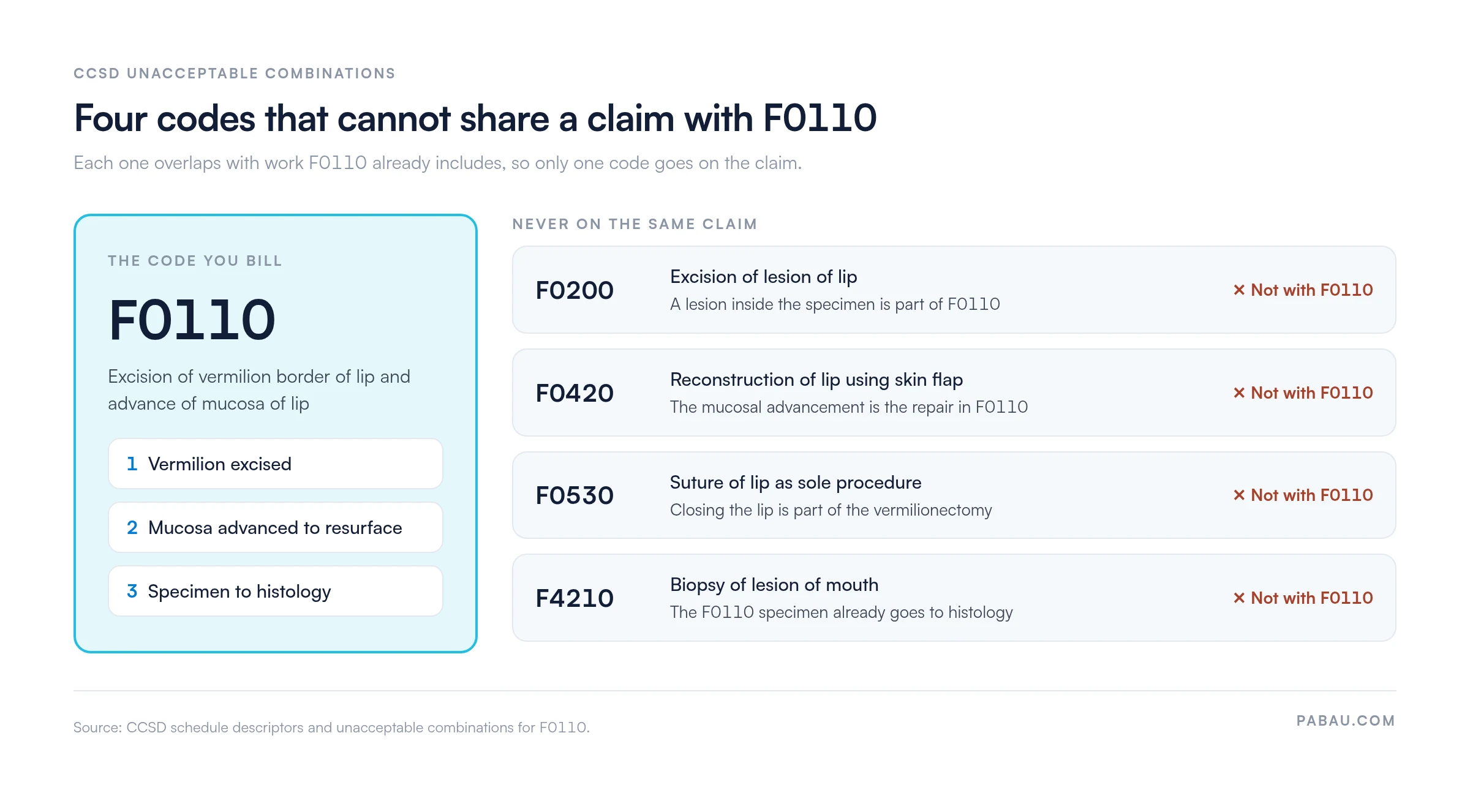
F0110 is an unacceptable combination with F0200, F0420, F0530 and F4210, so none of them should share a claim with it.
A clean claim needs the indication, the extent of the excision, the advancement step and the histology report on file.
CCSD code F0110 is the code for excision of the vermilion border of the lip and advance of mucosa of the lip. In plain terms, it is a vermilionectomy, sometimes called a lip shave. The surgeon removes the red part of the lip, then draws the inner lip mucosa forward to cover the raw surface.
The code bundles two steps into one line. The excision and the mucosal advancement are both part of F0110. Neither step is billed separately when the operation follows this pattern.
F0110 sits in chapter 6 of the CCSD code schedule, which covers the face, mouth, salivary glands and thyroid. Within that chapter, it belongs to section 6.2, the lips. The Bupa CCSD codes guide explains how the schedule is organized across insurers.
A vermilionectomy treats disease that spreads across the lip surface rather than sitting in one spot. Long-term sun damage is the classic cause. The lower lip takes most of that exposure, so it is the usual site.
Typical indications recorded on an F0110 claim include:
A single, well-defined lesion is a different job. If the surgeon cuts out one lesion and closes the wound, F0200 usually fits better. F0110 describes removing the vermilion as a whole and resurfacing it with mucosa.
Coders mix these codes up because they all involve the lip or the mouth. The operative note decides which one applies.
Read the note for the repair method first. Mucosal advancement points to F0110. A skin flap points to F0420, and a suture alone points to F0530. A sample alone points to F4210. All four neighbors are unacceptable combinations with F0110, so only one of these codes goes on the claim.
An insurer reviewing F0110 wants proof of two things. The vermilion was excised, and the mucosa was advanced to close it. A note that mentions only one step invites a query or a downgrade.
Keep these items in the record before the claim goes out:
The histology report matters most when the indication is premalignant or malignant. It confirms the diagnosis that justified the surgery. It also shows whether further treatment will follow.
The CCSD schedule lists unacceptable combinations for each code. These are pairs an insurer will not pay together on the same claim. F0110 has four of them: F0200, F0420, F0530 and F4210.
The biopsy clash makes sense clinically. The vermilionectomy specimen goes to histology anyway, so a separate biopsy of the same area adds no new procedure. If a biopsy was done at an earlier, separate visit, it belongs on its own claim for that date.
The other three each overlap with work F0110 already includes:
Side by side, each clash comes down to work that F0110 already pays for.
Before you add a second code to an F0110 claim, open both codes in the CCSD schedule and check each unacceptable combinations list. The pairing rules change with schedule updates, so check the current version rather than an old crib sheet.
Most UK private insurers expect pre-authorization before planned surgery. Get it before the operation, then submit electronically through Healthcode. Electronic submission gives you a tracked record of each claim.
Fees for F0110 vary by insurer and by policy. Check the current figure with each insurer before you quote the patient.
Most rejections trace back to the note, the code choice or the paperwork around authorization. Each one has a simple fix.
Many practices still rekey the code, the authorization reference and the patient’s policy details into a separate claims portal. Each retyped field is a chance for a rejection.
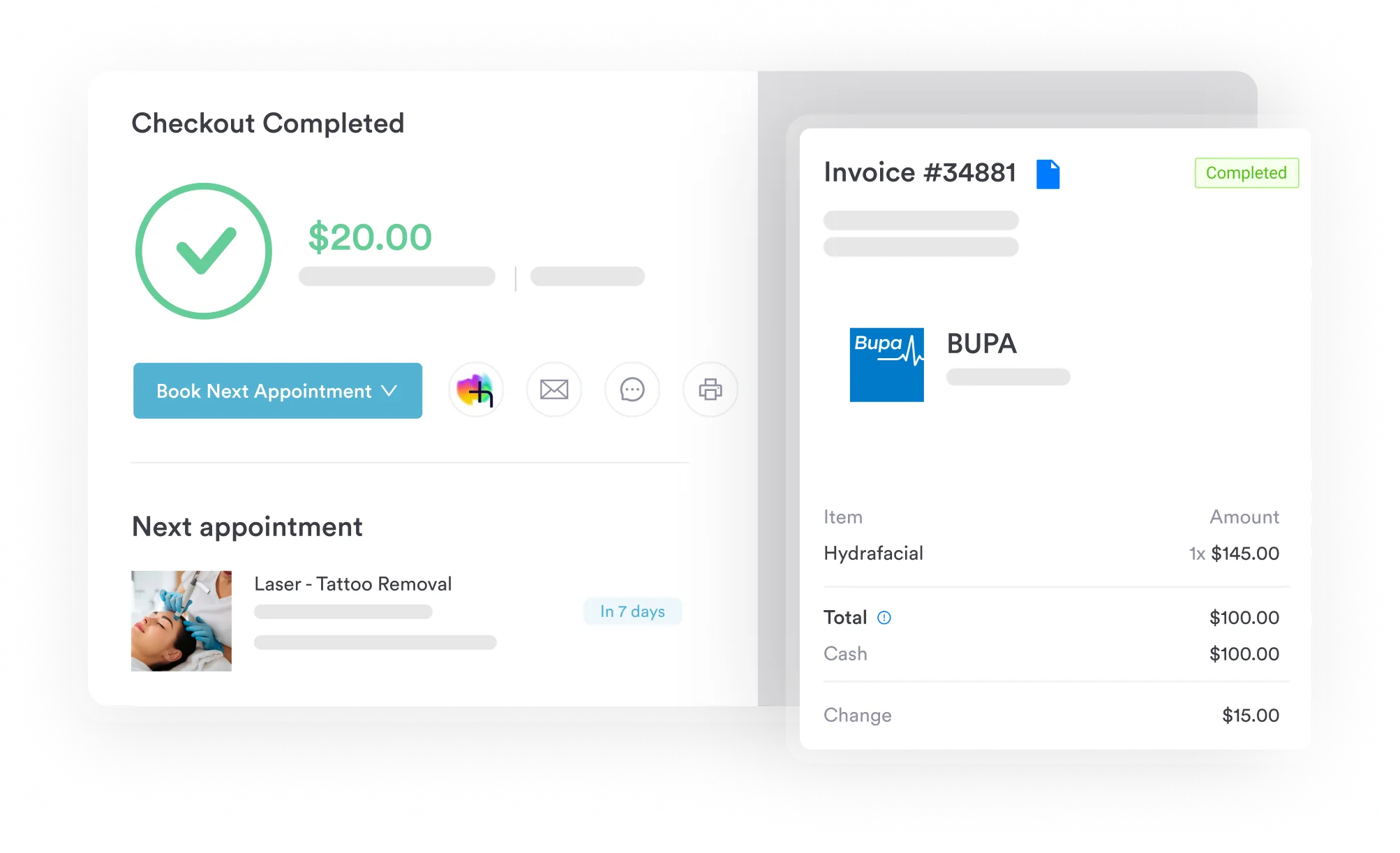
Pabau, the practice management platform we build, connects directly to Healthcode through its claims management software. Your team sends CCSD-coded claims straight from the patient record. Pabau checks that required claim fields are complete before submission, then tracks each claim’s status.
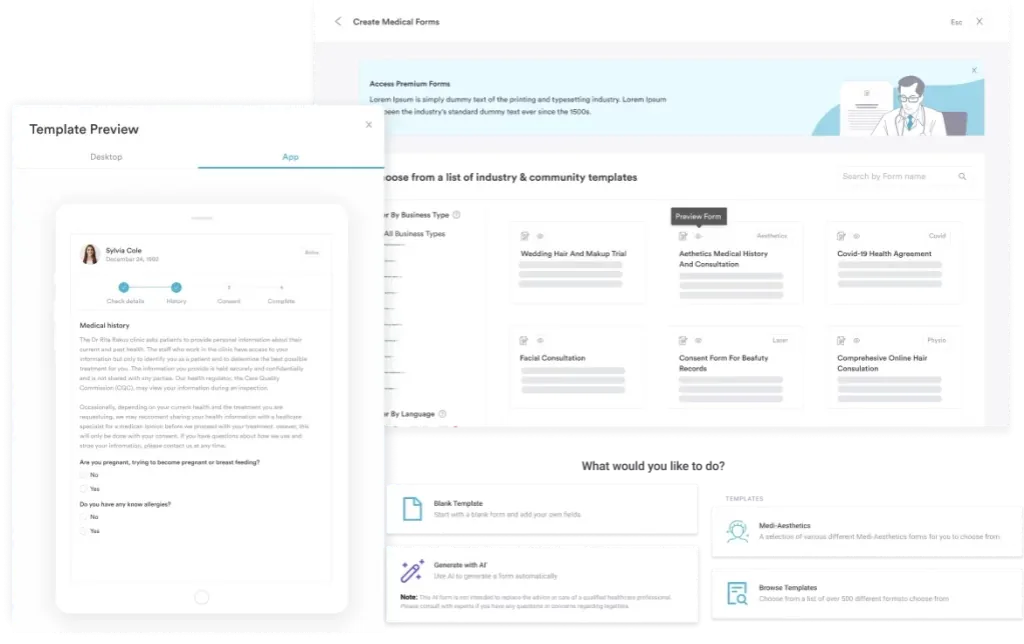
The consent form, the operative note and the histology report sit in the same patient record. When an insurer queries the claim, your team answers from one place.

Pabau connects to Healthcode, so your team submits F0110 claims from the patient record and tracks each one to payment.

F0110 is a narrow code with a clear test. If the note shows the vermilion excised and the mucosa advanced to close it, the code fits. If it shows a single lesion, a skin flap, a suture or a biopsy alone, another code fits better.
Get the indication, the histology and the authorization on file before the claim leaves. Then keep F0200, F0420, F0530 and F4210 off the same claim. Book a demo to see how Pabau sends CCSD claims to Healthcode from the patient record.

Billing a single lip lesion instead? CCSD code F0200 covers excision of lesion of lip and how it differs from a full vermilionectomy.
Need the wider CCSD picture? Bupa CCSD codes guide explains how the schedule is organized and used by UK private insurers.
Working through other chapter 6 codes? CCSD code F4810 covers open biopsy of a salivary gland lesion.
Want fewer rejected insurer claims? Claims management in Pabau shows how claims are built from the patient record and tracked to payment.
CCSD code F0110 is the code for excision of the vermilion border of the lip and advance of mucosa of the lip. Surgeons call it a vermilionectomy or lip shave. It sits in the lips section of CCSD chapter 6.
The usual indications are actinic cheilitis, leukoplakia or dysplasia across the vermilion, carcinoma in situ, and early squamous cell carcinoma of the vermilion. The note should state the diagnosis and any earlier treatment that failed.
Not with F4210, biopsy of lesion of mouth, on the same claim. F4210 lists F0110 as an unacceptable combination. A biopsy done at an earlier, separate visit goes on its own claim.
F0110 removes the vermilion and resurfaces the lip with advanced mucosa. F0200 covers excision of a single lesion of the lip. Use F0200 when only one lesion was removed and closed.
Keep the indication, the extent of the excision, a note of the mucosal advancement, the histology report with margins, and the signed consent. Add the pre-authorization reference to the claim.