HCPCS Code G0278: Iliac and femoral angiography billing guide
What is HCPCS Code G0278? HCPCS Code G0278 is the add-on code for non-selective ...

Last Updated: Nov 2, 2026
86481 is the CPT code for tuberculosis test, cell mediated immunity antigen response measurement; enumeration of gamma interferon-producing T-cells in cell suspension. In practice, that means the T-SPOT.TB blood test, which counts TB-reactive T-cells by ELISpot.
QuantiFERON-TB Gold and Gold Plus measure gamma interferon in plasma instead, so they bill under 86480. The lab's assay method decides between the two codes, and NCCI bars billing both on one date of service.
Let Pabau's smart automation suggest the right codes, reduce claim denials, and keep your practice compliant—effortlessly.
Automate repetitive tasks and focus on what matters most—your patients.
Reduce coding errors and ensure compliance with the latest regulations.
Clean claims, fewer denials, and faster reimbursements.
Powerful insights and reporting to help your practice thrive.
HIPAA compliant SOC 2 certified GDPR-compliant Trusted by 4,000+ clinics worldwide

CPT code 86481 covers the IGRA that counts gamma interferon-producing T-cells in a cell suspension, which in practice means T-SPOT.TB.
QuantiFERON-TB Gold Plus measures gamma interferon in plasma, so it bills under 86480, not 86481.
The two codes split by assay method, not by antigen or tube count, and NCCI bars billing both on one date of service.
ICD-10 Z11.1 is the standard screening pairing. Use an LTBI history or confirmed TB code only when the chart supports it.
86481 is reimbursed under the Medicare Clinical Laboratory Fee Schedule, not the Physician Fee Schedule.
Claims software such as Pabau checks each 86481 claim for missing or invalid details before it reaches the clearinghouse.
CPT code 86481 describes: Tuberculosis test, cell mediated immunity antigen response measurement; enumeration of gamma interferon-producing T-cells in cell suspension. It sits in the Immunology subsection (86000-86849) of the Pathology and Laboratory chapter.
The key phrase is “enumeration of gamma interferon-producing T-cells in cell suspension.” The lab isolates peripheral blood mononuclear cells (PBMCs) from the sample, counts them, and exposes them to TB antigens. It then counts each T-cell that releases gamma interferon, using an ELISpot method. That is how T-SPOT.TB works, and the AMA created 86481 for it, effective January 1, 2011.
Neither 86480 nor 86481 mentions antigens or tubes in its descriptor. The codes split by assay method, so the number of antigen tubes or panels never decides which one you bill.
Note on lab method changes: The code follows the method the lab runs, not the brand name on the order. In 2021, the University of Michigan lab moved its QuantiFERON billing to 86481 after a method change. Treat that as a lab-specific exception, and confirm the method in the performing lab’s test catalog before you assign either code.
A common coding error in TB IGRA billing is assigning 86481 to a QuantiFERON test. The two codes describe different lab methods, and payers audit for the mismatch. The decision comes down to one question about what the lab measured.
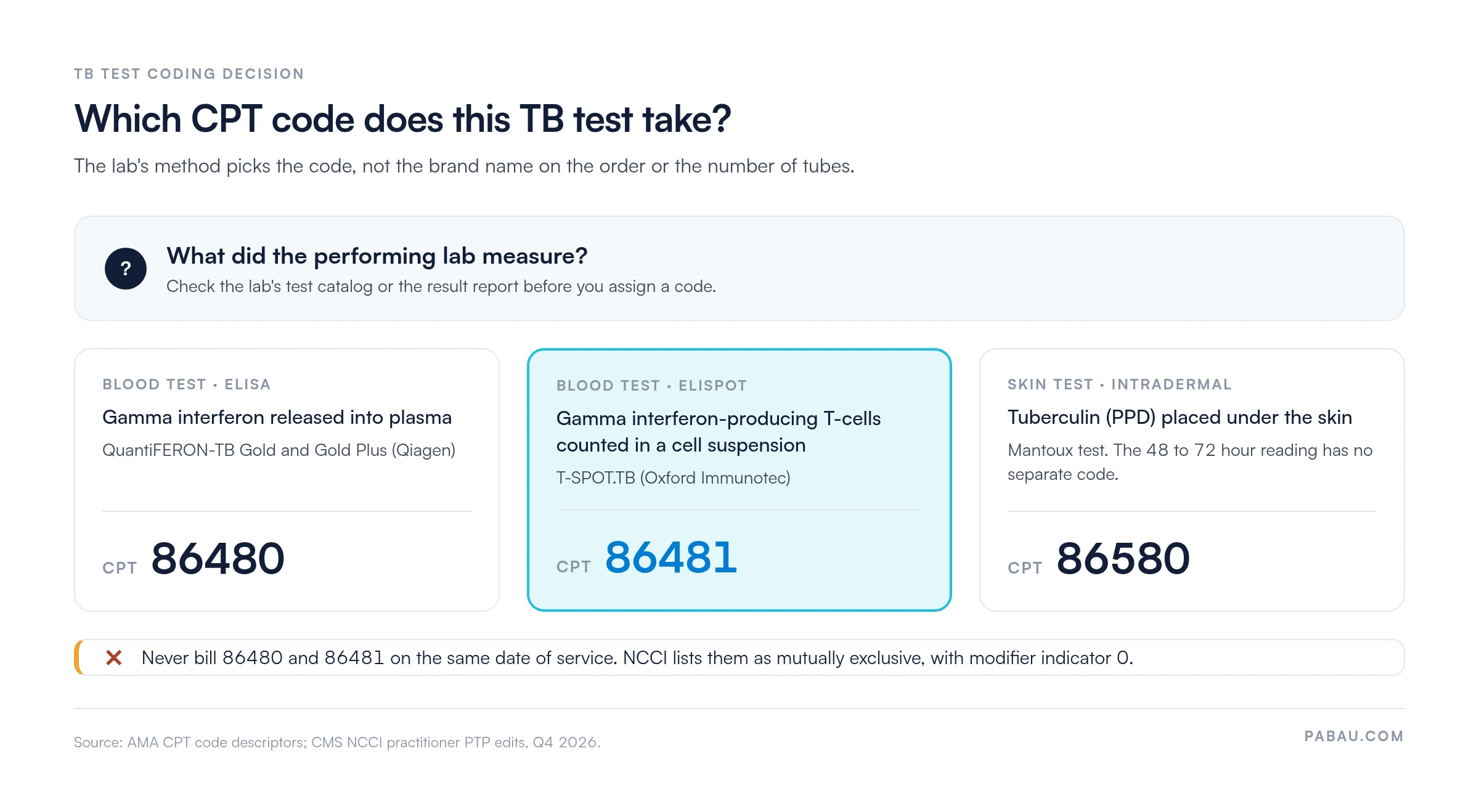
Most US labs run QuantiFERON-TB Gold Plus, so 86480 is the IGRA code most outpatient and occupational health claims need. Reserve 86481 for T-SPOT.TB or another lab-confirmed T-cell enumeration method. If your EHR maps QuantiFERON orders to 86481, update the order set.
Blood-based IGRAs and tuberculin skin tests (TSTs) serve the same clinical purpose but bill under completely different code families. They are not interchangeable on the same date of service.
86580 covers the intradermal PPD (Mantoux) test. Reading the result 48 to 72 hours later has no separate CPT code.
CDC and USPSTF guidelines indicate IGRA is preferred over TST in BCG-vaccinated individuals because prior BCG vaccination can cause false-positive TST results. That clinical preference does not automatically translate to payer coverage. Some commercial plans and Medicaid programs still require TST first and only cover IGRA on a step-edit basis.
Payers validate that the diagnosis code supports the medical necessity of the IGRA. Using Z11.1 correctly is the first line of defense against a CO-11 denial.
Verify each code against your MAC’s LCD covered-indication list before billing. Novitas, CGS, and Palmetto GBA each publish an LCD governing IGRA reimbursement, and covered diagnosis codes sometimes differ across contractors.
Pair Z11.1 with any documented high-risk factor in the chart note: Foreign birth in a high-prevalence country, HIV-positive status, immunosuppressive therapy, or healthcare worker exposure. Unsubstantiated Z11.1 claims without a documented clinical rationale are a common LCD audit trigger.
CPT code 86481 is reimbursed under the Medicare Clinical Laboratory Fee Schedule (CLFS), not the Physician Fee Schedule. Rates are set annually by CMS and differ between independent laboratory settings and hospital outpatient settings. Check the current-year rate in the CMS Clinical Laboratory Fee Schedule files before you quote expected reimbursement to a patient or payer.
No standalone National Coverage Determination (NCD) governs 86481 at the federal level. Coverage is managed through Local Coverage Determinations issued by each MAC. Three key LCD families to know:
When billing Medicare, pull the specific LCD in effect for your MAC jurisdiction and retain a copy in your billing records. LCD-based denials are almost always preventable with the right documentation on file at the time of service.
Most traditional Medicare claims for CPT code 86481 do not require prior authorization. The picture is different for commercial plans and Medicare Advantage.
When prior auth is required, document the clinical risk factor, the order rationale, and any prior TST results in the authorization request. Turnaround for lab-service authorizations is typically 24-72 hours for non-urgent cases.
Strong documentation is the difference between a paid claim and a post-payment audit recoupment. For medical billing compliance, the chart note supporting CPT code 86481 must contain all of the following before the claim goes out.
Occupational health settings handle high volumes of IGRA orders. A clean claim submission requires that batch orders include individual patient-level documentation, not a single group notation. Each patient record must stand alone under audit.
These are the denial patterns billing staff see most often on 86481 claims, along with the corrective action and resubmission approach. For deeper context on managing these across your practice, see denial management workflows and the reference on medical billing denial codes.
The National Correct Coding Initiative (NCCI) publishes quarterly procedure-to-procedure (PTP) edit tables that govern which codes can be reported together. For CPT code 86481, the most important edit pairs it with 86480. The practitioner PTP table lists 86481 as column 1 and 86480 as column 2, as mutually exclusive procedures. Its modifier indicator is 0, so no modifier can override it. Both codes answer the same clinical question using different lab methods.
Always verify NCCI edits against the current quarterly table. The edits above come from the Q4 2026 Medicare practitioner PTP table (version 32.3). Edit assignments change between quarters, so a coder working from last year’s table can bill a pair that is now barred.
A clean 86481 claim follows a predictable workflow. Claims most often fail at step 2 (wrong code assigned) or step 4 (diagnosis not on the LCD list).
Set up an automated worklist in your billing system for 86481 denials. Have it flag any claim returned with CARC CO-11 or CO-96 within 48 hours of ERA receipt. Medicare allows 120 days from the initial determination to request a redetermination. Catching denials early leaves time to gather documentation before that window closes.
Each denial in this guide starts upstream in medical billing, before the claim leaves the practice. A QuantiFERON order lands under 86481, a Z11.1 claim goes out without a risk factor, or a Medicare Advantage plan wanted an authorization nobody requested.
Pabau, the practice management platform we build, raises the claim from the patient’s invoice and submits it as a CMS-1500 through Claim.MD. Its claim validation scrubs each claim for missing or invalid details before it leaves Pabau. Prior authorizations are stored as a case and attached at booking, so the authorization code follows the appointment onto the claim.
When a claim comes back rejected, Pabau flags it as Needs action and links straight to the field that needs correcting. Payments settle from the electronic remittance advice (ERA) file, so your team works the denials instead of matching remittances by hand. No software can promise the payer’s decision, but the coding and data errors you control get caught first.

Pabau’s claim validation checks each TB test claim for missing or invalid details before it reaches Claim.MD. Rejected claims show the reason and the field to fix, so each correction takes seconds.

Code the method, not the brand name. Before any IGRA claim goes out, confirm what the lab ran, then bill 86481 for T-SPOT.TB and 86480 for QuantiFERON.
The harder habit is documentation. A Z11.1 claim with no recorded risk factor may pay today and still fail an LCD audit later. Write the risk factor into the chart note at the visit, when it takes one sentence.
Book a demo to see how Pabau checks TB test claims for coding and diagnosis errors before they reach the payer.

Need to understand how clearinghouse validation reduces claim errors? Claim.MD clearinghouse overview covers how real-time eligibility and 837P validation work for lab claims.
Want a framework for tracking denial patterns across your billing team? Revenue cycle management fundamentals explains how to build a denial-trend dashboard and reduce preventable write-offs.
Billing for other lab immunology codes alongside 86481? Superbill construction guide walks through how to structure multi-code lab claims accurately.
CPT code 86481 covers a tuberculosis interferon gamma release assay (IGRA) that counts gamma interferon-producing T-cells in a cell suspension. In practice, that means T-SPOT.TB, the ELISpot assay the AMA created the code for, effective January 1, 2011. QuantiFERON tests measure gamma interferon in plasma instead and bill under 86480. The code belongs to the Immunology subsection of the AMA’s Pathology and Laboratory chapter and is reimbursed under the Medicare Clinical Laboratory Fee Schedule.
The two codes split by assay method. CPT 86480 covers gamma interferon measurement, the ELISA approach used by QuantiFERON-TB Gold and Gold Plus. CPT 86481 covers counting gamma interferon-producing T-cells in a cell suspension, the ELISpot approach used by T-SPOT.TB. Neither descriptor refers to antigens or tube counts. NCCI lists the pair as mutually exclusive, and billing the code that doesn’t match the lab’s method is a common denial reason.
ICD-10 Z11.1 (encounter for screening for respiratory tuberculosis) is the primary pairing for routine LTBI screening. Z86.15 applies for patients with a personal history of LTBI. R76.11 is used when 86481 is ordered to confirm an indeterminate or positive TST result. Always verify covered diagnosis codes against your MAC’s current LCD, as Novitas, CGS, and Palmetto GBA may list different acceptable codes.
Yes, Medicare covers CPT 86481 for high-risk patients under Local Coverage Determinations issued by each MAC. Coverage is not automatic for all patients: The clinical risk factor must be documented in the chart note and must match the LCD’s covered-indication list. Traditional Medicare does not require prior authorization. Medicare Advantage plans may add that requirement.
No. NCCI lists 86480 and 86481 as mutually exclusive procedures for the same date of service, with a modifier indicator of 0. No modifier can override the edit, so the column 2 code, 86480, is denied. The lab report names the assay method, so bill the single code that matches it.
CPT 86580 covers the intradermal PPD (Mantoux) test. The reading has no separate CPT code. Both are distinct from the blood-based IGRA family (86480/86481). IGRAs are preferred in BCG-vaccinated patients because prior BCG vaccination can cause false-positive TST results. However, some payers require TST first and only cover IGRA after an indeterminate result. Check your payer’s step-edit policy before ordering.