CCSD code E2940: Partial laryngectomy billing guide
CCSD code E2940: what the code covers CCSD code E2940 is the procedure code for ...

Last Updated: Oct 15, 2026
E0412 is the CCSD code for reduction of the nasal turbinates by laser, diathermy, out fracture or a similar technique. UK private surgeons use it to bill insurers for shrinking enlarged inferior turbinates that block the nasal airway.
Insurer schedules grade E0412 as a Minor procedure. CCSD bars it alongside septoplasty (E0360), septorhinoplasty (E0220, E0230), turbinate trimming or excision (E0420), division of turbinate adhesions (E0440) and bilateral FESS (E1432).
Let Pabau's smart automation suggest the right codes, reduce claim denials, and keep your practice compliant—effortlessly.
Automate repetitive tasks and focus on what matters most—your patients.
Reduce coding errors and ensure compliance with the latest regulations.
Clean claims, fewer denials, and faster reimbursements.
Powerful insights and reporting to help your practice thrive.
HIPAA compliant SOC 2 certified GDPR-compliant Trusted by 4,000+ clinics worldwide

CCSD Code E0412 covers reduction of the nasal turbinates by laser, diathermy, out fracture or a similar technique.
ICD-10 J34.3 (hypertrophy of nasal turbinates) is the primary supporting diagnosis. Allergic rhinitis codes (J30.x) are typically accepted alongside it, but verify on the insurer portal.
CCSD lists E0360, E0220, E0230, E0420, E0440 and E1432 as unacceptable combinations with E0412, because each already covers turbinate work.
Private medical insurers such as Bupa and AXA Health typically require pre-authorisation for turbinate reduction, so verify on the insurer portal before booking.
Pabau, our practice management platform, keeps the CCSD code, diagnosis, authorisation reference and operative note on one patient record.
CCSD Code E0412 is the UK private billing code for “reduction turbinates of nose (laser, diathermy, out fracture etc).” Surgeons use it when they shrink enlarged inferior turbinates to relieve nasal obstruction. The “etc” signals that the three named techniques are examples rather than a closed list. That matters for newer energy-based methods (see the radiofrequency section below).
E0412 sits in the nose and nasal cavity section of the ENT chapter of the CCSD code schedule. Insurer schedules such as Freedom Health Insurance and National Friendly grade it as a Minor procedure. Its descriptor has no laterality wording, which raises a common billing question for bilateral procedures.
E0412 covers the turbinates only. Septoplasty, nasal polypectomy and functional endoscopic sinus surgery (FESS) each carry their own CCSD codes. Several of those codes already include attention to the turbinates, so CCSD bars E0412 alongside them (see the co-coding section below).
The inferior turbinates are bony shelves lined with mucosa on the inner walls of the nasal cavity. They can enlarge because of allergic rhinitis, chronic non-allergic rhinitis, or compensatory hypertrophy after septoplasty. Enlarged turbinates narrow the nasal airway and cause persistent obstruction, mouth breathing and disturbed sleep. Turbinate reduction shrinks them to restore airflow, without removing the turbinate entirely.
The procedure is typically performed as a day case or outpatient procedure under local or general anaesthetic, depending on technique and patient preference. Patient selection matters for billing. Insurers treat turbinate reduction as a functional procedure rather than a cosmetic one. They require documented turbinate hypertrophy, failed conservative management and objective impairment.
The three techniques named in the E0412 descriptor work differently, but all reduce turbinate volume to improve nasal patency. The table below summarises each technique, its typical setting, and whether it belongs under E0412.
Radiofrequency ablation (RFA) and Coblation turbinoplasty are not named in the E0412 descriptor. Both are energy-based techniques that reduce submucosal volume in a way similar to diathermy. No published CCSD ruling explicitly includes or excludes RFA from E0412. Until one exists, document the technique in detail, apply E0412 as the closest matching code, and confirm the approach with the insurer before submission. If a payer disputes the coding, raise a formal query with CCSD.
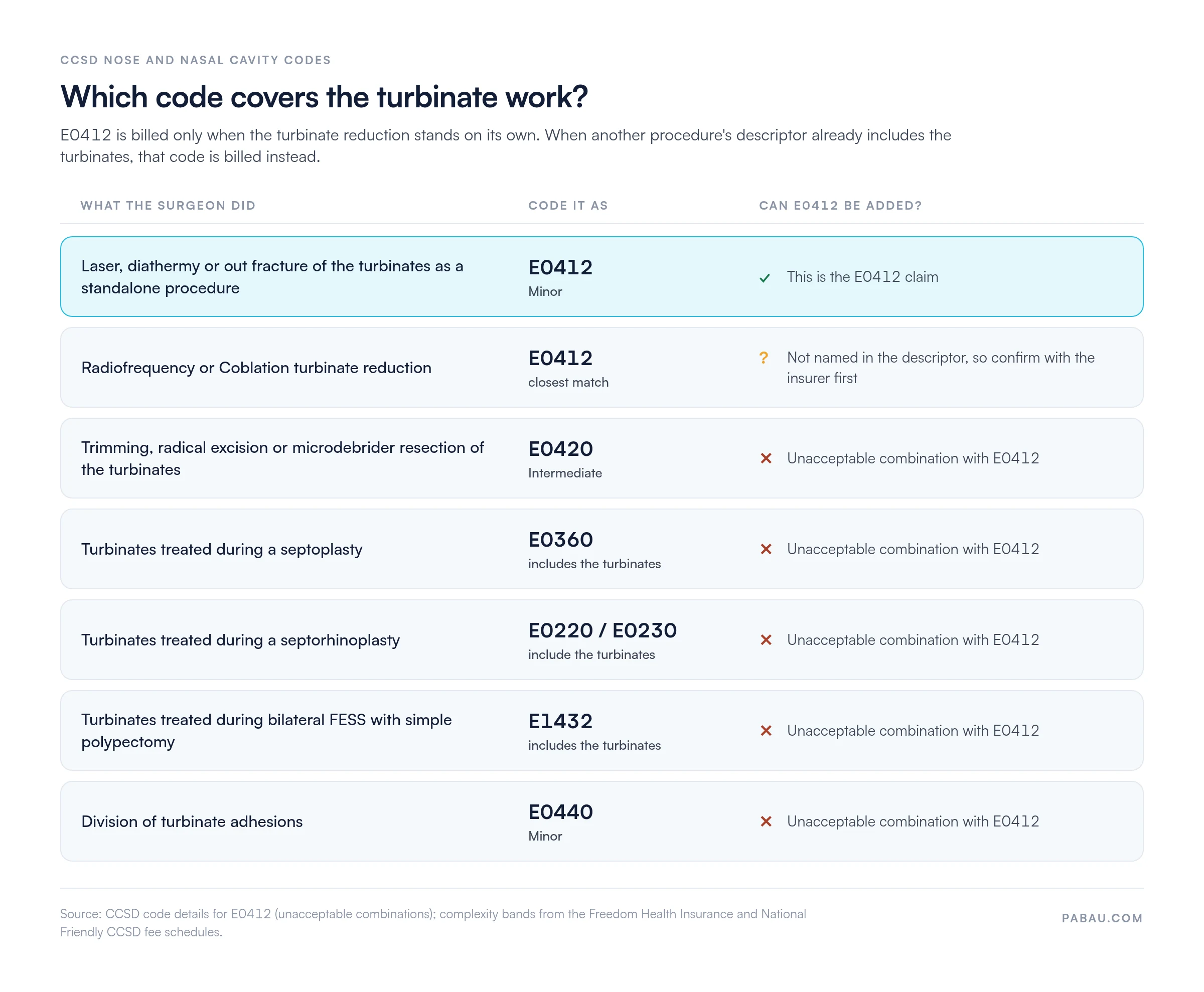
E0412 is one of several CCSD codes covering nasal surgery, and the turbinates appear in more descriptors than coders expect. The table below maps the neighbouring codes, their complexity band in published insurer schedules, and whether each can sit on the same claim as E0412.
Septoplasty and turbinate reduction are often performed together, because a deviated septum and enlarged turbinates frequently coexist. Even so, CCSD does not allow E0412 on the same claim as septoplasty E0360. The septoplasty descriptor already includes attention to the turbinates, so the turbinate work is paid within E0360.
The same rule applies to septorhinoplasty (E0220 and E0230) and to turbinate trimming or radical excision (E0420). It also covers division of turbinate adhesions (E0440) and bilateral FESS (E1432), whose descriptor includes the turbinates.
Submucous resection of the septum (E0310) is not on the E0412 unacceptable list, but confirm the pairing at pre-authorisation. When turbinate reduction happens during a septoplasty or FESS, code the main procedure alone and still describe the turbinate work in the operative note. The chart below maps each turbinate scenario to the code that covers it.
Submit one E0412 for a bilateral procedure, never two. CCSD has no modifiers, and the E0412 descriptor says nothing about laterality, so each insurer sets its own bilateral handling. Confirm how the insurer treats a bilateral E0412 at pre-authorisation. Then record laterality explicitly in the operative note (“bilateral inferior turbinate reduction performed”).
Every E0412 claim must be supported by an ICD-10 diagnosis code that confirms medical necessity. Insurers cross-check the diagnosis against their coverage criteria. A diagnosis that does not clearly indicate turbinate hypertrophy or significant nasal obstruction will trigger a medical necessity query or an outright denial.
J34.3 is the preferred primary code for most E0412 claims. When allergic rhinitis is the underlying cause, J30.x codes work as secondary or co-primary codes alongside J34.3. UK claims use the WHO ICD-10 edition, so US ICD-10-CM codes such as J34.89 do not apply. Avoid J34.2 (deviated septum) as the sole diagnosis, because it supports a septoplasty rather than turbinate surgery.
Prior authorisation is the most important step before any surgical ENT procedure in UK private practice. Submitting an E0412 claim without it is a common cause of denial. The table below shows typical requirements for four main private medical insurers. Payer policies change, so always verify current requirements on each insurer’s provider portal before advising patients.
See the Bupa CCSD code schedule for a broader reference on how Bupa applies the CCSD schedule across procedure categories. For AXA Health and Vitality, check current fee schedule publications to confirm E0412 is listed at the fee you intend to charge.
A correct code on an invoice is only half the claim. Insurers audit operative notes when disputes arise, and an incomplete note is treated as evidence that the procedure was not performed as claimed. Every E0412 claim should be supported by an operative note that covers the following.
Structured operative note templates reduce the risk of missing any of these elements. A template that prompts for technique, laterality and indication at the point of note completion catches omissions before they become denied claims.
Build ‘Right / Left / Bilateral’ as a mandatory field in your operative note template for turbinate procedures. It takes seconds at the point of dictation, and the note can no longer be saved without a side recorded.
Common E0412 denials can be prevented at the booking and note-writing stages. The table below covers each denial reason, the prevention action and the appeals route.
UK private medical insurers draw a firm line between functional turbinate reduction, which is covered, and cosmetic or elective reduction, which is not. A claim can cross into cosmetic territory when a note in the same episode uses certain phrases. Examples include “patient concerned about nose appearance,” “aesthetic improvement,” or “cosmetic rhinoplasty.” The rule applies to the referral letter, consultation note and operative note, even when the turbinate procedure itself is functional.
To establish medical necessity, record the following before seeking pre-authorisation. Note symptom duration of at least 3 months and a named trial of conservative treatment, including the intranasal corticosteroid spray by brand and duration. Add objective findings from nasal endoscopy and, where available, rhinomanometry or a validated symptom score such as the NOSE scale. These elements give the insurer what it needs to approve the claim and, if audited, to defend it.
ENT practices billing E0412 repeat the same administrative steps for every case. They check the code and its unacceptable combinations, then secure pre-authorisation. Next, they invoice with the correct code and diagnosis and keep operative notes that hold up to insurer scrutiny. Pabau brings these steps into one system for UK private practices.

Pabau keeps CCSD codes, insurer authorisations and operative notes on one patient record. UK private ENT practices can then submit cleaner claims without switching systems.

For E0412, the code itself is rarely the problem. Claims fail when they carry an unacceptable combination, a missing authorisation reference, or an operative note that does not name the technique and side.
Check the full procedure list against the CCSD combinations before you submit. Let septoplasty, septorhinoplasty or FESS absorb the turbinate work when their descriptors include it. Then make technique and laterality mandatory in the note, so every E0412 claim you send can be defended on audit.
Book a demo to see how Pabau keeps CCSD codes, authorisations and operative notes together for UK private ENT practices.

Need a reference for all Bupa procedure codes? Bupa CCSD codes and fee schedule covers how Bupa applies the CCSD schedule across specialties, with guidance on unbundling and billing rules.
Coding turbinate work done during sinus surgery? CCSD code E1432 for bilateral FESS explains the sinus surgery code whose descriptor already includes the turbinates.
Treating turbinate adhesions instead? CCSD code E0440 for turbinate adhesions covers division of adhesions of the turbinate and how to bill it.
Operating on the septum as well? CCSD code E0310 for submucous resection covers submucous resection of the nasal septum and its billing rules.
Want to streamline private insurance claim submission? Pabau’s claims management tools send claims to Healthcode and track them for UK private practices.
CCSD Code E0412 covers reduction of the nasal turbinates by laser, diathermy or out fracture, as defined in the official CCSD schedule. ENT surgeons use it to bill UK private medical insurers and self-pay patients for this procedure, and it sits within the E-series nose codes.
E0412 does not explicitly name radiofrequency ablation (RFA) or Coblation, but both are energy-based techniques functionally similar to diathermy. No published CCSD ruling confirms or excludes RFA from E0412. Coders should document the technique in full, apply E0412 as the closest match, and confirm with the relevant insurer before submission. Seek formal CCSD guidance if a payer disputes the code.
ICD-10 J34.3 (hypertrophy of nasal turbinates) is the primary supporting diagnosis for E0412 and is widely used by UK insurers. J30.1 or J30.4 (allergic rhinitis) may be added as secondary codes when allergy is the underlying cause. Avoid J34.2 (deviated septum) as the sole diagnosis, because it supports a septoplasty rather than turbinate surgery.
The most common reasons are a missing pre-authorisation and an operative note that does not name the technique. Others include a diagnosis that does not establish turbinate hypertrophy and E0412 billed twice for a bilateral procedure. E0412 billed alongside an unacceptable combination, such as septoplasty E0360, is denied too. Cosmetic language in the referral letter or notes can also trigger a cosmetic exclusion.