

CCSD code G5100: Bypass of duodenum billing guide
CCSD code G5100 bills a bypass that leaves the duodenum in place CCSD code G5100...

Last Updated: Oct 16, 2026
83615 is the CPT code for lactate dehydrogenase (LD), (LDH), a quantitative test of total LDH enzyme activity in serum or plasma. It reports one numeric result and sits in the Chemistry section of the Pathology and Laboratory codes.
Isoenzyme fractionation isn't included and is billed separately as 83625. Medicare pays 83615 under the Clinical Laboratory Fee Schedule, and the claim needs a diagnosis showing why tissue damage was suspected.
Let Pabau's smart automation suggest the right codes, reduce claim denials, and keep your practice compliant—effortlessly.
Automate repetitive tasks and focus on what matters most—your patients.
Reduce coding errors and ensure compliance with the latest regulations.
Clean claims, fewer denials, and faster reimbursements.
Powerful insights and reporting to help your practice thrive.
HIPAA compliant SOC 2 certified GDPR-compliant Trusted by 4,000+ clinics worldwide

CPT Code 83615 covers total LDH measurement only, and isoenzyme fractionation is billed separately under CPT 83625.
LDH is not a component of the AMA-defined CMP (80053) or BMP (80048), but some payers apply their own bundling rules.
Medicare pays 83615 under the Clinical Laboratory Fee Schedule (CLFS), not the Physician Fee Schedule, and rates vary by MAC jurisdiction.
R74.02 codes an elevated LDH result directly, so it supports follow-up LDH testing better than the catch-all R79.89.
Practice management software like Pabau generates claims from your invoices and runs validation checks before they reach the payer.
CPT Code 83615 is the code for a quantitative test of total lactate dehydrogenase activity in serum or plasma. Its official American Medical Association descriptor is Lactate dehydrogenase (LD), (LDH). It falls within the Chemistry Procedures section of the CPT code set (codes 82009 through 84999).
That section covers single-analyte quantitative measurements on serum, plasma, or whole blood. The test produces one numeric result, and Medicare pays for it under the Clinical Laboratory Fee Schedule.
LDH is an intracellular enzyme present in most tissues. When cells are damaged or destroyed, LDH leaks into the bloodstream. A total LDH result shows that cell damage has occurred somewhere, but not which tissue is involved. That question is answered by 83625, the isoenzyme fractionation code, not by 83615 itself.
Medical necessity for CPT Code 83615 exists when the ordering clinician documents a condition linked to tissue damage, abnormal cell proliferation, or hemolysis. These are the indications payer policies accept most often.
The ordering note should name the working diagnosis that makes each test necessary. A note that records symptoms without a working diagnosis frequently triggers medical necessity denials.
Pairing CPT Code 83615 with a well-supported ICD-10 diagnosis code is the most effective way to prevent payer denials. The CDC ICD-10-CM tool maintains the complete list of valid diagnosis codes. The table below covers the pairings commercial and Medicare payers accept most often.
Use the most specific code available. When the finding is a raised LDH, R74.02 names it directly, so there’s no need to fall back on R79.89. Claims billed with only an “other abnormal” code and no clinical diagnosis face higher audit risk.
Payers that follow Local Coverage Determinations (LCDs) for lab tests usually require the ordering diagnosis to appear on the LCD’s covered-diagnoses list.
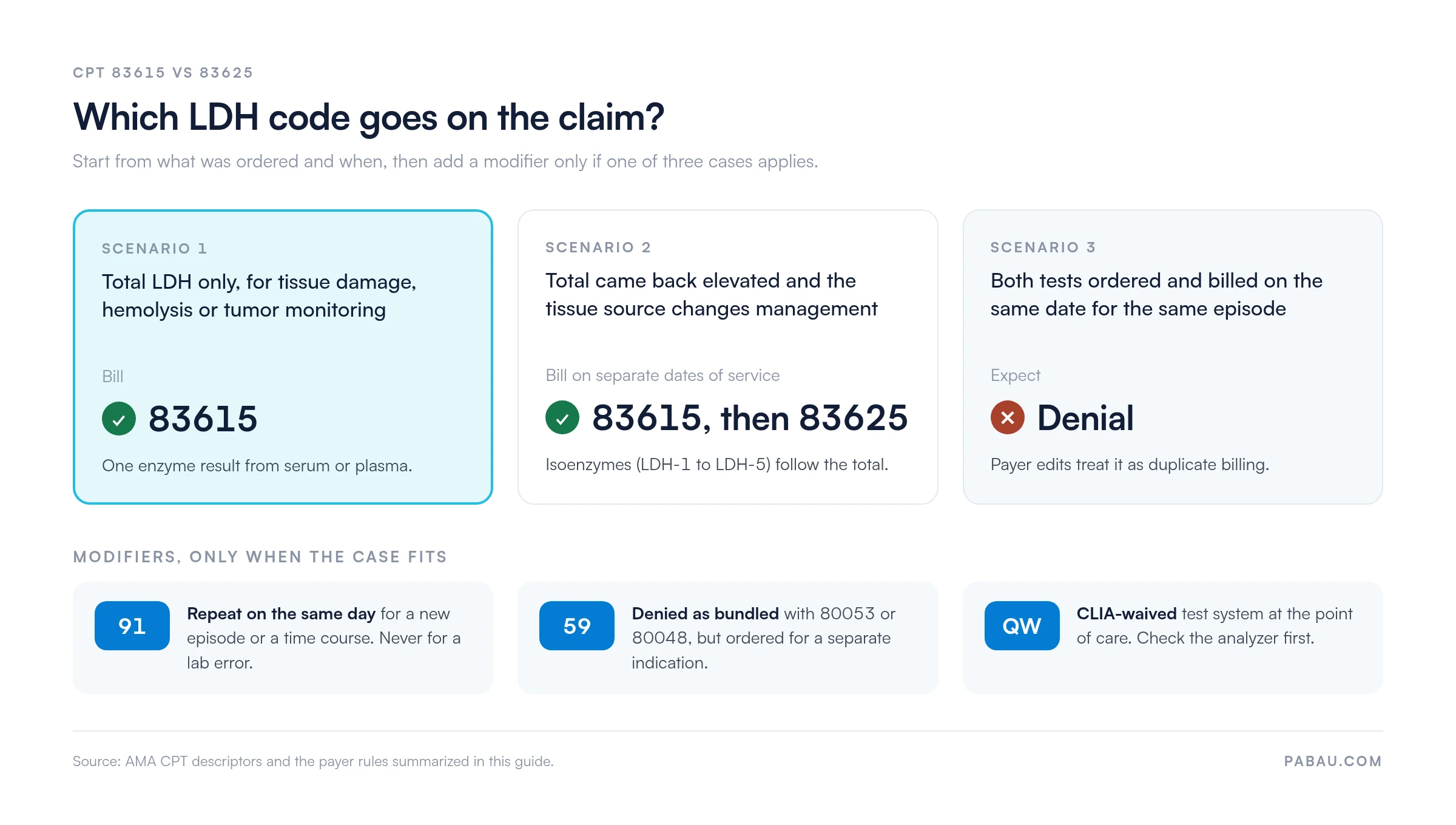
CPT 83615 measures total LDH activity in a single enzymatic reaction. CPT 83625 separates LDH into its five isoenzyme fractions (LDH-1 through LDH-5), usually by electrophoresis. That shows clinicians which tissue source is driving the elevation.
The most common coding error here is ordering both tests at once and billing both codes on the same claim. When isoenzymes are run only after an elevated total LDH, the two tests usually fall on different dates of service. Each one can then be billed separately.
Same-day dual billing triggers automatic payer edits and is a leading denial cause for this code pair. The panel below maps each ordering scenario to the code that belongs on the claim.
Medicare pays for CPT Code 83615 under the Clinical Laboratory Fee Schedule (CLFS), not the Physician Fee Schedule. The Centers for Medicare and Medicaid Services (CMS) updates the CLFS every year. It sets maximum payments for lab tests billed by independent labs, hospital outpatient labs, and physician office labs.
The CMS Physician Fee Schedule search tool doesn’t apply to 83615. The test has no professional component, so it’s technical-only.
Reimbursement for 83615 is modest. Under the 2025 CLFS, national limitation amounts for simple chemistry tests in this range typically fall between $5 and $15. The exact figure for 83615 varies by MAC jurisdiction and appears in the annual CMS CLFS rate file.
Pull your MAC’s current CLFS schedule directly rather than relying on third-party fee data, which can lag the effective date.
Pull the current CMS CLFS rate file from the CMS website each January. The file is a downloadable Excel spreadsheet and includes the national limitation amount for every covered lab code, including 83615. Compare it against your contracted commercial rates quarterly to surface underpayments before they age.
CPT Code 83615 generally doesn’t need prior authorization. Medical necessity must still be documented under the Local Coverage Determination (LCD) or National Coverage Determination (NCD) that applies in the ordering clinician’s MAC jurisdiction.
Key payer policy points for 83615:
A complete ordering note for CPT Code 83615 needs specific elements to survive payer review and any later audit. Missing even one element is grounds for a post-payment recoupment request.
Capturing these elements when the test is ordered is far easier than rebuilding them after a payer requests records.
Denials for CPT Code 83615 cluster around five predictable root causes. When a remittance comes back, match its reason code against our list of denial codes for billers to find the fix.
Billing teams working in claims software for practices with built-in CPT and ICD-10 catalogs can run pre-submission edits. Those edits catch the first three denial types before a claim reaches the clearinghouse.
Most 83615 claims go out without modifiers. Three scenarios call for one.
Hospital outpatient departments bill 83615 under the hospital’s outpatient provider number with the relevant place-of-service code. That setting decides which fee schedule applies and how the facility’s bundled payment treats the test. Build setting-specific rules into your billing workflow when one code is billed in both outpatient and office settings.
Before applying modifier QW to any LDH test, verify the specific analyzer model and test kit’s CLIA waiver status on the CMS CLIA waiver database. CLIA complexity categories are assigned per test system, not per code. Billing QW on a non-waived system is a compliance risk regardless of the test’s billing code.
Most 83615 errors start between the lab order and the submitted claim. A biller who looks a code up in one system and retypes it into another adds transcription risk at every step.
Practice management software like Pabau generates claims from the invoices your team already raises, with the invoice details pre-filled. Through Claim.MD, our US clearinghouse integration, claims go electronically to thousands of payers. Real-time eligibility checks confirm the patient’s coverage before the specimen is drawn.
Pabau also runs validation checks in the background for required details such as membership numbers and authorization codes. Each claim’s status then updates in one dashboard, from submission to payment or denial. Electronic remittance advice posts back against the right invoice, so a denied 83615 claim shows up the day it returns.
Insurer-specific price lists let you set your contracted fee for 83615 per payer. A short payment then stands out against the rate you agreed, instead of hiding in a spreadsheet.

Pabau turns your invoices into claims, checks eligibility in real time, and tracks every CPT Code 83615 claim from submission to payment.

Most 83615 denials are preventable, and they come from two decisions made before the claim exists. Decide up front when isoenzymes are needed, then keep 83625 off the date the total LDH was billed.
Next, check each commercial contract for proprietary panel bundling before billing 83615 alongside 80053 or 80048. A few minutes of setup per payer costs less than working the same denial every month.
The fee on this code is small, so it only pays when it’s collected on the first pass. Book a demo to see how Pabau tracks lab claims from invoice to payment.

Need to understand how clearinghouse edits work before claims reach the payer? How medical claims clearinghouses process lab claims explains the real-time edit checks that catch CPT and ICD-10 mismatches at submission.
Working a backlog of denied lab claims? Denial management in healthcare covers the workflow for categorizing, appealing, and preventing recurring denials by root cause.
Building out a lab billing compliance program? Medical billing compliance sets out the documentation and audit standards that apply to chemistry panel claims, including 83615.
CPT code 83615 covers a quantitative measurement of total lactate dehydrogenase (LDH) enzyme activity in serum or plasma. It’s a single-analyte chemistry test used across oncology, hepatology, cardiology, and hematology to identify tissue damage or high cell turnover. Isoenzyme fractionation isn’t included and is reported separately under CPT 83625.
CPT 83615 reports total LDH activity as a single numeric value. CPT 83625 reports the five LDH isoenzyme fractions, LDH-1 through LDH-5, after separation and quantitation. Billing both on the same date for the same episode triggers a duplicate billing denial. Order 83625 only when the total is elevated and the tissue source changes clinical management.
Yes, Medicare covers CPT 83615 when the ordering diagnosis meets the applicable Local Coverage Determination (LCD). Payment comes from the Clinical Laboratory Fee Schedule (CLFS), not the Physician Fee Schedule. If the diagnosis isn’t on the LCD’s covered list, the lab must issue an Advance Beneficiary Notice (ABN) before drawing the specimen.
The most common cause is an ICD-10 code missing from the payer’s LCD covered list. Next come duplicate billing of 83615 and 83625 on the same date, and payer edits that fold LDH into a metabolic panel. LDH isn’t an AMA-defined component of CPT 80053 or 80048, so those bundling edits can be appealed. Ordering provider non-enrollment is fourth, and a pre-submission eligibility check prevents it.
The most widely accepted pairings include R74.02 (elevated LDH), R74.01 (elevated liver transaminases), and C85.90 (non-Hodgkin lymphoma). D59.9 (acquired hemolytic anemia), I21.9 (acute myocardial infarction), and M62.82 (rhabdomyolysis) are also common. Check the applicable MAC LCD for the complete covered list before submitting. Use the most specific code available rather than defaulting to R79.89 without a supporting diagnosis.
Modifier 91 applies when a repeat LDH test is ordered on the same date for a different clinical episode or a time course. Serial LDH measurements during acute MI monitoring are one example. Don’t use it when the repeat was caused by equipment failure or a quality control issue. Most payers deny modifier 91 claims where a lab error, not a new clinical need, drove the repeat.



