



CCSD code G5100: Bypass of duodenum billing guide
CCSD code G5100 bills a bypass that leaves the duodenum in place CCSD code G5100...

Last Updated: Oct 16, 2026

CPT code 83540 (Iron; quantitative) measures total serum iron and sits in the Chemistry Procedures subsection of the CPT code set.
Medicare covers CPT 83540 under NCD 190.18 for iron deficiency anemia, hemochromatosis, hemolytic anemia, suspected iron poisoning, and monitoring of iron therapy.
The 2026 national average Medicare allowed amount is approximately $8.44, with variation by MAC jurisdiction. Routine screening without documented medical necessity is not covered.
E83.11 is a non-billable parent code, so a hemochromatosis claim needs a fifth character such as E83.111.
Pabau’s claims management software links CPT codes to ICD-10 diagnoses and submits claims electronically, reducing manual coding steps for chemistry panel orders like 83540.
CPT code 83540 is the code for “Iron; quantitative,” a laboratory test that measures total serum iron. The American Medical Association (AMA) maintains it within the Pathology and Laboratory section of the CPT code set, under Chemistry Procedures (codes 82009-84999).
The test measures the concentration of iron (Fe) in serum or plasma. Results are reported in micrograms per deciliter (mcg/dL) or micromoles per liter (umol/L), depending on the laboratory’s convention. Ferritin reflects stored iron. Serum iron measured by 83540 represents the iron bound to transferrin that is circulating right now.
Clinicians order this test when they need a direct measure of circulating iron. It separates iron deficiency from other anemias and flags iron overload. Common clinical applications include:
In practice, CPT 83540 rarely travels alone. Most ordering providers request a full iron study panel that also includes TIBC (CPT 83550). The transferrin saturation ratio carries more diagnostic information than either value in isolation.
Medicare and most commercial payers cover CPT code 83540 when there is a documented clinical indication tied to a supporting ICD-10 code. The ordering provider’s chart must record why the test was clinically necessary for that specific patient encounter.
The most common ordering scenarios are symptomatic anemia workup, follow-up after a low hemoglobin or hematocrit, and monitoring of known hemochromatosis. Fatigue, pallor, and dyspnea on exertion are the symptoms that usually prompt the first of those. Family history of hereditary hemochromatosis without symptoms does not automatically qualify under NCD 190.18, so the chart still needs documentation of suspected disease.
The Centers for Medicare and Medicaid Services (CMS) governs Medicare coverage for serum iron testing under National Coverage Determination (NCD) 190.18. That NCD covers both CPT 83540 (serum iron) and CPT 83550 (TIBC) when the tests are medically necessary. Verifying insurance eligibility before the order goes out reduces the risk of after-the-fact denials for non-covered indications.
CMS requires the ordering provider to document the specific clinical indication in the patient record. A clearinghouse that validates ICD-10-to-CPT pairings before submission catches coverage mismatches before they turn into denials.
Lab evidence carries the same weight for treatment codes. Payers cover IV chelation under HCPCS code M0300 for heavy metal poisoning only when laboratory results confirm the toxicity.
Review NCD 190.18 language directly on the CMS Medicare Coverage Database before billing serum iron studies. The NCD is updated periodically. Local Coverage Determinations from your MAC may add indications or documentation requirements beyond what the NCD itself specifies.
Every claim for CPT 83540 must carry at least one ICD-10-CM diagnosis code that establishes medical necessity. The CMS ICD-10 codes page is the authoritative source for current code validity. Our ICD-10-CM code index carries detailed write-ups for many of the diagnosis families below.
Use the most specific ICD-10 code available. Submitting D50.9 when a more specific code applies, such as D50.0 for blood-loss anemia, can trigger extra review requests from some MACs. E83.11 is a non-billable parent code, so a hemochromatosis claim needs the fifth character that matches the documented cause. Verify code validity against the applicable fiscal year’s ICD-10-CM release, since codes are updated each October.
CPT 83540 is reimbursed under the Clinical Laboratory Fee Schedule (CLFS), not the Physician Fee Schedule. CMS updates the CLFS annually. Publicly available fee schedule data cited by multiple coding reference sources puts the 2026 national average Medicare allowed amount at approximately $8.44. Confirm that figure against the current CMS CLFS release for your MAC jurisdiction before billing.
Rates vary by Medicare Administrative Contractor (MAC) jurisdiction. Practices in high-cost urban areas may receive slightly higher rates than the national average, and rural regions sometimes fall below it. Use the CMS Clinical Laboratory Fee Schedule and its annual data file to check the exact rate for your jurisdiction. Receiving electronic remittance advice (ERA) after each claim batch makes it easier to spot rate discrepancies before they accumulate.
Note: Rates for 83550, 82728, and 85025 above are illustrative typical ranges from published sources. Confirm them against the current CLFS before you use them in billing. Only the 83540 figure has been cited by multiple coding reference sources specifically for 2026.
CPT 83540 rarely bills in isolation. Understanding how it relates to companion codes prevents undercoding, where a billable test is missed, and overcoding caused by bundling errors. The AAPC CPT code lookup provides descriptor cross-references that help confirm which codes can be billed together.
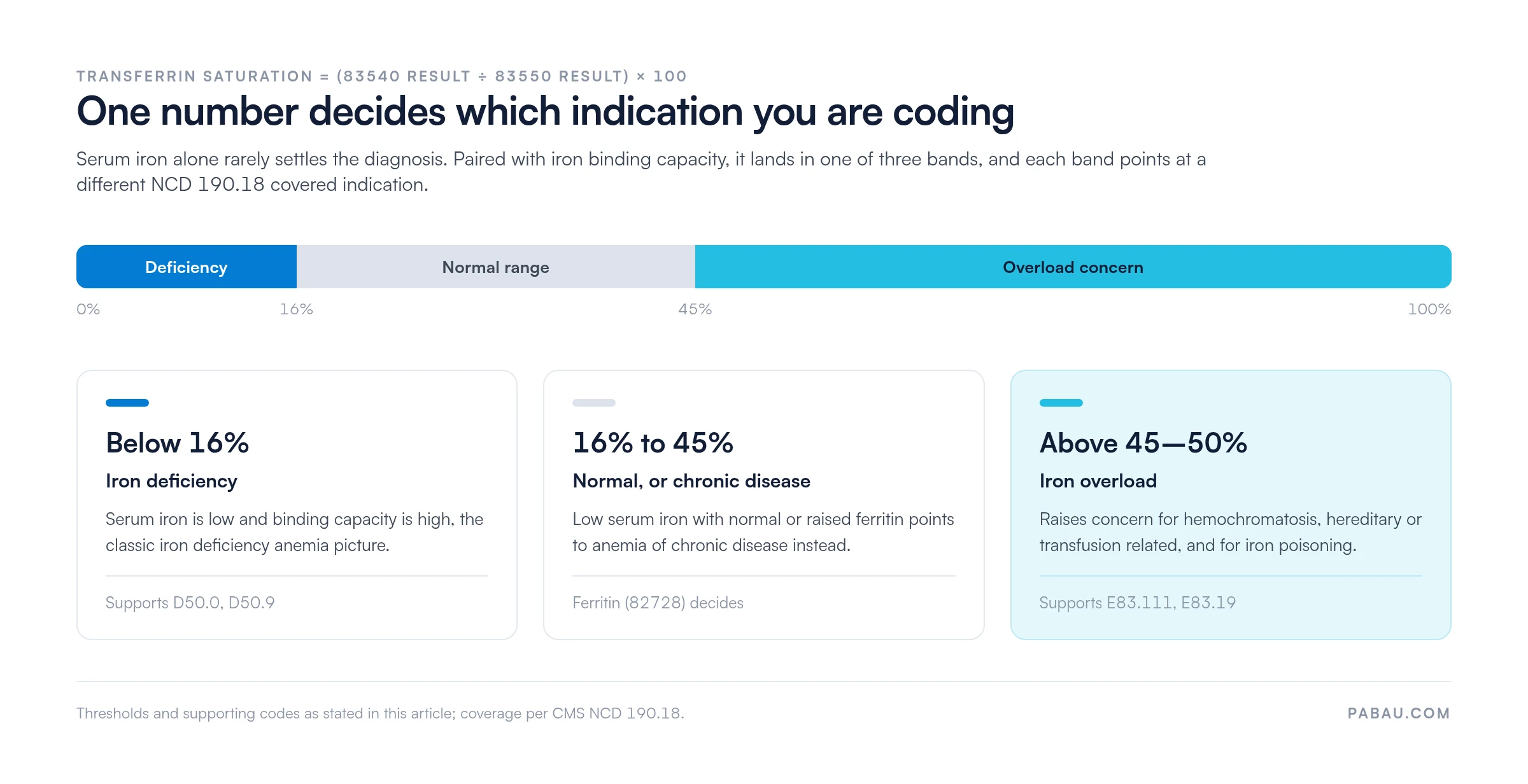
CPT 83540 measures the iron concentration in serum. CPT 83550 measures the iron binding capacity of transferrin, meaning the amount of iron transferrin could carry if it were fully saturated.
Together the two results produce transferrin saturation, calculated as the 83540 result divided by the 83550 result, multiplied by 100. A saturation below 16% typically indicates iron deficiency. One above 45-50% raises concern for iron overload. Which band the result lands in decides which covered indication you document.
Both codes are covered under NCD 190.18 when the clinical indication is documented. Billing one without the other is clinically unusual for a full iron deficiency workup.
A lone 83540 can still be appropriate for a quick monitoring check during iron supplementation therapy. Payers occasionally question a solo 83540 claim on an initial anemia evaluation, so document clearly when you order only the serum iron test.
Documentation is the primary defense against denied claims and audits. Sound medical billing compliance for CPT 83540 rests on five elements. Practices that build these into the ordering workflow, rather than chasing paperwork after a denial, submit cleaner claims from the start.
Common denial reasons for CPT 83540 claims include missing ICD-10 linkage, mismatched specimen dates, and billing a routine screening with no documented clinical necessity. Checking those three before a batch goes out catches most of them.
When a denial does occur, the claim adjustment reason code (CARC) on the ERA identifies the payer’s specific objection. That code is what tells billing staff whether to appeal or to correct and resubmit.
Build a serum iron panel order set in your practice management system. Have it link CPT 83540 and 83550 to the most common supporting ICD-10 codes, D50.9 and E83.10, as default suggestions. Coders can override the default for unusual presentations. The linkage still removes the most common reason for an 83540 denial, which is a missing diagnosis code.
Most CPT 83540 denials are preventable. They happen because the CPT-to-ICD-10 linkage is made by hand at billing time, rather than at order time when the clinical context is freshest. Software that joins lab ordering, superbill generation, and claim submission in one workflow closes that distance.
Practice management software like Pabau builds ICD-10 linkage into CPT code assignment, so the diagnosis travels with the lab order. Pabau’s claims management software keeps that pairing intact from documentation through to claim submission. For internal medicine, functional medicine, and integrative health practices ordering iron panels weekly, that removes the rework a preventable denial creates.
Pabau also submits claims electronically through Claim.MD, a US clearinghouse that connects to thousands of payers, including CMS Medicare. A clean 83540 claim with the correct ICD-10 code attached moves straight to the payer’s adjudication queue. There is no separate clearinghouse login and no manual file export.
The same integration supports real-time eligibility checks before the specimen is collected. That is the cleanest way to confirm Medicare or commercial coverage before the test is ordered.
Revenue cycle work for lab-heavy practices also runs on the back end: ERA posting when remittances arrive, claim status tracking, and underpayment flags. For a code like 83540, where the allowed amount is under $10, working a manual denial often costs more than the reimbursement itself.
Automation is what makes it economically viable to appeal, correct, and resubmit rather than write off small-dollar lab claims. Denial handling built into the billing workflow can meaningfully improve net collection rates for practices with high lab volume.

Pabau connects CPT code assignment, ICD-10 linking, and electronic claim submission in one workflow. See how practices using Pabau reduce iron panel billing errors and speed up reimbursement.

CPT code 83540 is a straightforward chemistry code with a narrow reimbursement window. The ICD-10 linkage, the NCD 190.18 indication, and a clean first submission are the three levers a practice actually controls.
The trade-off worth remembering is economic. At roughly $8.44 per claim, the labor cost of reworking a denial can exceed the payment. That is why the correction work has to happen before submission rather than after it.
Practices that pair the code at order time, check eligibility before collection, and post remittances automatically keep more of what they bill. Book a demo to see how Pabau handles CPT assignment, diagnosis linkage, and clearinghouse submission for lab-intensive practices.

Want to understand what clearinghouse connectivity does for lab claim submission? How a medical claims clearinghouse works explains the full EDI claim path from practice to payer.
Seeing recurring denial codes on your ERA and not sure how to respond? Electronic remittance advice explained covers how to read CARC and RARC codes and decide whether to appeal or resubmit.
Need a framework for evaluating your lab billing compliance? Revenue cycle management guide outlines the end-to-end process from eligibility check through payment posting.
CPT code 83540 (Iron; quantitative) measures the concentration of iron (Fe) in a patient’s serum or plasma. The result reflects circulating iron bound to transferrin, not stored iron, which ferritin (CPT 82728) measures separately. It is most commonly ordered as part of an iron deficiency anemia workup alongside total iron binding capacity (CPT 83550).
The 2026 national average Medicare allowed amount for CPT 83540 is approximately $8.44, based on publicly available Clinical Laboratory Fee Schedule data. Actual rates vary by MAC jurisdiction. Check the exact rate for your region in the CMS CLFS annual data file before billing.
The most common supporting codes are D50.9 (iron deficiency anemia, unspecified) and D50.0 (iron deficiency anemia secondary to blood loss). For iron overload, use E83.111 for hemochromatosis due to repeated red blood cell transfusions. E83.10 covers an unspecified disorder of iron metabolism, and D59.9 covers acquired hemolytic anemia. Use the most specific code available for the documented condition.
CPT 83540 measures the iron concentration in serum. CPT 83550 measures iron binding capacity, the amount of iron transferrin could carry if fully saturated. Dividing the 83540 result by the 83550 result and multiplying by 100 gives transferrin saturation. That percentage is the most useful single value for diagnosing iron deficiency or overload. Both codes are separately billable and covered under NCD 190.18 when medically indicated.
Yes. Medicare covers CPT 83540 for iron deficiency anemia under National Coverage Determination NCD 190.18. The claim must include a supporting ICD-10-CM diagnosis code, such as D50.9 or D50.0. The patient record must also document the clinical indication. Routine screening without documented medical necessity is not covered.
Yes. CPT 83540 and CPT 82728 (ferritin) can be billed on the same claim when both tests are medically necessary. Each must be supported by a covered ICD-10 diagnosis code. There is no bundling edit that prevents these two codes from appearing together. The pairing is standard for iron deficiency anemia workups, where separating deficiency from anemia of chronic disease needs both values.



