HCPCS Code G0163: Skilled nursing observation and assessment
What is HCPCS Code G0163? HCPCS Code G0163 is a deleted Level II code for skille...

Last Updated: Oct 15, 2026
82947 is the CPT code for glucose; quantitative, blood (except reagent strip). It covers a precise numeric glucose result measured on an automated chemistry analyzer, from a plasma, serum, or whole blood specimen.
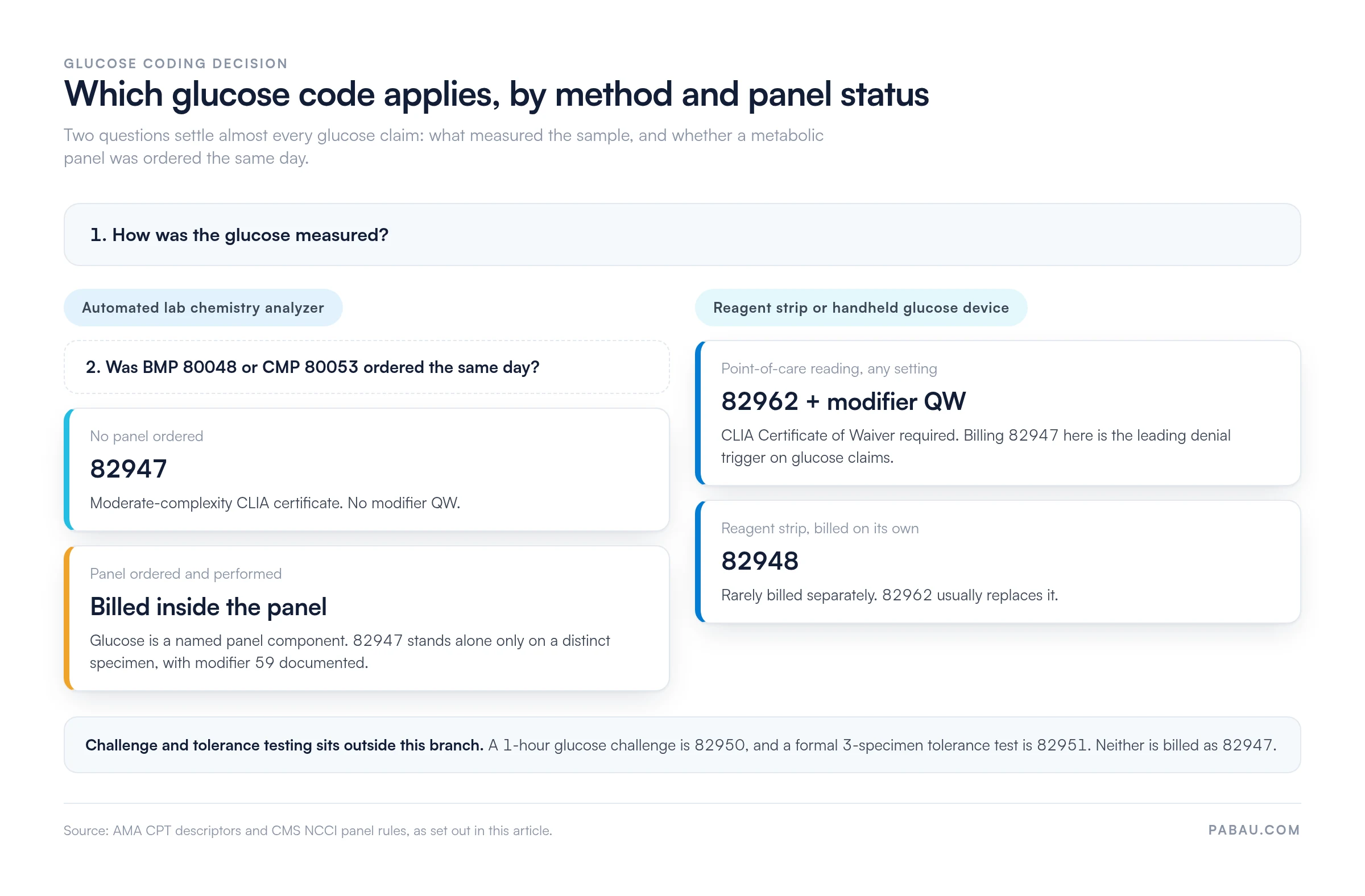
The parenthetical exclusion decides most claims. A reagent strip or handheld glucometer reading belongs to 82962, which needs modifier QW and a CLIA Certificate of Waiver. 82947 also sits inside the basic and comprehensive metabolic panels, so it cannot be billed alongside 80048 or 80053. A distinct specimen and modifier 59 are the one exception.
Let Pabau's smart automation suggest the right codes, reduce claim denials, and keep your practice compliant—effortlessly.
Automate repetitive tasks and focus on what matters most—your patients.
Reduce coding errors and ensure compliance with the latest regulations.
Clean claims, fewer denials, and faster reimbursements.
Powerful insights and reporting to help your practice thrive.
HIPAA compliant SOC 2 certified GDPR-compliant Trusted by 4,000+ clinics worldwide

CPT code 82947 covers quantitative glucose testing on plasma, serum, or whole blood by automated laboratory analyzer, and it excludes reagent-strip methods.
82947 is a named component of the basic metabolic panel (80048) and the comprehensive metabolic panel (80053). Billing it alongside either panel triggers an NCCI edit.
CPT 82962 is the correct code for an in-office glucometer reading, and it needs modifier QW to show CLIA-waived performance.
Practice management software like Pabau runs pre-submission validation checks on lab claims and sends them straight to the clearinghouse.
CPT Code 82947 is defined by the American Medical Association as “Glucose; quantitative, blood (except reagent strip).”
The parenthetical exclusion carries the weight here. Any glucose measured by reagent strip or handheld glucometer falls outside the code’s scope. Quantitative means the result is a precise numeric concentration, usually reported in mg/dL. An automated chemistry analyzer in a qualified laboratory produces it.
The code belongs to CPT’s Pathology and Laboratory section, Chemistry subsection (codes 82009-84999). It is priced on the CMS Clinical Laboratory Fee Schedule (CLFS), not the Physician Fee Schedule. So it carries no work RVU, and the GPCI locality adjustments that apply to evaluation and management codes never touch it.
CPT 82947 covers quantitative glucose measurement ordered for any clinically documented reason that calls for a precise numeric result from a laboratory analyzer. The common ordering scenarios fall into six categories. Each one carries its own supporting ICD-10 code to establish medical necessity.
Fasting status affects clinical interpretation but does not change the CPT code. Whether the specimen is collected fasting or non-fasting, 82947 is the correct quantitative glucose code. Document fasting status in the chart note whenever the ordering clinician considers it clinically relevant, because some payers request it during a post-payment audit.
Billing CPT Code 82947 for an in-office glucometer reading is the most common coding error on glucose claims, and it produces an immediate denial. The two codes describe different instruments, different lab settings, and different CLIA requirements.
The correct code for an in-office glucometer reading is CPT code 82962. That code is CLIA-waived, so the practice needs a valid Certificate of Waiver before it bills.
Practices that perform in-office point-of-care glucose checks must hold a Certificate of Waiver under CLIA regulations. Billing 82947 without a moderate-complexity CLIA certificate is a compliance risk even when the claim pays, because post-payment audits review CLIA credentials against billed codes. See the AAPC’s CPT code reference for descriptor language on the full 82940s glucose code family. Two questions route a glucose order to its correct code. The chart below works through the measurement method first, then the panel question.
CPT Code 82947 sits in a family of glucose-related codes. Coders who order one often need to know when to substitute or add another. The table below covers the most frequently ordered codes in this cluster.
83036 and 82947 serve complementary roles. A1c reflects average glycemia over the preceding 90 days, while a quantitative fasting glucose captures a point-in-time value. Both can be billed on the same date of service when the treating clinician documents separate medical necessity for each test.
Every CPT 82947 claim needs an ICD-10-CM code that establishes medical necessity, and the correct pairing depends on the clinical scenario. Each descriptor below is listed in full in our ICD-10-CM codes reference. Using a non-covered diagnosis without an Advance Beneficiary Notice (ABN) leaves the practice liable for the write-off.
Z13.1 is the cornerstone code for the Medicare preventive diabetes screening benefit. Section 1861(yy) of the Social Security Act sets the frequency. High-risk beneficiaries get fasting glucose testing twice per year, and lower-risk patients once per year. Risk factors include impaired fasting glucose, a BMI at or above 30, a family history of diabetes, and prior gestational diabetes. Confirm current ICD-10-CM code validity with the CDC/NCHS ICD-10-CM web tool each fiscal year, because a deleted or revised code on a claim denies automatically.
The diagnosis code decides the preventive benefit on other screening labs too. A screening diagnosis of Z12.11 supports CPT code 82270, while a symptomatic diagnosis routes that stool test to 82272.
CPT 82947 is reimbursed under the CMS Clinical Laboratory Fee Schedule, which sets a National Limitation Amount (NLA) updated each calendar year. The 2025 NLA is subject to annual CMS recalibration, so verify the current rate before submitting claims or updating fee schedules. The CLFS rate applies to every Medicare Part B outpatient claim regardless of where the performing lab sits. The GPCI locality adjustments on the physician fee schedule do not apply.
Many practices expect the physician fee schedule rate and are surprised by the CLFS payment. The CLFS rate for quantitative glucose has historically run from roughly $4 to $7, depending on the annual CMS update. Map the code to the correct fee schedule in your billing system, so the claim routes to CLFS adjudication rather than PFS.
Check the CMS CLFS addendum files, released each November for the following January, and update your 82947 fee schedule before the new calendar year starts. Entering stale NLA rates into your billing system means you may accept write-offs that CMS would have paid.
A claim for CPT Code 82947 clears adjudication faster when the chart carries every element a payer auditor expects to find. Missing documentation is the second most common denial trigger after wrong-code errors.
Checking coverage before the draw date catches problems before they become write-offs. If the patient’s plan has already met its diabetes screening frequency for the year, the practice can obtain an ABN in advance. That beats absorbing the denial later. Treat CLIA numbers and ordering-provider NPIs as required fields on every lab claim, not optional administrative detail.
The denial patterns on CPT 82947 are predictable, so a pre-submission checklist removes most rejections before they reach the payer. Good denial management starts with the root cause behind each denial type, rather than a reflexive rebill of the same claim.
Reading the remittance advice (835 ERA) alongside the denial reason speeds up root-cause work. The CARC code on the ERA names the denial category. Payers use the same standardized codes, so one pattern shows up consistently across dates of service.
CPT 82947 is a named component of two CMS panel codes, CPT 80048 (Basic Metabolic Panel) and CPT 80053 (Comprehensive Metabolic Panel). When either panel is ordered and performed in full, glucose already sits inside the panel’s payment and must not be billed separately. Billing the panel and a standalone 82947 on the same claim creates an NCCI bundling edit, which ends in denial or recoupment.
Separate billing is appropriate in one scenario. The glucose test has to be ordered and performed on a distinct specimen, or for a clinically distinct purpose the panel does not cover. Modifier 59 (Distinct Procedural Service) then goes on 82947, and the chart must document why the standalone glucose was necessary alongside the panel.
Audit high-volume days for panel-plus-component patterns before you submit a batch. A single day with 20 claims that each bill 82947 alongside 80048 generates 20 NCCI edit denials, and each one needs its own correction.
Run a monthly query in your billing system for claims carrying both 82947 and either 80048 or 80053. Flag any pair that shares a date of service and a patient. Each hit is an NCCI bundling risk, so remove 82947 before submission unless modifier 59 is documented.
A practice billing glucose by hand checks the same three things on every claim. Someone confirms that the method matches the code and checks whether a panel was ordered the same day. Then the CLIA number gets copied onto the form. On a busy lab day, one of those checks gets skipped.
Practice management software like Pabau removes those manual steps. Its claims management software runs pre-submission validation checks, pre-fills the invoice from the appointment and the treatment record, and submits straight to the clearinghouse. Claim.MD and Tyro connect directly, so a lab claim leaves the practice without a re-key.
Every claim then sits on one dashboard with its current status. A rejection surfaces the day it lands, rather than at month-end reconciliation. For a practice running metabolic panels all week, that is the difference between correcting one claim and reworking twenty.

Pabau validates claims before submission, pre-fills invoices from the appointment record, and routes them straight to the clearinghouse. Track every lab claim’s status on one dashboard.

CPT Code 82947 has a narrow scope. It covers quantitative blood glucose measured on a laboratory analyzer, and never a reagent-strip reading. Three recurring mistakes drive most of its denials. Practices file 82947 where 82962 belongs, or unbundle glucose from a metabolic panel without modifier 59. The third is a missing CLIA number or an unsupported ICD-10 code.
Fixing those three is a workflow change rather than a coding one. The method question belongs at the point of order, and the panel question belongs at the point of submission. A practice that answers both in the same system stops rediscovering the same denial every month.
Pabau validates lab claims before they leave and submits them to thousands of US payers through Claim.MD. Book a demo to see how that fits your billing workflow.

Need a systematic approach to claim rejections? Denial management in healthcare covers the frameworks practices use to track, categorize, and reduce claim rejection rates.
Want to understand how lab claims move through the revenue cycle? Medical claims clearinghouse guide explains how clearinghouses validate and route 837P files before payer adjudication.
Preparing for a payer audit on your lab claims? Medical billing compliance outlines the documentation standards that protect practices during retrospective claim review.
CPT code 82947 covers quantitative glucose measurement performed on a plasma, serum, or whole blood specimen using an automated laboratory chemistry analyzer. It does not cover reagent-strip or point-of-care glucometer readings, which are billed under CPT 82962. The test is ordered for fasting glucose evaluation, diabetes monitoring, hypoglycemia workup, and routine metabolic panel component testing.
CPT 82947 applies to automated quantitative laboratory testing requiring a moderate-complexity CLIA certificate. CPT 82962 applies to point-of-care glucometer readings performed under a CLIA Certificate of Waiver and requires modifier QW on the claim. Billing 82947 for a glucometer reading is a coding error that leads to denial and potential compliance risk.
No. In-office glucometer readings must be billed under CPT 82962, not CPT 82947. Billing 82947 for a POC test is incorrect because 82947’s descriptor explicitly excludes reagent-strip methods. The practice must also hold a CLIA Certificate of Waiver and append modifier QW when billing 82962 for a CLIA-waived test.
Yes. Every CPT 82947 claim requires a supporting ICD-10-CM diagnosis code to establish medical necessity. For Medicare preventive diabetes screening, Z13.1 is the primary code; high-risk patients may also carry R73.01 (impaired fasting glucose) or a BMI-related code. For established diabetic patients, E11.9 or E10.9 are appropriate. Claims submitted without a covered diagnosis are denied as not medically necessary.
Yes, with frequency limits. Medicare covers fasting glucose testing for diabetes screening twice per year for high-risk beneficiaries. Risk factors include impaired fasting glucose, a BMI at or above 30, family history, and prior gestational diabetes. Standard-risk patients are covered once per year. Use diagnosis code Z13.1 paired with the appropriate risk-factor code. Tests beyond the covered frequency require an ABN signed before the test is performed.
Common pairings are E11.9 (type 2 diabetes, unspecified), E10.9 (type 1 diabetes, unspecified), R73.01 (impaired fasting glucose), and R73.09 (other abnormal glucose). Screening uses Z13.1, hypoglycemia workup uses E16.0 (drug-induced hypoglycemia without coma), and gestational cases use O24.419 (gestational diabetes in pregnancy, unspecified control). Select the code that most accurately reflects the documented clinical indication for the test.
Required documentation includes a signed physician order and the supporting ICD-10-CM diagnosis in the chart note. Document fasting status when a fasting specimen is ordered, plus the specimen source and collection date. The claim itself needs the performing lab’s CLIA number and the ordering provider’s NPI. Missing the CLIA number is a mechanical denial that bypasses clinical review.