ICD-10 Code S42.444P: Medial epicondyle fracture, right humerus
ICD-10 Code S42.444P: full descriptor and code validity ICD-10 Code S42.444P car...

Last Updated: Oct 13, 2026
Billable Code Specific Code
Z13.1 is the billable ICD-10-CM code for encounter for screening for diabetes mellitus.
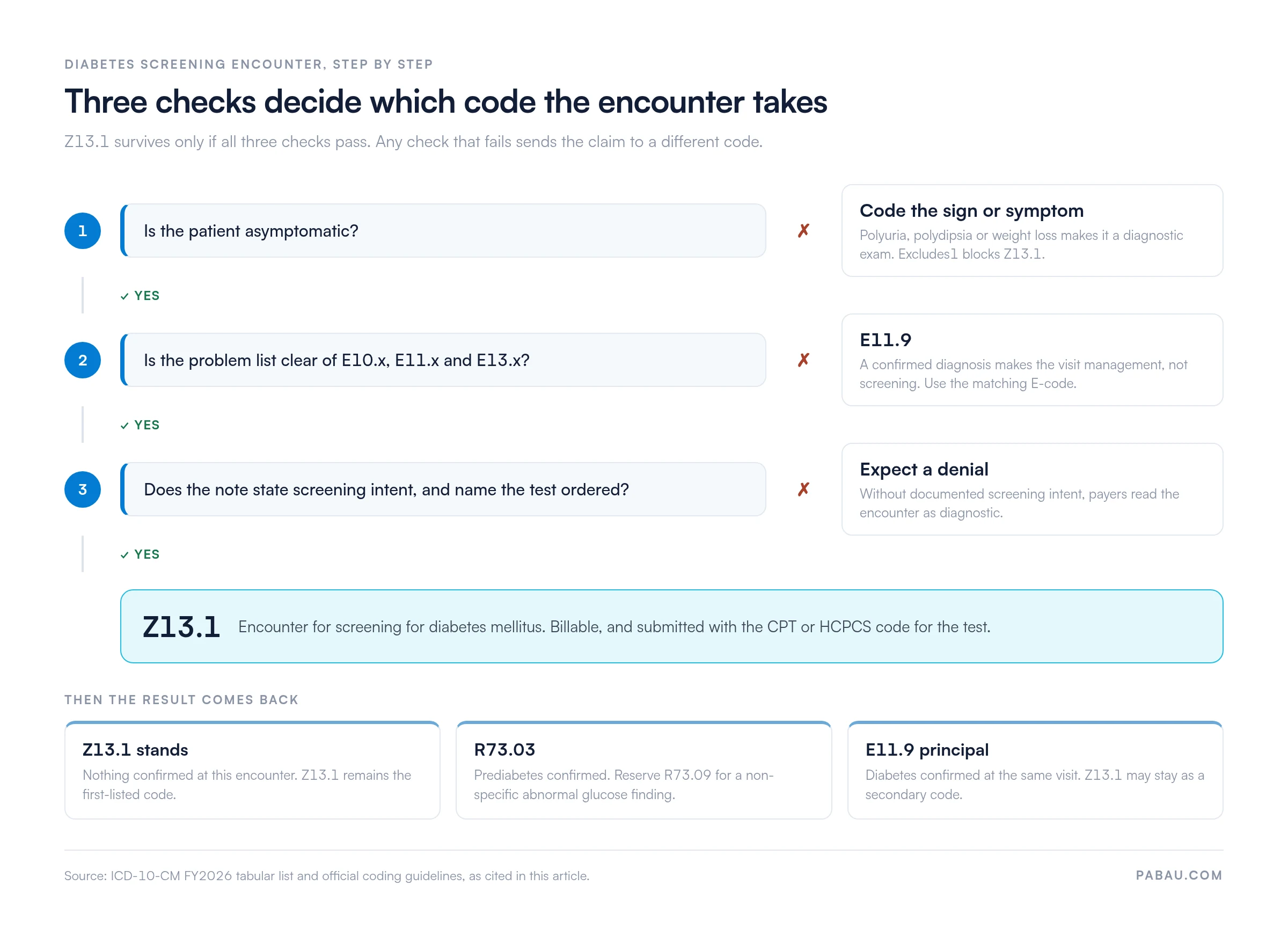
It covers exactly one situation: an asymptomatic patient with no confirmed diabetes diagnosis presenting for a preventive glucose or HbA1c test. The screening intent has to be stated in the note, and the problem list has to be clear of E10.x, E11.x and E13.x.
Once a diabetes diagnosis sits in the record, the encounter becomes management rather than screening, and Z13.1 no longer applies. They also cover the tests that pair with the code and the errors that trigger denials.
Let Pabau's smart automation suggest the right codes, reduce claim denials, and keep your practice compliant—effortlessly.
Automate repetitive tasks and focus on what matters most—your patients.
Reduce coding errors and ensure compliance with the latest regulations.
Clean claims, fewer denials, and faster reimbursements.
Powerful insights and reporting to help your practice thrive.
HIPAA compliant SOC 2 certified GDPR-compliant Trusted by 4,000+ clinics worldwide

ICD-10 Code Z13.1 describes an encounter for screening for diabetes mellitus in an asymptomatic patient with no confirmed diabetes diagnosis.
Z13.1 is a billable ICD-10-CM code effective October 1, 2025 (FY2026) and valid for HIPAA-covered claim submission.
Never use Z13.1 when diabetes is already diagnosed. Switch to E11.9 or the E-code that matches the confirmed type.
Once screening confirms prediabetes, the encounter takes R73.03, and R73.09 is reserved for a non-specific abnormal glucose finding.
Practice management software like Pabau validates ICD-10 entry inside the billing workflow, which cuts Z13.1 coding errors before submission.
ICD-10 Code Z13.1 is the ICD-10-CM diagnosis code for “encounter for screening for diabetes mellitus.” It belongs to the Z13 category, which covers encounters for screening for other disorders. The code describes a preventive, asymptomatic encounter whose explicit purpose is testing for undiagnosed diabetes.
The CDC/NCHS ICD-10-CM tool lists Z13.1 as a billable, specific code for fiscal year 2026. It is valid for HIPAA-covered transactions, with an effective date of October 1, 2025.
Z13.1 carries a fourth character, so it holds specificity that the parent code Z13 does not. That fourth character is what makes it submittable on a claim. It designates one clinical scenario: a patient without a known diabetes diagnosis presenting for a screening test.
The Z13 category also carries an Excludes1 note for diagnostic examinations. If a sign or symptom prompted the test, the coder reports that sign or symptom and no screening code at all.
Z13.1 applies when the encounter has one purpose: screening an asymptomatic patient for diabetes mellitus. The U.S. Preventive Services Task Force recommends screening for prediabetes and type 2 diabetes in adults aged 35 to 70 who are overweight or obese.
That covers a wide slice of the primary care panel, so the code comes up often in annual wellness visits.
Use Z13.1 in the following clinical scenarios:
Z13.1 does not apply when the patient already has a confirmed diabetes diagnosis. It also does not apply to a management or monitoring visit, or to the evaluation of a known elevated glucose. Those encounters take a diagnosis code instead: E11.x for type 2, E10.x for type 1, or R73.09 for a non-specific abnormal glucose finding.
The Z13.1 versus E11.9 decision is the most common source of confusion in diabetes coding. The rule itself is short. Z13.1 covers screening where no diagnosis exists yet, and E11.9 covers a confirmed case of type 2 diabetes. Coders run into trouble when a screening result comes back positive during the same encounter.
When a screening encounter produces a new diabetes diagnosis at the same visit, ICD-10-CM guidelines sequence the confirmed code as principal. Z13.1 may still be reported as an additional code, depending on payer policy. Check the payer’s local coverage determination before you submit.
In practice the decision comes down to three checks, run in order, before the claim goes out.
Incomplete documentation is the leading trigger for Z13.1 denials. The record has to establish that the encounter was a preventive screening visit rather than a diagnostic or management visit.
The following elements must be present in the clinical record to support Z13.1:
Some payers also want the USPSTF Grade B recommendation referenced, or the risk stratification criteria documented explicitly. Review the local coverage determination (LCD) for your Medicare Administrative Contractor before you submit a Z13.1 claim.
Z13.1 is a diagnosis code, so it never travels alone. It is submitted alongside a procedure code describing the screening test performed, and the pairing has to reflect what happened in the encounter.
Payer acceptance of specific pairings varies, so verify against the applicable LCD or national coverage determination (NCD) first.
G0438 and G0439 are HCPCS Level II codes rather than CPT codes. That distinction matters because payer edits often check the two code sets separately. If you are pairing Z13.1 with a G code, confirm the descriptor against the current HCPCS codes list rather than a CPT book.
CPT 82947 and 83036 are the pairings AAPC describes as most common in practice. Payer coverage rules still vary, so confirm them against current LCDs before submission. Not all payers reimburse a standalone HbA1c as a screening test outside Medicare, and some require a two-hour glucose tolerance test instead.
Z13.1 sits inside the Z13 parent category, which covers screening encounters for a range of conditions. Knowing the sibling codes helps coders pick the most precise one and avoid incorrect substitutions. The AAPC ICD-10-CM code lookup lists the full Z13 category with all sibling codes.
Screening for cancer belongs to the neighboring Z12 category rather than Z13. An encounter for bladder cancer screening takes Z12.6, which carries the same asymptomatic requirement. Payers deny it when hematuria is already documented, because that visit is diagnostic.
Z13.1 errors fall into a small number of recurring patterns. Most come from applying the code to management or evaluation visits rather than preventive screening encounters.
Build a pre-submission audit step that flags any Z13.1 claim where the patient also carries an active E11.x or E10.x code. Catching the conflict before the claim leaves the practice is far cheaper than appealing the denial afterward.
ICD-10-CM Official Guidelines for Coding and Reporting govern every Z13.1 claim submitted on or after October 1, 2025. CMS and CDC publish them jointly. The CMS ICD-10 codes page hosts the current tabular list and the guideline documents.
Key guidelines applicable to Z13.1:
Build a simple EHR workflow flag: before submitting any claim with Z13.1 as the primary code, run a check against the patient’s active problem list. If E11.x, E10.x, or E13.x appears anywhere in the active diagnoses, Z13.1 is invalid for that encounter. Most EHR platforms support this type of coding validation alert through their billing module.
Coding accuracy for Z13.1 rests on two things: documentation quality at the point of care, and billing validation before the claim goes out. Both break down when they run on manual handoffs and shared spreadsheets.
Practice management software like Pabau closes the distance between the provider’s note and the biller’s code selection. Its medical claims management tools let ICD-10 entry happen inside the clinical workflow, so the code is chosen while the encounter is still fresh.
Claims carrying Z13.1 are then validated against payer rules before submission, which catches diagnosis conflicts and missing procedure companions.
When Pabau is connected to a clearinghouse such as Claim.MD, that validation runs before the claim ever reaches the payer. For practices screening across several providers or locations, it cuts per-claim review time and keeps documentation standards consistent across the team.

Pabau’s claims management tools help primary care and metabolic health practices submit cleaner ICD-10 claims, track denials, and keep documentation audit-ready. See how it works for your team.

Getting Z13.1 right is less about the code than about what sits around it. The disqualifier lives in the patient’s problem list, not in the order the coder is looking at. A coder reading only the test order sees a screening test and codes it as one.
So the fix is structural rather than educational. A validation rule that checks the active diagnosis list before submission will catch the conflict every time, where a coder’s memory will not. The same rule protects the two codes that take over after the result, R73.03 and E11.9.
Pabau gives primary care and metabolic health practices that validation step inside the billing workflow, along with denial tracking when a claim comes back. Book a demo to see how it handles preventive screening claims for your practice.

Need a reference for managing claims across multiple ICD-10 codes? What is medical billing covers the end-to-end process from code entry to claim payment.
Wondering which test code to pair with a screening encounter? CPT code 83036 covers the HbA1c test most often ordered alongside Z13.1.
Billing a Medicare annual wellness visit with the screening? HCPCS code G0438 explains what the initial wellness visit has to include.
Want to understand how clearinghouse validation reduces denials? Claim.MD vs Office Ally breaks down how clearinghouse options differ for US practices.
Looking for guidance on ICD-10 documentation compliance? Medical billing compliance outlines the documentation and audit requirements for preventive coding encounters.
ICD-10 Code Z13.1 is the diagnosis code for “encounter for screening for diabetes mellitus.” It applies when an asymptomatic patient with no confirmed diabetes diagnosis presents for a preventive screening test. That test is usually a fasting glucose or an HbA1c. Z13.1 is billable and valid for FY2026 HIPAA-covered claims.
Use Z13.1 when the patient has no prior diabetes diagnosis and the encounter purpose is preventive screening. Use E11.9 when type 2 diabetes has already been confirmed. If a screening encounter produces a new diabetes diagnosis at the same visit, E11.9 becomes the principal code.
Yes. Z13.1 is a billable, specific ICD-10-CM code effective October 1, 2025 (FY2026). It is valid for HIPAA-covered electronic transactions. Its fourth character gives it the specificity payers require, provided the documentation supports its use.
CPT 82947 (glucose, quantitative) and 83036 (HbA1c) are the pairings most commonly reported with Z13.1, though payer acceptance varies. For Medicare annual wellness visits, the HCPCS codes G0438 and G0439 may accompany Z13.1. Always verify pairings against the applicable local coverage determination.
Yes, Z13.1 is appropriate when screening for prediabetes before any diagnosis is confirmed. Once prediabetes is confirmed, the encounter takes R73.03 instead. R73.09 is reserved for a non-specific abnormal glucose finding. The USPSTF Grade B recommendation covers screening for prediabetes and type 2 diabetes in adults aged 35 to 70.
No. Z13.1 is strictly for asymptomatic patients with no existing diabetes diagnosis. If a patient has a confirmed diabetes diagnosis in their active problem list, Z13.1 is invalid for any encounter with that patient. Use the appropriate E10.x or E11.x code based on the confirmed diabetes type.