HCPCS Code G0163: Skilled nursing observation and assessment
What is HCPCS Code G0163? HCPCS Code G0163 is a deleted Level II code for skille...

Last Updated: Oct 15, 2026
82270 is the CPT code for blood, occult, by peroxidase activity (eg, guaiac), qualitative; feces, consecutive collected specimens with single determination, for colorectal neoplasm screening. It is the guaiac fecal occult blood test (gFOBT), where the patient collects stool at home on three cards or a single triple card.
One unit of 82270 covers the whole set of cards, billed on the date they are developed and read. Immunoassay tests bill under 82274 or HCPCS G0328, and a guaiac test ordered for symptoms bills 82272.
Let Pabau's smart automation suggest the right codes, reduce claim denials, and keep your practice compliant—effortlessly.
Automate repetitive tasks and focus on what matters most—your patients.
Reduce coding errors and ensure compliance with the latest regulations.
Clean claims, fewer denials, and faster reimbursements.
Powerful insights and reporting to help your practice thrive.
HIPAA compliant SOC 2 certified GDPR-compliant Trusted by 4,000+ clinics worldwide

CPT 82270 covers the guaiac-based qualitative FOBT for colorectal cancer screening. Immunoassay (FIT/iFOBT) tests bill under 82274 or HCPCS G0328 instead.
Medicare covers 82270 once every 12 months for average-risk beneficiaries aged 45-75, with no patient cost-sharing when Z12.11 is the paired ICD-10 code.
82270 is paid under the CMS Clinical Laboratory Fee Schedule, not the Physician Fee Schedule. The performing lab bills the code, not the ordering physician.
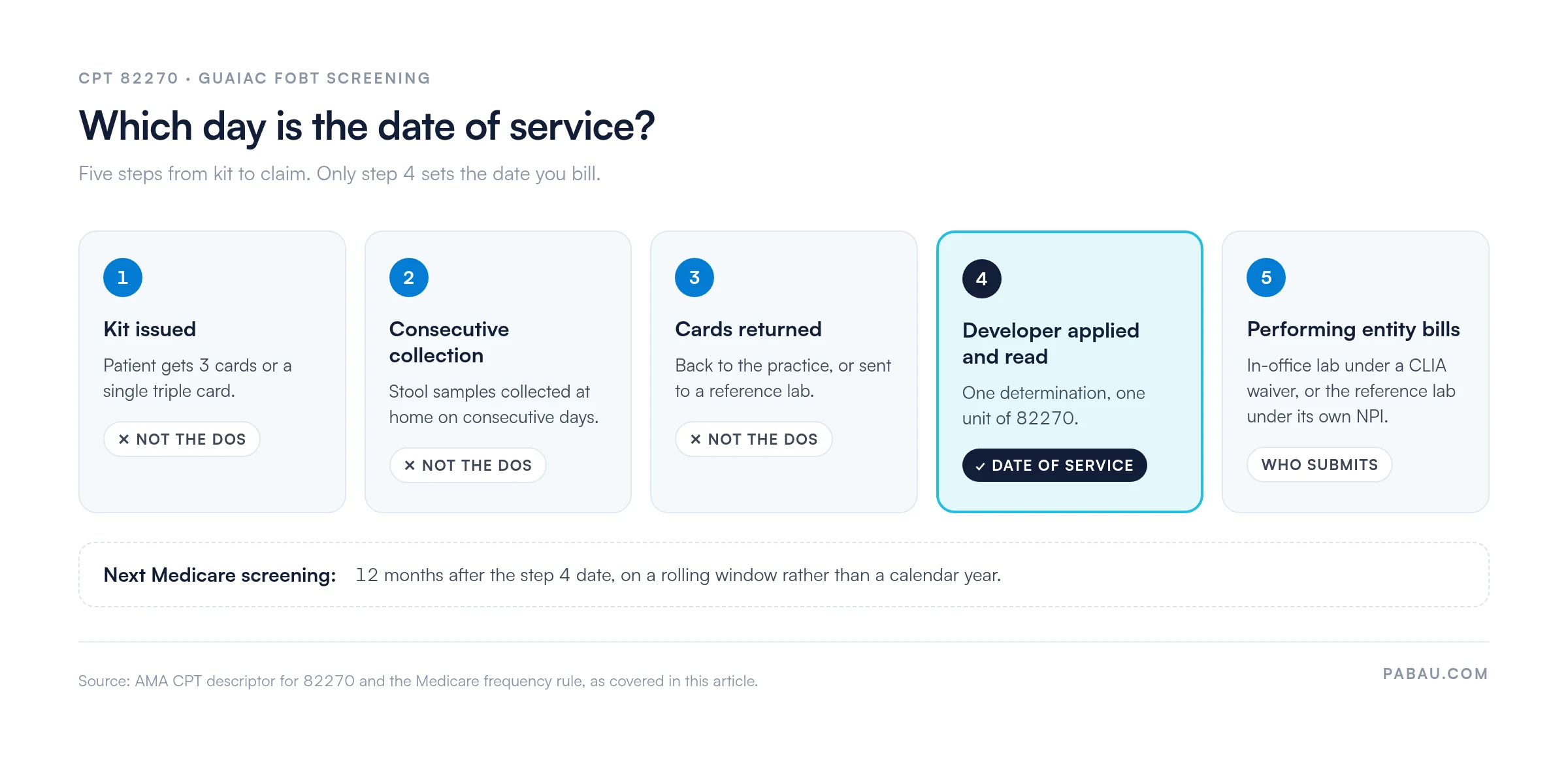
The date of service is the day the cards are developed and read, not the day the kit was issued.
Claims management software like Pabau flags frequency violations and ICD-10 mismatches for 82270 before a claim reaches the clearinghouse.
The American Medical Association descriptor for CPT code 82270 comes in two parts, split at the semicolon. The shared stem reads “Blood, occult, by peroxidase activity (eg, guaiac), qualitative.” The part after the semicolon is specific to 82270:
Feces, consecutive collected specimens with single determination, for colorectal neoplasm screening (ie, patient was provided 3 cards or single triple card for consecutive collection)
The operative terms are guaiac, qualitative, and screening. One determination covers the whole set of cards.
The code sits in the Chemistry Procedures section of the CPT code set. Its neighbors are 82271 (other sources), 82272 (stool testing for reasons other than screening) and the immunoassay sibling 82274. The family matters because payers that have moved their screening coverage to 82274 or G0328 will deny 82270, even when the test is medically appropriate.
CPT 82270 covers guaiac-based qualitative detection of occult blood in feces, using peroxidase activity, for colorectal cancer screening. The patient collects specimens on consecutive days, on three cards or a single triple card.
The code is reported once for that set, because the descriptor calls for a single determination. You do not report it three times for a three-card return.
The table below shows which stool and occult blood tests fall outside 82270, and the code each one takes instead.
The guaiac FOBT workflow starts at the practice and ends at the lab, and billing 82270 correctly depends on documenting both ends of that chain. A patient receives a take-home kit of three cards or a single triple card and collects stool samples on consecutive days. The completed cards go back to the practice or to a reference lab.
The lab (or CLIA-waived in-office facility) applies a developer solution to each card. A color change indicates peroxidase activity and a positive result. For billing, the encounter date is the day the cards are developed and read, as the flow below shows.
Record these six points for every 82270 claim:
82270 and 82274 both describe fecal occult blood tests, but they detect blood through entirely different mechanisms. Using the wrong code for the methodology performed is a payer mismatch denial that cannot be corrected with a modifier.
G0328 is the HCPCS Level II code for immunoassay FOBT. Some Medicare Administrative Contractors route screening immunoassay FOBT claims to G0328 rather than 82274. Always verify the preferred code with the specific payer’s LCD before submitting.
The ICD-10 code you pair with a guaiac stool test decides both the CPT code and the patient’s cost-sharing. An asymptomatic screening test carries Z12.11 and bills 82270. A test ordered because of symptoms carries the symptomatic diagnosis and bills 82272, the non-screening guaiac code.
The screening-diagnostic distinction: Z12.11 triggers the preventive service benefit under ACA Section 2713 and the USPSTF Grade B recommendation for colorectal cancer screening. A patient with no symptoms, aged 45 or older, undergoing routine screening should always carry Z12.11.
Pairing a symptomatic code like K92.1 with 82270 is a coding mismatch. Symptomatic testing bills 82272, and the claim processes as diagnostic, with cost-sharing for the patient.
A patient already treated for colorectal cancer has moved from screening into surveillance, so Z12.11 no longer fits. Serum CEA monitoring bills under CPT 82378 instead, paired with a cancer or personal history diagnosis.
Medicare covers CPT 82270 once every 12 months for average-risk beneficiaries aged 45 to 75. No patient cost-sharing applies when Z12.11 is the primary diagnosis. This coverage expanded from age 50 to age 45 in line with the USPSTF 2021 Grade B recommendation for colorectal cancer screening.
Commercial payers follow ACA Section 2713 for non-grandfathered plans, which mandates first-dollar coverage for preventive services rated Grade B or higher by the USPSTF. Colorectal cancer screening for average-risk adults aged 45 and older qualifies. A symptomatic presentation shifts the encounter to diagnostic, removing the first-dollar protection.
CPT 82270 is a laboratory code reimbursed under the CMS Clinical Laboratory Fee Schedule (CLFS), not the Medicare Physician Fee Schedule (MPFS). This distinction matters for billing responsibility: the performing lab bills 82270, not the ordering physician. If a practice sends guaiac cards to a reference lab, the reference lab submits the claim for 82270 using its own NPI.
The CLFS rate for 82270 has been approximately $4 to $6 in recent years, and CMS updates the fee schedule annually. For the exact 2026 allowable, check the CMS CLFS lookup tool directly, because rates are revised each year.
Site-of-service also affects payment. Hospital outpatient lab settings reimburse differently from independent labs. Independent labs billing under CLIA certification receive the CLFS rate.
Practices performing the test in-office under a CLIA Certificate of Waiver receive the same CLFS rate, provided the waived test kit used is FDA-approved. Reviewing the electronic remittance advice after submission confirms the rate applied and flags any payer-initiated adjustments.
Most CPT 82270 denials fall into six categories, and each one has its own fix. The remark code on the remittance points to the category, so match it against the table below before you rebill. Our reference on medical billing denial codes decodes any remark code outside this list.
Yes, with conditions. If the physician develops a patient-supplied guaiac card during the office visit, 82270 may be billed separately from the evaluation and management (E/M) code. That holds when the visit includes a separately identifiable service.
Append modifier -25 to the E/M to signal the two services are distinct. The developing and reading of the card must be performed by a CLIA-certified entity, which can be the in-office lab under a Certificate of Waiver.
When the patient returns cards from a kit handed out at a prior visit, bill 82270 on the date the cards are read. Billing on the kit-issue date creates a date-of-service mismatch, and the claim denies.
CPT 82270 qualifies as a CLIA-waived test when performed using an FDA-approved waived guaiac card kit. A practice holding a CLIA Certificate of Waiver can perform and bill 82270 in-office without a full moderate- or high-complexity lab certificate. That lets a primary care practice develop cards on-site instead of sending them to a reference lab.
Practices that run in-office CLIA-waived tests like the guaiac FOBT need billing software that catches coding errors before the clearinghouse rejects the claim. Claims management software like Pabau includes a built-in CPT code library with the full descriptor for 82270. Its ICD-10 pairing logic flags symptomatic codes on screening claims, and automated claim scrubbing checks frequency windows before submission.
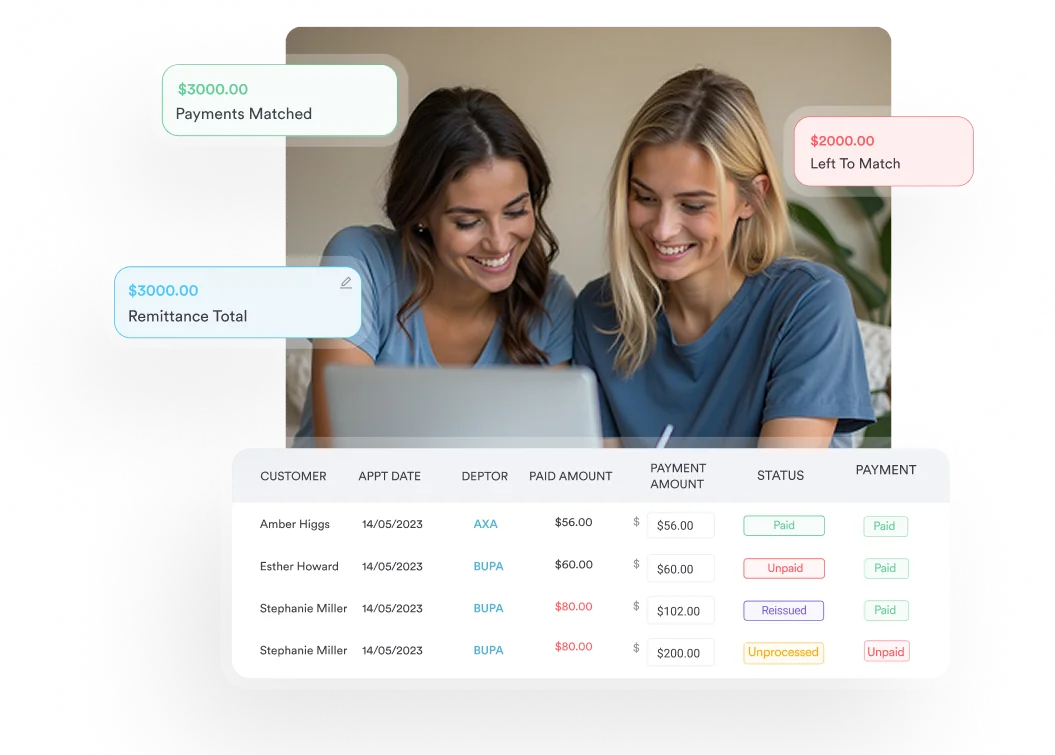
For practices generating superbills after each encounter, Pabau pre-populates CPT and ICD-10 codes from the documented encounter, which cuts manual entry errors. Claims route through the Claim.MD clearinghouse integration, with real-time eligibility checks before the visit.
Payers’ 835 electronic remittance advice files come back into the same system, so your team reconciles payments without re-keying remittance data. The dashboard also shows which 82270 denials recur most often, so you can fix the cause once instead of reworking each claim.
Track the date of each patient’s prior 82270 claim in your practice management system. A quick frequency check before ordering the next FOBT kit saves the write-off that comes from billing inside the 12-month window. Build this into your front-desk pre-visit workflow, not the billing team’s post-denial queue.

Pabau’s CPT code library and claim scrubbing flag frequency violations and ICD-10 mismatches for codes like 82270 before the claim reaches the clearinghouse.

Settle the screening question before the kit leaves the practice. If the patient has symptoms, the test is 82272 and the claim is diagnostic, so 82270 never enters the picture. If they don’t, check the prior FOBT date first, because a claim inside the 12-month window denies whatever the result.
Both checks belong at the front desk, where they stop the frequency and ICD-10 denials in the table above before a claim exists. Book a demo to see how Pabau flags 82270 frequency and ICD-10 conflicts before a claim goes out.

Need to understand how clearinghouse submission works for lab codes? Medical claims clearinghouse guide explains how claims route from EHR to payer and where 82270 fits in that chain.
Struggling with repeated claim rejections? Claim.MD clearinghouse overview covers how Pabau’s clearinghouse partner handles real-time eligibility and ERA processing for lab claims.
Seeing the same denials every month? Denial management in healthcare shows how to trace repeat denials back to their cause and stop the write-offs.
Want fewer rejections on the first pass? What is a clean claim breaks down the fields payers check before they accept a claim for processing.
Billing the colonoscopy side of colorectal screening? HCPCS code G0121 covers Medicare screening colonoscopy for patients who are not at high risk.
CPT code 82270 covers a guaiac fecal occult blood test for colorectal cancer screening, using peroxidase activity and reported qualitatively. The patient collects consecutive specimens on three cards or a single triple card, and one determination covers the set. Immunoassay (FIT) tests, stool DNA tests and symptomatic guaiac testing use separate codes.
82270 uses the guaiac (peroxidase) method and is qualitative; 82274 uses immunoassay technology and can be qualitative or quantitative. The two tests detect occult blood through different chemical mechanisms, so the code follows the methodology performed, not the clinical purpose.
Z12.11 (encounter for screening for malignant neoplasm of colon) is the ICD-10 code for 82270, because the code covers screening only. It triggers first-dollar ACA coverage for average-risk patients. Symptomatic indications such as K92.1 (melena), K92.2 (gastrointestinal hemorrhage, unspecified) or R19.5 (other fecal abnormalities) point to 82272 instead, with cost-sharing.
Yes. Medicare covers 82270 once every 12 months for average-risk beneficiaries aged 45 to 75 with no patient cost-sharing when billed with Z12.11. Coverage extended to age 45 following the USPSTF 2021 Grade B recommendation for colorectal cancer screening.
Once every 12 months under Medicare. This is a rolling 12-month window, not a calendar-year reset. A claim submitted fewer than 12 months after the prior FOBT claim will deny for frequency regardless of clinical indication.
No. G0328 is the HCPCS Level II code for immunoassay (not guaiac) FOBT, used mainly in Medicare billing when the immunoassay method was performed. 82270 is the CPT code for guaiac-based FOBT only. Substituting one for the other constitutes incorrect coding if the methodology documented does not match.