

CCSD code G5100: Bypass of duodenum billing guide
CCSD code G5100 bills a bypass that leaves the duodenum in place CCSD code G5100...

Last Updated: Oct 16, 2026
82172 is the CPT code for apolipoprotein, each. The word "each" sets the unit of service, so one unit covers one distinct apolipoprotein analyte. Ordering Apolipoprotein A-I (Apo A-I) and Apolipoprotein B (Apo B) on the same date bills two units, not one.
The code sits in the Chemistry subsection of Pathology and laboratory, and Medicare prices it on the Clinical Laboratory Fee Schedule. Coverage varies by payer, by the diagnosis code submitted, and by whether a prior lipid panel is on file.
Let Pabau's smart automation suggest the right codes, reduce claim denials, and keep your practice compliant—effortlessly.
Automate repetitive tasks and focus on what matters most—your patients.
Reduce coding errors and ensure compliance with the latest regulations.
Clean claims, fewer denials, and faster reimbursements.
Powerful insights and reporting to help your practice thrive.
HIPAA compliant SOC 2 certified GDPR-compliant Trusted by 4,000+ clinics worldwide

CPT 82172 bills per analyte, so Apo A-I and Apo B on the same date submit as two units.
The code sits in the Chemistry subsection of Pathology and laboratory, and Medicare prices it on the Clinical Laboratory Fee Schedule.
Diagnosis codes that support the test include E78.5, E78.00, E78.01, Z82.49, and I25.10.
Medicare treats some apolipoprotein biomarkers as investigational under CMS article A57055, so check your MAC’s coverage policy first.
Pabau’s claims management software checks membership and authorization details on every claim before it leaves the practice.
CPT code 82172 is a Chemistry procedure code inside the Pathology and laboratory section of the AMA CPT code set. Its official descriptor is Apolipoprotein, each. That word “each” fixes the unit of service, so one unit equals one distinct apolipoprotein analyte tested.
Apolipoproteins are the protein components of lipoprotein particles. They control how lipids travel through the blood, how quickly they clear, and where they settle in arterial walls. Measuring them gives a clinician a sharper cardiovascular risk picture than a lipid panel on its own.
The reference details billers reach for most often sit in the table below.
Apolipoprotein A-I (Apo A-I) is the main structural protein of HDL particles, and higher levels track with reverse cholesterol transport and lower atherosclerotic risk. Apolipoprotein B (Apo B) rides on every atherogenic particle, including LDL, VLDL, and IDL.
Each LDL particle carries exactly one Apo B molecule. An Apo B concentration therefore works as a direct count of atherogenic particles, which several guidelines treat as a sharper risk marker than calculated LDL-C.
Both analytes bill under CPT 82172, one unit apiece. Neither belongs to CPT 80061, the standard lipid panel, which covers total cholesterol, HDL-C, and triglycerides. Ordering 82172 alongside 80061 holds up at the payer when the record explains what the particle-level data adds.
None of the codes below absorbs 82172, and each covers a distinct analyte or panel. Mixing them up is one of the steadiest sources of claim error in cardiovascular risk billing. Read the table before you assume a bundling edit applies.
Ordering a lipid panel (CPT 80061) and apolipoprotein testing (CPT 82172) on the same date? Document why the particle-level data is needed beyond the panel result. Payers look for distinct clinical rationale for each test, not one blanket cardiovascular workup order.
Submit CPT 82172 without a covered diagnosis and the claim comes back as a medical-necessity denial. The codes below are the ones commercial and Medicare payers accept most consistently with apolipoprotein testing.
Map each order to the most specific diagnosis the encounter note supports. Our ICD-10-CM codes hub holds the wider set, and the CMS ICD-10-CM code set carries the official tabular list.
CPT code 82172 is priced under the Medicare Clinical Laboratory Fee Schedule (CLFS), not the Physician Fee Schedule. CLFS rates update annually and vary by Medicare Administrative Contractor jurisdiction.
The 2026 national limitation amount for 82172 runs roughly $19 to $22 per unit, and your local allowable depends on the jurisdiction adjustment.
Because 82172 carries no RVUs, an RVU lookup tool says nothing useful about it. Work from the current year’s CLFS data file instead. CMS publishes it on the clinical laboratory fee schedule page each fall, for the calendar year ahead. Third-party fee aggregators are fine for a rough estimate and unsafe as a billing decision.
Put a quarterly CLFS review in the billing calendar so a stale rate never sits in your fee file.
Medicare sets its position locally. CMS article A57055 (Biomarkers in Cardiovascular Risk Assessment) separates apolipoprotein biomarkers with enough clinical evidence to cover from those it still treats as investigational. Check whether a Local Coverage Determination applies in your MAC jurisdiction before you submit.
Commercial positions vary just as widely, and they vary by diagnosis inside a single plan. Run the benefits check before the specimen is drawn, not after the denial lands.
A medical-necessity denial on 82172 usually traces to a record that is thin rather than missing. Picture the reviewer opening the chart. They are looking for one answer. Why did this patient need an apolipoprotein measurement on this date, given the lipid results already on file?
Take a familial hypercholesterolemia follow-up as an example. The note carries E78.01, the prior LDL-C value, and the current statin dose. One line says Apo B is being used to judge residual particle burden. That record answers the reviewer’s question before it is asked.
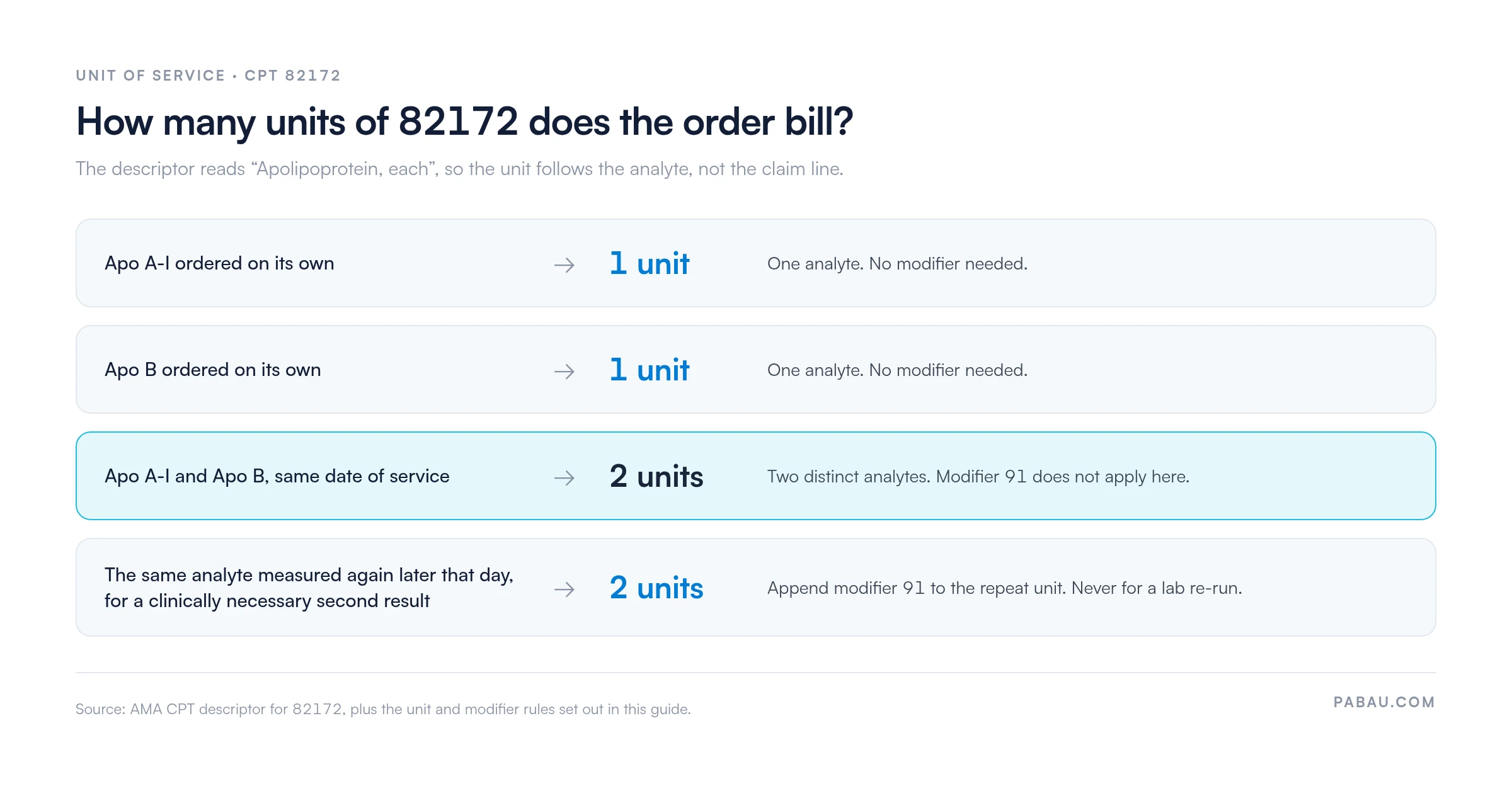
Submit one unit of CPT code 82172 for each distinct apolipoprotein analyte tested on that date of service. Two analytes on the same day means two units. Your billing system may put them on one claim line with a quantity of two, or on two lines of one unit each. Either shape is fine, as long as the total matches the requisition.
The chart below walks through the four orders that come up most, and what each one bills.
For practices submitting lab claims at volume, five checks catch nearly every avoidable rejection. Run them before the claim leaves the building.
A validated CPT code lookup confirms current NCCI edit pairs and payer-specific rules before submission.
Apolipoprotein claims fail more often than routine chemistry codes, because payer policy on cardiovascular biomarkers is less standardized than policy on lipid panels. Match the reason code on the remittance to the fix below before you appeal, since the approach changes with the reason.
Where the same reason code keeps returning, treat it as a process problem rather than a run of bad luck. A structured denial management routine is what turns a repeat denial into a fixed workflow.
Pull a 90-day denial report filtered to CPT 82172 and sort it by CARC code. When more than 20% of denials carry the same CARC, that is a systemic billing error rather than an outlier. Fix the cause at order entry or claim generation, instead of appealing each claim one at a time.
An incomplete lab claim tends to get caught after the payer sends it back. The biller reopens the encounter, tracks down the missing membership number or authorization code, corrects it, and resubmits. Two weeks of the payment cycle have gone by then.
Practice management software like Pabau moves that check to the front of the process. Pabau’s claims management software validates the administrative side of each claim before submission. Membership numbers and authorization codes are checked and formatted before the claim reaches your clearinghouse.
That check is administrative, not clinical. Pabau does not re-read your ICD-10 pairings or judge your unit counts, so the coding and documentation work in this guide stays with your team. Claims route through Claim.MD in the US, and through the regional clearinghouse in other markets.
The outcome is fewer round trips. A lab claim that leaves administratively complete gets judged on its clinical merits, instead of bouncing back on a blank field.
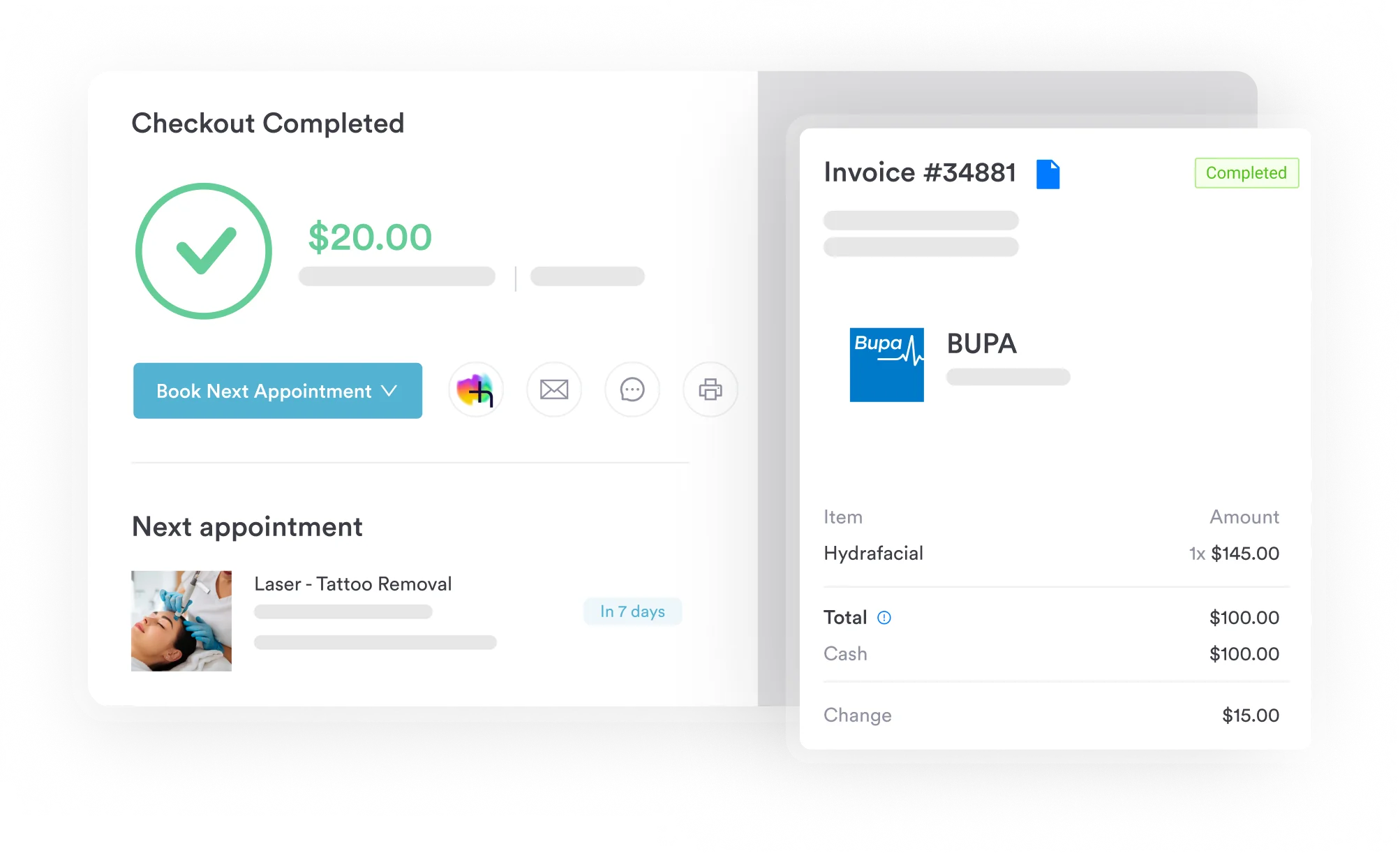

Pabau’s claims management software checks membership and authorization details on every claim before submission. Your lab claims then reach the clearinghouse with the administrative fields filled in.

CPT code 82172 is simple to describe and easy to bill wrong. The per-analyte unit rule, the payer-specific medical-necessity tests, and the NCCI edits around lipid panel codes each open their own route to a denial.
Pick one of them to fix first. For most billing teams that is the unit count, because it is the cheapest to automate and the easiest to spot on a remittance report. Work the diagnosis mapping next, then the prior-authorization check at order entry.
Book a demo to see how Pabau checks the administrative side of a lab claim before it reaches your payer.

Need a template to justify a borderline apolipoprotein order? Medical necessity letter template lays out the diagnosis, ICD-10, and clinical-justification fields a payer expects to see.
Confirming a plan’s prior authorization rule before the draw? The prior authorization process walks through the five-step workflow and the CMS turnaround ceilings that apply.
Running the benefits check before the specimen leaves for the lab? Insurance eligibility verification covers what to confirm about coverage before you order.
Want 82172 claims to clear the payer on the first pass? What is a clean claim in medical billing sets out the scrubbing checklist behind HFMA’s 98% clean-claim target.
No. CPT carries no code for a calculated ratio. Bill one unit of 82172 for Apo B and one for Apo A-I, then report the ratio in the result narrative. A third unit for the calculation will be denied.
No. ApoE genotyping is a molecular test, reported with CPT 81401 rather than 82172. Code 82172 covers a quantitative protein measurement in serum or plasma. The two answer different clinical questions, so read the order before you code it.
Hospital outpatient labs usually report 82172 under revenue code 0301, the chemistry line inside the 030X laboratory series. Offices billing on the CMS-1500 use no revenue code at all. Confirm the mapping against your facility’s chargemaster before you submit.
Name each analyte on the requisition. An order reading only “apolipoprotein” leaves the lab to guess, and a single-analyte result cannot support two units. Writing “Apo A-I and Apo B” gives the biller the evidence for the second unit.
Yes. The lab that performs the assay reports 82172, and the practice that draws the specimen reports the collection code. Only one party reports the test itself, so agree the split before the account opens.



