

Pabau Engage inbox

Pabau Engage is here: every patient conversation in one inbox.

Learn more
CPT Code

CPT code 82248 – Direct bilirubin measurement


Code Definition

82248 is the CPT code for bilirubin; direct. It reports a laboratory measurement of the conjugated bilirubin fraction in serum or plasma.

Most denials on this code trace back to two mistakes. Coders bill it when a hepatic function panel already includes it, or swap it with its neighbor, CPT 82247 (total bilirubin). The documentation requirement is straightforward, but payers look hard at medical necessity. That makes ICD-10 linkage and physician-order language critical. This guide covers the official descriptor, the 2026 Medicare fee schedule, NCCI bundling edits, supported ICD-10 codes, and the most common denial patterns.

Section
80047-89398 Pathology and laboratory
Subsection
82009-84999 Chemistry
Code range
Bilirubin: 82247, 82248
Billable
No
Code also known as
conjugated bilirubin test, direct-reacting bilirubin, serum direct bilirubin
Save time. Improve accuracy. Get paid faster.
Automate coding with Pabau

Let Pabau's smart automation suggest the right codes, reduce claim denials, and keep your practice compliant—effortlessly.

  • AI-powered code suggestions
  • Real-time compliance checks
  • Faster claims, fewer denials
Why practices choose Pabau
Save hours every week

Automate repetitive tasks and focus on what matters most—your patients.

Improve accuracy

Reduce coding errors and ensure compliance with the latest regulations.

Get paid faster

Clean claims, fewer denials, and faster reimbursements.

Grow with confidence

Powerful insights and reporting to help your practice thrive.

HIPAA compliant SOC 2 certified GDPR-compliant Trusted by 4,000+ clinics worldwide

Key takeaways

Key takeaways

CPT code 82248 reports direct (conjugated) bilirubin, a separate measurement from total bilirubin code 82247.

Both 82247 and 82248 are required components of CPT 80076. Neither is billed separately when the hepatic function panel is on the same claim, unless a documented modifier applies.

The most common denial cause is a missing or mismatched ICD-10 code. R17, P59.x and K70.x are the leading supporting diagnoses.

Pabau builds each claim from the invoice, validates it and submits it through Claim.MD, so coding errors surface before the payer sees them.

CPT code 82248: Official descriptor and clinical overview

CPT code 82248 carries the official AMA CPT descriptor: Bilirubin; direct. It belongs to the Chemistry subsection of the Pathology and Laboratory section (CPT range 80047-89398). The hepatic function panel (CPT 80076) already includes it, so 82248 is billed on its own only when that panel is not on the claim.

Bilirubin is produced when red blood cells break down. The liver conjugates (makes water-soluble) the unconjugated fraction and excretes it as bile. Direct bilirubin measures only the conjugated portion.

An elevated direct fraction points to hepatic or post-hepatic obstruction rather than pre-hepatic hemolysis. That is why ordering it alongside or instead of total bilirubin changes the clinical picture.

Code detailValue
Official descriptorBilirubin; direct
CPT sectionPathology and Laboratory / Chemistry
Test typeQuantitative serum chemistry
Neighbor code82247 (Bilirubin; total)
Specimen typeSerum or plasma
CLIA complexityModerate complexity (not typically CLIA-waived)

Clinical indications: When is CPT 82248 ordered?

Direct bilirubin is ordered when a clinician suspects cholestatic jaundice, hepatocellular disease, or neonatal hyperbilirubinemia, and needs to distinguish the conjugated fraction from total bilirubin. Medical necessity is the gating issue for payers, so the order must document which clinical question the test answers.

  • Neonatal jaundice (P59.x): The highest-volume use case. In physiologic newborn jaundice the unconjugated fraction predominates. An elevated direct fraction instead signals biliary atresia or neonatal hepatitis, which needs urgent workup.
  • Cholestasis and biliary obstruction (K83.1, K80.x): Direct bilirubin rises disproportionately when bile flow is blocked by stones, strictures, or primary biliary cholangitis.
  • Hepatocellular disease (K70.x, K74.x): Alcoholic liver disease, cirrhosis, and viral hepatitis elevate both fractions, but tracking the direct component helps stage severity.
  • Jaundice, unspecified (R17): When the cause has not yet been established, R17 supports initial workup including 82248.
  • Post-liver-transplant monitoring: Graft rejection and biliary complications elevate direct bilirubin before total bilirubin changes significantly.

82247 vs 82248: Total vs direct bilirubin differences

Confusing 82247 and 82248 is the most common coding error on bilirubin claims. According to AAPC Codify, the two codes are adjacent in the Chemistry subsection but measure different fractions.

FeatureCPT 82247 (Total bilirubin)CPT 82248 (Direct bilirubin)
What it measuresUnconjugated + conjugated bilirubin combinedConjugated (direct-reacting) bilirubin only
Clinical useFirst-line screen for jaundice and hemolysisDifferentiates cholestatic from hemolytic jaundice
Included in 80076 panel?Yes, a required panel componentYes, a required panel component, same as total bilirubin.
Can be billed together?Yes, when both fractions are separately medically necessaryYes, subject to NCCI edits and documentation
Primary denial riskRedundant billing when 80076 is already on the claimRedundant billing with 80076, a missing ICD-10 code, or a mix-up with 82247

When a physician orders both total and direct bilirubin on the same date, both codes may be billed. Each one needs a distinct clinical justification in the order and the chart note. Payers may request documentation showing the direct fraction was clinically necessary beyond the total alone.

Bundling rules and NCCI edits

Bundling conflicts on CPT 82248 come from the hepatic function panel. CPT 80076 includes total bilirubin (82247) and direct bilirubin (82248) as required components. Payers therefore treat direct bilirubin as separately reportable only when the panel is not on the same claim.

  • CPT 80076 (Hepatic function panel): The panel includes total bilirubin (82247) and direct bilirubin (82248) as required components. Neither code is billed alongside 80076 for the same test. Verify against the current NCCI table before billing, because edit pairs change quarterly.
  • Unbundling risk: Billing 82247 or 82248 separately when 80076 is already on the claim triggers an NCCI edit, because both are defined panel components. MAC policies vary, so check your contractor’s guidance too.
  • Modifier 59 / XU: When direct bilirubin serves a separate clinical purpose from the panel, a modifier can override the edit. Use 59 (distinct procedural service) or XU (unusual non-overlapping service). The documentation must support that separate purpose. A same-day repeat for new clinical circumstances takes modifier 91 instead.

Put together, the panel check comes first and the physician order second, as the decision below shows.
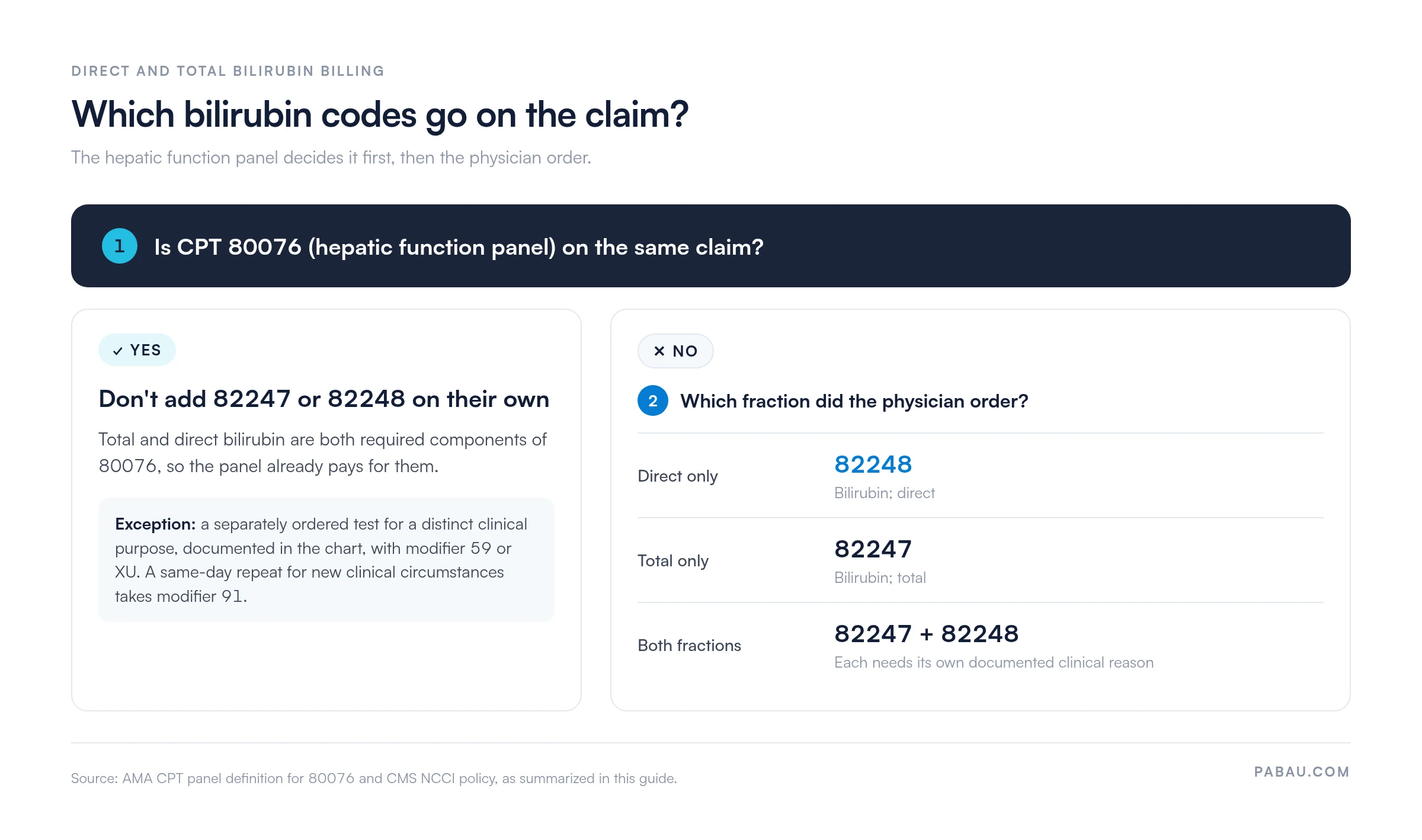
Decision diagram for bilirubin codes.
A hepatic function panel on the claim absorbs both bilirubin codes, so the order only decides the code when 80076 is absent. Based on the AMA CPT definition of 80076 and CMS NCCI policy.

Pro Tip

Check the current CMS NCCI Policy Manual quarterly before filing 82248 alongside any panel code. Edit pairs are published at cms.gov and change on January 1, April 1, July 1, and October 1. An edit that blocked a claim last quarter may be gone from the next table version.

ICD-10 codes that support medical necessity

Per the CDC/NCHS ICD-10-CM web tool, these are the most payer-accepted diagnosis codes paired with CPT code 82248. The code must be documented in the physician order and the visit note before the claim is filed.

ICD-10-CM codeDescriptionClinical context
R17Unspecified jaundiceFirst-line workup when cause is unknown
P59.0Neonatal jaundice associated with preterm deliveryPremature neonates with hyperbilirubinemia
P59.9Neonatal jaundice, unspecifiedNewborn serum bilirubin monitoring
K83.1Obstruction of bile ductCholestatic jaundice from biliary blockage
K70.10Alcoholic hepatitis without ascitesHepatocellular injury staging
K74.60Unspecified cirrhosis of liverChronic liver disease monitoring
K80.20Calculus of gallbladder without cholecystitis, without obstructionGallstone-related cholestasis workup

When the cause of jaundice is still unknown, R17 is usually the first diagnosis on the claim. ICD-10-CM codes are updated annually on October 1. Verify each code against the current fiscal year’s release before linking it to an 82248 claim. Retired or revised codes are the second-most-common cause of medical necessity denials.

LCD and payer coverage criteria

Medicare does not maintain a single national coverage determination (NCD) specifically for direct bilirubin testing. Coverage is governed by Local Coverage Determinations (LCDs) issued by each Medicare Administrative Contractor (MAC), which means criteria vary by region.

Pair the LCD text with a medical claims clearinghouse that checks eligibility and validates the claim before it reaches the MAC.

  • Documentation the LCD typically requires: A signed physician order that states the clinical indication, plus a diagnosis code matching a covered indication in the LCD. The laboratory report stays in the patient record for a minimum of five years.
  • Advance Beneficiary Notice (ABN): Issue an ABN before the test when the clinical indication is borderline, such as routine screening without active liver disease symptoms. Without it, the practice absorbs a denial without the ability to bill the patient.
  • Frequency limits: Some MACs cap bilirubin testing frequency for stable chronic liver disease patients. Check the applicable MAC’s LCD article for frequency language before billing serial 82248 tests.
  • Commercial payer variation: Most major commercial payers follow CMS coverage principles for direct bilirubin but may apply stricter diagnosis linkage requirements. Pre-authorization is generally not required, but prior-auth portals vary by plan.

2026 Medicare reimbursement and fee schedule

Direct bilirubin testing is reimbursed under the Clinical Laboratory Fee Schedule (CLFS), not the Medicare Physician Fee Schedule (MPFS). It is a laboratory test rather than a physician service. The CMS Physician Fee Schedule lookup tool confirms CLFS-only pricing for chemistry codes in this range.

Pull the current year’s CLFS from the official CMS.gov publication for exact rates by MAC jurisdiction, because rates are adjusted annually.

Rate typeGoverning scheduleNotes
National limitation amountCMS Clinical Laboratory Fee Schedule (CLFS)Typically under $10; verify exact rate at cms.gov/medicare/billing/clinical-laboratory-fee-schedule
Place of service impactCLFS rates are site-neutral for laboratory servicesHospital outpatient and independent lab rates may differ under OPPS
Modifier 26 / TC splitNot applicable for independent labsWhen a physician practice interprets a lab result performed elsewhere, modifier 26 separates the professional component
CLFS annual updateJanuary 1 each yearPull current rates from the CMS CLFS data file, not third-party fee databases

Modifiers and when to append them

Most 82248 claims are filed without a modifier when performed by an independent or physician-office laboratory. Modifiers become necessary in specific billing scenarios where the claim would otherwise be misread by the payer.

  • Modifier 26 (Professional component): Append when the physician interprets the bilirubin result from an external lab and bills only for professional review. Do not append when the same practice performed and interpreted the test.
  • Modifier TC (Technical component): Append when the laboratory performs the test but the interpretation is billed separately by the ordering physician. Uncommon for routine chemistry panels.
  • Modifier 91 (Repeat clinical diagnostic laboratory test): Append when new clinical circumstances require a repeat direct bilirubin on the same date of service. The AMA and CMS define modifier 91 usage narrowly: the repeat test must be medically necessary and not performed to confirm an initial result. Do not use modifier 91 for equipment failure or repeated sampling for non-clinical reasons.
  • Modifier QW (CLIA-waived): Direct bilirubin testing is generally classified as moderate complexity and is not on the current CLIA-waived test list. Appending QW without confirmation of CLIA-waived status on the specific analyzer used will trigger a compliance audit. Verify the analyzer’s CLIA classification before applying this modifier.

Common denial reasons and how to fix them

Understanding denial management in healthcare starts with knowing which CARC and RARC codes correspond to specific root causes. The table below maps the most frequent 82248 denial patterns to corrective actions.

Denial reasonTypical CARCCorrective action
Missing or unsupported ICD-10 codeCARC 5 / RARC M19Link 82248 to a covered diagnosis from the LCD list; correct the ICD-10 code in the chart and refile
NCCI bundling conflict (82247 + 82248 same DOS)CARC 97Confirm each fraction is separately documented as medically necessary; add modifier 59/XU if applicable and appeal
82247 or 82248 billed separately with 80076CARC 97 / RARC N519If 80076 is on the claim, remove the standalone 82247 and 82248. Keep either one only with a documented separate purpose and the right modifier.
No ABN on file for non-covered indicationCARC 50Cannot appeal without an ABN; improve front-end process to issue ABNs before borderline tests
Frequency limit exceededCARC 119Review MAC LCD for frequency language; if medically necessary, appeal with clinical documentation explaining why serial testing was required
Incorrect code (82248 filed instead of 82247)CARC 4Verify original order specifies direct vs total bilirubin; file a corrected claim with the right code

Our reference to CARC and RARC codes maps each denial code to its appeal pathway.

Documentation requirements for direct bilirubin billing

A well-documented claim for CPT code 82248 needs four elements in the patient record. Missing any one of them gives a payer a path to deny on medical necessity grounds without reviewing the clinical merit of the test.

  • Signed physician order: The order must specify “direct bilirubin” or “conjugated bilirubin,” not just “bilirubin panel.” A generic order for “liver function tests” without specifying the direct fraction creates ambiguity that auditors exploit.
  • Clinical indication in the chart note: The visit note or progress note must document the symptom or condition that prompted the test. “Jaundice with suspected cholestasis, ordering direct bilirubin to differentiate fraction” is sufficient. “Ordered per patient request” is not.
  • ICD-10 code linking test to condition: The diagnosis code on the claim must correspond to the indication documented in the note. A code of R17 on the claim paired with a chart note that only discusses hypertension will not survive a request for records.
  • Laboratory report retention: The result report from the performing laboratory must be retained in the patient record. Most MAC guidance and state law require a minimum of 5 to 7 years depending on jurisdiction.

Building a clean claim from the order stage rather than the billing stage is the most reliable way to prevent 82248 denials. Practices that embed ICD-10 validation into their ordering workflow catch mismatches before the encounter closes.

Billing direct bilirubin for neonatal jaundice

Neonatal hyperbilirubinemia is the highest-volume clinical indication for CPT code 82248 in hospital and outpatient laboratory settings. Billing for newborn direct bilirubin carries some additional nuances that do not apply in adult hepatology.

  • ICD-10 code selection: Use P59.x codes for neonatal jaundice specifically. P59.0 covers preterm-associated jaundice; P59.9 is the default for unspecified neonatal jaundice. Do not use R17 (jaundice, unspecified) as the primary code for a newborn. Payers expect age-appropriate neonatal diagnosis codes.
  • Place of service: Neonatal testing typically occurs in hospital-based labs (POS 21 or 22). Independent labs billing for serum bilirubin drawn in a hospital NICU must confirm the claim carries the correct POS code. The billing provider also needs the appropriate hospital lab agreement in place.
  • Transcutaneous vs serum bilirubin: Transcutaneous bilirubin measurement is reported with CPT 88720 (bilirubin, total, transcutaneous), not 82248. CPT 82248 applies only to serum or plasma direct bilirubin measured in the laboratory. Billing 82248 for a transcutaneous device reading is incorrect and will not survive an audit.
  • Repeat testing frequency: Neonatal hyperbilirubinemia protocols commonly require serial daily or twice-daily serum bilirubin measurements. Modifier 91 applies when the same code is billed multiple times on the same date of service due to clinical necessity. Each repeat must be individually documented in the nursing or physician progress notes.

Pro Tip

For NICU billing, check your MAC’s LCD to see whether neonatal direct bilirubin monitoring meets its covered-indication criteria. Also confirm whether serial testing beyond the initial workup needs an ABN. Some MACs distinguish between therapeutic monitoring and diagnostic testing in their coverage language.

How claims management software prevents CPT 82248 denials

On many lab claims, bundling and diagnosis errors only surface once the denial arrives. Someone reads the remittance, works out which panel absorbed the bilirubin code, and refiles by hand.

In Pabau, the practice management platform we build, the claim starts from the invoice that already exists. CPT and ICD-10 catalogs sit inside the invoice, so the 82248 line and its supporting diagnosis are chosen together. The claim is validated, then submitted to thousands of US payers through our Claim.MD integration.

Eligibility runs from the client card and returns a full benefit report, so the front desk knows the patient’s coverage before the draw. ERAs settle the claim automatically.

When a payer does deny, the CARC reason sits on the claim with its full history, ready for a corrected claim or an appeal. That is the job Pabau’s claims management software does for lab billing.

Stop chasing lab claim denials manually

Pabau builds each 82248 claim from the invoice, validates it, and submits it through Claim.MD, so bundling and diagnosis errors surface before a denial lands.

Pabau claims management dashboard

Conclusion

CPT code 82248 is a simple test to bill and an easy one to lose money on. Denials here rarely turn on clinical doubt. They come from a missing diagnosis link, a hepatic panel already on the claim, or a modifier the chart cannot support.

So fix the order rather than the claim. A physician order that names the direct fraction and its reason, checked against the panel before submission, removes most of the risk on this code. The cost is a few extra seconds at ordering, paid back every time an appeal is not needed.

Book a demo to see how Pabau builds, validates and submits lab claims like 82248 straight from the invoice.

Continue your research

Continue your research

Need to understand how clearinghouse submissions work end to end? 837 electronic claim file guide explains how lab claims move from the practice to the payer.

Seeing repeated eligibility-related denials on lab claims? Insurance eligibility verification covers how real-time eligibility checks prevent preventable claim rejections.

Want a plain-English overview of the billing compliance rules that govern lab testing? Medical billing compliance guide covers ABN requirements, CLIA rules, and audit-readiness for laboratory claims.

Frequently asked questions

What does CPT code 82248 cover?

CPT code 82248 covers a quantitative serum measurement of direct (conjugated) bilirubin, the portion of bilirubin already processed by the liver. It does not include total bilirubin (CPT 82247) or any panel that reports both fractions together.

What is the difference between CPT 82247 and 82248?

CPT 82247 measures total bilirubin (both unconjugated and conjugated fractions combined), while CPT 82248 measures only the direct (conjugated) fraction. Both are required components of the hepatic function panel (80076), so neither is billed separately when the panel is on the same claim.

Can CPT 82247 and 82248 be billed together on the same date of service?

Yes, when both total and direct bilirubin are separately ordered and each fraction has a documented clinical reason. The chart must show why the physician needed both values, not simply that the analyzer ran both. Payers may request records to confirm separate medical necessity.

What ICD-10 codes support medical necessity for 82248?

The most accepted supporting diagnoses are R17 (jaundice, unspecified), P59.0 and P59.9 (neonatal jaundice), and K83.1 (bile duct obstruction). K70.x and K74.x codes cover alcoholic liver disease and cirrhosis. The diagnosis code on the claim must match the clinical indication documented in the physician’s order and chart note.

Why is CPT 82248 being denied by my payer?

The most common cause is a missing or unsupported ICD-10 code (CARC 5). Next come NCCI bundling conflicts when 82247 or 80076 is also on the claim (CARC 97). The third is a missing ABN when the indication does not meet LCD coverage criteria (CARC 50). Review the remittance advice CARC and RARC codes first to identify the specific denial reason before filing an appeal.

What modifiers are used with CPT code 82248?

Modifier 26 separates the professional component when a physician interprets an externally performed result. Modifier 91 applies when a repeat direct bilirubin is medically necessary on the same date of service. Modifier 59 or XU resolves NCCI edit conflicts when separate medical necessity is documented. Modifier QW is generally not applicable because direct bilirubin is a moderate-complexity test, not a CLIA-waived procedure.

Is a hepatic function panel (80076) inclusive of CPT 82248?

Yes, 80076 requires both total (82247) and direct (82248) bilirubin as named components. With the panel on the claim, bill 82248 separately only for a documented distinct purpose with the right modifier. Verify against the current NCCI table, as edit pairs are updated quarterly.


Avatar photo
Anja Dodevska
Content Writer

Anja Dodevska writes about healthcare, dermatology, and the day-to-day realities of running a medical practice for Pabau. She enjoys breaking down complex topics into clear, accessible content and has a soft spot for the often-overlooked aspects of clinic life. When she's not writing, she's exploring cafes, walking her dog, or spending time with friends and family.
×

