

HCPCS Code Q4175: Billing, coverage, and documentation guide
HCPCS Code Q4175: Code Description and Product Identity HCPCS Code Q4175 is the ...

Last Updated: Nov 20, 2026
82077 is the CPT code for alcohol (ethanol) testing by immunoassay or enzymatic method on any specimen except urine and breath. The specimen can be serum, plasma, whole blood, or saliva. The method can be an immunoassay such as EIA or EMIT, or an enzymatic method such as alcohol dehydrogenase.
The AMA added the code on January 1, 2021. Coders often swap it with CPT 82075, the breath alcohol code, or report it for a gas chromatography result that belongs under 80320. Both errors trigger avoidable denials. The code sits in the Chemistry subsection of the CPT code set (82009-84999), and Medicare pays it under the Clinical Laboratory Fee Schedule.
Let Pabau's smart automation suggest the right codes, reduce claim denials, and keep your practice compliant—effortlessly.
Automate repetitive tasks and focus on what matters most—your patients.
Reduce coding errors and ensure compliance with the latest regulations.
Clean claims, fewer denials, and faster reimbursements.
Powerful insights and reporting to help your practice thrive.
HIPAA compliant SOC 2 certified GDPR-compliant Trusted by 4,000+ clinics worldwide

CPT code 82077 reports ethanol testing by immunoassay or enzymatic method on any specimen except urine and breath, such as serum, plasma, blood, or saliva
The method sets the code: breath alcohol is 82075, and a definitive method such as gas chromatography is 80320
Medicare pays 82077 under the Clinical Laboratory Fee Schedule, and the chart must carry a diagnosis that supports the test
Record the specimen type and the test method on every requisition, because both decide whether 82077 is the right code
CPT code 82077 is the billing code for an ethanol test run by immunoassay or an enzymatic method on any specimen except urine and breath. The AMA added it to the CPT code set on January 1, 2021. CMS’s CY 2021 CLFS update confirms it as a new code for that year, priced at the same rate as immunoassay code 83520. The official descriptor follows. Alcohol (ethanol); any specimen except urine and breath, immunoassay (eg, IA, EIA, ELISA, RIA, EMIT, FPIA) and enzymatic methods (eg, alcohol dehydrogenase).
Two conditions have to hold for 82077 to fit. The specimen is serum, plasma, whole blood, saliva, or another fluid that is not urine or breath. The lab runs the test by immunoassay or by an enzymatic method such as alcohol dehydrogenase. According to the AMA’s CPT code set overview, the code you report must match the service as performed. Therefore, for 82077, the analyte, the specimen, and the method all have to match.
CPT 82075 is the breath code, and CPT 82077 covers immunoassay or enzymatic testing on almost any other specimen. Both codes measure the same analyte. Billing one when the other was performed is one of the most common errors on alcohol testing claims.
Urine is outside both codes. A urine ethanol screen by immunoassay or enzymatic method is a presumptive drug test, reported with 80305-80307. Older references also list CPT 82055, but the AMA deleted that code on January 1, 2015, so it is no longer reportable. The chart below lines up all five codes by specimen and method, so a requisition can be matched in one pass.
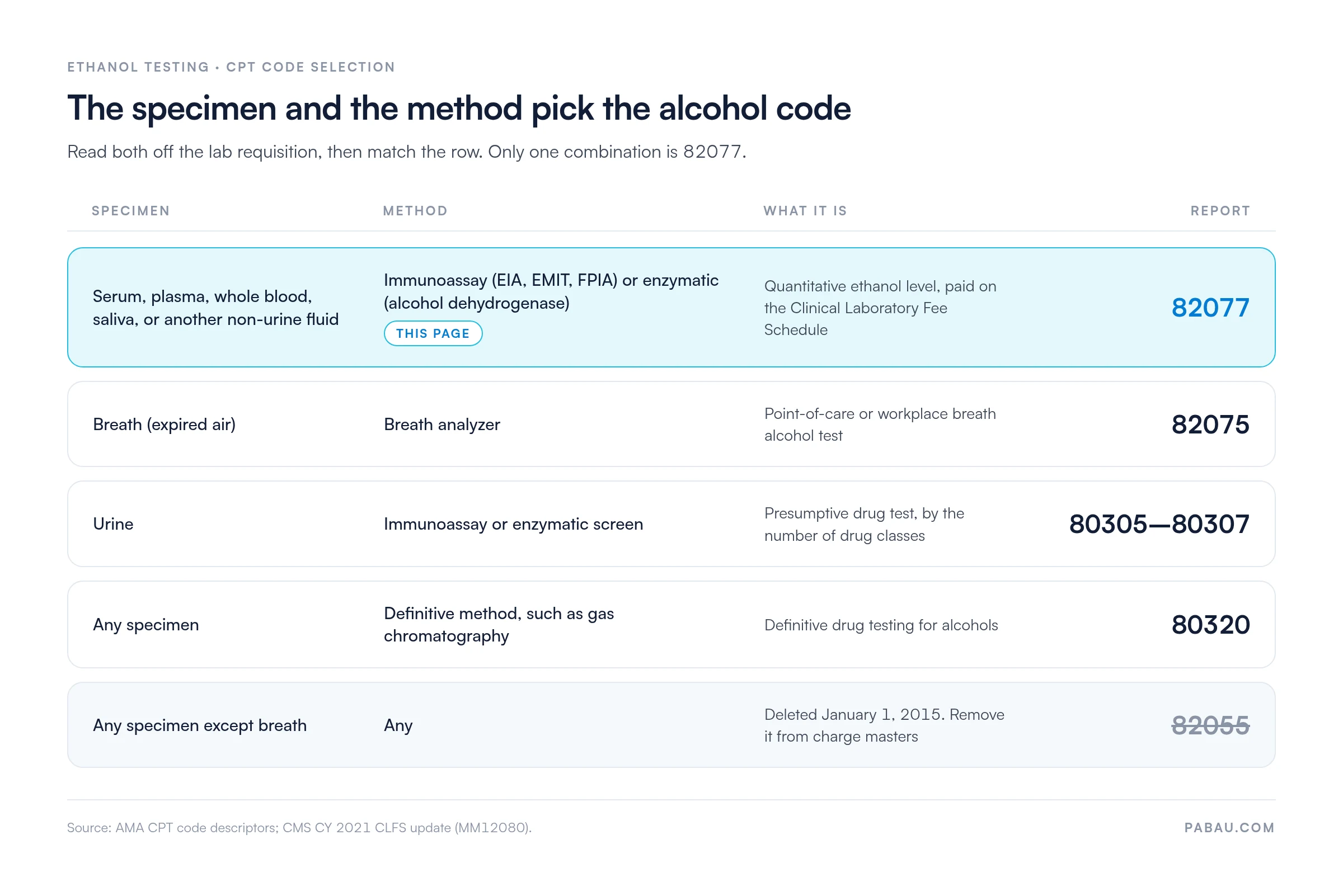
Several companion codes appear regularly alongside CPT code 82077. Knowing which ones replace it and which ones sit on the same claim also prevents duplicate-billing denials.
For 36415, Medicare generally pays the venipuncture separately on the Clinical Laboratory Fee Schedule. On a hospital outpatient claim that also carries an OPPS-paid service, the draw is usually packaged instead. Commercial payers vary, so check the payer’s policy or your MAC’s guidance before adding it to the claim.
The 82077 workflow runs from clinical order through lab report. Each step generates documentation, so payers expect to see it reflected in the chart note.
Bill CPT 36415 alongside CPT code 82077 when your team drew the blood specimen. Medicare generally pays 36415 separately on the CLFS, once per patient encounter, even when one draw supports several tests. Commercial payers vary, so check each payer’s fee schedule or provider line before adding 36415 to the claim.
Before adding CPT 36415 to an 82077 claim, pull the payer’s current specimen collection policy from its portal. Note the policy date in your billing notes. If the payer returns a CO-97 denial on the 36415 line, that note tells you whether to appeal or write it off.
Medical necessity is a frequent denial trigger for CPT code 82077, because payers check the diagnosis against the test. The chart must contain a diagnosis code that logically supports ordering an ethanol test before the claim is submitted. The CDC ICD-10-CM coding tool is the reference source for current code validity.
Z81.1 alone rarely establishes medical necessity, because payers usually expect a concurrent encounter or active treatment code. A code that describes the condition itself, such as F10.20 for alcohol dependence, supports the order more directly. Still, record the clinical reason for the test in the note either way.
Medicare pays CPT code 82077 under the Clinical Laboratory Fee Schedule (CLFS), which CMS updates every year. Claims go out on the CMS-1500 form or its 837P electronic equivalent. Pabau, a practice management platform, submits these claims through Claim.MD, its US clearinghouse partner, and tracks eligibility and remittances from the data your team enters.
Medicare pays for the test when it is reasonable and necessary to diagnose or treat the patient. Routine screening of a patient with no signs or symptoms is not covered. Each Medicare Administrative Contractor (MAC) can also set local documentation rules, so check whether yours publishes a policy that touches alcohol testing. Whatever the policy says, the chart needs a documented clinical indication and a supporting ICD-10 diagnosis code. The CMS Clinical Laboratory Fee Schedule files list the national payment amount by CPT code.
Medicare’s CLFS rate for CPT code 82077 changes with each annual update. Pull the current figure from the CMS CLFS file and note the effective year in your billing documentation. Reimbursement rates for commercial payers and Medicaid programs are set separately, so they vary significantly by state and contract.
Therefore, never state a fixed dollar amount for CPT code 82077 reimbursement in provider education materials without noting the effective year and advising verification. Rates also fluctuate annually and differ by geography and payer contract.
Three modifiers appear most often with CPT code 82077. Using the wrong one, or leaving out a required one, returns a CO-4 denial, so the claim goes back for correction. Applying modifiers to medical billing compliance requirements also limits your audit exposure.
Most 82077 denials trace back to a few fixable errors. Denial management starts with spotting which pattern your remittances show.
The denial codes reference covers the CO and PR codes most often returned on lab claims. CO-4 means a modifier conflicts with the procedure code or is missing. CO-11 means the diagnosis conflicts with the procedure. Finally, CO-97 means another allowance includes the service.
A missing chart element costs less to fix before the claim leaves the practice than after a denial arrives. The chart note for a CPT code 82077 encounter should contain each element below. Payers and auditors expect to find them quickly, so they do not need to request the full record. A consistent clean claim process cuts first-pass denials across the lab billing workflow.
Run a weekly query in your practice management system for 82077 claims that are more than 14 days old with no remittance. These are your highest-probability denials. Pull the chart notes for each before the timely filing window closes. Verify that specimen type, method, diagnosis code, and test result are all documented. Catching missing elements at day 14 is cheaper than appealing a denial at day 90.
Most 82077 rework starts before the claim exists. The requisition omits the method, the chart note omits the indication, or a stale template still lists 82055. Pabau keeps the order, the note, and the claim on one patient record, so the biller sees all three at once.
Pabau’s claims management software submits the claim through Claim.MD using the codes your team enters. It checks eligibility before the visit and posts the ERA against the patient once the payer responds. Denials show up on the record, so your billers can work them there.
The coding decision stays with your team, so the specimen and method belong on the requisition. With both on file, choosing between 82077, 82075, and 80320 takes seconds.

Pabau submits your lab claims through Claim.MD, checks eligibility, and posts ERAs against the patient record. Your billing team spends less time chasing denials and more time on care.

Put the specimen and the method on every requisition, and choosing 82077 stops being a judgment call. A blood or saliva level by immunoassay or enzyme is 82077. Breath goes to 82075, and a gas chromatography result goes to 80320.
The decision worth settling once, however, is 36415 and repeat testing. Medicare generally pays the draw, but commercial payers and monitoring contracts set their own limits. Build those rules into your claim template, so the same denials stop coming back.
Book a demo to see how Pabau keeps lab orders, chart notes, and claims on one patient record.

Need to understand how clearinghouse validation works? Claim.MD clearinghouse guide explains how electronic claim routing, eligibility checks, and ERA processing reduce lab billing rework.
Looking for the full revenue cycle picture? Revenue cycle management overview covers the end-to-end workflow from patient encounter to payment posting, including where lab codes fit.
Want a reference for 837P electronic claim formatting? 837 file guide details the transaction set structure used to submit CPT claims electronically to clearinghouses and payers.
CPT code 82077 covers an ethanol test run by immunoassay or an enzymatic method such as alcohol dehydrogenase. It applies to any specimen except urine and breath, so serum, plasma, whole blood, and saliva all qualify. Breath alcohol uses CPT 82075, and urine screens use the presumptive drug test codes 80305-80307.
CPT 82075 covers breath alcohol testing on expired air. CPT 82077 covers immunoassay or enzymatic ethanol testing on any specimen except urine and breath, most often serum, plasma, or blood. The two codes are not interchangeable. Billing one for the other is a coding error that payers deny or recoup.
Yes. Medicare generally pays CPT 36415, routine venipuncture, separately on the Clinical Laboratory Fee Schedule when your team draws the blood for CPT code 82077. It allows the draw once per patient encounter. Commercial payers vary, so check the payer’s policy before adding 36415 to the claim.
Three modifiers matter most. Modifier 91 marks a repeat test on the same day when a second specimen is clinically justified. Modifier 59 marks a distinct service when an NCCI edit pairs 82077 with another code billed that day. Modifier QW needs two things. The CMS list of waived tests must assign your kit to this code, and your site must hold a CLIA Certificate of Waiver. Payer acceptance of modifier 91 varies, so confirm before billing.





