CCSD Code V2543: Revision posterior disc excision with facetectomy
What is CCSD Code V2543? CCSD Code V2543 is the Clinical Coding and Schedule Dev...

Last Updated: Nov 25, 2026
82044 is the CPT code for albumin; urine (eg, microalbumin), semiquantitative (eg, reagent strip assay). It reports a urine albumin screen read from a dipstick or reagent strip as a range, not an exact concentration.
Coders often confuse it with CPT 82043, the quantitative code for immunoassay and nephelometry results. The method on the lab report decides between them. Medicare pays 82044 under the Clinical Laboratory Fee Schedule, and diagnoses usually come from diabetes, kidney disease or hypertension.
Let Pabau's smart automation suggest the right codes, reduce claim denials, and keep your practice compliant—effortlessly.
Automate repetitive tasks and focus on what matters most—your patients.
Reduce coding errors and ensure compliance with the latest regulations.
Clean claims, fewer denials, and faster reimbursements.
Powerful insights and reporting to help your practice thrive.
HIPAA compliant SOC 2 certified GDPR-compliant Trusted by 4,000+ clinics worldwide

CPT code 82044 reports a semiquantitative urine albumin (microalbumin) test read from a dipstick or reagent strip, not an immunoassay.
82044 and 82043 are generally not reported together on the same date, so bill the code that matches the method used.
Diabetic kidney codes E10.2x and E11.2x, the most specific billable N18 code, and I10 are the main diagnoses supporting medical necessity.
Medicare pays 82044 at a single national rate under the Clinical Laboratory Fee Schedule, not the Physician Fee Schedule.
Pabau, a practice management platform, submits 837P claims for 82044 through Claim.MD and posts ERA remittances back to each claim.
CPT code 82044 reports a semiquantitative urine albumin test, often called a microalbumin screen. The AMA’s CPT code set describes it as Albumin; urine (eg, microalbumin), semiquantitative (eg, reagent strip assay).
The descriptor tells coders three things. First, the analyte is albumin. Second, the specimen is urine, where albumin appears once damaged glomeruli let it leak through. Third, the method is semiquantitative, so the result comes back as a range or threshold rather than a precise concentration.
Semiquantitative methods include dipstick reagent strips and immunochemical strip tests. They report results as negative, trace, 1+ or 2+, or as broad mg/L bands such as under 30, 30 to 100, and over 100. Immunoassay and nephelometry methods that return an exact milligrams-per-liter result are quantitative and map to CPT 82043 instead. As a result, applying 82044 to a quantitative immunoassay result is a coding error that exposes the claim to denial or audit.
The CPT code set places 82044 within the Chemistry subsection of Pathology and Laboratory, among the albumin codes 82040 to 82045. It is also a standalone code with no procedure-specific modifiers required under normal billing circumstances. The AAPC’s CPT code lookup is a handy reference for confirming descriptors and parenthetical notes before you finalize a claim.
82044 is ordered in three main clinical scenarios. Each one also needs a supporting ICD-10 diagnosis on the claim to pass medical necessity review.
Some Medicare Administrative Contractors (MACs) also cover proteinuria screening in patients with a family history of renal disease, or in pre-transplant evaluation. Check the applicable MAC’s Local Coverage Determination before billing for these less common scenarios.
CPT 82043 is albumin in urine, quantitative. In contrast, CPT 82044 is albumin in urine, semiquantitative. The method determines which code is correct, not the clinical indication or the result value, and the diagram below maps each method to its code.
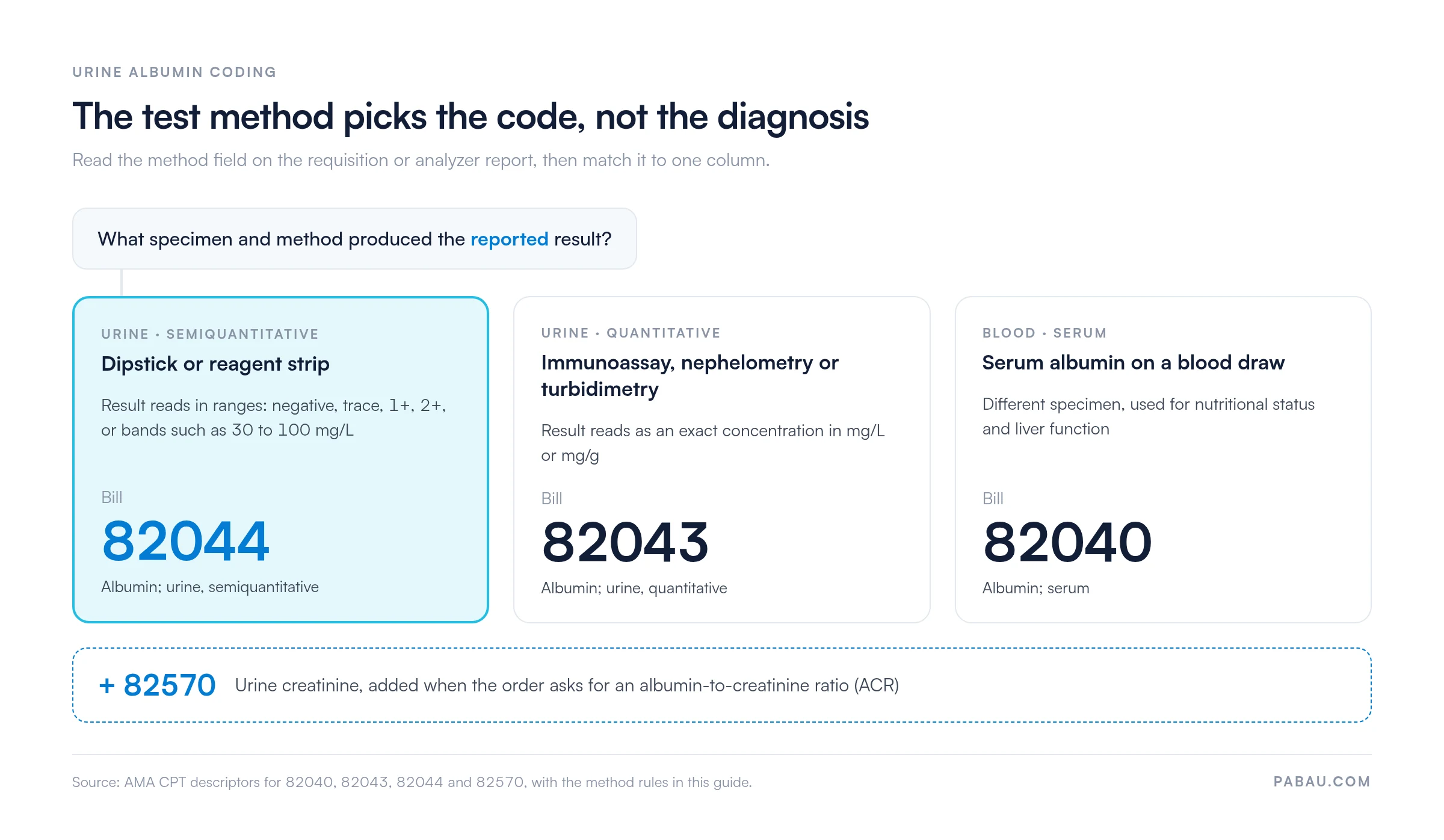
Say the practice ordered a dipstick screen, but the reference lab ran a quantitative immunoassay. The correct code is 82043 for the test performed, not 82044 for the method originally planned. Therefore, code what was done.
Knowing where 82044 sits in the albumin code family prevents misapplied codes and helps billers build complete claims.
Some practices need an albumin-to-creatinine ratio (ACR) from a strip method. Billing CPT 82044 with urine creatinine, 82570, on the same date is generally supported. Most clinical guidelines still recommend 82043 for a confirmed ACR, because a semiquantitative strip lacks the precision staging decisions need. Verify the lab’s method before you select the code combination.
Before selecting between 82044 and 82043, check the lab requisition or the analyzer report for the method field. If it reads immunoturbidimetry, nephelometry, or immunoassay, bill 82043. If it reads dipstick, reagent strip, or point-of-care strip, bill 82044. Never select the code based on the clinical indication alone.
A claim for CPT 82044 without a covered ICD-10 diagnosis is denied on medical necessity grounds, however well the rest of it is documented. These are the most commonly accepted diagnosis codes, though the covered list varies by MAC and commercial payer.
For a routine annual screen with no documented kidney complication, E11.9 or E10.9 carries the claim. Hypertensive screening rests on I10 instead.
Therefore, use the most specific diagnosis code available. R80.9 (proteinuria, unspecified) may satisfy medical necessity for an initial workup, but MACs often flag repeat testing under R80.9 alone. In addition, use an underlying etiology code alongside it where documented. For crosswalk guidance, CrossCoder’s procedure-to-diagnosis crosswalk tool maps CPT codes to supported ICD-10 diagnoses by payer policy.
The National Correct Coding Initiative (NCCI) publishes procedure-to-procedure (PTP) edits for code pairs CMS doesn’t expect on the same date. Mutually exclusive pairs have sat in the same PTP table since 2012, and each pair carries a modifier indicator.
82043 and 82044 are generally not reported together on the same date of service. Billing a semiquantitative and a quantitative urine albumin test for one specimen duplicates the service, because both report the same analyte. Say a practice runs a dipstick screen and then sends the same specimen for quantitative analysis. Then bill one code for that date, matching the method behind the result the clinician acted on.
Check the current tables on the CMS Medicare NCCI PTP edits page, because CMS updates them quarterly. For example, a pair that allows a modifier one quarter can lose that indicator the next.
CPT 82044 is paid under the Medicare Clinical Laboratory Fee Schedule (CLFS), not the Physician Fee Schedule. Under the Protecting Access to Medicare Act (PAMA), CMS sets one national rate per test from private payer data. Medicare then pays the lesser of the billed charge and that national rate.
Practices that bill electronically send 82044 through a clearinghouse. For example, in Pabau that is Claim.MD, Pabau’s US clearinghouse, and payer coverage comes from the clearinghouse’s payer list.
Key reimbursement facts to verify each year against the current CMS CLFS file:
Note the year whenever you cite a CLFS rate in internal documents, because rates can change each January 1.
A claim for CPT 82044 without supporting documentation risks denial and creates compliance exposure if audited. Therefore, these elements must appear in the chart or on the lab requisition. Submitting a clean claim starts with documentation that is complete before the encounter closes.
Where the test is performed determines who can bill for it and which POS code applies.
CLIA waiver status for CPT 82044 depends on the specific device used. For example, a practice using an FDA-cleared point-of-care microalbumin analyzer on the CLIA-waived list may bill under a Certificate of Waiver. Device lists change, so verify current status through the CMS CLIA program before billing. Finally, a lapsed CLIA certificate, or a non-waived device billed under a waiver, is an OIG audit trigger.
These six denial patterns account for most rejected 82044 claims. Effective denial management workflows address them systematically instead of claim by claim. The full list of medical billing denial codes covers the remittance remark codes tied to each scenario.
Run a quarterly audit of all 82044 claims denied for bundling or medical necessity. If the same ordering provider or department appears repeatedly, the fix is a corrected lab order template, not a claim-by-claim appeal. Build the right ICD-10 codes into the standard order set for diabetic monitoring panels.
CMS has not issued a National Coverage Determination (NCD) specifically governing CPT 82044. Coverage is therefore set at the MAC level through Local Coverage Determinations. That matters because LCD policies vary by region, and each MAC updates its own.
Several MACs have published LCDs for laboratory urine albumin testing. Common provisions across published policies include the following:
First, find the applicable LCD by searching your MAC’s website for CPT 82044. Medical billing compliance programs should track LCD effective dates and update coding order sets whenever policies change.
Most 82044 denials start at ordering and coding, before the claim reaches a payer. A method mismatch or a vague diagnosis caught before submission saves a full rework cycle.
Pabau’s claims management software builds CMS-1500 and 837P claims from the patient record and submits them through Claim.MD. Eligibility checks run before the visit, so a lapsed policy surfaces before the test is billed. ERA remittances then post back against each claim, which keeps every 82044 denial reason next to the claim it belongs to.
Practices can also switch on lab ordering. Quest tests are ordered from the patient record and the results import automatically. Similarly, Labcorp orders placed in Labcorp Link sync their results back too. The ordering provider, diagnosis and result then sit on one record for whoever codes the claim.

Pabau builds 837P claims from the patient record, checks eligibility before the visit, and posts ERA remittances back to each claim. Your team sees every 82044 denial reason without leaving the record.

CPT 82044 is a narrow code, and the choice it asks for is narrower still. Read the method on the lab report before choosing between 82044 and 82043, and let the result format settle it.
Then fix the order set once. Diabetic and CKD panels should carry the most specific E10.2x, E11.2x or N18 code, and every in-office claim needs its CLIA number. Those two habits remove most of the rework this code generates, and they cost one template update.
Book a demo to see how Pabau keeps lab orders, eligibility checks and claim remittances on one patient record.

Need to understand how clearinghouse submission works? Claim.MD clearinghouse guide explains how electronic claims move from the practice to Medicare and commercial payers.
Seeing repeated denials across multiple lab codes? Understanding the 837 file format covers how claim data is structured in EDI submissions, which helps identify where coding errors propagate.
Want to verify eligibility before ordering labs? Insurance eligibility verification outlines how eligibility checks prevent claims on lapsed or inactive coverage.
CPT code 82044 covers a semiquantitative urine albumin (microalbumin) test, performed using a dipstick or reagent strip method. It is used to screen for and monitor early kidney damage in patients with diabetes, hypertension, or chronic kidney disease.
CPT 82044 is semiquantitative, with a dipstick or reagent strip producing a range result. CPT 82043 is quantitative, with an immunoassay producing an exact mg/L concentration. The two are generally not reported together on the same date of service.
For diabetic kidney involvement, use E10.21, E10.22 or E10.29 for type 1 and E11.21, E11.22 or E11.29 for type 2. Routine screening uses E10.9 or E11.9. CKD takes the most specific billable N18 code, and hypertension takes I10. Covered diagnoses vary by MAC LCD.
Generally, no. Billing a semiquantitative and a quantitative urine albumin test on the same date duplicates the service. Bill the code that matches the method used, and check the current NCCI PTP file for the pair’s modifier indicator.
CPT 82044 may be CLIA waived when performed with a specific FDA-cleared, CLIA-waived dipstick device. Waiver status is device-specific, not code-specific. Verify the device appears on the current CMS CLIA-waived list before billing under a Certificate of Waiver.