



CCSD code G5100: Bypass of duodenum billing guide
CCSD code G5100 bills a bypass that leaves the duodenum in place CCSD code G5100...

Last Updated: Oct 16, 2026

CPT code 78452 covers tomographic SPECT myocardial perfusion imaging with multiple studies, such as rest and stress performed in the same session.
Use 78452 when both rest and stress imaging happen, and CPT 78451 when only one phase is completed. Mixing the two is the top denial trigger on nuclear cardiology claims.
The 2026 Medicare global rate runs about $485 nationally, splitting into roughly $340 technical and $145 professional once modifier TC or 26 applies.
Practice management software like Pabau pre-fills the claim from the record and holds submission until required fields are complete, so fewer 78452 claims bounce.
CPT code 78452 bills a SPECT myocardial perfusion scan captured across more than one phase in the same session. Rest plus stress, or stress plus redistribution, both land here. A single-phase study belongs to CPT 78451 instead, and that one distinction drives most of the denials on this code pair.
Nuclear cardiology is one of the highest-value code families an outpatient practice bills, so payers review it closely. The phase count decides the code. Your setting decides the modifier. Your diagnosis code decides whether the claim clears medical necessity at all.
Work those three in order and a 78452 claim rarely comes back.
One SPECT session, more than one imaging phase. That is the whole of 78452, and the American Medical Association’s CPT code set says it in three parts.
In practice that describes a nuclear scan of the heart taken under two physiologic states, usually rest followed by stress. Stress followed by redistribution qualifies too.
The phases have to be different physiologic states, though. Re-acquiring the same rest images because the first set was blurry does not create a second study.
Was the patient imaged under more than one physiologic state in the same session? Yes means 78452. No means 78451.
Payers audit this pair often, because the reimbursement difference between the two codes is substantial.
That last row is a hard stop. The CMS National Correct Coding Initiative pairs the two codes as mutually exclusive, so a claim carrying both is rejected on arrival rather than reviewed.
Medical necessity for 78452 rests on why the ordering physician wanted both phases, not on the scan itself. The American Society of Nuclear Cardiology’s appropriate use criteria shape that judgment.
Commonly accepted indications include:
Payers cross-reference the ordering diagnosis against these criteria during pre-payment review. A claim supported only by “fatigue” or “general weakness” comes back as a medical necessity denial most of the time.
Every 78452 claim needs a diagnosis code that explains why the study happened. Pick the most specific code the chart supports. A vague one invites review, and review costs more than the extra minute it takes to read the note properly.
Coverage still turns on your MAC’s local coverage determination (LCD) for nuclear cardiology. Not every payer accepts the same diagnosis list for 78452. Check the LCD that applies to your region before you rely on these pairings.
Append modifier 26 when your physician only interprets the study. Append TC when your facility only supplies the camera, the dose, and the staff.
Bill globally, with no modifier, when one entity does both. The split between those two halves is not even, and its direction catches out practices that mostly bill professional services.
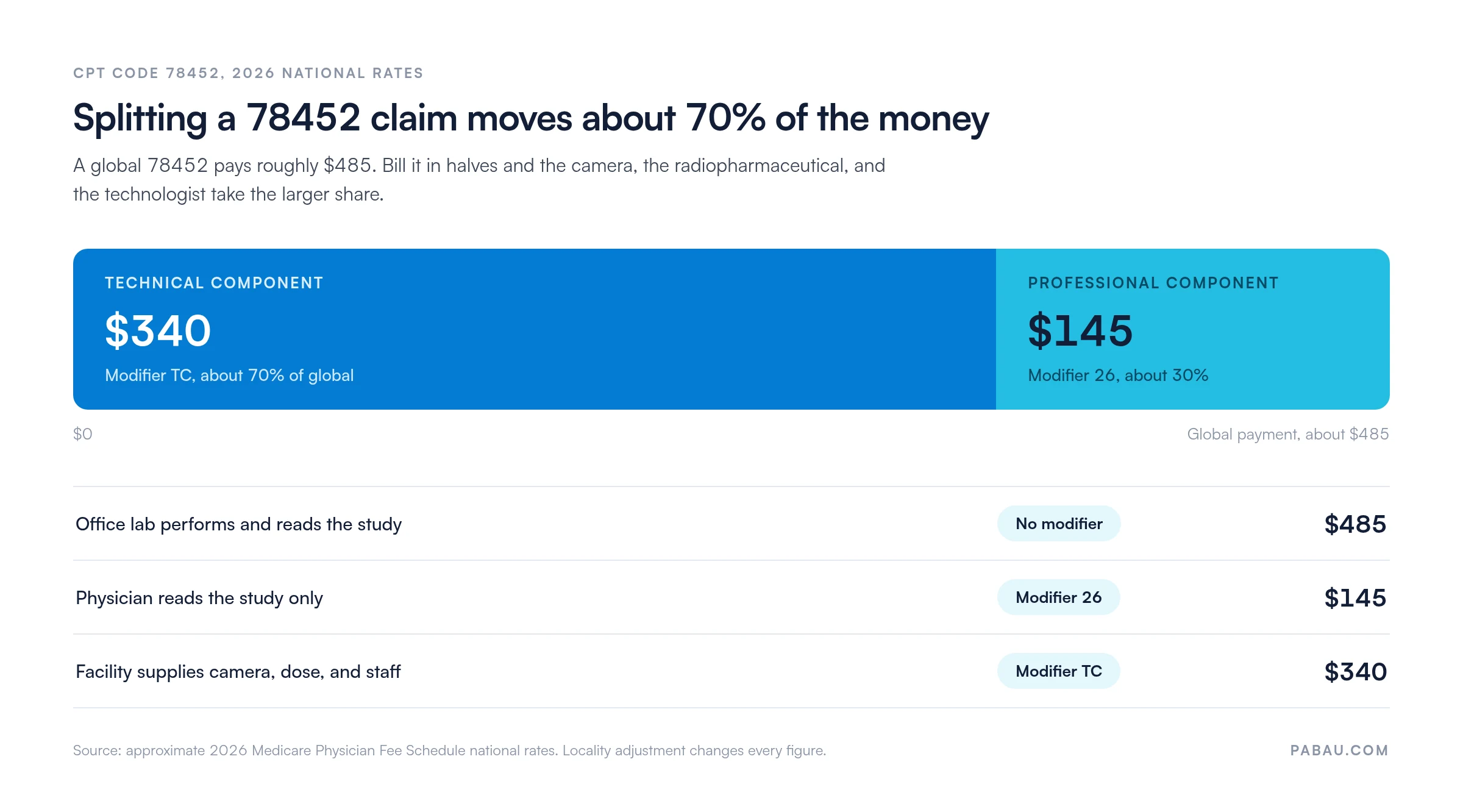
A global 78452 pays roughly $485 nationally in 2026, before any locality adjustment. The CMS Medicare Physician Fee Schedule Look-Up Tool returns the exact amount for your area.
Treat the figures below as national approximations, not quotes.
Geographic multipliers move these numbers a long way. High-cost areas such as San Francisco, New York City, and Boston can run 20% to 30% above the national rate. Rural localities may sit around 15% below it.
Check each remittance against the rate you expected, because a locality error looks like a normal payment until you compare the two.
Approximate 2026 CMS MPFS components look like this:
Non-facility practice expense runs roughly nine times the facility figure. That difference pays for the camera, the radiopharmaceutical, and the technologist an office-based nuclear lab carries itself. Radiopharmaceuticals bill separately, typically under HCPCS A9502 or A9500. A9500 is the Tc-99m sestamibi line, and a parathyroid planar study under 78070 captures that same tracer charge.
Rules are easier to hold onto once you have watched them run. Here is a single hospital outpatient study on its way to payment, with the decision points marked.
Two of those steps carry most of the risk. Step five sets the code and the modifier. Step two decides whether the payer ever agreed to the study at all, which is where the next section starts.
Traditional Medicare does not require prior authorization for CPT code 78452. Most Medicare Advantage plans and many commercial payers do, so the answer changes with the card in front of you.
Send the planned stress modality, the clinical indication, and any earlier cardiac workup with every request. An authorization denial is far easier to argue before the study than a claim denial after it.
Build a nuclear cardiology prior auth template with fields for stress type, ordering indication, risk stratification score, and prior test results. A completed template cuts submission time and reduces back-and-forth with payer clinical reviewers.
Seven elements decide whether a technically correct claim survives review. Check the chart for each one before you release the charge:
The superbill for nuclear cardiology should carry a field for each phase completed. Then the coder can confirm 78452 is right before the claim ever reaches the clearinghouse.
Most rejections on this code trace back to six errors, and every one of them is catchable at charge entry. Sorting through medical billing denial codes weeks later costs far more than a two-minute check on the way out.
Nuclear cardiology studies rarely travel alone. Where your practice owns the stress equipment and one physician both supervises and reads it, 93015 covers the whole stress test.
The AAPC CPT code reference and the table below cover the rest of the neighborhood.
Most of the 78452 workflow happens twice. The phase count sits in the interpretation report. From there the CPT code gets typed into a billing screen, and the diagnosis is copied from the chart. Each hand-off is a chance to drop a modifier or transpose a digit.
Practice management software like Pabau shortens the distance between the record and the claim form. The CPT code attached to the service lands on the charge line by itself, and ICD-10 slots seed from the patient’s recorded problem list.
Full ICD-10-CM and CPT lookup libraries sit behind a search icon, so a coder can confirm a code without leaving the claim.
Before a claim can go out, the system checks that claim-required fields are complete, including membership and authorization numbers.
Pabau’s medical claims management then routes it to the Claim.MD clearinghouse in the US. Real-time eligibility checks, claim status tracking, and ERA remittance posting all land back on the patient record.
Coding judgment stays with your coder, where it belongs. What changes is how many times a 78452 charge gets retyped, and how many claims stall on an authorization number nobody wrote down.

Pabau pre-fills the claim from the patient record, checks required fields before submission, and routes 78452 claims to the clearinghouse. Eligibility checks and ERA remittance come back to the same record.

Almost every 78452 problem starts in the same place. The fact that decides the code, the number of phases imaged, lives in a clinical report rather than on the charge sheet. Whoever carries it across is where your denial rate gets set.
So the fix sits upstream of billing. Ask your interpreting physicians to state the phase count in plain words. Map place of service to modifier at charge entry. Confirm authorization before the patient is on the table. Those three habits close most of what payers send back.
Nuclear cardiology will always be a scrutinized code family. Fewer of those claims should be slow because of a typo. Book a demo to see how Pabau carries a 78452 charge from the patient record to the clearinghouse without a re-key.

Need a framework for managing denied claims after submission? Denial management in healthcare covers the full appeals workflow and the CARC code categories clearinghouses use.
Want to see how an 837P file reaches the payer? 837 file submission explains the EDI transaction structure behind electronic claims for nuclear medicine codes.
Looking to benchmark your billing operation? Revenue cycle management fundamentals outlines the KPIs and workflow stages that matter to cardiology practices.
Chasing payment after a clean submission? Electronic remittance advice shows how to read an 835 and spot a component payment error early.
Not quite. 78452 bills only the imaging half of a nuclear stress test. The exercise or pharmacologic stress portion is billed separately under the cardiovascular stress test codes.
Use POS 11 for a study performed in a physician office and POS 22 for hospital outpatient. Place of service drives which modifier applies, so a wrong POS usually produces a wrong modifier.
No. Diagnostic imaging codes such as 78452 carry an XXX global indicator, so no post-service period applies. An office visit on the same day can still be billed when it is separately identifiable and documented.
Rarely. Medicare covers myocardial perfusion imaging as a diagnostic test, so an asymptomatic patient with no risk-based indication usually fails medical necessity. Check your MAC’s LCD before scheduling on that basis.
There is no single national frequency limit, but MACs and commercial plans set their own. A repeat study inside a year normally needs a documented symptom change or a new cardiac event.



