



CCSD code G5100: Bypass of duodenum billing guide
CCSD code G5100 bills a bypass that leaves the duodenum in place CCSD code G5100...

Last Updated: Oct 16, 2026
CPT code 78264 is the nuclear medicine code for a gastric emptying imaging study of the stomach alone. The study can use a solid meal, a liquid meal, or both phases.
The moment the imaging follows the meal past the stomach, the correct code becomes 78265 or 78266. That boundary matters to billers and practice managers, because scope errors and thin medical necessity notes cause most denials on this code.
Below you will find the official descriptor, the ICD-10 pairings, the modifiers, and how Medicare pays. The route a claim takes and the checks that keep it clean follow.

CPT code 78264 covers a gastric emptying imaging study of the stomach only, with no small bowel or colon transit imaging.
The usual ICD-10 pairings are K31.84 for gastroparesis, K30 for functional dyspepsia, and R11.2 for nausea with vomiting.
Modifier 26 bills the interpretation and modifier TC bills the technical side, so split arrangements carry one of them on every claim.
Most denials trace back to an unsigned order, a thin medical necessity note, or a code that does not match the imaging scope.
Practice management software like Pabau submits claims electronically and filters outcomes by date, insurer, or invoice ID.
CPT code 78264 sits in the Nuclear Medicine section of the AMA’s CPT code set. Its official descriptor reads: Gastric emptying imaging study (eg, solid, liquid, or both).
The code applies only while the protocol stays in the stomach. Once imaging tracks transit beyond it, 78265 or 78266 takes over.
The study itself is straightforward. The patient eats a standardized meal labeled with a radiopharmaceutical, usually technetium Tc 99m sulfur colloid.
Images follow at timed intervals, and the percentage of the meal still in the stomach is calculated at each one. A nuclear medicine physician then reads the images and signs a formal report.
That 000 global period is useful to know at the scheduling desk. No follow-up period is bundled into the code, so each imaging session stands on its own claim. Schedulers never have to work around a surgical-style global window.
Physicians order this study when symptoms point to a stomach that empties too slowly. Gastroparesis is the leading indication, and diabetes is the most frequent cause behind it. Scintigraphy remains the standard way to quantify delayed emptying, which is why the study keeps its place in the workup. These are the indications payers expect to see in the note.
The indication has to be on the record before imaging is ordered, not reconstructed afterwards. Payers deny CPT 78264 when the physician’s note carries no symptom history and no reason to choose nuclear imaging over other tests.
The three gastric emptying codes differ on one axis only, which is how far the imaging follows the meal. CPT 78264 covers the stomach. CPT 78265 adds small bowel transit. CPT 78266 adds colon transit on top of both.
Picking the wrong one is among the most common billing errors in nuclear medicine gastroenterology.
Bill 78264 only where the protocol is limited to gastric clearance. If the order or the report documents small bowel or colon transit, move up to 78265 or 78266.
Coding down to 78264 after a wider study understates the work the report describes, and it is a compliance problem in its own right.
Medical necessity lives in the diagnosis code, so the pairing decides whether the claim survives review. The codes below reflect accepted pairings under CMS ICD-10 coding guidance and the applicable Local Coverage Determinations.
Those LCDs vary by Medicare Administrative Contractor, so check your MAC’s current policy before you submit.
K31.84 is the most specific code for gastroparesis, so it belongs first on most 78264 claims. Reaching for a symptom code such as R11.2 while the chart already documents gastroparesis weakens the claim.
The payer sees a thinner rationale than the record supports, and a medical necessity review often follows.
Modifier choice on CPT 78264 follows the billing arrangement between the reading physician and the imaging facility. Three modifiers cover almost every arrangement you will meet.
Laterality modifiers are a different story. LT and RT do not apply to gastric imaging, because the stomach is not a paired structure. Appending either one can trip a claim edit or a rejection, so check your MAC’s policy before you use them on this code.
When the reading physician and the imaging facility share a tax ID and bill globally, CPT 78264 needs no modifier at all. Split billing applies only where two entities bill the professional and technical components separately. Record the arrangement in your payer contract file, so modifiers stay consistent from one claim to the next.
Medicare pays CPT 78264 through the Physician Fee Schedule, and the amount depends on where you practice and how you bill. The rate is built from work, practice expense, and malpractice RVUs. Those are adjusted for your locality, then multiplied by the annual conversion factor.
Look up the current figure for your region with the CMS Physician Fee Schedule lookup tool. Locality adjustments move the number enough that a national average makes a poor stand-in.
Setting changes the arithmetic on the technical side. Hospital outpatient departments bill under the Outpatient Prospective Payment System, so their rates differ from a free-standing imaging center.
The reading physician still bills the professional component under the fee schedule either way. When the remittance arrives, check which component was paid before anyone books the balance as underpayment.
Documentation decides more 78264 claims than any other factor, and incomplete records drive a large share of first-pass denials. The physician’s order and the nuclear medicine report have to cover all seven elements below between them.
Retention percentages deserve particular attention. A narrative impression reads well clinically, but it gives a reviewer no figure to measure the study against. Quantified intervals are what turn a records request into a closed file.
Traditional Medicare does not require prior authorization for most nuclear medicine diagnostic studies, and that includes gastric emptying imaging.
Medicare Advantage plans and commercial insurers often do. Because the requirement travels with the plan rather than the code, confirm it before the patient is scheduled.
A strong authorization request attaches the referring physician’s order, a summary of the indication, prior treatment history, and any relevant test results.
Verifying benefits at scheduling is what surfaces the requirement in time. It also tells the front desk what the patient will owe before they arrive for imaging.
A gastric emptying claim passes through six stages, and each one leaves behind a document the payer may ask for later. Walking the route in order shows where the administrative work sits.
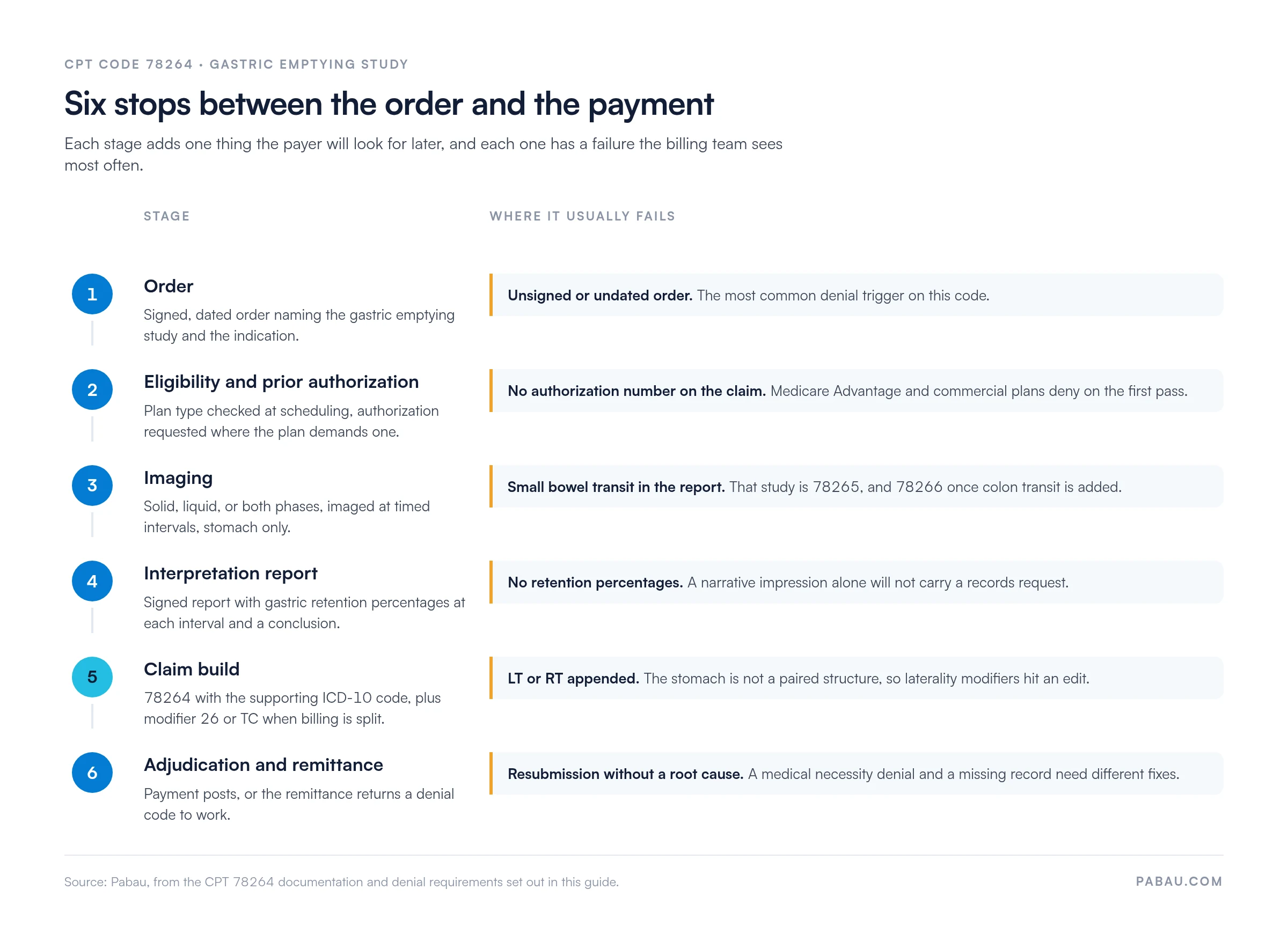
It starts with the referring physician’s signed order, which names the study and the indication. Scheduling then verifies the plan and requests authorization where one is needed. The study follows, imaged at timed intervals with the meal the protocol specifies.
From there the work turns administrative. The nuclear medicine physician signs a report carrying retention percentages at each interval.
Coding builds the claim from that report, pairing 78264 with the supporting ICD-10 code and adding modifier 26 or TC where billing is split. The payer adjudicates, and the remittance either posts a payment or returns a denial code to work.
Most 78264 denials are preventable at the desk, and the check takes a couple of minutes. Run this list before the batch goes out, and a clean claim becomes the default rather than the exception.
Gastric emptying claims deny more often than many comparable nuclear medicine codes, mainly because the documentation rules are specific and payer policies differ.
Each of the mistakes below has its own fix, so name the cause before anyone resubmits.
When a claim comes back, read the remittance before you touch it. The denial codes separate a medical necessity problem from a missing record, and the two need different work.
Medical necessity usually calls for a peer-to-peer review or a physician attestation letter. A documentation failure calls for a corrected claim with the records attached.
Audit exposure on this code comes from two directions: NCCI bundling edits, and medical necessity documentation that does not hold up.
The Office of Inspector General and the MACs review nuclear medicine gastroenterology codes periodically. Studies billed alongside GI endoscopy on the same service date draw the most attention.
The National Correct Coding Initiative publishes procedure-to-procedure pairs that cannot be billed together without a modifier.
Check the current table before billing CPT 78264 on the same date as another gastroenterology or nuclear medicine code. CPT 78226, the hepatobiliary scan, sits in the same nuclear medicine group, so one upper GI workup can generate both claims. Modifier 59 is the standard bypass, but it only holds where the documentation shows two genuinely separate services.
Volume attracts attention. A practice billing 78264 heavily for its size or specialty mix can draw a Recovery Audit Contractor or MAC review. Three patterns come up repeatedly:
Regular internal audits of 78264 claims against the documentation remain the best defense. A practice management system makes the sampling step quicker. In Pabau, claim outcomes filter by date, insurer, or invoice ID while you pull the quarter’s list.
Audit your own 78264 claims once a quarter. Pull every claim billed in the period and match each one to its physician order and report. Then confirm the diagnosis code appears in the clinical note. Finding a missing report before a payer asks for records costs far less than answering a formal audit.
The pieces of a gastric emptying claim often live apart. The order sits in the EHR, the report arrives from the imaging side, and the charge is typed into billing from a printout. Two weeks later a denial lands in a payer portal that nobody has open. Whoever works it has to rebuild the story from three systems.
Practice management software like Pabau keeps that chain on one patient record. The clinical note, the coded charge, and the claim stay together, so the documentation a payer asks for is attached to the claim it supports.
Claims go out electronically through Claim.MD, a clearinghouse connected to thousands of US payers, and remittances post back against the invoice they came from.
For a billing team, the practical benefit is fewer places to look. Pabau’s claims software for billers lists submitted claims and filters them by date, insurer, or invoice ID.
That is enough to pull a quarter of nuclear medicine claims for an internal check. Templated clinical notes can prompt the order details, the protocol, and the retention percentages while the study is fresh.

Pabau links clinical documentation to the claim it supports, so gastroenterology and nuclear medicine practices can submit, track, and work denials from one patient record.

Getting CPT 78264 paid comes down to three habits. Match the code to the scope of imaging the report describes. Lead with the most specific diagnosis the chart supports. Capture the order, the protocol, and the retention percentages while the study is fresh, rather than at appeal.
The trade-off worth remembering is where the effort sits. A few minutes of checking before submission replaces a much longer appeal later. Practices with a low denial rate on this code simply front-load that work. If the documentation is already in the claim, an audit becomes a filing exercise instead of a reconstruction.
If the pieces of your nuclear medicine claims are scattered across systems today, that is the problem worth fixing first. Book a demo to see how Pabau keeps the note, the charge, and the claim on one record. You can then filter outcomes by date, insurer, or invoice ID.

Need to understand how clean claims are built? Clean claim submission walks through every element that must be present before a claim reaches the payer.
Want to spend less time chasing denials? Denial management in healthcare covers root-cause analysis and appeal workflows for common denial patterns.
Exploring how clearinghouse billing works end to end? Claim.MD clearinghouse overview explains how electronic claim routing, eligibility, and ERA remittance fit together.
New to the billing cycle behind a code like this? What is medical billing sets out how a service becomes a claim and then a payment.
Building an internal audit routine? Medical billing compliance explains the controls that keep coding and documentation defensible.
Yes. The tracer carries its own HCPCS supply code, and technetium Tc-99m sulfur colloid is reported with A9541. Free-standing imaging centers bill it alongside 78264. In hospital outpatient departments, OPPS packaging rules usually fold the tracer into the payment for the study.
No. CPT 78264 is reported once per study, whatever the number of imaging time points. A four-hour solid-phase protocol bills the same as a shorter one. Record the intervals anyway, because reviewers read them as evidence that the study was complete.
Medicare publishes no national frequency limit, so MAC policy and plan rules decide. A repeat study within a short window needs a documented change in symptoms or treatment. Without that note, the second claim invites a medical necessity review.
The place of service reflects where the imaging happened. Hospital outpatient departments use POS 22 on campus and POS 19 off campus. An office-based imaging suite uses POS 11. A place of service that contradicts the billing arrangement is a common source of edits.
Only where Medicare is likely to deny the study as not medically necessary. Form CMS-R-131 has to be signed before the scan, never afterwards. Routine notices on every patient are not acceptable, and blanket use can become an audit finding itself.



