

CCSD code G5100: Bypass of duodenum billing guide
CCSD code G5100 bills a bypass that leaves the duodenum in place CCSD code G5100...

Last Updated: Oct 16, 2026
CPT code 78226 reports hepatobiliary system imaging, including the gallbladder when present, without a drug intervention. It's the code for a standard HIDA scan. A Tc-99m tracer is injected, and the camera follows bile from the liver to the gallbladder and bowel. Physicians order it to confirm acute cholecystitis, find a bile-duct blockage or work up biliary atresia in infants.
One fact decides the code. If sincalide (CCK) or another pharmacologic agent, such as morphine, was given during the study, the claim belongs under 78227. The modifiers, 2026 rates and denial triggers below all build on that split.
Let Pabau's smart automation suggest the right codes, reduce claim denials, and keep your practice compliant—effortlessly.
Automate repetitive tasks and focus on what matters most—your patients.
Reduce coding errors and ensure compliance with the latest regulations.
Clean claims, fewer denials, and faster reimbursements.
Powerful insights and reporting to help your practice thrive.
HIPAA compliant SOC 2 certified GDPR-compliant Trusted by 4,000+ clinics worldwide

CPT code 78226 reports a HIDA scan done without pharmacologic intervention. Sincalide/CCK or another pharmacologic agent, such as morphine, moves the study to 78227.
Patients without a gallbladder still qualify for 78226, as long as the report notes that the gallbladder is absent.
In 2026, the national Medicare non-facility rate for the global service is about $284.91, with a work RVU of 0.72.
Unsupported diagnosis codes and missing prior authorization cause most 78226 denials, so check both before the patient arrives.
Pabau, practice management software with built-in insurance billing, pre-fills the CMS-1500 from the patient record and checks required claim fields before sending.
CPT code 78226 is defined by the American Medical Association as hepatobiliary system imaging, including gallbladder when present. It sits in the Nuclear Medicine section of the CPT code set, under Diagnostic, Gastrointestinal System. Clinicians call the study a HIDA scan or cholescintigraphy.
The tracer is a technetium-99m (Tc-99m) labeled iminodiacetic acid agent, usually mebrofenin or disofenin. After an IV injection, the liver takes it up and excretes it into bile. The camera then follows bile flow, gallbladder filling and drainage into the small bowel, usually over 60 minutes or longer.
No drug is given to make the gallbladder contract or to speed filling. That single condition is what keeps the study under 78226.
CPT 78227 reads “with pharmacologic intervention, including quantitative measurement(s) when performed.” So the question is broader than whether an ejection fraction was calculated.
If sincalide/CCK or another pharmacologic agent, such as morphine, was given during the study, bill 78227. If no drug was given, bill 78226.
Here’s a quick example. A patient with suspected acute cholecystitis is scanned for 60 minutes. The gallbladder never fills, so the physician gives morphine and keeps imaging. That study now belongs under 78227, even though no ejection fraction was calculated.
Some coders assume 78226 needs a visible gallbladder. It doesn’t. “Including gallbladder when present” means post-cholecystectomy patients still qualify, as long as the report notes the absence and describes hepatobiliary function.
Auditors look at the report first. A study without a signed final interpretation is hard to defend, however well it was performed. Build your clean claim requirements for 78226 around these elements.
Keep the order and the signed report together, ready to attach if a payer asks. Your superbill documentation should list the tracer’s HCPCS code next to 78226 at charge entry.
Medical necessity for 78226 rests on a diagnosis that justifies imaging the liver and biliary tree. Payers compare the ICD-10-CM code on the claim with their coverage policies. If the code isn’t on the list, expect a denial.
When the order describes an acute episode on top of chronic disease, K81.2 usually fits better than K81.0 alone. Check your MAC’s coverage articles and LCDs, if any, for hepatobiliary imaging before submitting. A code Medicare accepts may still fail under a specific Medicare Advantage plan.
The modifier depends on who owns the camera and who reads the study. Four situations cover almost every 78226 claim.
The classic error looks like this. A radiologist reads a hospital outpatient HIDA scan and bills 78226 with no modifier. The hospital has already billed the technical side on its own claim. The payer sees two claims for one study and denies or cuts the physician’s line. Confirm the billing arrangement before charge entry, every time.
The Medicare Physician Fee Schedule (MPFS) sets national rates for 78226 each year. The figures below come from the CMS Physician Fee Schedule lookup. Your allowed amount will differ by locality, because each one carries its own GPCI adjustments.
Use the FastRVU 2026 RVU lookup to pull work, practice expense and malpractice RVUs with your locality applied. The tracer is not part of these rates. It goes on its own HCPCS line, covered in the NCCI section below.
Original Medicare Part B doesn’t require prior authorization for 78226. Other payers set their own rules, so confirm before scheduling. Here’s how the main payer types usually line up.
Put the check at scheduling, not at billing. When a HIDA scan is ordered, the front desk confirms whether the plan needs authorization before the patient arrives. Our guide to the prior authorization process walks through that intake step.
A HIDA scan claim passes five checkpoints. The code is decided at the scanner, but most denials start at scheduling, charge entry and follow-up.
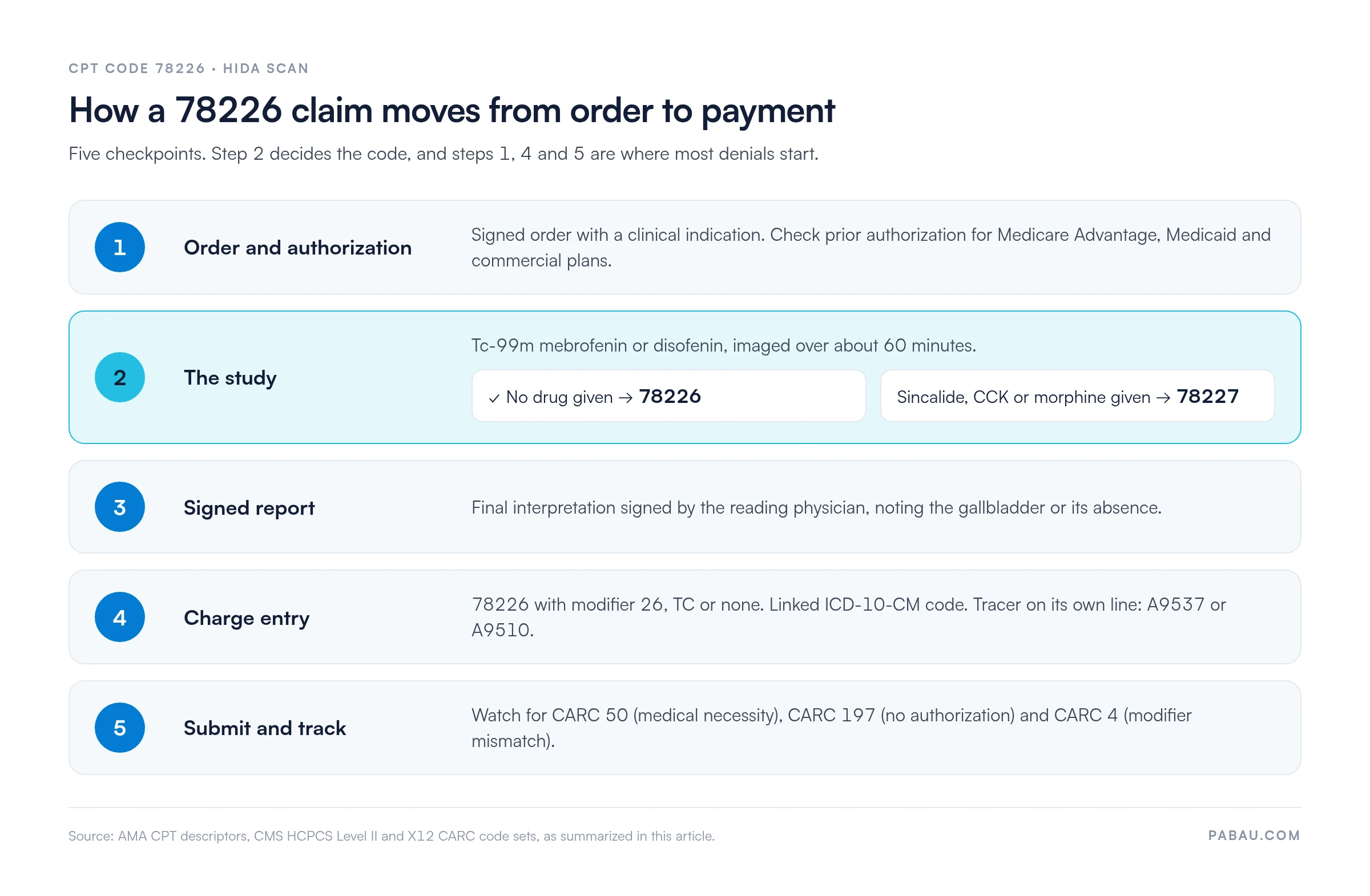
In practice, the handoffs trip claims up. The technologist knows whether morphine was given, but the coder only sees the report. If the report is silent, the coder guesses, and a wrong guess is either upcoding or lost revenue.
Nuclear medicine denials follow a predictable pattern. Tracking 78226 denials by reason, as part of your denial management workflow, shows you which process to fix.
Payers attach claim adjustment reason codes (CARCs) to each rejection. On HIDA scans, three come up most. CARC 50 means not medically necessary, and CARC 197 means precertification or authorization was absent. CARC 4 flags a procedure code inconsistent with the modifier. Look up any others in our guide to reading denial codes quickly.
Run a monthly denial report filtered to CPT code 78226. If CARC 197 (precertification/authorization/notification/pre-treatment absent) shows up more than twice from one payer, your scheduling team is missing that payer’s authorization rule. Fix the intake checklist before you rebill.
NCCI edits treat 78227 as the fuller version of the same study. Reporting both for one patient on one date triggers a column 1/column 2 edit, with 78226 as the bundled code. Modifier 59 only applies to two separate, fully documented sessions on the same day, which is rare.
The tracer is reported on its own HCPCS Level II line. For Tc-99m hepatobiliary agents, the codes are:
Whether the tracer pays separately depends on setting. Hospital outpatient departments usually have it packaged into the facility payment. Imaging centers billing in a non-facility setting are more likely to report it separately. The AAPC Codify CPT lookup shows bundling context alongside each descriptor.
Run through this list before the claim leaves your practice. It takes a minute and catches the errors covered above.
Most 78226 errors start at charge entry. Someone retypes the order, diagnosis and authorization number into a claim form, and one wrong digit sends it back.
Pabau removes most of that retyping. Its faster claims management pre-fills the CMS-1500 from the patient record. ICD-10 and CPT lookup libraries sit in the same screen. Before the claim can be sent, Pabau checks that required fields, such as the authorization number, are complete.
In the US, claims go out through Claim.MD, a clearinghouse that supports CMS-1500 and 837P submission. Your team can run eligibility checks, post ERAs and track claim status there, without logging into each payer portal.
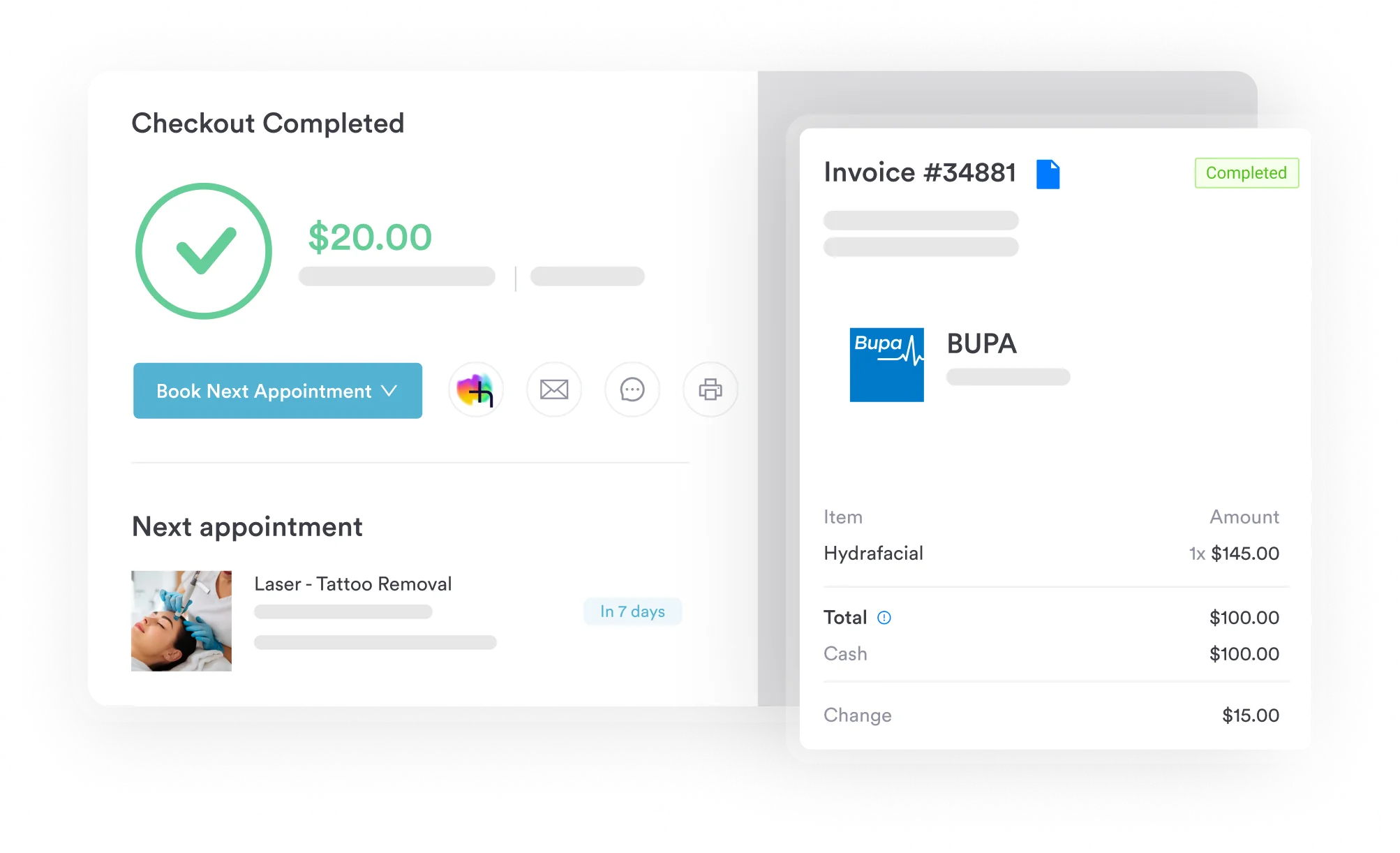

Pabau pre-fills the CMS-1500 from the patient record and checks required fields, like authorization numbers, before a 78226 claim goes out. US claims then route through Claim.MD with eligibility checks and ERA posting.

Settle the drug question before you pick a code. Ask the technologist, read the report, and make sure the report says what was given. Once that’s clear, a covered diagnosis, the right component modifier and an auth number on file remove most of the remaining risk.
The trade-off is a few extra minutes at scheduling and charge entry. That costs far less than reworking a denied nuclear medicine claim weeks later.
Book a demo to see how Pabau pre-fills and checks HIDA scan claims before they reach the clearinghouse.

Need a structured approach to claim denials? Denial management in healthcare covers the end-to-end denial workflow from CARC identification through appeals.
Want to understand what goes on a clean claim? Clean claim requirements explains every field payers check before adjudicating a nuclear medicine or radiology claim.
Looking for how clearinghouses fit into billing? Medical claims clearinghouses explains how 837P files, ERAs, and eligibility checks connect your practice to payers.
Checking coverage before the scan? Insurance eligibility verification shows what to confirm at intake so the claim doesn’t bounce.
Billing the drug-assisted version? CPT code 78227 covers HIDA scans with sincalide, morphine or another pharmacologic agent.
CPT code 78226 reports hepatobiliary system imaging, including the gallbladder when present, with no pharmacologic intervention. It’s the standard HIDA scan, also called cholescintigraphy.
78226 is billed when no drug is given during the study. 78227 is billed when sincalide/CCK or another pharmacologic agent, such as morphine, is given. It includes quantitative measurements, like gallbladder ejection fraction, when performed.
Standard imaging runs about 60 minutes. If the gallbladder hasn’t filled, the physician may add delayed images or give morphine. Delayed images alone keep the study under 78226. Morphine moves it to 78227.
Yes. A HIDA scan is a common way to look for a bile leak after gallbladder or liver surgery. If no drug is given, 78226 applies. The diagnosis code should describe the postoperative complication.
A right upper quadrant ultrasound is usually reported with 76705, a limited abdominal ultrasound. A complete abdominal study is 76700. Ultrasound is often done first, with a HIDA scan ordered when results are unclear.



