CCSD Code M6530: Endoscopic resection of prostate (TUR)
CCSD Code M6530: Definition and clinical scope CCSD Code M6530 is the UK private...

Last Updated: Nov 6, 2026
76885 is the CPT code for a dynamic ultrasound of an infant's hips, performed in real time with imaging documentation. The descriptor requires the physician or other qualified health care professional to manipulate the hips during the scan. Stress views that reproduce the Barlow and Ortolani maneuvers are the typical example.
A static exam without manipulation, such as a Graf-only morphology study, is reported with 76886 instead. The descriptors say nothing about laterality, so the choice between the two codes turns on technique alone.
Let Pabau's smart automation suggest the right codes, reduce claim denials, and keep your practice compliant—effortlessly.
Automate repetitive tasks and focus on what matters most—your patients.
Reduce coding errors and ensure compliance with the latest regulations.
Clean claims, fewer denials, and faster reimbursements.
Powerful insights and reporting to help your practice thrive.
HIPAA compliant SOC 2 certified GDPR-compliant Trusted by 4,000+ clinics worldwide

CPT code 76885 reports a dynamic infant hip ultrasound, where the physician or other qualified health care professional manipulates the hips during real-time imaging.
A static exam with no manipulation, including a Graf-only morphology study, is reported with 76886 instead of 76885.
Neither descriptor mentions laterality, so one unit of 76885 covers the session and modifier 50 adds no Medicare payment.
The Medicare NCCI edits list 76886 as a column 2 code to 76885, so bill only the code that matches the technique performed.
The CY2026 national non-facility total is 3.94 RVUs, about $132.26 at the QP conversion factor or $131.60 at the non-QP factor.
CPT code 76885 reports a real-time ultrasound of an infant’s hips with imaging documentation, performed dynamically. “Dynamic” means the physician or other qualified health care professional manipulates the hips during the scan. “Imaging documentation” means permanent images are archived and a signed written report is produced.
The exam is designed for infants. The femoral head is still largely cartilage in early infancy, so X-ray is unreliable before roughly four to six months of age. Ultrasound shows the cartilaginous structures that X-ray cannot, which is why DDH imaging in young infants relies on it.
The descriptor says nothing about which side is scanned. What separates 76885 from its sibling 76886 is technique. 76885 requires manipulation, while a static exam without manipulation goes to 76886.
Medical necessity for CPT code 76885 rests on recorded clinical suspicion or confirmed risk for developmental dysplasia of the hip. Payers require a supporting ICD-10 code that ties back to one of these clinical scenarios.
The American Academy of Pediatrics (AAP) advises selective imaging for infants with DDH risk factors, typically ultrasound at around six weeks of age. Universal ultrasound screening is not standard practice in the US.
Under the AMA CPT code set, 76885 applies only when the hips were manipulated under real-time imaging. A static study without manipulation, including a Graf-only morphology exam, is reported with 76886.
76885 is the dynamic exam, with the physician or other qualified health care professional manipulating the hips. 76886 is the limited, static exam, with no manipulation required. The report decides which code applies, so it must state whether stress maneuvers were performed.
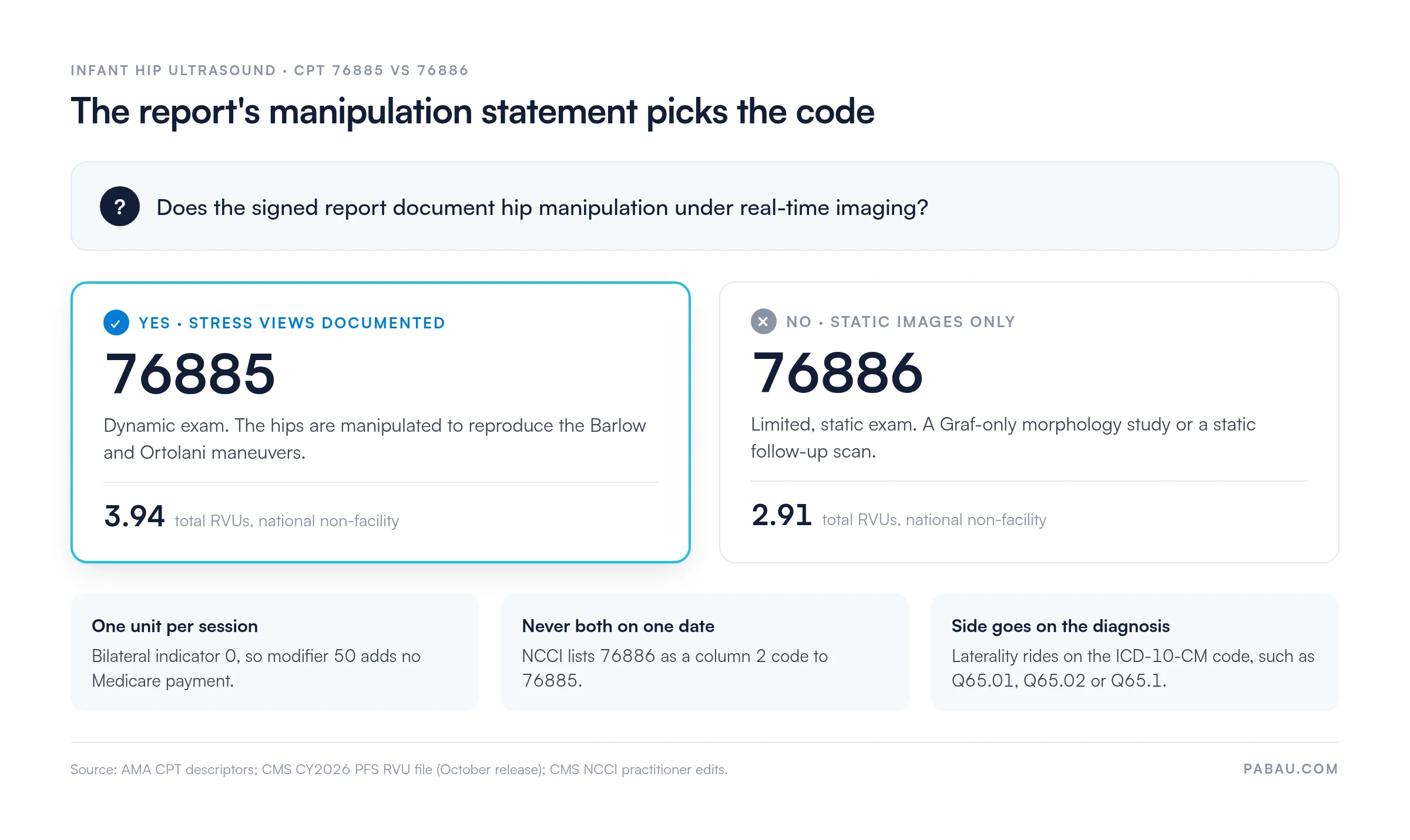
NCCI edit: the Medicare NCCI practitioner edits list 76886 as a column 2 code to 76885, with the rationale “HCPCS/CPT procedure code definition.” The edit carries modifier indicator 1, but a dynamic exam already includes the static views. Bill 76885 alone when manipulation was performed. If a planned dynamic exam ends without manipulation, bill 76886 and note why.
Every 76885 claim needs at least one diagnosis code that supports medical necessity. The Q65 category (congenital deformities of hip) covers the main DDH findings.
The ICD-10-CM code, not 76885, carries the side. Q65.01 and Q65.02 name the right or left hip, and Q65.1 reports bilateral dislocation. Q65.00 is a unilateral dislocation with the side unspecified, so query the side before you bill it.
Check ICD-10 pairing against your Medicare contractor’s coverage policies and each commercial payer’s rules. Accepted diagnoses can differ by jurisdiction and by plan.
The Graf method uses a standard coronal view to classify hip morphology, and on its own it is a static technique. A 76885 exam adds dynamic stress views, with the hips manipulated to reproduce the Barlow and Ortolani maneuvers under real-time imaging. A clean claim submission for 76885 depends on the report showing that manipulation took place.
Your report must show the following to support a 76885 claim:
For imaging codes, the radiology report must exist in the medical record before the claim is submitted. It cannot be added retroactively once the claim is queried.
76885 has no side in its descriptor, and the CY2026 Medicare fee schedule gives it bilateral surgery indicator 0. That indicator means the 150% bilateral payment adjustment does not apply. With modifier 50, or with RT and LT, Medicare still pays no more than 100% of one fee schedule amount.
Medicare guidance: Bill 76885 once per session, without modifier 50. Reporting the code twice with RT and LT does not raise the allowed amount. For commercial plans and Medicaid, check the payer’s billing guidelines directly, as policies vary.
Reimbursement for CPT code 76885 comes from the CMS Medicare Physician Fee Schedule (MPFS). Rates change every year and vary by region. The figures below are national amounts from the CY2026 RVU file, October release. Check the CMS Physician Fee Schedule lookup tool for your regional rate.
CY2026 uses two conversion factors. The QP factor of $33.5675 applies to qualifying APM participants, and the non-QP factor of $33.4009 applies to every other clinician.
Each payment is the total RVU multiplied by the conversion factor, before the geographic adjustment for your area. The professional component pays the same 1.02 RVUs in any setting. In a hospital, the facility bills the technical portion under its own payment system, so the global and technical rows apply only outside it.
Pabau, the practice management platform we build, sends claims through Claim.MD, its US clearinghouse partner, and posts electronic remittances back to the patient record. Clearinghouse rejections come back before the claim reaches the payer. A missing modifier or diagnosis is then corrected at that stage instead of after a denial.
Medicare does not require prior authorization for CPT code 76885 under current coverage policy, but claims can still be reviewed. Commercial payers and Medicaid managed care organizations (MCOs) vary widely. Some require PA for all outpatient imaging, while others exempt studies on children with a recorded risk factor.
Commercial payers usually want the ordering provider’s notes on DDH risk factors or exam findings. Add the patient’s date of birth and the planned ICD-10 codes with laterality specified.
Good insurance eligibility verification at scheduling catches PA requirements before the exam takes place. Adding coverage checks to the booking workflow removes the most avoidable 76885 denial.
If a payer requires PA, request it for the code that matches the planned technique. A PA approved for the static exam (76886) does not cover a dynamic exam billed as 76885.
Most 76885 denials fall into six patterns. Each one is preventable at the billing or booking stage.
Strong denial management workflows catch these errors before submission rather than after a remittance arrives. Claims management software keeps the claim, the clearinghouse response, and the remittance on one record. A rejected 76885 claim is then quick to correct and resend.
Where the exam is performed changes who bills what and at what rate. The main scenarios are a hospital outpatient department and a physician office or independent pediatric practice.
When the same physician performs and interprets the exam and owns the equipment, global billing (no modifier) is correct in a non-facility setting. Billing global in a facility setting where the hospital absorbs the technical cost is a compliance error. Confirm component ownership before submitting.
Coders working with pediatric and musculoskeletal imaging meet several codes alongside CPT code 76885. The table below covers the codes most often confused with it or ordered with it. Codes outside this group sit in our full CPT codes library.
For joint ultrasound outside the infant hip codes, bill CPT code 76881 for a complete joint exam. A limited or focal extremity study goes to CPT code 76882 instead.
Run a quarterly audit of 76885 and 76886 claims. Flag any date of service where both codes appear for one patient, and any 76885 claim whose report never mentions manipulation. Most billing software can produce that report in a few minutes.
Infant hip ultrasound claims usually fail on details the report already holds. The usual causes are unrecorded manipulation, a diagnosis that misses the side, or a skipped PA check.
Pabau keeps booking, coverage checks, clinical notes, and billing on one patient record. Its claims management software pulls the details already on that record into the claim and sends it through Claim.MD. Remittances post back automatically, so your team sees a denial in the same place it fixes one.
The coding decision stays with your coders. Pabau puts the report, the order, and the claim history side by side when they make it.

Pabau connects scheduling, eligibility checks, claims submission, and remittance tracking in one platform. See how pediatric and imaging practices keep each 76885 claim linked to the report behind it.

CPT code 76885 turns on one fact: whether the hips were manipulated under real-time imaging. If the report shows stress maneuvers, 76885 is correct. If it shows a static study, the claim belongs to 76886, however many hips were scanned.
Build that check into the report template rather than the billing queue. The code, the Q65 diagnosis and its side, and the single unit per session then follow from the record.
Book a demo to see how Pabau keeps the report, the claim, and the remittance together for imaging and pediatric practices.

Following a DDH case past early infancy? CPT code 72170 covers the pelvic X-ray that takes over once the femoral heads ossify.
Imaging both hips in an older child? CPT code 73521 explains the bilateral hip X-ray with pelvis, 2 views.
Need a denial management framework? Denial management in healthcare covers root-cause analysis, appeal workflows, and tracking metrics for billing teams.
Want to understand how clearinghouses fit into the billing cycle? How Claim.MD clearinghouse works explains real-time eligibility, 837P claim submission, and ERA posting in plain language.
New to the billing cycle? What is medical billing breaks down the end-to-end billing cycle from patient registration through payment posting.
CPT code 76885 covers a dynamic real-time ultrasound of an infant’s hips with imaging documentation. The physician or other qualified health care professional manipulates the hips during the scan. It is used mainly to assess developmental dysplasia of the hip (DDH) before the femoral heads ossify enough for X-ray.
76885 is the dynamic exam, which requires manipulation of the hips during scanning. 76886 is the limited, static exam with no manipulation, such as a Graf-only morphology study. Neither descriptor mentions laterality. NCCI edits pair the two, so bill only the code that matches the technique performed.
Medicare does not require prior authorization for 76885 under current national coverage policy. Commercial plans and Medicaid managed care organizations vary widely, and some require PA for all outpatient imaging. Run eligibility and PA checks at scheduling to avoid post-service denials.
Generally no. The Medicare NCCI practitioner edits list 76886 as a column 2 code to 76885 on the same date of service. A dynamic exam already includes static imaging, so bill the code that matches the technique and document it in the report.
Under the CY2026 Medicare Physician Fee Schedule, 76885 carries 3.94 total non-facility RVUs, made up of 0.72 work, 3.16 practice expense, and 0.06 malpractice. That is about $132.26 nationally at the QP conversion factor and $131.60 at the non-QP factor. Use the CMS lookup tool for your regional rate.