



CCSD code G5100: Bypass of duodenum billing guide
CCSD code G5100 bills a bypass that leaves the duodenum in place CCSD code G5100...

Last Updated: Oct 16, 2026

CPT Code 72170 describes a radiologic examination of the pelvis with 1 or 2 views. The AMA maintains it, and radiology, orthopedics, and primary care all bill it.
The CY2026 work RVU for 72170 is 0.17 and the total RVU is 0.84. There is no practice expense split, so facility and non-facility pay the same. National unadjusted payment is about $28.06 to $28.20.
72190 is the only other current code in this family, and view count is the sole differentiator. CPT 72180 was deleted in 1998 and is no longer billable.
Modifier 26 (professional component) and TC (technical component) are the most common modifiers applied to 72170 when the technical and professional components are billed separately.
Pabau’s claims management software validates coded radiology claims, checks modifiers, and routes them to the payer. Your coders still assign the diagnosis codes, and the scrub catches mismatches before submission.
CPT Code 72170 is the billing code for a radiologic examination of the pelvis with one or two views. It carries most plain pelvic X-ray claims. The documented view count is the only thing separating it from 72190.
This reference sets out the AMA descriptor, CY2026 RVU values and Medicare rates, the modifiers that apply, and the ICD-10 pairings payers expect. A dedicated section compares 72170 with 72190, the only other current pelvic X-ray code.
Official AMA descriptor: Radiologic examination, pelvis; 1 or 2 views.
CPT Code 72170 is the correct billing code for a basic pelvic X-ray producing one or two radiographic views. It sits within the Diagnostic Radiology subsection of the Radiology chapter, under the “Spine and Pelvis” grouping (codes 72020-72295). The AMA CPT code set assigns this code to examinations limited to the pelvis itself. It does not extend into the lumbar spine or hip joint as separate structures.
Specialties that commonly bill 72170 include diagnostic radiology, orthopedic surgery, emergency medicine, obstetrics and gynecology, and primary care when in-office imaging is performed. The procedure itself is brief. The patient is positioned supine, or standing for weight-bearing views. The radiograph captures the bony pelvis, including the iliac wings, sacrum, pubic symphysis, and proximal femora.
When 72170 applies:
Relative value units (RVUs) determine how Medicare calculates payment for CPT Code 72170. The CMS RBRVS system assigns three RVU components: work (wRVU), practice expense (PE RVU), and malpractice (MP RVU). Practice expense values often differ by place of service, but 72170 is one of the codes CMS values identically in both settings.
These values come from the official CMS CY2026 National Physician Fee Schedule relative value file (RVU26A). Third-party RVU lookup sites often lag the annual file, so treat the CMS release as the source of record. Verify current-year figures against the CMS Physician Fee Schedule lookup tool, as RVU values are updated annually with each January 1 effective date.
Medicare payment for CPT Code 72170 is calculated as Total RVU x Geographic Adjustment x Conversion Factor (CF). CMS finalized two conversion factors for CY2026. Qualifying APM participants are paid at $33.5675, and all other clinicians are paid at $33.4009.
Because the practice expense RVU for 72170 does not split by place of service, the facility and non-facility payments are the same. Geographic Practice Cost Indices (GPCIs) still move the final number by Medicare Administrative Contractor (MAC) region. The rates below are unadjusted national amounts.
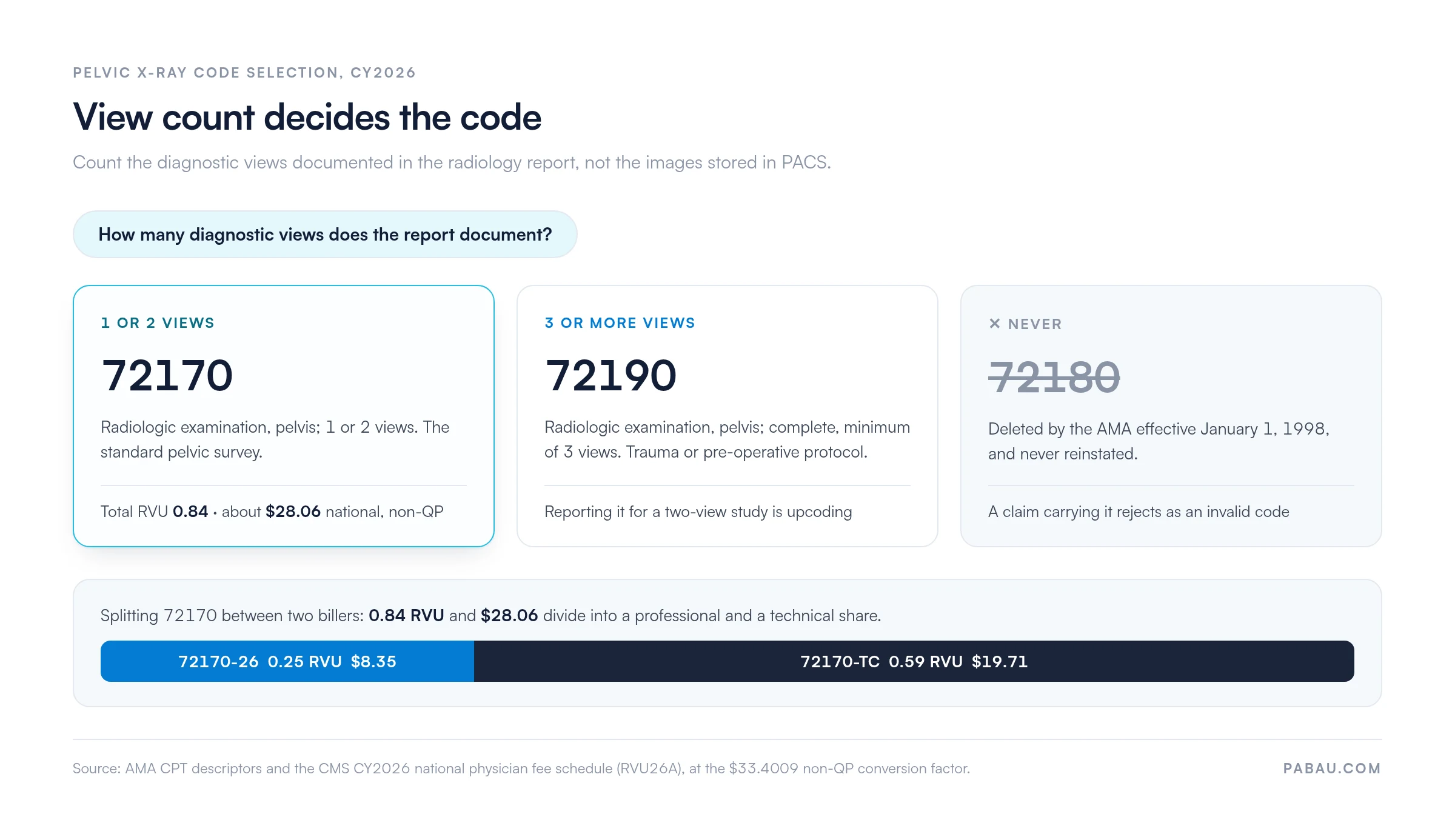
The setting does not change what Medicare pays for 72170. The component billed does. A radiologist reading a study taken on someone else’s equipment bills 72170-26 and is paid the professional amount only, while the equipment owner bills 72170-TC.
The two component values add back to the global total of 0.84. If a split-component claim pays noticeably more or less than these amounts, look at your locality first. The GPCI adjustment explains the difference far more often than a coding error.
Regional MAC variation is material. High-cost geographic areas such as Manhattan and San Francisco receive higher GPCI adjustments, producing payments meaningfully above the national averages above. Use the CMS Physician Fee Schedule lookup with your specific MAC locality to get the precise rate for your practice location.
Run a quarterly fee schedule audit using your practice’s specific MAC locality code. National average Medicare rates for CPT Code 72170 can differ by several dollars from your actual payment. Locality-specific rates are available directly in the CMS MPFS lookup tool under ‘Search the Physician Fee Schedule.’
Modifier selection for 72170 depends on the billing arrangement between the radiologist and the facility. Modifier denials on this code usually come down to one mismatch. The claim bills the global code when a split-component arrangement is in place, or the reverse.
The global billing arrangement (no modifier) applies when a single provider or group owns both the technical equipment and performs the professional interpretation. Confirm your billing arrangement in writing before submitting. Modifier 26 and TC are mutually exclusive on the same claim line.
Medical necessity documentation drives pelvic X-ray coverage decisions. Payers expect an ICD-10-CM diagnosis code that clinically justifies the imaging order. The following codes represent the most frequently paired diagnoses, consistent with CDC ICD-10-CM classifications. Our ICD-10-CM code library carries the full descriptor and coding notes for each one.
Two details in that table trip coders up. Fracture codes need a seventh character, which is why the table shows M84.552A. And M84.5- covers pathological fracture in neoplastic disease, so an osteoporotic fracture takes an M80.- code instead.
Document the specific clinical indication in the order and in the medical record before submitting. Payers audit pelvic X-ray claims for medical necessity, particularly when paired with broadly worded diagnosis codes like R10.2. A Local Coverage Determination (LCD) from your MAC may further restrict covered indications.
A correctly coded 72170 claim can still fail a post-payment review if the record behind it is thin. Post-payment reviews of plain radiography turn on documentation more often than on code selection.
Required documentation elements for a 72170 claim:
Keep the signed report in the patient record and retrievable on request. Missing or unsigned reports are among the most cited deficiencies in MAC post-payment reviews of radiology claims.
Two current CPT codes describe a plain pelvic X-ray, and view count is the only thing separating them. 72170 covers one or two views. 72190 covers a complete study with a minimum of three views. Reporting 72190 for a two-view study is upcoding and creates audit exposure.
72180 is not a billable code. The AMA deleted CPT 72180 effective January 1, 1998, and it has never been reinstated. A claim carrying 72180 rejects as an invalid code. Legacy chargemasters and older reference material still list it. Check your fee schedule for a stale entry and map it to 72170 or 72190 by documented view count.
Decision rule: Count the diagnostic views documented in the radiology report. One or two views is 72170. Three or more views is 72190. Never code from the number of images saved to PACS. The chart below sets out all three outcomes, including the one that is never billable.
Accurate billing for 72170 requires more than correct code selection. Payer policies, NCCI edits, and documentation requirements all affect whether a claim pays on first submission.
When claims do deny, group them by reason code before reworking any of them. The payer’s reason and remark codes name the documentation element that failed. Fixing that element clears the whole batch, not one claim at a time.
Yes, CPT Code 72170 and CPT 73502 can be billed together. The AMA descriptor for 73502 reads “Radiologic examination, hip, unilateral, with pelvis when performed; 2-3 views.” It carries no weight-bearing qualifier.
Both studies need separate orders, and each must be documented independently in the radiology report. They describe anatomically distinct structures. 72170 covers the pelvis proper. 73502 is a dedicated hip examination centered on the femoral head and acetabulum.
Check current NCCI edit pairs before submitting. If an edit exists between 72170 and 73502 for your encounter date, you may need Modifier 59 or XS. Documentation must support billing the two studies as separate structures. Check your MAC’s NCCI table for the encounter date before appending any modifier.
High-volume, low-value codes like 72170 are where manual billing workflows fail most often. A team keying dozens of pelvic X-ray claims a day mistypes a view count or drops a modifier. Sometimes it attaches a diagnosis the payer will not cover. At roughly $28 a claim, reworking the denial can cost more than the payment.
Practice management software like Pabau catches this at the point of claim creation. Its claims software for radiology scrubs the CPT code against active NCCI edits and flags modifier mismatches before submission. The scrub also checks that the diagnosis codes your coders attached sit on the payer’s covered list.
From there, Pabau’s Claim.MD integration routes the coded claim to any of 4,000+ US payers and tracks the response. It returns eligibility checks and files Electronic Remittance Advice (835 ERAs) against the claim. Pabau does not select diagnosis codes, so your coders keep control of what the claim says.

A practice billing CPT 72170 regularly gets three practical benefits:
At 72170’s dollar value, manual rework rarely pays for itself. Catching the error before submission is what keeps the claim out of the denial queue.
Audit your last 90 days of 72170 claims for modifier consistency. If your practice has both in-house imaging and hospital-based radiologists interpreting, inconsistent modifier application is the most common source of payer refund requests. A quarterly modifier audit takes 30 minutes and prevents write-offs that accumulate quietly.

Pabau’s claims management software checks coded radiology claims for modifier and covered-diagnosis mismatches, then routes them to the payer and tracks the response. See how it works for your practice.

72170 pays about $28, which is exactly why it needs a process rather than attention. A code this small cannot absorb a rework cycle. The margin on it lives entirely in the first submission.
Pull your fee schedule entry for 72170 and check three things:
Those three checks close most of the denial routes on this code. The trade-off worth remembering is that no claim scrub can supply medical necessity. If the order does not say why the pelvis was imaged, no software will make the claim payable. Book a demo to see how Pabau moves radiology claims from order to remittance.

Need to understand denial reason codes on 72170 claims? Denial management in healthcare explains how to categorize payer denial codes and address root causes before they compound.
Wondering how clearinghouse claim submission works end to end? Medical claims clearinghouse overview covers 837P file routing, real-time eligibility, and ERA processing for outpatient claims.
Looking for a reference on medical billing fundamentals for your coding team? Superbill guide explains how charge capture documents connect to CPT and ICD-10 code selection before claims submission.
CPT Code 72170 is a radiologic examination of the pelvis with 1 or 2 views, as defined by the American Medical Association CPT code set. It is used when a basic pelvic X-ray is performed and only one or two diagnostic views are captured and reported.
Medicare pays about $28.06 for 72170 under the non-qualifying CY2026 conversion factor of $33.4009. Practices that qualify as APM participants are paid at $33.5675, or about $28.20. The amount is the same in facility and non-facility settings, and actual payment varies by MAC locality and GPCI adjustment.
No. The AMA deleted CPT 72180 effective January 1, 1998, and it has never been reinstated. A claim submitted with 72180 rejects as an invalid code. The two current pelvic X-ray codes are 72170 and 72190.
The most common modifiers are 26 (professional component only) and TC (technical component only), used when interpretation and equipment billing are split between providers. Modifier 52 applies when services were reduced. Bill global (no modifier) only when a single entity owns the equipment and performs the interpretation.
The CY2026 work RVU for 72170 is 0.17, the practice expense RVU is 0.65, and the malpractice RVU is 0.02. Total RVU is 0.84. The practice expense value does not split by place of service, so the total is the same in facility and non-facility settings.



