



CCSD code G5100: Bypass of duodenum billing guide
CCSD code G5100 bills a bypass that leaves the duodenum in place CCSD code G5100...

Last Updated: Oct 16, 2026

CPT code 76770 reports a complete retroperitoneal ultrasound of the kidneys, aorta, common iliac artery origins, and inferior vena cava.
A study of the kidneys and urinary bladder also counts as complete when the history points at urinary tract disease.
Medicare’s 2026 national allowance is $106.21 global, $34.07 for the professional component, and $72.15 for the technical component.
Three ICD-10 codes often paired with 76770, including R59.0 and R19.09, are missing from Palmetto’s A55336 covered list.
NCCI treats 76700 as the comprehensive code, so any bypass modifier belongs on 76770 rather than on 76700.
CPT code 76770 bills a complete retroperitoneal ultrasound: kidneys, abdominal aorta, common iliac artery origins, and inferior vena cava. One word decides the claim, and that word is complete. Leave a structure out of the report and the study belongs on 76775 instead.
Medicare’s 2026 national allowance for the global service is $106.21, and two thirds of that sits in the technical component. Scope, diagnosis code, and modifier all have to agree before the claim goes out, or the payer sends it back. Start with what counts as complete, because every other decision on the claim follows from it.
A complete retroperitoneal ultrasound means real-time scans of the kidneys, the abdominal aorta, the common iliac artery origins, and the inferior vena cava.
Any retroperitoneal abnormality the sonographer demonstrates goes in the report as well. The AMA descriptor reads: Ultrasound, retroperitoneal (eg, renal, aorta, nodes), real time with image documentation; complete.
There is a second route to complete, and it is the one most renal studies take.
When the history points at urinary tract disease, kidneys plus urinary bladder also counts as a complete retroperitoneal ultrasound. That is why a renal survey with bladder views codes to 76770 rather than 76775.
So a supportable 76770 report addresses each of the following:
Medicare adds a limit on top of that. Billing and Coding Article A55336 (companion to LCD L34577) expects 76770, 76775, and 76776 only when the exam stayed inside the retroperitoneum.
If the sonographer also looks at the gallbladder, liver, or spleen, the study has become an abdominal ultrasound and bills as 76700 or 76705.
Nor can you have it both ways. The A55336 article says plainly that billing a retroperitoneal study and an abdominal study together is not appropriate when the exam simply expanded. One study, one code.
Real-time image documentation is part of the descriptor, not an extra. Stored images have to correspond to the structures the report discusses.
A narrative with no images attached does not meet the definition, however thorough the narrative is.
Bill 76770 when the report covers the full retroperitoneal survey, and 76775 when it covers one or two structures.
That single decision moves $45.42 on the 2026 national allowance, which is exactly why auditors look at it. The choice is not a judgment call, though. It is settled by what the report documents.
Read the report before you pick. Findings for kidneys, aorta, iliac origins, and inferior vena cava support 76770, and so does a kidneys-plus-bladder study on a urinary indication.
A note that only addresses the right kidney after a stone treatment is a 76775. Upcoding that study is the single easiest error for a payer to spot, because the report says what was examined.
Medical necessity drives more 76770 denials than any other cause, and the diagnosis code decides it. Palmetto GBA lists 797 ICD-10-CM codes that support a retroperitoneal ultrasound in Article A55336.
Several codes that coding round-ups routinely pair with 76770 are not among them.
Two caveats before you rebuild your diagnosis crosswalk around this. A55336 belongs to Palmetto GBA. It applies in jurisdictions J and M, covering Alabama, Georgia, Tennessee, South Carolina, Virginia, West Virginia, and North Carolina.
Other contractors may publish no policy at all for retroperitoneal ultrasound, so confirm your own before you rely on the list.
The pattern travels even where the policy does not. Unspecified codes fail medical necessity far more often than specific ones.
If you are pulling diagnoses from a shared ICD-10-CM code library, check the descriptor against the report rather than reusing last year’s favorite.
The report carries the claim. A payer reviewing 76770 wants proof that the study happened, that a physician read it, and that the order had a reason. Six items do that work.
One phrase deserves a note. “Limited by body habitus” is acceptable when it is accurate, and it does not knock the study down to 76775.
What it cannot do is stand in for a structure nobody tried to image. Document the attempt, then document why the view failed.
Which modifier you use depends on two questions: who owns the machine, and who reads the study. If the answer to both is your practice, you bill 76770 with no modifier at all and collect the global amount.
Modifier 26 and modifier TC never appear on the same line from the same provider. Between them they equal the global service, so billing both is billing the same work twice.
Modifier 52 also deserves a second look before you use it. If the sonographer only managed one or two structures, the honest answer is usually 76775 rather than a reduced 76770. Reach for 52 when a genuinely complete study was interrupted.
Medicare prices 76770 from relative value units. Multiply the total RVUs by the conversion factor, then adjust for your locality’s geographic practice cost indices.
The national figures below come from the 2026 relative value file at the $33.4009 conversion factor.
Set the three 76770 rows next to each other and the shape of the code becomes obvious. The equipment and the sonographer carry most of the value, and the read carries the rest.
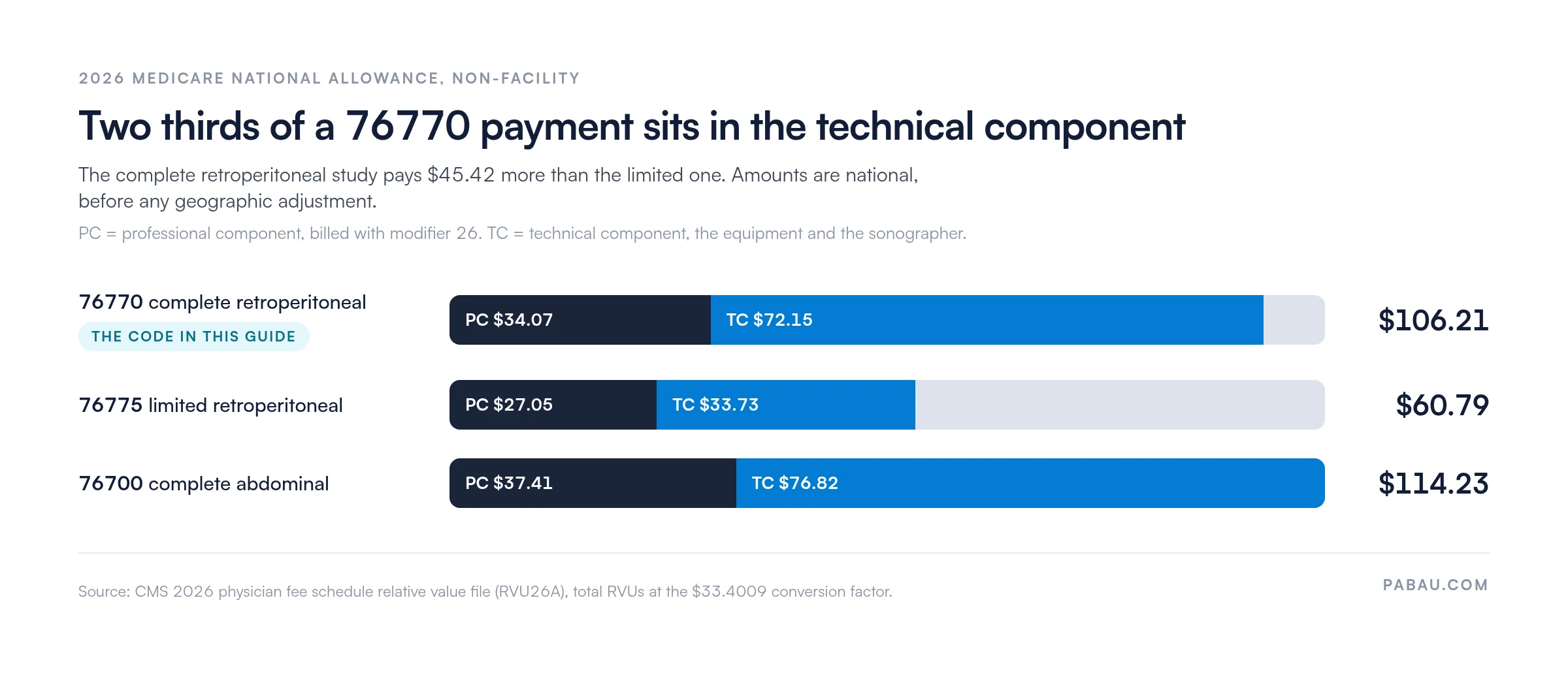
There is no facility global rate for 76770, which surprises people. The fee schedule marks the facility practice expense as not applicable. In a hospital outpatient department the physician bills 76770-26 for $34.07, and the hospital is paid separately under the outpatient system.
One more wrinkle is new enough that most fee tables miss it. Medicare runs two conversion factors in 2026: $33.4009 for most billers, and $33.5675 for qualifying alternative payment model participants.
The same 76770 claim allows $106.21 under the first and $106.74 under the second. Check the CMS fee schedule look-up tool for your locality and your status.
Commercial payers usually sit above Medicare, often by 10% to 40%, but only your contract says by how much. Compare each remittance against the contracted rate rather than against the Medicare figure.
Flag any 76770 payment that lands below your contracted rate, then appeal it with the remittance detail attached. Payers often apply the wrong locality row when a code is miskeyed on submission. A standing remittance review catches those underpayments while the filing window is still open.
The National Correct Coding Initiative, or NCCI, publishes quarterly edits that say which code pairs can go out together. For 76770 the pair that matters is 76700, the complete abdominal ultrasound. The two studies overlap, because a complete abdominal exam already views the kidneys and the upper aorta.
Direction is where coders trip. In the procedure-to-procedure edit, 76700 sits in column one as the comprehensive code and 76770 sits in column two. So when both go out on the same date of service, 76770 is the line that drops.
That also settles where the modifier goes. If the two studies were genuinely separate and separately ordered, the NCCI-associated modifier belongs on 76770, the column two code. Modifier 59 or one of the X modifiers, XE, XP, XS, or XU, tells the payer which circumstance applies. Appending it to 76700 has no effect.
Even then, expect scrutiny. A55336 says it is not appropriate to bill a retroperitoneal study alongside an abdominal one when the retroperitoneal exam simply expanded mid-scan. Two orders, two indications, and two reports are what make the pair defensible.
76770 and 76775 never go out together for the same patient on the same date. Complete or limited, pick one. Edit pairs change every quarter. Pull the current table from the NCCI edit files rather than trusting any list in an article, including this one.
Most 76770 problems are baked in long before anyone opens the billing screen. Here is the path a clean one takes.
Worked through with numbers, it looks like this. A nephrologist orders a renal ultrasound for stage 3b chronic kidney disease. The sonographer scans both kidneys and the bladder, and the radiologist reports both. The history points at urinary tract disease, so the study is complete.
The practice owns the scanner and employs the radiologist, so the claim goes out globally with no modifier. Code 76770, diagnosis N18.32, place of service 11. Allowed amount before locality adjustment: $106.21. Every step was routine, and that is the point.
Retroperitoneal ultrasound denials cluster tightly. Each of the five below has a fix that belongs in the workflow rather than in the appeal queue.
Eight questions, answered in order, catch nearly all of the above:
Practices that run this check as part of submission rather than as an audit afterwards see the difference in first-pass acceptance. A clean claim costs a couple of minutes up front and saves a fortnight of chasing.
In most practices the claim gets rebuilt by hand. Someone retypes the CPT code onto the form, then opens a second window to look up the diagnosis. The missing membership number only surfaces after the payer rejects the file.
Practice management software like Pabau closes that loop inside the record. The code attached to the service lands on the charge line, and the diagnosis slots seed from the client’s recorded problem list.
Built-in ICD-10-CM and CPT libraries let a coder confirm a descriptor without leaving the claim. Required fields are validated before the send button unlocks, so a claim missing an authorization number does not go anywhere.
US claims route out through Claim.MD. That gives you real-time eligibility checks, claim status tracking, and remittance posting in the same place as the client record.
When a 76770 claim comes back denied, the CARC code sits next to the visit it belongs to. Your biller can work the appeal without opening a second system. Pabau’s cleaner claims management is built around that single record.
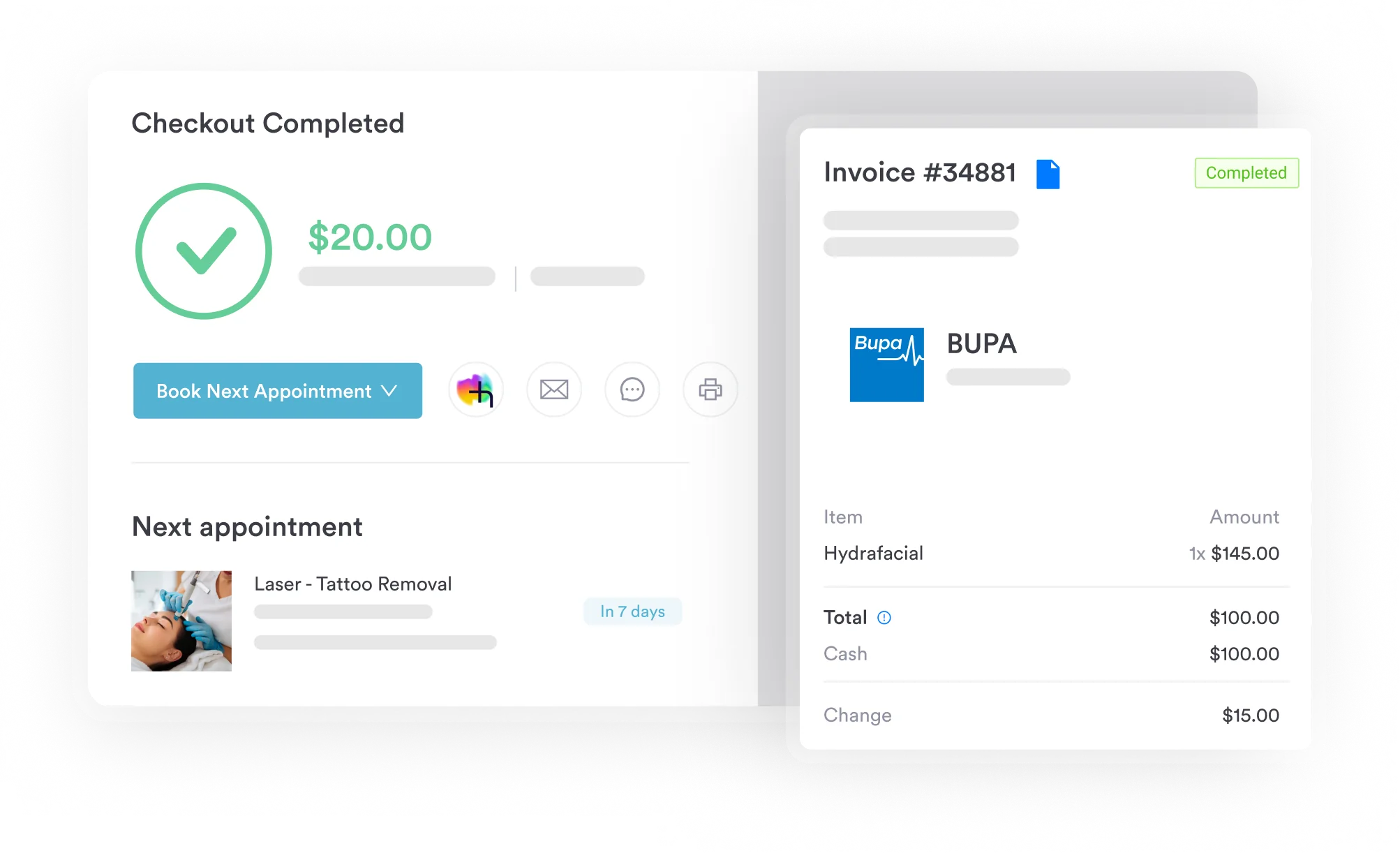

Pabau’s claims management fills the CMS-1500 from the client record and checks the required fields before the claim can be sent. US claims route through Claim.MD for eligibility checks, claim status, and remittance posting.

76770 is not a difficult code. It is a strict one. The report decides whether you may bill it, the diagnosis decides whether you get paid for it, and the modifier decides how much lands.
If you change one habit after reading this, make it the diagnosis. Coders reach for the unspecified code because it is quick, and unspecified codes are the ones that fall off covered lists. Pull the specific one from the report instead, and a large share of your medical necessity denials stop happening.
The rest is process. Same checks, same order, every claim. Book a demo to see how Pabau builds the 76770 claim from the record and tracks it through to the remittance.

Working through a stack of denied imaging claims? Denial management in healthcare sets out how to triage denials by cause and stop the repeat offenders.
Not sure what your remittance is telling you? Electronic remittance advice explains how to read an ERA and spot an underpayment against your contracted rate.
Wondering where a claim goes after you hit send? Medical claims clearinghouse walks through the route to the payer and the checks that catch errors first.
Need the file format behind an electronic claim? The 837 electronic claim file breaks down what each loop carries and where imaging claims fail validation.
Comparing clearinghouses for a US practice? The Claim.MD clearinghouse guide covers eligibility checks, remittance processing, and payer enrollment.
No. 76770 carries an XXX global indicator on the Medicare fee schedule, so no pre-operative or post-operative period applies. An evaluation and management service on the same day is separately reportable when the record supports it.
No. 76770 has a bilateral surgery indicator of 0, so the bilateral payment adjustment does not apply. Report it with modifier 50, or with RT and LT, and Medicare still pays no more than the single-code amount.
Yes. 76770 carries multiple procedure indicator 4 and diagnostic imaging family 88. When another imaging study runs in the same session, the highest-priced technical component pays in full and each later one drops by 50%. The professional component of the later service drops by 5%.
No. Medicare pays for AAA screening under its own code, 76706, with its own coverage rules. Use 76770 for a diagnostic retroperitoneal study ordered because of signs, symptoms, or a known condition.
Palmetto GBA does, through LCD L34577 and Billing and Coding Article A55336. It applies in jurisdictions J and M: Alabama, Georgia, Tennessee, South Carolina, Virginia, West Virginia, and North Carolina. Other contractors may publish no policy, so check yours before relying on a covered code list.



