

HCPCS Code E0272: Foam rubber mattress billing guide
HCPCS Code E0272: official descriptor and code overview HCPCS Code E0272 is the ...

Last Updated: Nov 6, 2026
76506 is the CPT code for echoencephalography, real time with image documentation (gray scale). It measures ventricular size, delineates cerebral contents and detects fluid masses or other intracranial abnormalities. A-mode encephalography is included as a secondary component where indicated.
The code sets no age limit and no scanning approach, although neonatal head ultrasound through the fontanel is its most common use. It sits in the Diagnostic Ultrasound section of the AMA CPT code set (76506-76999). Coders most often confuse it with 76536, which covers soft tissue of the head and neck.
Let Pabau's smart automation suggest the right codes, reduce claim denials, and keep your practice compliant—effortlessly.
Automate repetitive tasks and focus on what matters most—your patients.
Reduce coding errors and ensure compliance with the latest regulations.
Clean claims, fewer denials, and faster reimbursements.
Powerful insights and reporting to help your practice thrive.
HIPAA compliant SOC 2 certified GDPR-compliant Trusted by 4,000+ clinics worldwide

CPT code 76506 describes echoencephalography: Real-time, gray-scale ultrasound of the brain and intracranial structures with stored image documentation.
The descriptor sets no scanning approach and no age limit. Neonatal head ultrasound through the fontanel is its most common use, but any patient with a sonographic window qualifies.
Modifier 26 (professional component) or TC (technical component) must be appended whenever the interpreting physician and the imaging facility are different billing entities.
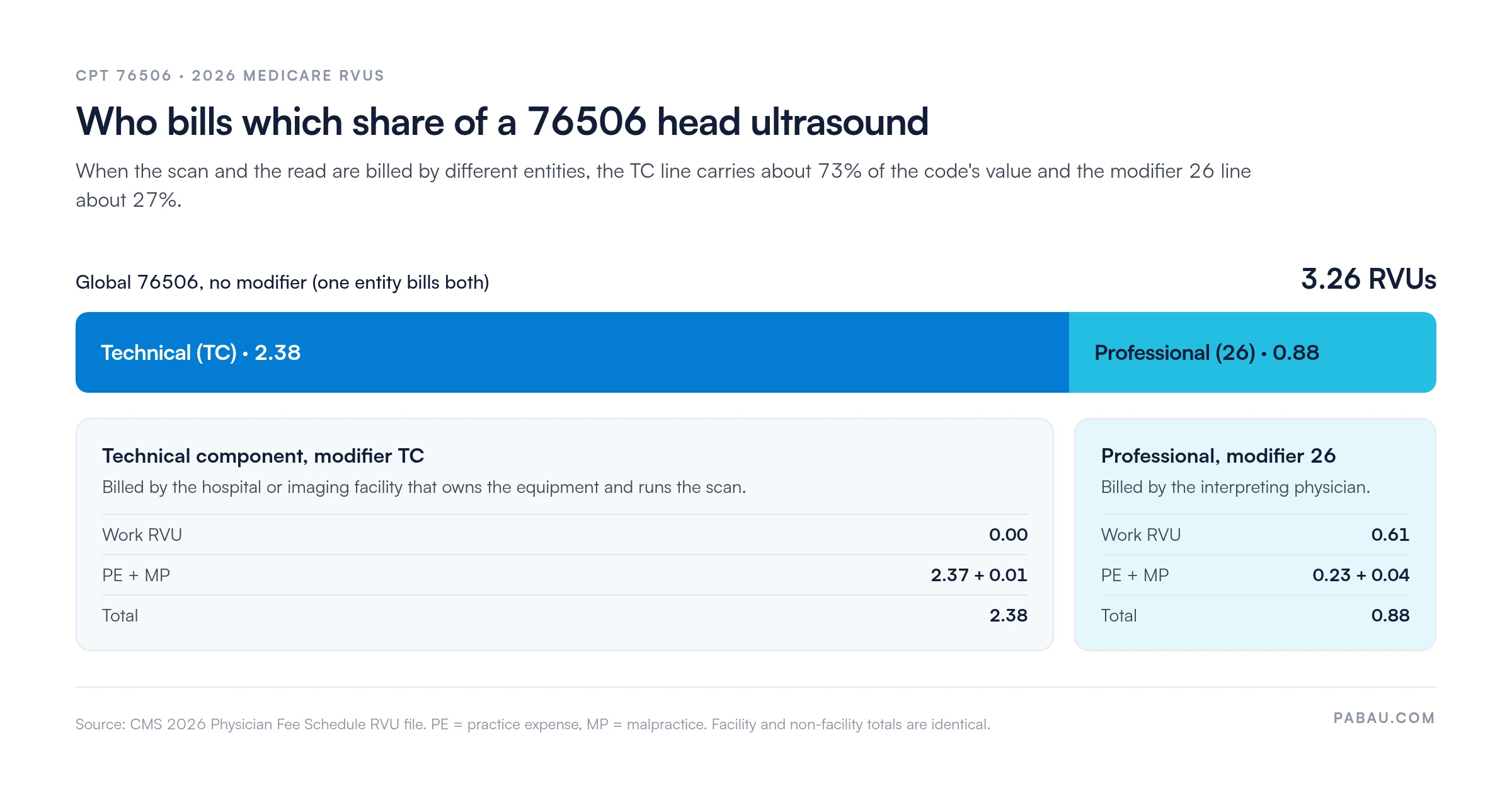
In 2026, global 76506 carries 3.26 total RVUs in facility and non-facility settings alike. Medicare payment varies by locality and by component (2.38 technical, 0.88 professional).
The most common denial triggers are using 76536 instead of 76506, a diagnosis that does not support medical necessity, and missing prior authorization.
CPT code 76506 covers echoencephalography, a real-time ultrasound examination of the brain and intracranial structures with stored images. The CMS short descriptor is “Echo exam of head.” The full AMA descriptor has three parts, and each one shapes how you bill it.
The descriptor names no acoustic window and no patient age. In practice, most 76506 studies are neonatal head ultrasounds performed through the open anterior fontanel. When the same infant needs the spine scanned, for example over a sacral dimple, that study is reported with 76800 instead.
An older child or adult can still be scanned under 76506 when a sonographic window exists, such as a skull defect after craniectomy. Transcranial Doppler of the intracranial arteries is a different service, reported with 93886-93893.
Within the CPT procedure codes, 76506 belongs to the Diagnostic Ultrasound subsection of the Radiology section. Billing requires both a technical component (the scan itself, equipment, and technician) and a professional component (physician interpretation and written report). When a single provider furnishes both, the code is billed globally without a modifier.
Understanding scope prevents miscoding at the charge-entry step. The table below summarizes what is and is not covered under 76506.
Coders often mix up the three codes below. Anatomical site and clinical purpose decide which one applies, whatever wording the order uses.
Key rule: 76536 is never a substitute for 76506. If the order says “head ultrasound” but the clinical question involves a neck mass or thyroid nodule, 76536 is correct. If the question involves intracranial pathology, at any age, 76506 is correct. Billing 76536 for an intracranial ultrasound is a coding error that payers deny.
Payers require a supporting ICD-10-CM diagnosis that establishes medical necessity. The table below lists the codes most commonly accepted with CPT code 76506, grouped by clinical scenario. Verify against the applicable LCD or payer policy before submitting, as coverage criteria vary.
Neonatal IVH is the primary indication in most NICU settings. Outside the NICU, code the documented intracranial finding, such as G91.9 or G93.0. Submitting a vague code such as G93.89 (other specified disorders of brain) without clinical specificity is a known denial trigger. Use the most specific code the documentation supports.
Document the clinical indication in the ordering note before the scan date, not after. Payer auditors check whether the diagnosis code on the claim matches language in the clinical note that predates the service. Backdating or amending diagnoses post-denial is both ineffective and a compliance risk.
A clean claim submission for CPT code 76506 requires that the medical record and ultrasound report together cover the points any payer auditor will check. Missing any one of these is sufficient grounds for denial or recoupment.
The superbill should capture the performing facility, ordering provider NPI, date of service, and POS code before the claim is batched. Separating these steps at the point of service prevents the most common front-end errors.
Modifier rules for imaging codes decide which entity gets paid for which part of the study. The table below covers the modifiers most relevant to CPT code 76506.
Critical rule: Never append both modifier 26 and TC to the same claim line. They are mutually exclusive. Billing globally (no modifier) is also incorrect when two entities split the professional and technical components. On audit, it shows up as a duplicate payment.
Medicare payment for CPT code 76506 is set each year through the Physician Fee Schedule. The 2026 RVUs below are national values, and 76506 carries the same totals in facility and non-facility settings. Payment varies by locality, through the Geographic Practice Cost Index (GPCI), and by component. Always confirm current figures using the CMS Physician Fee Schedule lookup tool or the FastRVU 2026 RVU lookup before publishing your fee schedule.
Split billing sends most of the value to whoever runs the scanner. The TC line carries 2.38 of the 3.26 total RVUs, about 73%. The interpreting physician’s modifier 26 line carries 0.88.
Traditional Medicare (Parts A and B) does not require prior authorization (PA) for CPT code 76506. The requirement varies significantly across other payer types, and assuming authorization is not needed is a common reason claims are denied post-service.
Conducting insurance eligibility verification at the time of scheduling captures the patient’s imaging benefit tier and surfaces any PA requirement before the service date. Waiting until after the scan to check PA status converts a preventable denial into an avoidable write-off.
The denial patterns below are the usual 76506 rejections that reach denial management workflows. Each maps to a correctable root cause.
Some patients need a diagnostic head ultrasound and an ultrasound-guided procedure, reported with 76942, in the same session. That raises a bundling question governed by National Correct Coding Initiative (NCCI) edits. As a general rule, 76506 and 76942 are not automatically bundled, but NCCI may set an edit pair depending on the procedure being guided. Verify the current NCCI edit table at AAPC Codify before billing both codes on the same claim.
Most 76506 denials start before the claim is built: A wrong code, a missing modifier or an authorization nobody checked. Billing teams usually catch them weeks later, when the remittance comes back with a denial code.
Pabau, the practice management and billing platform we build, sends electronic claims through Claim.MD, its US clearinghouse partner. It supports CMS-1500 and 837P submissions for codes including diagnostic ultrasound. Real-time eligibility checks run before the appointment, and ERA/835 remittance files arrive after adjudication. Your team sees payment or denial reasons without logging into each payer portal.
Pabau’s claims management software keeps the code, modifier and diagnosis together on the claim line. Coders can review a 76506 charge before it leaves the practice. Paired with electronic remittance advice through Claim.MD, each denial reason maps back to the originating claim line. That shortens the loop between a bundling error and its correction.

Pabau’s claims workflows connect to Claim.MD to check eligibility in real time and surface denial reasons in your billing queue. Your team spends less time chasing remittances.

Let the descriptor decide when you report 76506, whatever the patient’s age or scanning window. The official text asks for real-time, gray-scale imaging of intracranial structures with stored images. Neonatal fontanel scans will still make up most of your 76506 volume. An older patient with a usable window is no reason to switch codes.
The bigger revenue risk sits upstream of the scan. Settle the clinical question, the modifier split and any prior authorization before the study, and most 76506 denials never happen. Book a demo to see how Pabau checks eligibility and submits clean diagnostic ultrasound claims through Claim.MD.

Need a primer on clearinghouse claim submission? Medical claims clearinghouse guide explains how 837P files move from practice to payer and where edits are applied.
Struggling with recurring denial patterns across your imaging codes? Denial codes in medical billing breaks down the most common CARC and RARC codes and the appeal steps for each.
Want to understand how Claim.MD pricing works before committing? Claim.MD pricing overview covers clearinghouse fee structures and what to expect at different claim volumes.
Coding a neonatal scan that shows white matter injury? ICD-10 code P91.2 covers neonatal cerebral leukomalacia, one of the diagnoses that supports a 76506 claim.
CPT code 76506 covers echoencephalography, a real-time, gray-scale ultrasound of the brain and intracranial structures with stored image documentation. It evaluates ventricular size, cerebral contents and fluid masses or other intracranial abnormalities. The descriptor sets no age limit and no scanning approach. It does not cover soft tissue of the head and neck, which is 76536.
Under the 2026 Physician Fee Schedule, global 76506 carries 3.26 total RVUs, which Medicare converts to dollars and adjusts for your locality. Payment varies by locality (GPCI) and by component, not by setting, because facility and non-facility RVUs are identical. The technical component carries 2.38 RVUs and the professional component 0.88. Rates change each January 1, so verify the current figure in the CMS Physician Fee Schedule lookup tool.
76506 covers ultrasound of the brain and intracranial structures, at any age. 76536 covers ultrasound of the soft tissue of the head and neck, including thyroid, lymph nodes, salivary glands and parotid. They describe different anatomical sites and are never interchangeable. Submitting 76536 for an intracranial scan is a coding error.
Traditional Medicare does not. Medicare Advantage and commercial plans vary by plan and payer, and Medicaid varies by state. Verify at scheduling, before the study.
Yes, neonatal head ultrasound is the most common use of 76506. The scan usually goes through the open anterior fontanel, but the descriptor does not require that approach or set an age limit. In NICU settings it is the standard code for intraventricular hemorrhage screening and hydrocephalus monitoring.
Yes, but only when the diagnostic head ultrasound (76506) and the ultrasound guidance for a procedure (76942) are distinct services in the same session. NCCI edits may apply. When billing both, append modifier 59, XS or XE as documented to the column-two code of the edit pair, usually the 76942 guidance line. Document each service separately in the ultrasound report, and verify the current NCCI edit pair before submitting.




