

CCSD code G5100: Bypass of duodenum billing guide
CCSD code G5100 bills a bypass that leaves the duodenum in place CCSD code G5100...

Last Updated: Oct 16, 2026
76497 is the CPT code for unlisted computed tomography procedure (eg, diagnostic, interventional).
CPT code 76497 reports a CT imaging service that no specific CPT code in the radiology section accurately describes. Practices use it for a novel CT protocol or an emerging imaging technique that the listed codes don't yet cover. It is a last-resort code, and claims that misapply it, skip the special report, or bypass prior authorization face a high risk of denial.
Let Pabau's smart automation suggest the right codes, reduce claim denials, and keep your practice compliant—effortlessly.
Automate repetitive tasks and focus on what matters most—your patients.
Reduce coding errors and ensure compliance with the latest regulations.
Clean claims, fewer denials, and faster reimbursements.
Powerful insights and reporting to help your practice thrive.
HIPAA compliant SOC 2 certified GDPR-compliant Trusted by 4,000+ clinics worldwide

CPT code 76497 is the AMA’s unlisted CT procedure code, used only when no specific radiology CPT code covers the service.
A special report describing the procedure, its medical necessity, and the most similar listed code must accompany every claim.
Most commercial payers and Medicaid managed care plans require prior authorization before the CT service is performed. A claim with no authorization number on file is denied.
Pabau, the practice software we build, helps submit claims electronically, track prior-authorization numbers and follow claim status. The special-report checklist stays a practice workflow.
CPT code 76497 is defined by the American Medical Association as “Unlisted computed tomography procedure (eg, diagnostic, interventional).” It sits in the Radiology section of the CPT codebook, in the Diagnostic Radiology range 70010-76499. That range covers X-ray, fluoroscopy, MRI, and CT procedures.
In CPT terminology, “unlisted” only signals that no five-digit code describes that particular CT service yet. An unlisted procedure can still be established, approved, and covered. The AMA uses unlisted codes for services that exist clinically but have no descriptor of their own. That includes novel techniques that post-date the current code cycle.
CPT code 76497 covers any CT-based imaging procedure for which no specific CPT code exists. Three kinds of CT service most often end up here:
Treat 76497 as a last-resort code, and use it only after confirming no specific code matches the service. The AMA’s CPT guidelines are explicit that unlisted codes should not be used when a more specific code is available.
The most frequent billing error with CPT code 76497 is using it for a CT procedure that already has a dedicated code. Payer edit engines check for this automatically. When a coder bills 76497 for a service that has its own code, the claim usually denies on the first pass.
Common CT procedures with their own specific codes that must never be billed as 76497:
MRI codes (for example 70551 or 72148) are never an alternative to 76497, because MRI is a different imaging modality. Plain radiograph codes and fluoroscopy codes don’t apply to CT services either. Review the full radiology section of the current CPT codebook before concluding that 76497 is appropriate.
CPT 76497 and CPT 76499 are easy to confuse, but each one covers a different imaging modality. Billing the wrong unlisted code gets the claim denied and delays payment.
Identify the imaging modality first, then pick the unlisted code for that modality. If the service used a CT scanner, 76497 is the only correct unlisted option, as the decision path below shows.
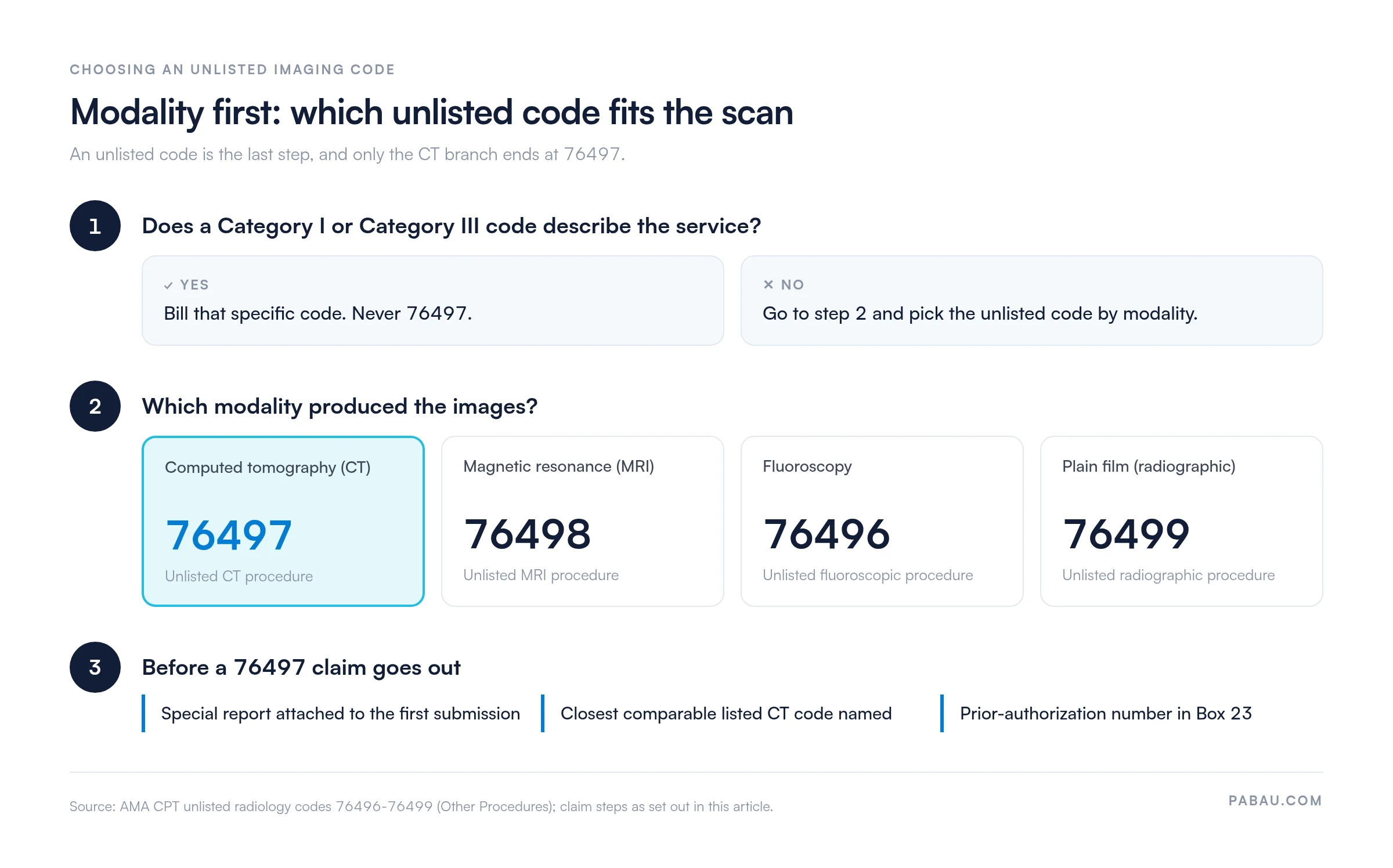
Every claim for CPT code 76497 needs a special report attached at the first submission. Payers price unlisted codes by report, so a claim sent without one is likely to be denied for missing documentation.
A complete special report covers five elements. Document all five before you submit, as part of your wider medical billing compliance routine:
Add all five elements as required fields to your superbill preparation checklist. The report is then finished before the claim goes out, and nobody has to rebuild it for an appeal.
Build a special-report template in your practice management system with the five mandatory fields as required entries. Hold any 76497 claim where those fields are blank before it reaches the clearinghouse. Fixing the report before submission is faster than filing an appeal.
Prior authorization is required by virtually all commercial payers and most Medicaid managed care plans for unlisted radiology codes including CPT code 76497. Many large commercial payers delegate imaging authorization to radiology benefit managers (RBMs). eviCore healthcare, NIA/Magellan (now Evolent Health), and Carelon Medical Benefits Management (formerly AIM Specialty Health) make prior-auth decisions for dozens of health plans. Check the patient’s insurance card or the payer portal to determine whether an RBM is involved before initiating the auth process.
Traditional Medicare (Parts A and B) does not use a standard prior-auth process for radiology in most settings. Medicare Administrative Contractors (MACs) still conduct medical review of unlisted-code claims. The claim still requires a complete special report to pass MAC review.
Submitting a clean claim for CPT code 76497 requires more preparation than a standard radiology code. Follow these steps in order to improve first-pass acceptance. Steps 5 and 6 are where practice claims management software takes over the manual submission work.

CPT code 76497 has no assigned Relative Value Units (RVUs) and no published Medicare Physician Fee Schedule rate. As an unlisted code, reimbursement is determined entirely through individual payer review and is designated “priced by report” (PBR) in the CMS Physician Fee Schedule.
In practice, payers benchmark the 76497 claim against the most similar specific CT code and pay at or near that code’s allowed amount. This is why the special report must explicitly identify the comparable code. A report that says “similar to CPT 74177” gives the payer’s pricing team a starting point. Without a comparison code, the reviewer has to guess, and the guess usually comes in low.
For charge setting, the table below shows 2026 Medicare national non-facility (global) rates for the CT codes most often used as comparators. Each is the total RVU from the CMS relative value file (July 2026) multiplied by the $33.4009 conversion factor.
These are national amounts before the Geographic Practice Cost Index (GPCI) adjusts them by locality. Qualifying APM participants are paid at a slightly higher conversion factor of $33.5675. Confirm local figures through the CMS fee schedule lookup or your MAC’s published rates.
No National Coverage Determination (NCD) or Local Coverage Determination (LCD) sets specific coverage criteria for CPT code 76497 itself. Coverage is decided by the Medicare Administrative Contractor (MAC) through individual claim review.
For a MAC to approve a 76497 claim, the documentation must satisfy three conditions:
Medicare Advantage plans (Part C) follow their own coverage policies, which may be stricter than Traditional Medicare. Confirm coverage and prior-auth requirements directly with the specific plan before performing the service.
Every unlisted-code claim goes to manual review, so CPT code 76497 claims are denied more often than claims for specific CT codes. Systematic denial management workflows and familiarity with medical billing denial codes help teams catch issues before they become recoupments.
Most denied 76497 claims are recoverable on first-level appeal when the denial is documentation-based. A missing special report or an inadequate medical necessity narrative is fixable; a timely-filing denial generally is not.
Set a calendar alert 20 days after a 76497 claim is submitted. If no remittance has posted by then, call the payer to confirm receipt and manual-review status. Unlisted-code claims processed through manual review can sit in queues for 30-45 days before a decision is issued.
Radiology billing teams often track 76497 claims across a payer portal, a spreadsheet of auth numbers, and a folder of special reports. Each handoff is a chance for the auth number to drop off the claim.
Pabau turns the invoice into an electronic CMS-1500 claim and sends it through Claim.MD to thousands of US payers. Your team can track the prior-authorization number against each claim and follow its status in the same billing workflow.
The special-report checklist stays a practice workflow, and your coders still confirm that no listed code fits. What changes is the follow-up. A claim stuck in manual review shows up in claim status long before the timely-filing deadline.

Pabau helps your team submit 76497 claims electronically, track prior-authorization numbers, and follow each claim’s status until it’s paid.

Billing CPT code 76497 well comes down to the work done before the scan. Confirm that no Category I or III code fits, secure the authorization, and write the special report against the closest comparable code. Done that way, novel CT work gets paid at a defensible rate. Used as a shortcut for listed procedures, the code brings denials and audit exposure.
The trade-off is time, because each 76497 claim takes more coder and radiologist effort than a listed code. Reserve it for services that need it. Pabau’s clean claim submission workflows help you submit claims electronically to thousands of US payers, track prior-authorization numbers and follow claim status. Book a demo to see how Pabau keeps your unlisted CT claims moving from submission to payment.

Need to understand how clearinghouse submission works for complex codes? Our Claim.MD clearinghouse guide explains how electronic claim routing works for unlisted and specialty codes.
Want to reduce denials before they happen? Understanding electronic remittance advice covers how to read ERA files and identify denial patterns early.
Looking for an overview of the claims filing process? The 837 file guide walks through EDI claim submission for radiology and specialty practices.
CPT code 76497 covers any computed tomography (CT) imaging procedure for which no specific CPT code exists in the current AMA codebook. This includes novel CT protocols, emerging interventional CT techniques, and CT services with no Category I or Category III code. It does not cover MRI, plain X-ray, or fluoroscopic procedures, which have their own unlisted codes (76498, 76499, and 76496 respectively).
Use CPT 76497 when the unlisted procedure involved a CT scanner. Use 76499 for a diagnostic radiographic (plain film) service; use 76496 for fluoroscopy and 76498 for MRI. The modality drives the code selection, and billing 76499 for a CT service is a coding error that gets the claim denied.
The most common reason is that a specific CPT code exists for the service. Claims are also denied when the special report is missing or incomplete, or the auth number is missing. Weak ICD-10 linkage to medical necessity and billing 76499 instead of 76497 round out the list. Most documentation-based denials are recoverable on first-level appeal.
File the appeal within the payer’s window (120 days for Medicare redetermination; typically 30-180 days for commercial payers). The appeal letter should cite AMA CPT unlisted-code guidelines and attach the complete special report. Name the comparable specific CPT code and explain the clinical difference that makes it inapplicable. For clinical-necessity denials, request a peer-to-peer review between the interpreting radiologist and the payer’s medical director.



