



CCSD code G5100: Bypass of duodenum billing guide
CCSD code G5100 bills a bypass that leaves the duodenum in place CCSD code G5100...

Last Updated: Oct 16, 2026

CPT code 73718 reports an MRI of the lower extremity other than a joint, performed without contrast material.
It covers non-joint soft tissue and bone: the thigh and femur, the lower leg, and the soft tissues of the foot outside a joint.
Joint studies are not billed with 73718. A non-contrast MRI of the hip, knee, ankle, or toe joint is CPT 73721 instead.
73718, 73719, and 73720 are the non-joint family. They differ only by contrast: without, with, and without-then-with.
Laterality modifiers RT and LT are required when the ordering physician documents a side. Leaving them off is a common denial trigger.
Medicare payment varies by locality through GPCI adjustments, so check the CMS Physician Fee Schedule lookup rather than a static figure.
Practice management software like Pabau tracks CPT codes and modifiers at the claim level, so radiology claims leave the practice clean.
CPT code 73718 reports an MRI of the lower extremity other than a joint, performed without contrast material. It covers the thigh, the lower leg, and the soft tissues of the foot outside a joint. A non-contrast MRI of the hip, knee, ankle, or toe joint is CPT 73721 instead.
The code sits within the MRI lower extremity family maintained by the American Medical Association. Coders who read 73718 as “any lower extremity MRI” send knee and ankle studies out under it, and those claims come back denied. What follows is a working reference for radiology billing staff, medical coders, and practice administrators.
CPT code 73718 describes: Magnetic resonance (eg, proton) imaging, lower extremity other than joint; without contrast material(s). It reports a non-contrast MRI of lower extremity anatomy that is not a joint. That means the thigh, the calf, or the soft tissues of the foot.
The code falls under the Radiology section of the CPT code set, in the musculoskeletal diagnostic imaging subsection. Because no contrast medium is injected, it suits patients with a gadolinium allergy or renal impairment. It also suits presentations where contrast would not change the diagnosis.
Sports medicine practices bill this code for hamstring tears, calf injuries, and tibial stress fractures. Musculoskeletal oncology and podiatry referrals generate it too. Knowing where the joint line falls, anatomically and in the code set, is the foundation of a clean claim here.
The table below summarizes the technical attributes of CPT code 73718, including its place in the code set and its key billing parameters.
RVU values change with each annual Medicare Physician Fee Schedule update. For current work, practice expense, and malpractice RVU figures, use the FastRVU lookup tool. The CMS Physician Fee Schedule lookup remains the authoritative source for every payment parameter by code and locality.
73718 applies when a physician orders a non-contrast MRI of non-joint lower extremity anatomy and the documentation supports medical necessity. The usual triggers are a soft-tissue mass and suspected bone or soft-tissue infection. Muscle or tendon injury away from the joint line counts too, as does a stress fracture through the shaft of a long bone.
Note the boundary. A knee MRI ordered for a meniscal tear is a joint study, so it is 73721 and not 73718. A calf MRI ordered for a gastrocnemius tear in the same patient is non-joint anatomy, so it is 73718. The order has to name the anatomy clearly enough for a coder to tell the two apart.
Local Coverage Determinations issued by Medicare Administrative Contractors govern covered indications for MRI. Criteria vary by MAC region, so review the applicable LCD for your area before assuming coverage. The CMS Medicare Coverage Database is the primary resource for this.
Practices that refer musculoskeletal patients on for diagnostic imaging meet this code often. The ordering physician’s documentation must establish medical necessity before the imaging facility can bill 73718 with confidence.
Modifier selection is where most 73718 claims go wrong. The table below covers every modifier relevant to this code, with guidance on when each one applies.
The professional and technical component split is standard radiology billing. When a radiologist reads a scan at a facility that owns the equipment, the radiologist appends modifier 26 and the facility bills TC. Confirm the current MPFS global billing status for 73718 before splitting components, because it sets the rate for each one.
Modifier 59 deserves particular care on this code. A knee study and a calf study performed the same day are separate codes, not one code with a 59 appended. Review the National Correct Coding Initiative (NCCI) edits before you use it.
Practice management software like Pabau tracks modifier usage at the claim line, so billing teams can spot the patterns that attract payer scrutiny. Its claims management software flags a 73718 line missing RT or LT before the file leaves the practice.

Medicare payment for CPT 73718 uses the Resource-Based Relative Value Scale, known as RBRVS. Each RVU component carries its own Geographic Practice Cost Index (GPCI) adjustment for the locality. That applies separately to the work, practice expense, and malpractice components.
The three adjusted components are then added together, and that sum is multiplied once by the CMS conversion factor. Rates therefore differ between high-cost urban markets and rural localities.
Because rates change every year, billing staff should bookmark the CMS Physician Fee Schedule search tool and check it each January. Commercial payer rates for 73718 are usually negotiated as a percentage of the Medicare allowable, so the Medicare figure anchors most contracts.
Ask the ordering physician to name the anatomy, not the limb. An order that says “MRI left lower extremity” forces the coder to guess between 73718 and 73721. That guess is wrong often enough to matter. An order that says “MRI left calf, non-contrast” codes itself. Build the prompt into your imaging order template and the ambiguity disappears at the source.
Every 73718 claim needs an ICD-10-CM diagnosis code that establishes medical necessity. Because 73718 is the non-joint code, the diagnosis should point at non-joint anatomy too. A knee or hip arthritis code paired with 73718 is a mismatch, and payers read it as evidence the wrong CPT code was chosen.
Descriptors above are the official ICD-10-CM long descriptors, shown with right-sided laterality as an example. Substitute the left-sided or unspecified code where the documentation calls for it. Always choose the most specific code available. Unspecified laterality codes are fine when the notes genuinely do not name a side, but habitual use invites payer review.
Fracture codes in the M84.3 range need a 7th character before they are billable. Use A for an initial encounter, D for a subsequent encounter with routine healing, and S for a sequela. G, K, and P cover delayed healing, nonunion, and malunion.
The AAPC Codify CPT lookup carries ICD-10 crosswalk data that helps confirm which diagnosis codes align with 73718 under each payer’s LCD. Documenting why a given diagnosis was chosen keeps the selection defensible under audit.
Thin documentation is the second most common reason 73718 claims are denied, after modifier errors. The ordering physician’s notes and the radiologist’s report each need specific elements.
A complete, well-documented claim cuts the odds of an additional documentation request. An order reading “leg pain, rule out pathology” carries no examination findings. The imaging facility then carries the denial risk, even though the scan was appropriate.
Lower extremity MRI billing produces predictable denial patterns. Catching them before submission costs far less than working an appeal. The list below reflects the mistakes that hit CPT 73718 specifically.
A pre-submission review catches most of these before the payer does. Check the anatomy against the code, then the modifiers, the diagnosis specificity, and the authorization status before the 837P file reaches the clearinghouse. Knowing the common denial codes also tells you which of these errors a payer flagged when a 73718 line comes back.
The six codes below form two parallel families, and reading them as one list is the root of most miscoding here. Codes 73718, 73719, and 73720 cover the lower extremity other than a joint. Codes 73721, 73722, and 73723 cover any joint of the lower extremity. Within each family, the only variable is contrast.
Two practical tests settle almost every case, and the chart below runs both of them. First, ask whether the report describes a joint and its internal structures, such as menisci, labrum, or articular cartilage. If it does, you are in the CPT 73721 family. Second, ask whether gadolinium was injected, and whether non-contrast sequences ran before it.
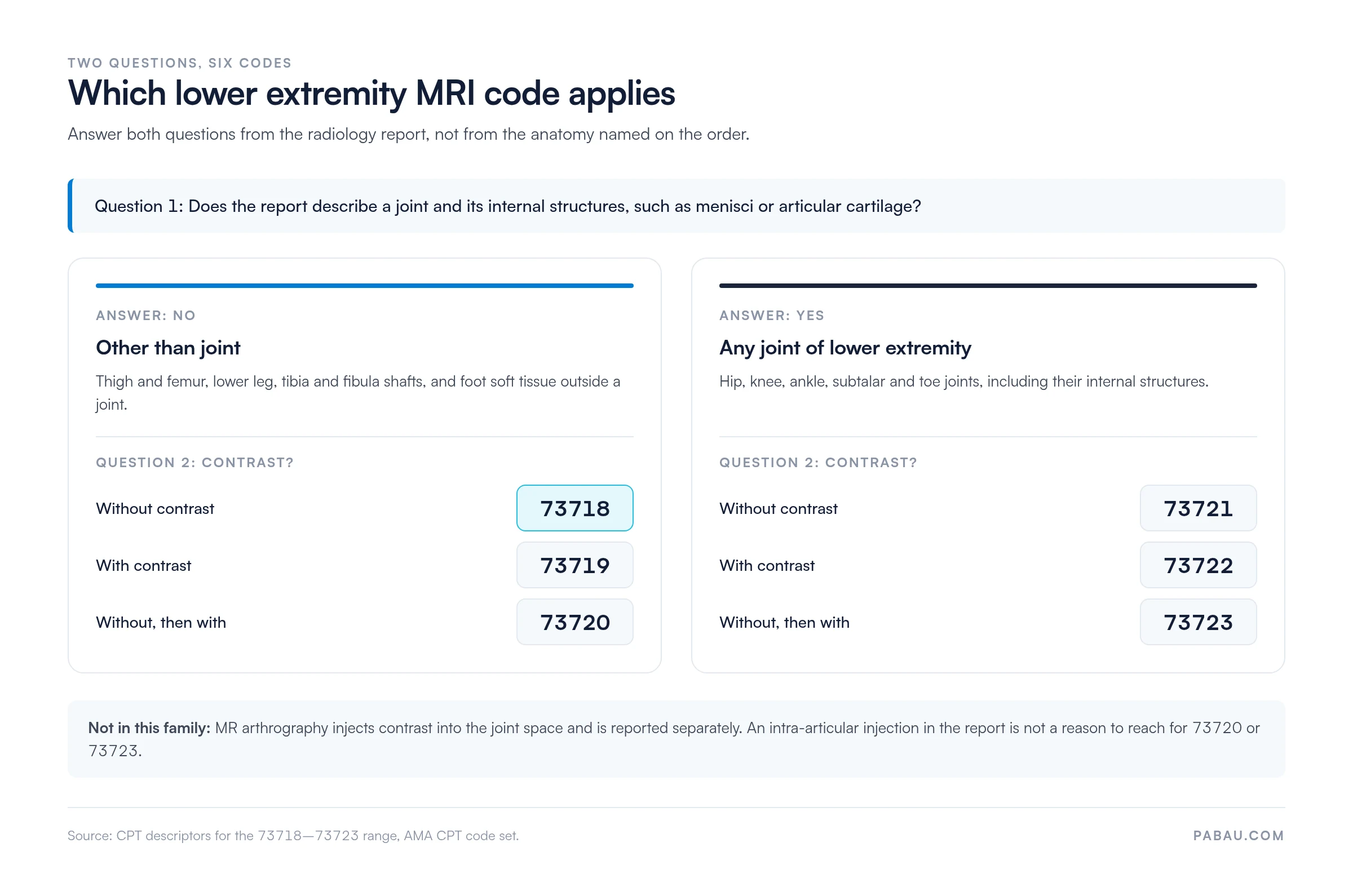
All six codes above are MRI codes. An arterial question, such as claudication, runoff mapping, or a suspected vessel injury, points to a different study. The usual choice is a CT angiogram of the lower extremity, reported as 73706.
One more distinction worth naming. None of these six codes is an arthrography code. MR arthrography involves injecting contrast into the joint space, and it is reported differently. Do not reach for 73723 because the report mentions an intra-articular injection.
Prior authorization requirements for 73718 vary by payer, plan type, and region. The framework below sorts them by payer type, so the requirement gets checked before the scan is scheduled rather than after.
Keep a payer-specific PA matrix for 73718 and refresh it at each contract renewal. Record the anatomic region alongside the code, because some payers authorize by body part rather than by CPT code. When a PA is denied, the appeal has to answer the exact criteria the payer applied.
The safeguard against a 73718 coding error is often one coder remembering the joint versus non-joint rule. Orders arrive worded loosely, a coder picks a code, and nobody sees the mismatch until the remittance advice lands weeks later. By then the appeal window has started closing.
Pabau, practice management software built for medical and aesthetic practices, keeps that check inside the workflow instead. Your CPT catalog holds 73718 with its descriptor, so the coder sees “other than joint” at the moment of selection. Modifiers and the paired ICD-10 code sit on the same claim line, and eligibility runs before the appointment rather than after the scan.
Claims then go out electronically through the Claim.MD clearinghouse integration, with electronic remittance advice coming back into the same record. So you find out about a rejected 73718 line in days, not at month end.
You can fix and resubmit while the payer’s timely filing clock still has room in it. Every Pabau subscription includes the full billing and reporting toolset.

See how Pabau holds your CPT catalog, modifiers, and diagnosis codes on one claim line. Claims then submit electronically through Claim.MD to thousands of US payers, with eligibility checks and ERA processing built in.

CPT 73718 is simple once the anatomy is settled. It is the lower extremity other than a joint, without contrast. That means the thigh, the lower leg, and the soft tissues of the foot outside a joint. Send a joint study out under this code and you have miscoded it, whatever the order said.
So the checklist is short. Confirm the anatomy against the report, then pick the contrast variant from 73718, 73719, or 73720. Append RT or LT, and pair the claim with a diagnosis that describes the same non-joint region. Then confirm prior authorization before the scan date.
For practices billing this code at volume, a clearinghouse that validates code and modifier combinations before submission catches these errors on its own. Pabau’s Claim.MD integration supports electronic 73718 submission across thousands of US payers, with CPT catalog validation, eligibility checks, and ERA processing.
To see how that works on your own claim volume, book a demo with our team.

Coding the joint study instead? CPT code 73721 covers non-contrast MRI of any lower extremity joint, the code 73718 is most often confused with.
Need the full medical billing lifecycle? What is medical billing covers the revenue cycle from patient registration through payment posting.
Working denials on imaging codes? Denial management in healthcare sets out a structured approach to reducing and appealing rejected claims.
Coding an upper extremity joint MRI? CPT code 73221 applies the same contrast logic to the shoulder, elbow, and wrist joints.
Chasing authorization before the scan? The prior authorization process sets out how to secure approval before an imaging appointment is booked.
CPT code 73718 reports an MRI of the lower extremity other than a joint, performed without contrast material. It covers the thigh, the lower leg, and the soft tissues of the foot outside a joint. Common indications include soft-tissue masses, osteomyelitis, muscle and tendon injury, and stress fracture. A non-contrast MRI of the hip, knee, ankle, or toe joint is reported with CPT 73721 instead.
The difference is anatomy, not contrast. CPT 73718 covers the lower extremity other than a joint, so it applies to the thigh, calf, or non-joint foot structures. CPT 73721 covers any joint of the lower extremity, including the hip, knee, ankle, and toe joints. Both are non-contrast codes. Read the radiology report and code by the anatomy the radiologist described.
The most common modifiers are RT and LT for laterality. Modifier 26 applies when the radiologist bills the interpretation separately, and TC covers the facility’s technical component. Modifier 59 may apply when 73718 covers a distinct anatomic site or session from another procedure that day. Check NCCI edits before appending 59.
Medicare payment for CPT 73718 varies by locality through GPCI adjustments, and by whether the facility or non-facility rate applies. Rates update every January with the Medicare Physician Fee Schedule final rule. Because static figures go stale quickly, verify the current amount with the CMS Physician Fee Schedule lookup tool at cms.gov.
It depends on the payer. Traditional Medicare generally does not require prior authorization for 73718, though documentation still has to support medical necessity under the applicable LCD. Medicare Advantage plans and most commercial payers usually do require it for outpatient MRI, often through a radiology benefit manager. Verify with the specific payer before scheduling the scan.
Yes, if MRI of both lower extremities was medically necessary and performed the same day. Bill 73718 on two lines, one with RT and one with LT. NCCI edits and payer bilateral policies still apply. Some payers reduce payment on the second line, and others want distinct medical necessity documented for each side.
Commonly paired codes include R22.41 (localized swelling, mass and lump, right lower limb) and M86.161 (other acute osteomyelitis, right tibia and fibula). Others are M84.361A (stress fracture, right tibia, initial encounter for fracture), S86.011A (strain of right Achilles tendon, initial encounter), and M72.2 (plantar fascial fibromatosis). Avoid joint diagnoses such as knee osteoarthritis, because those support 73721 rather than 73718.
It depends on which structures were imaged. A study of the plantar fascia, an intermetatarsal neuroma, or a plantar soft-tissue mass is non-joint anatomy, so 73718 applies. A study of the ankle joint, the subtalar joint, or a toe joint is a joint study, so 73721 applies. The radiologist’s report decides it, not the body part named on the order.



