CPT code 33234: Pacemaker lead removal billing guide
CPT code 33234: Official descriptor and code placement CPT code 33234 is the cod...

Last Updated: Nov 26, 2026
72202 is the CPT code for a radiologic examination of the sacroiliac joints with 3 or more views. It covers a bilateral SI joint series, typically an AP pelvis view with right and left oblique views. Radiologists read it for sacroiliitis, ankylosing spondylitis and other joint changes.
The code sits in the Spine and Pelvis subsection of Diagnostic Radiology (72010-72295). The view count stated in the radiology report decides it, and fewer than 3 documented views is billed as 72200.
Let Pabau's smart automation suggest the right codes, reduce claim denials, and keep your practice compliant—effortlessly.
Automate repetitive tasks and focus on what matters most—your patients.
Reduce coding errors and ensure compliance with the latest regulations.
Clean claims, fewer denials, and faster reimbursements.
Powerful insights and reporting to help your practice thrive.
HIPAA compliant SOC 2 certified GDPR-compliant Trusted by 4,000+ clinics worldwide

CPT code 72202 reports an X-ray of both sacroiliac joints with at least 3 views. Fewer than 3 documented views is billed as 72200.
The view count in the radiologist’s dictated report decides the code, not the technologist’s worksheet or the order.
Modifiers 26 and TC split the professional and technical components. LT and RT do not apply because the study is bilateral by definition.
Ankylosing spondylitis (M45.-) and sacroiliitis (M46.1) are the strongest diagnosis pairings. An unsupported diagnosis code is a common cause of medical necessity denials.
Traditional Medicare does not require prior authorization for 72202, but many Medicare Advantage and commercial plans do through radiology benefit managers.
CPT code 72202 is a diagnostic radiology code for a radiologic examination of the sacroiliac joints using three or more views. Its descriptor comes from the AMA’s CPT code set, the five-digit procedure codes maintained by the AMA’s CPT Editorial Panel. The code sits in the Radiology section, under Diagnostic Radiology, Spine and Pelvis (codes 72010-72295).
The procedure captures both sacroiliac joints in a single session. Because the study is bilateral by definition, modifiers LT and RT do not apply. No left-only or right-only SI joint series exists under this code.
The “3 or more views” threshold separates CPT code 72202 from its lower-tier neighbor, 72200. A standard series at this level includes an AP pelvis view plus right and left posterior oblique views of the SI joints.
Some series add a Ferguson view, an angled AP projection that opens the joint space. The radiologist evaluates joint space narrowing, subchondral sclerosis, erosion, and ankylosis.
The dictated report controls the code. If it states “two views obtained,” 72202 cannot be billed, whatever the technologist’s worksheet says or the ordering physician intended. No other rule does more to keep this code family out of an upcoding audit.
A typical 72202 series is built from these views.
Code selection runs in two steps. Confirm the anatomy the report describes, then count the views it documents.
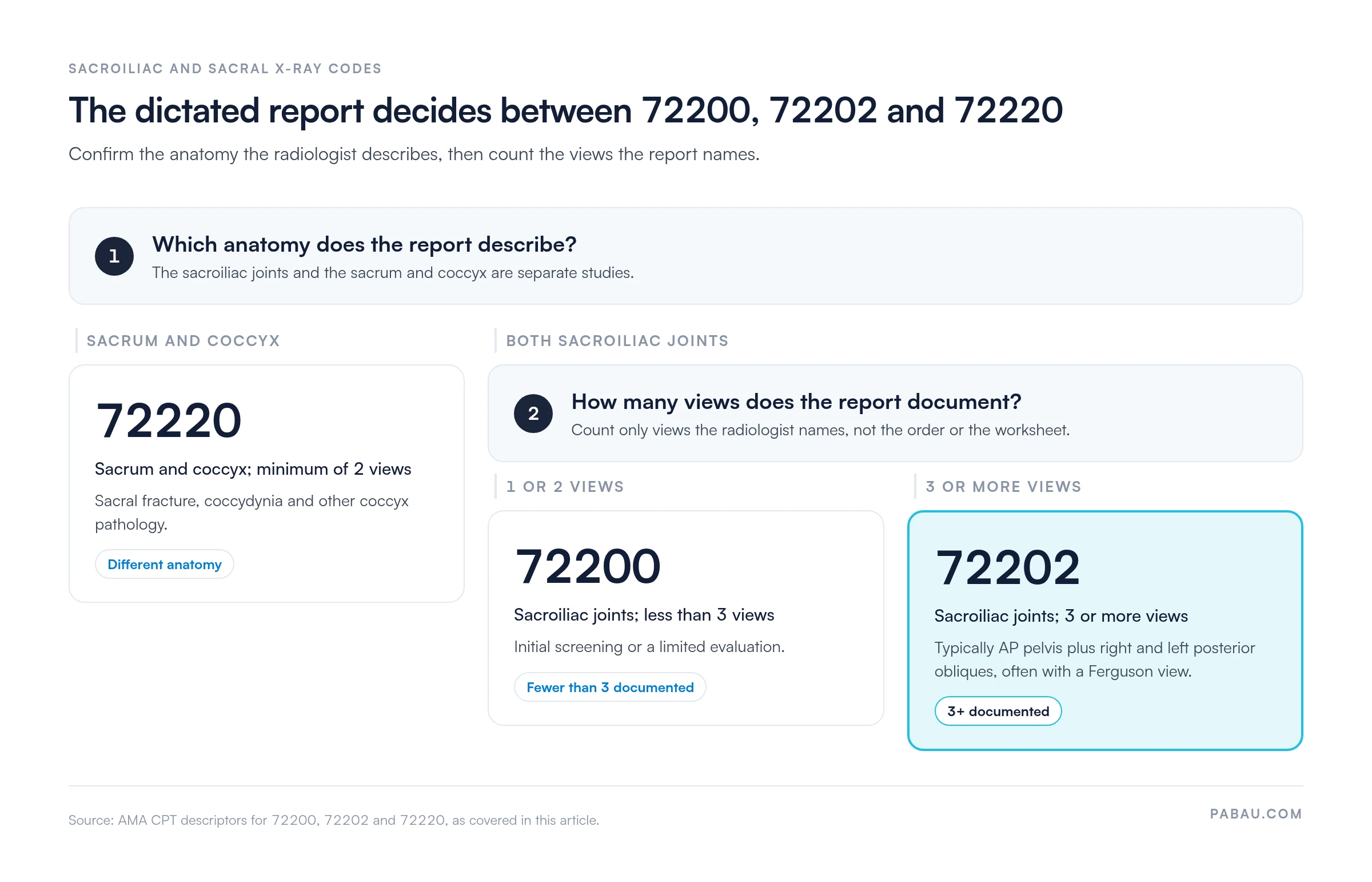
The three codes in this group split on view count and anatomy. Select the code after reviewing the radiology report, never before the exam is performed.
Critical distinction: CPT 72220 targets the sacrum and coccyx as bony structures, not the sacroiliac joints specifically. Billing 72220 for an SI joint inflammatory workup is a coding error. Conversely, billing 72202 for a coccyx injury study is equally wrong. Confirm the anatomy documented in the report before selecting between these codes.
Medical necessity for CPT code 72202 requires a supported diagnosis. Payers expect the ICD-10 code on the claim to reflect a condition where SI joint imaging has established clinical value. Medicare Administrative Contractors (MACs) apply the same test through local coverage determinations (LCDs). The table below lists the most commonly accepted pairings, so verify each one against your MAC’s LCD.
Practices with musculoskeletal or rheumatology caseloads should build diagnosis-code crosswalks into charge capture, so unsupported ICD-10 codes never reach the claim. Sacroiliitis coded as M46.1 is frequently paired with 72202 to stage active inflammation.
Before submitting a CPT 72202 claim, run the ICD-10 code through your MAC’s LCD policy for diagnostic imaging. Some contractors specifically list which M45.x and M46.x codes they will and will not accept for SI joint radiology. A crosswalk built into your charge capture screen eliminates this check from the coder’s manual queue.
Medicare reimbursement for CPT code 72202 is set annually through the CMS Physician Fee Schedule. Rates vary by geographic pricing locality. Use the CMS Physician Fee Schedule lookup tool to retrieve the rate for your practice location and the current calendar year.
The wRVU value of 0.22 for CPT code 72202 reflects the physician work component used in RBRVS-based payment calculations. For the full RVU breakdown including practice expense and malpractice RVUs, use the FastRVU 2026 lookup tool, which pulls directly from CMS data files.
Commercial payer rates are separately negotiated and typically expressed as a percentage of Medicare, ranging from 100% to 150% or higher depending on contract terms.
Modifier selection for CPT 72202 depends on the billing arrangement between the radiology group and the facility. Applying the wrong modifier, or omitting a required one, is a common source of zero-pay adjustments.
Modifier 59 caution: CMS has signaled that modifier 59 is overused and subject to audit. When 72202 shares a date of service with a lumbar spine series billed as CPT 72100, modifier 59 fits only separate clinical indications.
Each study also needs its own documented justification, and the same test applies to any other spinal imaging code. Stacking imaging codes on the same date with a reflexive -59 is an OIG audit pattern.
If in doubt, use the more specific X-modifiers (XE, XP, XS, XU) that CMS introduced to replace blanket modifier 59 use. See the AAPC CPT code reference for modifier guidance by code.
Traditional Medicare fee-for-service does not currently require prior authorization for CPT 72202. Diagnostic X-ray is not on the CMS prior authorization list for Traditional Medicare. That list is updated periodically, so verify it against the current CMS program scope.
Medicare Advantage plans and commercial insurers with radiology benefit management programs work differently. Radiology benefit managers such as eviCore and Carelon handle authorization for many plans, and SI joint imaging frequently appears on their review lists. Following medical billing compliance requirements means checking authorization status before the exam is performed.
CPT code 72202 attracts a predictable set of denial patterns. Each one maps to a specific documentation or workflow failure that can be caught before submission. Effective denial management workflows for radiology codes start with knowing what triggers these adjustments.
Check your 72202 denials against the full list of common denial codes. A reason that repeats across claims points to a workflow fault, while a one-off usually traces back to data entry.
The radiology report is the primary billing record for CPT 72202, ahead of the order, the technologist’s worksheet and the EHR encounter note. Payers audit the dictated report when investigating a 72202 claim, and it must contain specific elements to support the code.
Treat the dictated report as the floor for every 72202 claim. If the report cannot support the code, the code cannot be billed. Submitting a clean claim in radiology therefore depends on the coder checking charge capture against the radiologist’s report.
Set up a report-review checkpoint in your charge capture workflow specifically for the 72200 code family. Before a coder assigns 72202, require them to open the dictated report and confirm the view count. Add a single field to the charge ticket that reads ‘Views documented in report: ___’. It takes under ten seconds and prevents the most common denial on this code.
Manual charge capture is where view-count codes like CPT 72202 go wrong. A coder reads the report, keys the code, then retypes the diagnosis and authorization details into a separate billing screen. Each hand-off is another chance for the claim to drift from the record.
Pabau, a practice management platform with built-in insurance billing, keeps the diagnosis, the charge and the claim in one patient record. Its insurance claims management software sends US claims as 837P files through the Claim.MD clearinghouse to thousands of US payers. Eligibility checks run before the exam date, and 835 remittances post back against each claim.
Prior authorization codes, dates and sessions sit on the patient’s case, and Pabau warns staff when one is missing. A Medicare Advantage authorization then surfaces before the exam rather than as a CO-15 denial afterward. When CO-4 or CO-50 adjustments do come back, they land against the claim your team already works from.

Pabau keeps diagnosis codes, prior authorizations and claims in one patient record. US claims go out through Claim.MD and remittances post back, so denials surface where your billing team already works.

Get the view count right at charge capture and CPT code 72202 rarely causes trouble. The dictated report has to name at least three views of both sacroiliac joints. If it names fewer, bill 72200 rather than hoping the order carries the claim.
The trade-off is a few seconds of report review per study against a CO-4 denial and the rework that follows it. Build that check into the charge ticket, and pair the code with a diagnosis your MAC’s LCD accepts.
Book a demo to see how Pabau keeps radiology claims, authorizations and remittances tied to the patient record.

Need to understand how clearinghouse submission works? Pabau’s Claim.MD clearinghouse guide explains how 837P claims reach payers and how remittances come back as 835 files.
Seeing repeat denials without a pattern? Revenue cycle management fundamentals covers how to build a denial tracking system that separates systemic workflow faults from one-off data entry errors.
Want a reference for all denial adjustment reason codes? Electronic remittance advice (ERA) explained breaks down how 835 files carry CARC and RARC codes that tell you exactly why each line was adjusted.
CPT code 72202 covers a bilateral radiologic examination of the sacroiliac joints using three or more views, as defined by the AMA CPT codebook. The procedure evaluates both SI joints for joint space narrowing, sclerosis, erosion, and ankylosis in patients being worked up for inflammatory or structural sacroiliac pathology.
CPT 72200 covers fewer than 3 views of the sacroiliac joints, and CPT 72202 covers 3 or more views of the same joints. CPT 72220 covers the sacrum and coccyx rather than the SI joints. The first two differ only by view count. 72220 targets a different structure and is used for sacral fracture or coccyx pathology, not SI joint inflammation.
A minimum of three views must be documented in the radiologist’s dictated report. The technologist’s worksheet and the imaging order do not control code selection. Only the number stated in the dictated report decides whether 72200 or 72202 applies.
Modifiers 26 (professional component) and TC (technical component) apply in split-billing arrangements. Modifier 59 may be used when 72202 is billed on the same date as a clinically distinct imaging study with separate documentation. Modifiers LT and RT do not apply because 72202 is bilateral by definition, and appending them triggers an edit.
The strongest ICD-10 pairings are M45.- (ankylosing spondylitis) and M46.1 (sacroiliitis, not elsewhere classified). M53.3 (sacrococcygeal disorders) and the M54.5- low back pain codes are also accepted when documentation supports SI joint involvement. Some MAC LCDs require more specific coding for low back pain.
Traditional Medicare fee-for-service does not currently require prior authorization for CPT 72202. Medicare Advantage plans and commercial insurers that use radiology benefit managers such as eviCore or Carelon frequently require it. Check the specific plan’s requirements before scheduling the exam.
The leading denial cause is a dictated report whose view count supports only 72200, with fewer than 3 views. Other frequent reasons include unsupported ICD-10 codes, billing 72202 and 72200 on the same date, and missing split-billing modifiers. Prior authorization that the payer required but nobody obtained is another.