



CCSD code G5100: Bypass of duodenum billing guide
CCSD code G5100 bills a bypass that leaves the duodenum in place CCSD code G5100...

Last Updated: Oct 16, 2026

CPT code 72146 describes magnetic resonance imaging of the thoracic spine without contrast material, covering the spinal canal and its contents.
Medicare covers 72146 when documentation supports medical necessity under the local coverage determination your own MAC publishes. Covered indications commonly include herniated thoracic disc, myelopathy, and spinal stenosis.
Modifier 26 covers the professional component and modifier TC the technical component, and the wrong one is a top denial driver.
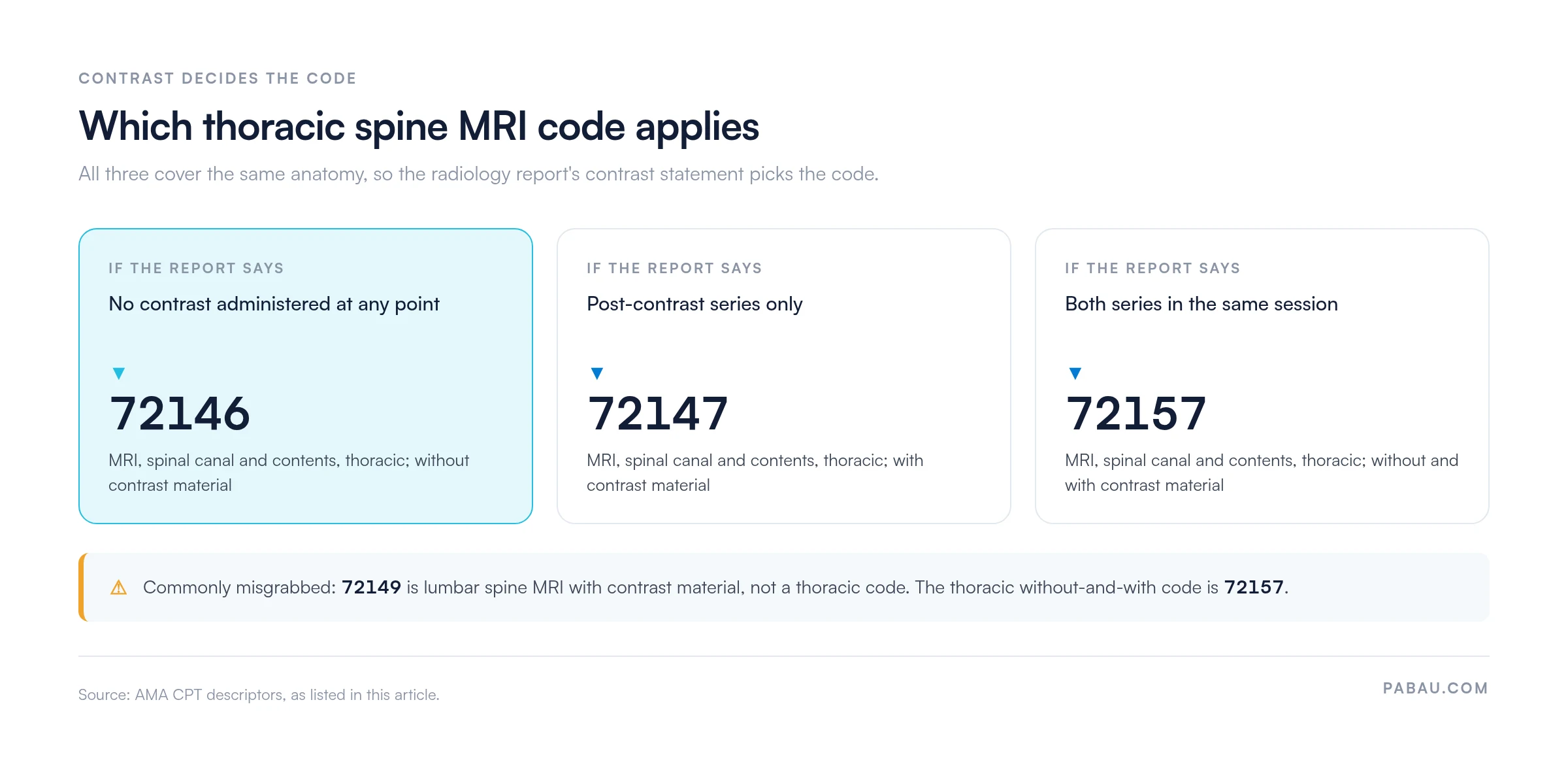
72149 is a lumbar spine code, so a thoracic MRI performed without and with contrast is billed as 72157.
Pabau’s claims management software submits 72146 claims through Claim.MD, checks eligibility before the scan, and tracks ERA remittances line by line.
CPT code 72146 is the AMA billing code for magnetic resonance imaging of the thoracic spine performed without contrast material. It covers the spinal canal and its contents across the T1-T12 vertebral segment. Payers treat it as a high-cost diagnostic study, so coverage turns on what the ordering note and the radiology report actually say.
The sections below cover what the code includes and the 2026 Medicare payment ranges. They also cover which modifiers apply and the ICD-10 codes that support medical necessity.
CPT code 72146 has the official AMA (American Medical Association) CPT descriptor: Magnetic resonance (eg, proton) imaging, spinal canal and contents, thoracic; without contrast material. In plain terms, it covers an MRI of the thoracic spine performed without intravenous contrast.
The code sits in the Diagnostic Radiology section of the CPT code set, in the 70010-79999 range. It applies when the radiologist images the thoracic spinal canal, the spinal cord, the intervertebral discs, and the surrounding soft tissue of the T1-T12 segment. No gadolinium-based contrast agent is given before or during the scan.
Billing the wrong code in the family is a common error, and the contrast statement in the report is what settles it. If contrast was administered at any point during the exam, 72146 is not the correct code. Use 72147 when only a post-contrast series was performed. Use 72157 when a non-contrast series and a post-contrast series were both performed in the same session.
Medicare covers CPT code 72146 when the clinical documentation demonstrates medical necessity under the applicable Local Coverage Determination (LCD). LCDs are issued by individual Medicare Administrative Contractors rather than by CMS. The LCD number and the exact list of covered indications therefore depend on which MAC processes your claims. Commonly covered indications include:
Medicare typically requires documentation of prior conservative management before it approves imaging for non-acute indications. That means physical therapy, medication, or chiropractic care. The ordering physician’s note must state why conservative management was insufficient, or why imaging is needed before treatment can begin. Always confirm the covered indications with your own MAC, because they vary by jurisdiction.
Where that medication trial is a short oral steroid course dispensed by the practice, it is reported separately under HCPCS code J7509. Recording it in the note builds the conservative treatment history the LCD expects before 72146 is approved.
The 2026 Medicare payment rate for CPT code 72146 comes from the Medicare Physician Fee Schedule (MPFS). The MPFS applies a geographic cost index to national RVU values. Because rates adjust for location, the figures below are approximate national averages. Use the CMS Physician Fee Schedule Look-Up Tool to verify the exact rate for your MAC region. For work, practice expense, and malpractice RVU detail, the FastRVU 2026 RVU lookup tool breaks each component out.
CMS applies different practice expense RVUs depending on where the service is performed. Facility rates apply in hospital settings, where the facility bills separately for overhead. Non-facility rates are higher because the billing provider absorbs the equipment and staffing cost itself.
These are national averages before geographic adjustment. Your actual payment will differ with the Geographic Practice Cost Index (GPCI) for your locality. Practices that receive ERA remittance files can reconcile each paid line against the expected amount and catch underpayments early.
Modifier assignment for CPT code 72146 depends on the billing model. Either the radiologist and the imaging facility bill as one entity, or they bill the two components separately. Applying the wrong modifier is one of the most common reasons radiology claims are denied or adjusted.
If modifier 26 and modifier TC are both billed for the same service by the same provider, the claim will reject. The two modifiers represent the two halves of the global payment. They are billed separately only when two distinct entities perform the professional and the technical service. Check the global billing indicator CMS assigns to 72146 in the current MPFS data file before assuming split-component billing applies.
Medical necessity for CPT code 72146 is established through the ICD-10-CM diagnosis code reported on the claim. The codes below are among those commonly covered for thoracic spine MRI. This is not an exhaustive list, so check each one against the current LCD for your MAC jurisdiction. The wider ICD-10-CM codes library covers the specificity rules that apply across diagnostic imaging claims.
Report the most specific diagnosis code the documentation supports. Where cord or vascular involvement is part of the code descriptor, confirm the clinical note records the finding rather than a suspicion. Payers increasingly audit ICD-10 specificity on imaging claims.
A clean claim for CPT code 72146 needs documentation that supports both the ordering decision and the reported ICD-10 code. Thin or missing documentation is the primary driver of medical necessity denials. Capture all of the following before the claim is filed:
Traditional Medicare (Parts A and B) does not generally require prior authorization for diagnostic MRI. Medicare Advantage plans and most commercial payers are a different story. Their requirements vary by plan, benefit year, and geographic region. UnitedHealthcare, Humana, and Cigna Medicare Advantage have all applied authorization requirements to outpatient spine MRI in multiple markets.
When prior authorization is required, submit the ordering physician’s clinical note, the proposed ICD-10 code, and the record of conservative treatment. Confirm the authorization number appears on the claim before submission. An authorization covering a lumbar MRI does not extend to thoracic imaging, so check the exact procedure code approved. Verifying the patient’s benefits before the scan is ordered saves the practice an avoidable appeal cycle.
Most denials for CPT code 72146 fall into four categories. Those are LCD non-compliance, modifier errors, bundling conflicts, and timely filing failures. Catching each one in the workflow before submission costs the practice less than working the denial afterward.
Structured denial management for radiology billing should track denial reason codes by CPT code. For 72146, LCD non-compliance and modifier errors consistently rank at the top. Separating the two in denial tracking tells you where the problem sits. One points at clinical documentation on the ordering side, the other at billing configuration on the coder side.
The spine MRI family covers three anatomical levels and three contrast variants. Selecting the wrong code from the family is a frequent error, particularly across the thoracic and lumbar ranges. The table below sets 72146 alongside the codes it is most often confused with.
When a patient has both thoracic and lumbar imaging on the same date, 72146 and 72148 may both be billed. Each has to be separately documented as clinically necessary, and not performed as one combined sequence. Use modifier 59 on the second code to override the bundling edit. Describe both regions independently in the radiology report.
One mix-up sits outside the spine family altogether. An order that says only thoracic MRI without contrast can mean the chest soft tissues. The mediastinum, hilar regions, pleura, and chest wall are reported with CPT 71550. Settle spine versus chest with the ordering physician before either code is assigned.
Run a monthly denial analysis segmented by CPT code. For 72146, track whether denials cluster on modifier errors or on LCD non-compliance. The first is a biller configuration problem and the second is a clinical documentation problem. Modifier errors are resolved once in your billing software setup. Documentation problems only change when the ordering physicians change what they write.
Radiology and imaging practices billing CPT code 72146 juggle three requirements before the claim goes out. The report has to state contrast use. The modifier has to match the billing arrangement, and the diagnosis code has to clear the payer’s coverage policy. Any one of the three can trigger a denial on its own.
Practice management software like Pabau keeps those details attached to the encounter rather than spread across separate systems. Its claims management software carries the procedure code, the diagnosis code, and the modifier from the order through to submission. The biller then works from one record.

Pabau integrates with Claim.MD, a US medical claims clearinghouse, to handle electronic submission for CPT and ICD-10 coded encounters. That integration covers three things:
The clearinghouse does not assign codes or decide coverage. Your coders still choose the procedure code, the modifier, and the diagnosis code for each thoracic spine MRI. The integration carries that decision to the payer. It brings the response back against the original claim line, with the CARC reason code attached. The biller can then see which requirement failed without reopening the chart.

Pabau checks patient eligibility before the scan and submits claims electronically through Claim.MD to over 4,000 US payers. ERA remittances then map each payment back to the line you billed.

CPT code 72146 denials trace back to the same three points. The diagnosis code is not on the payer’s covered list. The modifier does not match the billing arrangement. Or the radiology report is ambiguous about contrast. Settling all three before submission costs far less than working the appeal afterward.
The split between the two dominant denial reasons is the part worth acting on. Modifier errors are a configuration problem you fix once in your billing setup. LCD non-compliance is a documentation habit on the ordering side, and it shifts only when the ordering physicians change what they write. Book a demo to see how Pabau handles eligibility checks and electronic claim submission for imaging encounters.

Need a reference on US medical claims clearinghouses? Medical claims clearinghouse overview explains how clearinghouses validate, route, and track CPT-coded claims to US payers.
Want to reduce claim rejections across all procedure codes? Medical billing compliance guide covers the documentation and coding rules that keep claims clean across CPT code families.
Billing multiple spine codes on the same date? Denial codes in medical billing breaks down CARC reason codes and how to match them to the right corrective action for radiology claims.
CPT code 72146 is the AMA billing code for magnetic resonance imaging of the thoracic spine without contrast material. It covers the spinal canal and its contents in the T1-T12 vertebral segment, with no contrast agent administered. The official AMA descriptor reads: Magnetic resonance (eg, proton) imaging, spinal canal and contents, thoracic; without contrast material.
Modifier 26 applies when the radiologist bills the professional component separately from the facility. Use TC when the facility bills only for equipment and staff. Append 59 when 72146 is billed on the same date as another spine imaging code for a different region or session. Bill with no modifier only when one provider performs both components and bills globally.
Commonly paired ICD-10-CM codes include M51.04 (intervertebral disc disorders with myelopathy, thoracic region) and M51.14 (intervertebral disc disorders with radiculopathy, thoracic region). Others are M48.04 (spinal stenosis, thoracic region), M47.814 (spondylosis without myelopathy or radiculopathy, thoracic region), and G95.89 (other specified diseases of spinal cord). The reported code must match the clinical documentation and appear on the covered diagnosis list in your MAC’s LCD.
Traditional Medicare (Parts A and B) does not generally require prior authorization for thoracic spine MRI. Medicare Advantage plans and commercial payers frequently do, and their requirements vary by plan, region, and benefit year. Verify the requirements with the specific payer before ordering the study. Confirm the authorization covers the thoracic spine, rather than a general spine MRI approval.



