

CCSD code G5100: Bypass of duodenum billing guide
CCSD code G5100 bills a bypass that leaves the duodenum in place CCSD code G5100...

Last Updated: Oct 16, 2026
J7509 is the HCPCS Level II code for methylprednisolone oral, per 4 mg.
The injectable codes changed recently. CMS deleted J1020, J1030, and J1040 effective April 1, 2024, and J1010 replaced all three. Its descriptor is injection, methylprednisolone acetate, 1 mg, and the quantity billed is the total mg injected. Verify the drug's route before you assign either code.
Let Pabau's smart automation suggest the right codes, reduce claim denials, and keep your practice compliant—effortlessly.
Automate repetitive tasks and focus on what matters most—your patients.
Reduce coding errors and ensure compliance with the latest regulations.
Clean claims, fewer denials, and faster reimbursements.
Powerful insights and reporting to help your practice thrive.
HIPAA compliant SOC 2 certified GDPR-compliant Trusted by 4,000+ clinics worldwide

HCPCS code J7509 describes methylprednisolone oral, per 4 mg, the oral form sold as Medrol. It is active for 2026.
Each billing unit equals 4 mg. Divide total mg dispensed by 4, so a 21-tablet Medrol Dosepak (84 mg) bills as 21 units.
An NDC number is required on Medicare claims for J7509, and a missing one is among the most common denial reasons.
Injectable methylprednisolone acetate now uses J1010, billed per mg injected. CMS deleted J1020, J1030, and J1040 on April 1, 2024.
Practice management software like Pabau tracks dispensing units and HCPCS assignment, so unit errors get caught before the claim leaves.
The unit calculation for HCPCS code J7509 follows a single rule. Divide the total milligrams dispensed by 4. The rule turns on the word “dispensed” rather than “consumed.” For Medrol Dosepaks, the pharmacist dispenses the full pack, whatever the patient takes on any given day.
Formula: Units billed = Total mg dispensed ÷ 4
For tapered packs, always bill on total milligrams in the dispensed pack, not the day-one dose. A patient may start a 6-day taper at 24 mg and end at 4 mg. They still receive the full 84 mg pack, so 21 units is the correct J7509 quantity.
Medicare Part B covers J7509 when medical necessity is established and the claim comes from an eligible setting. That usually means a physician office or an outpatient facility. Coverage is not automatic. Local Coverage Determinations (LCDs) and National Coverage Determinations (NCDs) may add documentation requirements, depending on the treating condition and the MAC jurisdiction.
Payment rates under the Medicare fee schedule are set annually by CMS and vary by Medicare Administrative Contractor (MAC) locality. Use the CMS Physician Fee Schedule lookup tool to find the current payment limit for J7509 in your geographic area. Rates shown below are representative ranges; verify against your MAC’s current schedule before billing.
Coverage verification for J7509 belongs before the dispense, not after it. Some MACs run specific LCDs for corticosteroid prescribing that require a documented diagnosis, and in some cases prior authorization.
Verify J7509 payment rates quarterly, not just annually. CMS updates ASP-based drug payment limits every quarter (January, April, July, October). A rate valid in Q1 may differ by Q3. Build a quarterly fee schedule review into your billing team’s calendar to prevent systematic underpayment.
A National Drug Code (NDC) number must accompany J7509 on Medicare claims. CMS policy requires drug-code claims to carry the 11-digit FDA-assigned identifier for the specific product dispensed. Omitting the NDC is one of the most frequent reasons J7509 claims are rejected before adjudication begins.
Report the 11-digit NDC in 5-4-2 format, which is labeler-product-package. The qualifier “N4” precedes it on the claim line. The unit qualifier for oral methylprednisolone is usually “UN” for units, with the quantity matching the tablets dispensed. Confirm the NDC for the specific Medrol product against the package label before the claim goes out.
For a practice managing several drug codes, a clean claim starts with a verified NDC-to-HCPCS mapping in the billing system. Each J-code needs its own NDC record. Generic methylprednisolone and brand-name Medrol carry different NDC numbers, even at the identical dose and formulation.
Every J7509 claim must be supported by an ICD-10-CM diagnosis code that establishes medical necessity for oral methylprednisolone. Oral corticosteroids are prescribed across a wide range of inflammatory, autoimmune, and allergic conditions. The table below shows commonly linked diagnoses; this is not an exhaustive list, and payer LCDs may restrict covered indications.
Select the most specific ICD-10-CM code available for the patient’s condition. Unspecified codes (those ending in .9) increase audit risk. When the condition is well-documented, use the most granular code the medical record supports. Refer to the AAPC HCPCS code lookup for updated crosswalk data linking J7509 to covered diagnosis codes by payer.
Unit errors and missing NDCs account for most J7509 claim rejections. Each mistake below has a direct fix a billing team can apply immediately. Every one of them lands at a specific point in the dispense-to-payment path, mapped below.
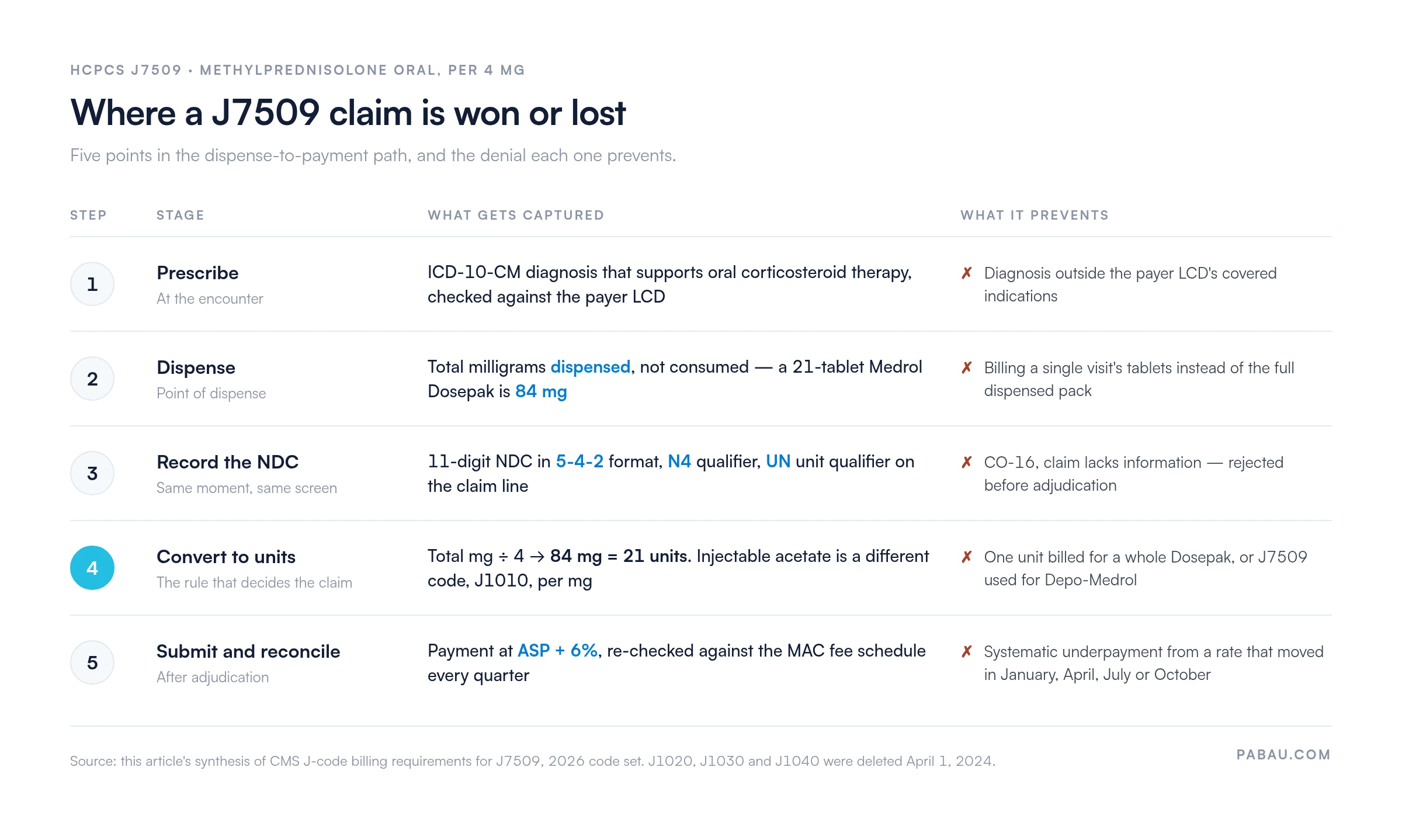
Where denials on drug codes repeat, the denial codes reference makes the pattern quick to spot. Most J7509 denials carry CO-16, meaning the claim lacks information, or CO-4, meaning the service is inconsistent with the modifier. Both point straight at the NDC or the unit count.
Methylprednisolone is one of several oral corticosteroids with dedicated HCPCS J-codes. Each code covers a specific drug, formulation, and unit measure. Using the wrong code, particularly swapping J7509 and J7510, results in incorrect drug reporting and potential overpayment or underpayment.
The J7510 confusion is worth extra attention. Prednisolone and methylprednisolone are different compounds with different unit sizes. J7510 bills per 5 mg of prednisolone, while J7509 bills per 4 mg of methylprednisolone. Applying J7509 units to a prednisolone prescription produces incorrect quantities on the claim.
Most J-code billing errors happen before the claim is submitted. Three habits at the point of care produce almost all of them:
Practices prescribing oral corticosteroids regularly need dispensing data captured at the point of care, not reconstructed later.
Pabau’s claims software for practices maps HCPCS codes to dispensing events and tracks units against the quantity dispensed. Claims then go out carrying the structured data payers ask for.
Where a practice dispenses injectables alongside oral drugs like J7509, the dispensing record shows what was given, in what form, and in what quantity. That keeps the oral and injectable corticosteroid codes apart at the point the code is chosen.
Superbill generation in Pabau captures drug codes, units, and diagnosis codes in one structured record. That record feeds claim creation directly, which removes the manual re-keying where unit errors start. For a practice dispensing a range of J-code drugs, that capture decides whether the claim clears first time or comes back for correction.

Pabau’s claims management software helps practices track drug dispensing units, attach NDC data to claims, and submit HCPCS drug codes accurately the first time.

J7509 rewards a habit rather than a lookup. Capture the milligrams at the dispense, divide by 4, and record the NDC on the same screen. A practice that works in that order rarely sees a J7509 denial at all.
The trade-off worth remembering is that the code set moves under you. J1020, J1030, and J1040 were live descriptors until April 2024, and the payment limit shifts every quarter. Build the quarterly check into the calendar rather than trusting last year’s note.
Pabau’s role here is to make that habit the default. Book a demo to see how units and NDC data stay attached to a J-code claim before it goes out.

Need to understand how drug billing fits into your revenue cycle? Revenue cycle management explained covers the full billing lifecycle from charge capture to payment posting.
Capturing drug codes and units at the point of care? Superbill generation shows how codes, units, and diagnoses reach a claim in one structured record.
Concerned about claim rejections on drug codes? Denial management in healthcare explains how to analyze rejection patterns and fix root causes before they repeat.
Want the compliance side of drug-code billing? Medical billing compliance covers the documentation and code-set rules that keep J-code claims defensible in an audit.
HCPCS code J7509 is used to bill for oral methylprednisolone (brand name Medrol), with each billing unit representing 4 mg of the drug dispensed. It is reported by physician offices, outpatient facilities, and other eligible providers when dispensing oral methylprednisolone for inflammatory, autoimmune, or allergic conditions.
Divide the total milligrams dispensed by 4. A standard 21-tablet Medrol Dosepak contains 84 mg total, so you bill 21 units. Bill based on what was dispensed, not what the patient consumed during a single day of a taper.
Medicare Part B may cover J7509 when medical necessity is established and the claim meets Local Coverage Determination (LCD) requirements for the treating diagnosis. Coverage is not automatic; documentation of the medical necessity for oral corticosteroid therapy must support the claim.
Medicare requires an 11-digit National Drug Code (NDC) in 5-4-2 format with an N4 qualifier on every J7509 claim line. The NDC identifies the exact product dispensed. Claims submitted without a valid NDC will be rejected before adjudication.
J7509 covers methylprednisolone oral, per 4 mg. J7510 covers prednisolone oral, per 5 mg. They are different drugs with different unit measures. Using J7509 for a prednisolone prescription produces an incorrect claim, and so does the reverse.
Standard J7509 claims for Medicare typically need no modifier for oral drug dispensing in an office setting. Modifier requirements still vary by payer and clinical scenario. Confirm them with your MAC or commercial payer before submission.
Yes. HCPCS code J7509 is an active code for 2026 with no recorded termination date, confirmed in the CMS HCPCS Level II annual code set update. Verify the current code status against CMS’s annual release before billing in any new year.
J1010, injection, methylprednisolone acetate, 1 mg. CMS deleted J1020, J1030, and J1040 effective April 1, 2024. Bill J1010 with the quantity as the total mg injected, and keep using J7509 for oral methylprednisolone.



