

CCSD code G5100: Bypass of duodenum billing guide
CCSD code G5100 bills a bypass that leaves the duodenum in place CCSD code G5100...

Last Updated: Oct 16, 2026
72132 is the CPT code for computed tomography, lumbar spine; with contrast material(s). Use it when the lower spine is scanned after contrast is given, with no non-contrast series first. A scan without contrast is 72131, and a scan with both phases in one session is 72133.
The signed report, not the order, decides which code applies. Getting the code or modifier wrong triggers denials and delays payment. Claiming global billing incorrectly can also create audit exposure under the False Claims Act. Modifiers, 2026 Medicare rates and prior auth each bring their own traps, and each gets a section below.
Let Pabau's smart automation suggest the right codes, reduce claim denials, and keep your practice compliant—effortlessly.
Automate repetitive tasks and focus on what matters most—your patients.
Reduce coding errors and ensure compliance with the latest regulations.
Clean claims, fewer denials, and faster reimbursements.
Powerful insights and reporting to help your practice thrive.
HIPAA compliant SOC 2 certified GDPR-compliant Trusted by 4,000+ clinics worldwide

CPT code 72132 is lumbar spine CT with contrast only, not without contrast (72131) or both phases in one session (72133).
Modifier 26 covers an independent radiologist’s read, and modifier TC covers the facility’s equipment and staff.
Many commercial payers route lumbar CT authorizations through radiology benefit managers such as Carelon or eviCore, so verify prior auth before scheduling.
Pabau, the practice software we build, submits claims through Claim.MD in the US and tracks denial reasons across payers, so imaging claims need less rework.
CPT code 72132 is “Computed tomography, lumbar spine; with contrast material(s).” That is the full official AMA descriptor. The radiologist images the lower spine in cross-section after contrast is given, usually through an IV.
Contrast brightens tissue that a plain scan shows poorly. Think scar versus recurrent disc, infection, tumor spread or a vascular lesion. That is why payers expect a clear clinical reason before they pay for it.
The code sits in a family of three, and contrast is the only difference between them. Pick the wrong sibling and the claim is undercoded or overcoded, even when the scan itself was justified.
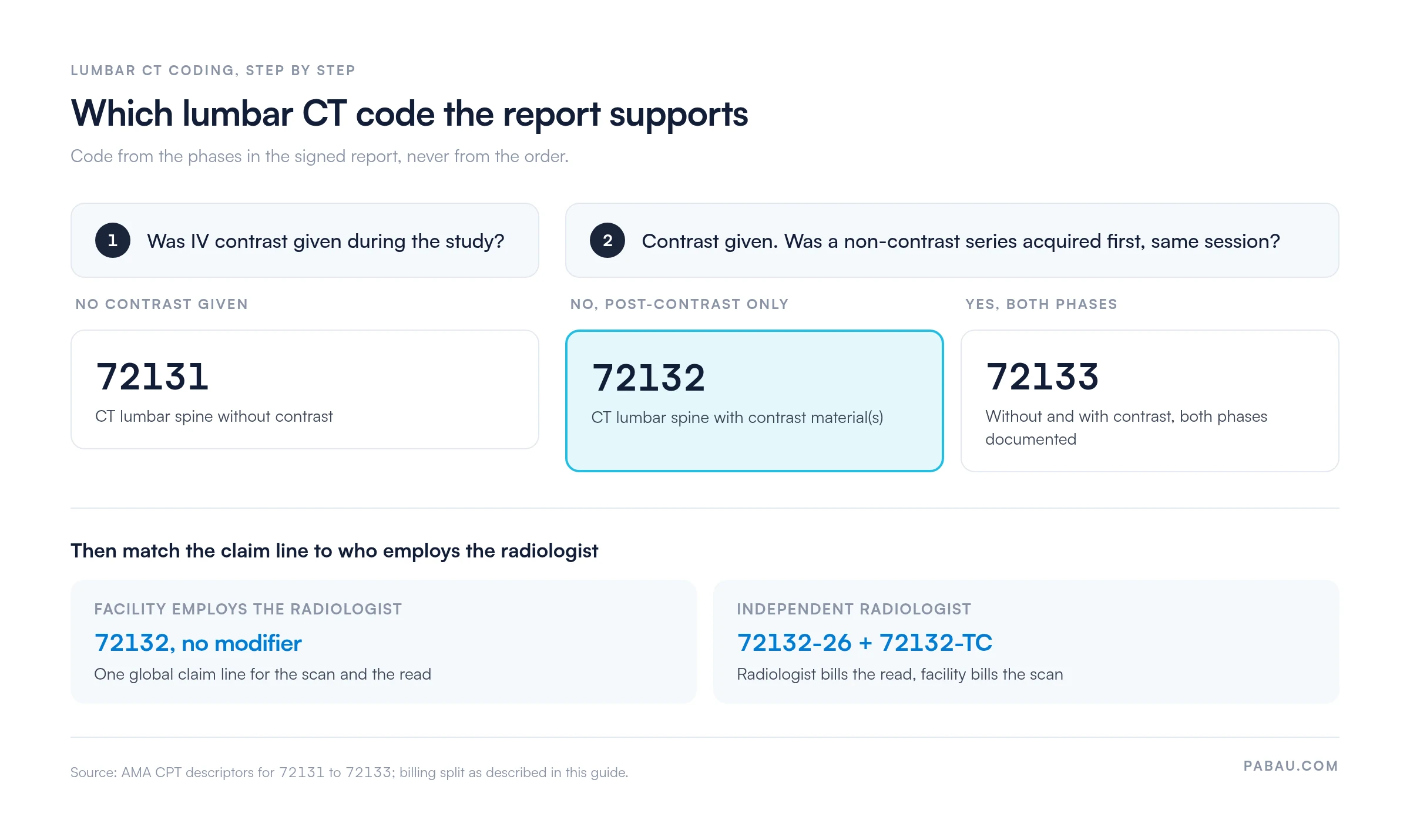
The three lumbar CT codes differ only by contrast. A study without contrast is 72131. A post-contrast study is 72132. A non-contrast series followed by a contrast series in the same session is 72133.
Here is how the choice plays out in practice. The order says “lumbar CT with contrast.” The tech runs one post-contrast series and nothing before it. The correct code is 72132, not 72133, even if the order reads like a two-phase study.
Two questions settle every lumbar CT claim, as the decision path below shows. The signed report has to answer both.
Contrast CT is not the default lumbar study. Payers usually accept 72131 for degenerative disease. Many Local Coverage Determinations (LCDs) want a specific reason before they approve contrast. These indications are broadly accepted:
The ICD-10-CM codes below commonly appear on approved 72132 claims. Payer acceptance varies, and codes update every year. Check the LCD for your payer before billing.
The modifier on a 72132 claim depends on the billing arrangement, not the scan. Get the component split wrong and you invite audits and medical billing compliance reviews. Four scenarios cover almost every case:
Say a hospital runs the scan and a contracted radiology group reads it. The split applies here. The group bills 72132-26 for the read, and the hospital bills 72132-TC for the scan.
Both claims carry the same date of service. Together, the two payments equal the global rate, and neither side gets more than its share. Now suppose the hospital employs the radiologist instead. Then it submits 72132 once, globally, with no modifier.
The mistake to avoid is billing global on top of a split. That is an overpayment and a compliance risk.
Flag radiology billing arrangements in your payer contract tracking. When a radiologist changes employment status mid-year, update the modifier on every active claim straight away. Billing global after a radiologist becomes an independent contractor is a common False Claims Act exposure point in outpatient imaging.
Medicare sets the rate for 72132 each year, and you can check it in the CMS Physician Fee Schedule lookup tool. The figures below are 2026 national averages. Your local rate shifts with the Geographic Practice Cost Index (GPCI).
Commercial rates are negotiated separately and often differ from Medicare. Check the current CMS figure before you quote a patient or negotiate a payer contract.
Prior authorization for 72132 is not universal. Still, treat it as the default with commercial payers. Many commercial and Medicare Advantage plans route lumbar CT requests through radiology benefit managers (RBMs). Carelon (formerly AIM Specialty Health) and eviCore are the big names.
Insurance eligibility verification comes first, but it does not confirm authorization. You still need a separate check against the payer’s imaging policy. A prior auth request for 72132 usually needs:
An auth for 72131 does not stretch to 72132. Sometimes the radiologist decides mid-workup that contrast is needed. In that case, get a supplemental auth before contrast goes in. Billing 72132 against a 72131 auth usually ends in an appeal, not a quick resubmission.
A 72132 claim is only as strong as the record behind it. Each missing element below can deny the first submission or fail a post-payment audit. The AMA’s CPT code set guidance is clear that billing reflects what was documented, not what was ordered.
A clean claim gets checked before it is generated, not after it bounces. Weekly batch reviews catch the same errors later and pile up appeals. Five minutes per claim covers it:
Denials on 72132 follow a handful of patterns. Once you know them, the fix is quicker and the prevention becomes routine.
Treat each denial as data, not a one-off. Log the reason code by payer, and the same two or three causes usually surface. A steady denial management routine then fixes the cause instead of the single claim.
Reading the codes on the remittance speeds this up. Our guide to medical billing denial codes explains what each one means, so your team knows which fix comes first.
Coders sometimes see 72132 and 72148 on overlapping orders. The second is MRI of the lumbar spine without contrast. They are different modalities, so bill the one that was performed, whatever the order said.
Both codes sit in diagnostic radiology, as the AAPC CPT code reference shows, but in different families. Billing one when the other was done is simply the wrong code. Correct it before submission rather than adjusting after a denial.
On a typical imaging claim, the order lives in one system and the signed report in another. The auth number often sits in an email. Billers then re-key the lot into a clearinghouse portal, and each hand-off is a chance for an error.
Pabau, the practice management platform we build, keeps the patient record, the invoice and the claim in one place. Its streamlined claims management turns the invoice into an electronic CMS-1500 claim. Required fields, such as the authorization number, must be complete before the claim can go.
In the US, claims go out through Claim.MD, Pabau’s integrated clearinghouse partner. It supports real-time eligibility checks and 835 ERA remittances. So you see what each payer paid on 72132, and the reason behind each denial, without leaving the patient’s record.

Pabau’s claims management software submits US claims through Claim.MD and tracks denial reasons across payers, so 72132 and similar radiology claims need less rework. See it in action.

Nearly every 72132 decision traces back to one question. Does the signed report prove contrast was given, in a single post-contrast phase? If it does, the code is settled, and the rest is process.
So put your effort upstream. Confirm the radiologist’s employment status before you choose global or split billing. Match the auth to the exact code before contrast goes in. Those two habits head off the costliest denials in the table above.
Pabau submits claims through Claim.MD in the US and tracks denial reasons across payers, so your team appeals only the claims worth fighting. Book a demo to see how Pabau moves imaging claims from invoice to remittance.

Struggling with medical billing claim errors? What is medical billing covers the full claim lifecycle from charge capture through remittance, with common error points flagged at each stage.
Need to understand how clearinghouse submissions work? Medical claims clearinghouses explains how 837 electronic claims are validated and routed to payers before adjudication.
Want to reduce denial rework across your practice? Electronic remittance advice walks through how 835 ERA files carry denial reason codes back to your billing system.
Billing a cervical spine CT instead? CPT code 72125 covers CT of the cervical spine without contrast.
Working on a thoracic spine study? CPT code 72128 covers CT of the thoracic spine without contrast.
No. CPT radiology guidelines define “with contrast” as intravascular, intrathecal or intra-articular contrast. Oral or rectal contrast on its own does not count. If the patient only drank contrast, code the study as 72131.
When CT is the only imaging after intrathecal contrast, report 62284 for the lumbar injection plus 72132 for the scan. If a conventional lumbar myelogram is done as well, pair 62304 with 72132 instead of 62284.
In an office or imaging center, Medicare pays for contrast separately under HCPCS codes in the Q9951 to Q9967 range. The code depends on the agent and its concentration. Hospital outpatient claims usually package contrast into the scan payment.
Each spine region has its own code, so report both. A contrast study of both regions is 72129 for the thoracic spine plus 72132 for the lumbar spine. Document both regions in the report, or the second line may deny.
No. Radiology codes like 72132 carry a global indicator of XXX, so the global period concept does not apply. Any follow-up visit is billed on its own.



