CPT code 28200: Flexor tendon repair, foot (primary or secondary, no graft)
CPT code 28200 covers direct flexor tendon repair in the foot CPT code 28200 is ...

Last Updated: Oct 19, 2026

CPT Code 72131 describes computed tomography of the lumbar spine without contrast material, classified under Diagnostic Radiology by the AMA.
The code carries 3.89 total RVUs, and that value is identical in facility and non-facility settings.
Modifier 26 and TC are the two modifiers applied to CPT 72131 most often. Incorrect modifier use is a leading denial trigger.
The place of service on the claim must match where the scan was performed, or the payer denies it on administrative grounds.
Practice management software like Pabau pairs a built-in CPT code library with pre-submission claim scrubbing, so radiology claims leave the practice clean.
CPT Code 72131 is the billable code for computed tomography of the lumbar spine performed without contrast material.
It covers the axial images of the L1 through L5 vertebrae, the intervertebral discs, and the spinal canal, along with the radiologist’s interpretation.
Billing it is straightforward once you know which half of the service you own. Modifier 26 and TC decide what Medicare pays, not the place of service on its own.
This reference covers the official code descriptor, 2026 Medicare reimbursement rates, RVU values, and the applicable modifiers. It also covers the ICD-10-CM crosswalk, documentation requirements, and the denial patterns that hit this code hardest.
The official short descriptor used by CMS is “CT lumbar spine w/o dye.” As defined by the American Medical Association’s CPT code set, it falls within the Diagnostic Radiology section of the CPT manual. Its sibling codes are 72132 (with contrast) and 72133 (without and with contrast).
Non-contrast imaging is the default for most lumbar CT indications. Bone, disc material, and bony canal stenosis are all visible without an iodinated contrast agent, so adding one rarely changes the read.
Medical necessity is the billing foundation for this code. Coverage criteria vary by Medicare Administrative Contractor (MAC) and commercial payer, but commonly accepted indications include:
Ordering providers should check the applicable Local Coverage Determinations (LCDs) before the scan is booked. An indication one MAC accepts is not automatically honored by the next one, and musculoskeletal referrals cross MAC boundaries often.
Medicare reimburses CPT 72131 under the CMS Physician Fee Schedule (MPFS). Rates depend on geographic locality (GPCI) and on whether the claim represents the global service, the professional component, or the technical component. The figures below are 2026 national benchmarks, so locality-adjusted rates will differ.
RVUs determine payment under the MPFS. CPT 72131 carries the following 2026 RVU components. Verify current values via the FastRVU 2026 RVU lookup tool or the CMS data file before billing.
The conversion factor applied to total RVUs determines the dollar payment. CMS updates that factor annually in the MPFS final rule. Confirm the current year’s figure from the CMS data file before you calculate expected reimbursement.
Place of service does not change what 72131 is worth. The facility and non-facility columns of the fee schedule both carry the same 3.89 total RVUs. What the setting changes is which component you are entitled to bill.
In an independent radiology office (POS 11) the practice owns the scanner and reads the study, so it bills the global service on one line. In a hospital outpatient department (POS 22) or an ambulatory surgical center, the radiologist bills only the professional component with modifier 26. The facility bills the technical side under the Outpatient Prospective Payment System (OPPS).
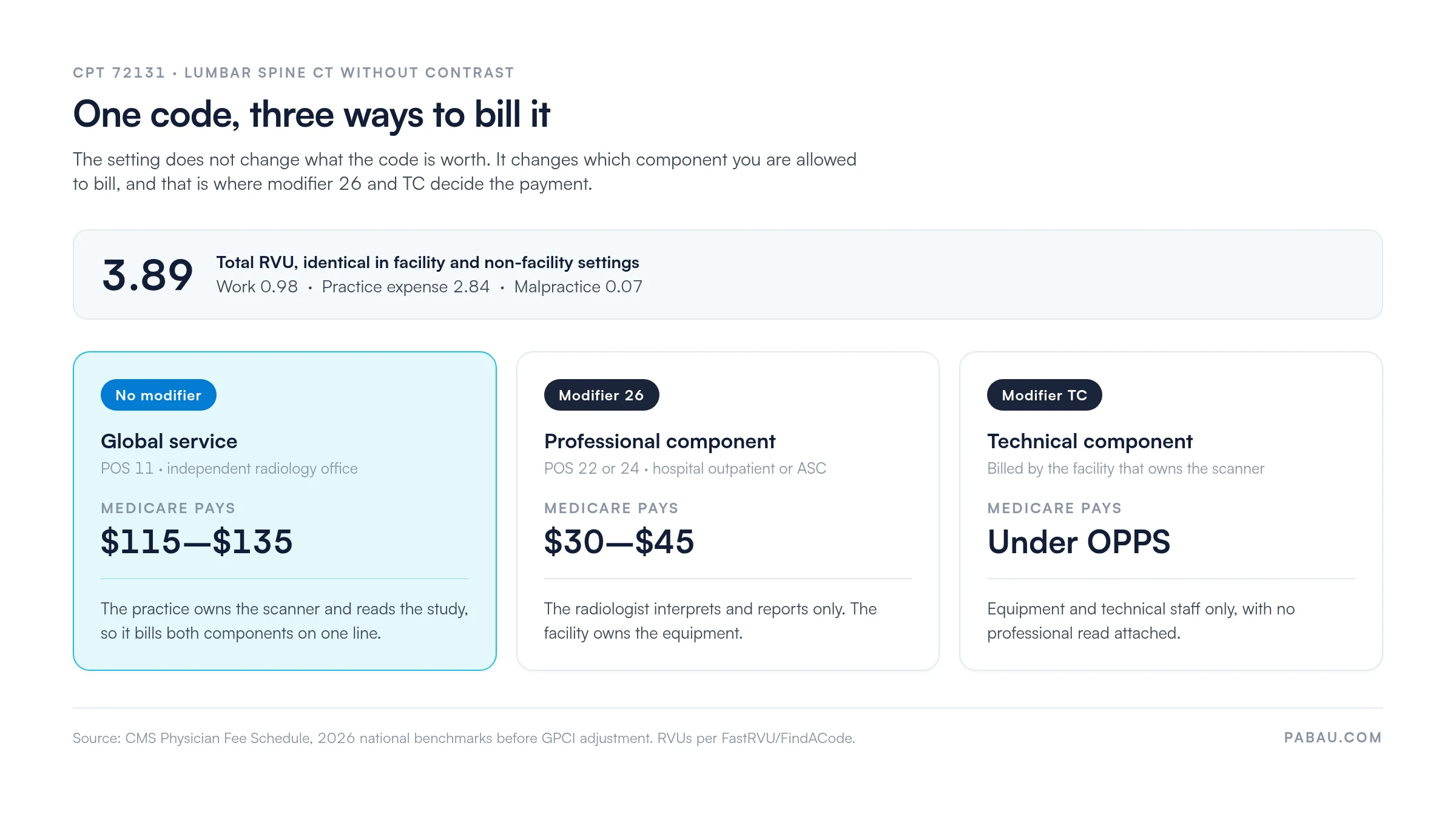
Those three configurations map onto the place-of-service codes a radiology practice bills most often:
Rates are geographic approximations based on 2026 national benchmarks, and locality-adjusted rates will vary. Real-time eligibility verification before the appointment is the cheapest way to confirm what the patient’s plan will actually pay.
Always verify your locality-adjusted MPFS rate for CPT 72131 using the CMS Physician Fee Schedule search tool. National benchmark figures can differ from your actual reimbursement by $20 or more, depending on the GPCI values in your area.
Modifier selection depends on who performed the technical and professional components, and on where the service was rendered. Applying the wrong modifier, or omitting a required one, is among the most preventable denial causes for radiology codes.
Modifier guidance reflects general NCCI policy and industry consensus. Confirm the current NCCI edits and your MAC’s own modifier policies before submission, because payer-specific rules override standard guidance.
Submitting CPT 72131 without a supporting ICD-10-CM diagnosis code is an automatic denial. The diagnosis code establishes medical necessity, and it has to reflect the clinical indication documented in the ordering provider’s record. The list below reflects commonly accepted codes from LCD crosswalk data, and it is not exhaustive.
ICD-10-CM codes update annually each October 1, so verify yours against the current CDC/NCHS release. The crosswalk above is a reference guide. Specific payer coverage lists govern how the claim is actually adjudicated.
Selecting the wrong code from the lumbar spine CT family is a frequent and avoidable error. The four codes below are the ones most commonly confused with CPT Code 72131.
CPT 72148 describes MRI of the lumbar spine without contrast, covering the same anatomical region through a different imaging modality. The clinical and billing distinction matters to payers.
Several commercial payers require MRI as first-line imaging for disc-related low back pain. Billing 72131 where payer policy wants 72148 first can trigger a medical necessity denial even when the CT is clinically appropriate. Verify payer-specific imaging protocols before ordering.
Never move 72131 up to 72133 when no contrast was administered. Choosing a code for its reimbursement rather than for the documented service is billing fraud and an OIG audit trigger. Use the AAPC CPT code lookup to confirm descriptors before submission.
Incomplete documentation is the second most common denial driver for lumbar imaging codes, after modifier errors. The medical record has to support the clinical indication and the choice of imaging modality.
Required documentation elements include:
Treat it as a three-way match: the clinical note, the order, and the claim all have to agree. When those three live in one auditable record, medical necessity denials drop and a payer audit takes hours instead of weeks.
Lumbar CT denials cluster around six errors, and each one is caught before submission by a check that takes seconds.
A systematic pre-submission review that checks modifier applicability, POS accuracy, and authorization status eliminates most of these triggers. Tracking denials by reason code also shows which error keeps recurring, which is where coding education pays for itself.
Run a quarterly audit of CPT 72131 claims filtered by denial reason code. CO-4 (incorrect code for service) and CO-11 (diagnosis inconsistent with procedure) are the two codes attached to lumbar CT denials most often. If either shows up regularly, the fix is a documentation or modifier protocol update, not a resubmission queue.
Most practices look 72131 up in one system, then type it into another. Practice management software like Pabau closes that step. Its claims management software holds the code library inside the billing module, so nobody retypes a code at charge capture.

Three capabilities do the work on radiology codes specifically:
Pabau also connects to a US clearinghouse network covering more than 4,000 payers. Real-time eligibility verification runs before the scan. You learn the patient’s coverage status and any pre-authorization requirement before the appointment, not after the denial.
For a practice processing a high volume of radiology claims, the time saved on validation and rework compounds fast. Submitting structured electronic claim files from one platform also removes the manual entry points where errors get in.

Pabau’s claims management software pairs a built-in CPT code library with pre-submission scrubbing. Modifier and place-of-service errors on codes like 72131 get caught in seconds. See how it fits your billing workflow.

The hard part of 72131 is not the code. It is knowing which component you are entitled to bill, and proving the scan was necessary. Get the modifier and the place of service right and the claim usually pays first time.
So the practical move is a pre-submission check rather than a bigger appeals queue. Denials on this code repeat, which means fixing the protocol once fixes every claim after it. Book a demo to see how Pabau catches modifier and documentation errors on radiology claims before a payer does.

Weighing the CT against the MRI? CPT code 72148 covers MRI of the lumbar spine without contrast, with its own rates and modifier rules.
Need the diagnosis side of the claim? ICD-10 code M51.16 sets out how lumbar disc disorders with radiculopathy are documented and coded.
Want to know what happens after you submit? What is a medical claims clearinghouse? explains how electronic claims are validated, scrubbed, and sent to payers.
Auditing your billing protocols this quarter? Medical billing compliance covers the laws, the common violations, and a checklist you can work through.
CPT Code 72131 is the AMA-defined code for computed tomography of the lumbar spine performed without contrast material. It sits in the Diagnostic Radiology section. It captures cross-sectional images of the lumbar vertebrae, intervertebral discs, and spinal canal without IV contrast. That makes it the standard code for bony and degenerative lumbar pathology.
It depends on which component you bill. The global service in an independent radiology office runs roughly $115 to $135 nationally. The professional component with modifier 26 runs roughly $30 to $45. Confirm your locality-adjusted figure with the CMS Physician Fee Schedule search tool, because GPCI adjustments create real regional variation.
CPT 72131 carries 3.89 total RVUs: 0.98 work, 2.84 practice expense, and 0.07 malpractice. Those values are identical in facility and non-facility settings, so the setting alone does not change the code’s RVU total. Multiply the total by the current MPFS conversion factor to estimate the payment.
CPT 72131 covers CT of the lumbar spine without contrast, and CPT 72132 covers the same scan with IV contrast administered. Use 72131 when no contrast agent is given. Use 72132 only when contrast is documented as having been administered, because billing it otherwise is upcoding and an audit risk.
Modifier 26 applies when only the radiologist’s interpretation is billed, and TC applies when only the equipment and technical staff costs are billed. Modifier 59 applies when 72131 is a distinct service billed on the same date as another procedure. Modifiers 76 and 77 cover a same-day repeat study by the same or a different provider.
Choose the CT when the clinical question is about bone. That covers fracture evaluation after trauma, post-surgical hardware assessment, and patients with an MRI contraindication such as a pacemaker. MRI gives better soft tissue resolution, and commercial payers often require it first for disc herniation and radiculopathy workups. Verify payer step-therapy rules before ordering.
CT spinal imaging uses 72125 and 72126 for the cervical spine, with or without contrast. 72128 covers the thoracic spine without contrast. The lumbar codes are 72131 (without contrast), 72132 (with contrast), and 72133 (without and with contrast). Picking the wrong region or protocol is a frequent billing error.