CPT Code 72081: Whole spine X-ray billing guide
CPT Code 72081: Official descriptor and what one view means CPT Code 72081 descr...

Last Updated: Nov 24, 2026
Billable Code
72074 is the CPT code for radiologic examination, spine, thoracic; minimum of 4 views. It covers a plain-film x-ray series of the thoracic vertebrae, T1 to T12, with at least four projections read in one encounter.
The view count in the signed radiology report decides the code. Two views is 72070, three views is 72072, and four or more views is 72074. A thoracolumbar junction study is coded separately, as 72080.
Let Pabau's smart automation suggest the right codes, reduce claim denials, and keep your practice compliant—effortlessly.
Automate repetitive tasks and focus on what matters most—your patients.
Reduce coding errors and ensure compliance with the latest regulations.
Clean claims, fewer denials, and faster reimbursements.
Powerful insights and reporting to help your practice thrive.
HIPAA compliant SOC 2 certified GDPR-compliant Trusted by 4,000+ clinics worldwide

CPT code 72074 covers a radiologic examination of the thoracic spine with a minimum of four views. Two views is 72070, and three views is 72072.
The radiology report must name every view acquired. A report without a stated count is the leading cause of downcodes to 72072.
Pair 72074 with an ICD-10-CM code such as M54.6 (pain in thoracic spine) or M48.04 (spinal stenosis, thoracic region) that meets the payer’s coverage policy.
Medicare’s 2026 national rate for the global service is approximately $44 before locality adjustment. Billing modifier 26 or TC splits that payment.
Pabau’s claims management software sends US claims through Claim.MD and posts ERA remittances back. Each 72074 denial is worked from the record it came from.
CPT code 72074 is the code for a radiologic examination of the thoracic spine with a minimum of four views. Its official descriptor comes from the AMA’s CPT code set, where every Category I code carries a descriptor for one procedure. For 72074 it reads “Radiologic examination, spine, thoracic; minimum of 4 views.” The code sits in the Spine and Pelvis subsection of Diagnostic Radiology.
It applies when a radiologist acquires and interprets at least four separate projections of the thoracic vertebrae in a single encounter. Three views billed as 72074 is upcoding. Four or more views billed as 72072 is under-billing, and the practice absorbs the difference. The code depends only on what the radiology report documents.
CPT 72074 covers a plain-film radiographic series of the thoracic vertebrae (T1 through T12). The minimum four-view series typically includes anteroposterior (AP), lateral, and at least two more projections the radiologist chooses for the clinical question. Oblique projections assess the facet joints and foramina. A swimmer’s view shows the cervicothoracic junction at T1-T2, and spot or cone-down views focus on one level.
Clinicians ordering this study for physical medicine and rehabilitation patients often need the extra projections. Scoliosis curvature, facet arthropathy, and compression fractures are hard to characterize fully on two views alone.
Common clinical indications that support medical necessity for CPT code 72074 include:
The clinical indication documented in the ordering physician’s note must map directly to the ICD-10 code on the claim. A mismatch between the documented indication and the submitted diagnosis code is a leading trigger for medical necessity denials.
The choice among 72070, 72072 and CPT code 72074 rests on one variable: The number of views documented in the radiology report. Two views is 72070, three views is 72072, and four or more views is 72074. The clinical scenario, the payer, and the diagnosis code do not change this rule, and the thoracolumbar junction code sits outside that ladder.
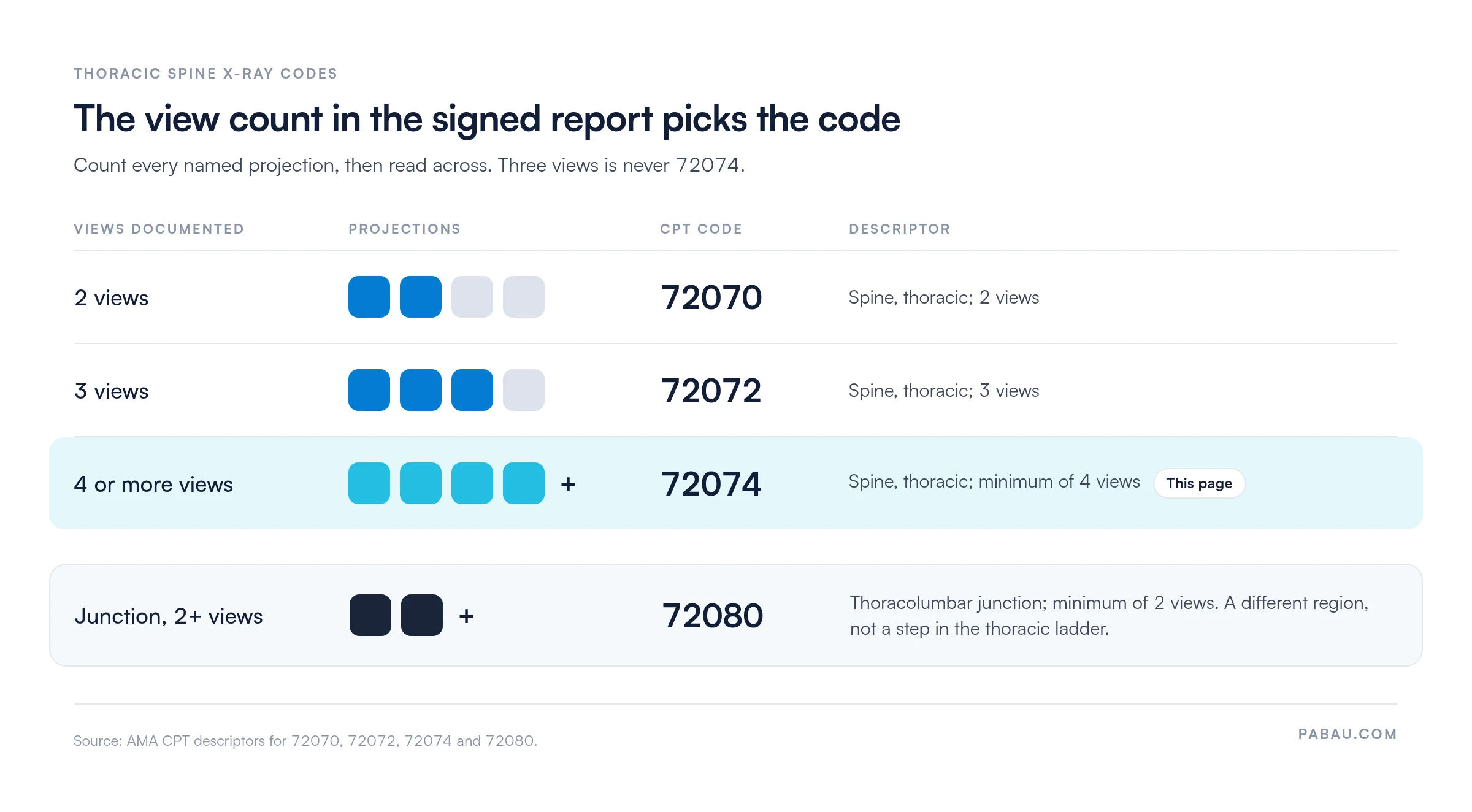
The full descriptors for the neighboring spine codes are below, including the lumbosacral series.
The practical audit step is to open the radiology report and count every named view. “AP and lateral” with no other projection is two views, which is 72070. “AP, lateral, right oblique, left oblique” is four views, which is 72074. If the report does not name the views, the coder must query the radiologist before assigning 72074. Billing the higher code on assumption is an audit liability.
72080 covers the thoracolumbar junction as a region of its own. If the order specifies thoracic and lumbar studies separately, each is billed with its own code, such as 72074 and 72100, not 72080.
Claim acceptance depends on pairing CPT code 72074 with an ICD-10 code that payers accept as medical necessity for a four-view thoracic series. Local Coverage Determinations (LCDs) from Medicare Administrative Contractors list the diagnosis codes that meet necessity criteria for spine radiography. The table below shows commonly accepted pairings. Verify them against the LCD for your jurisdiction before submitting.
Use the most specific ICD-10 code the documentation supports. Submitting M54.6 when the chart clearly documents M48.04 gives up specificity, and some payers flag that as under-coding on audit. Degenerative changes without nerve involvement belong under M47.814 rather than a pain code.
Medicare pays CPT code 72074 from the CMS Medicare Physician Fee Schedule, using the code’s relative value units and the annual conversion factor. For 2026, the national rate for the global service is approximately $44 before locality adjustment. That is 1.32 total non-facility RVUs multiplied by the $33.4009 conversion factor. Your payment moves with your locality and with which component you bill.
Verify the current-year rate in the CMS PFS Look-Up Tool, with your Medicare Administrative Contractor’s locality adjustment applied. Use FastRVU’s RVU lookup to retrieve the work, practice expense, and malpractice RVU components for 72074. The breakdown matters when you negotiate commercial contracts or check whether a contracted rate sits below the Medicare benchmark.
Modifier 26 and modifier TC determine how the work is split when interpretation and facility services are billed by different entities.
Applying the wrong modifier when two separate entities bill the same date of service generates a duplicate claim edit. The payer will pay one claim and deny the other. Confirm the billing arrangement with the facility before submission, and the denial never happens.

Every CPT code 72074 claim needs a documentation chain that connects the clinical indication to the number of views performed. Missing any element below gives payers grounds to downcode or deny.
Building a clean claim for 72074 starts with the radiology report, not the billing screen. Flag the report for view-count documentation before the radiologist finalizes it, not after the denial arrives.
Medicare fee-for-service does not require prior authorization for CPT 72074 as standard practice, but many Medicare Advantage plans and commercial insurers do. Prior auth requirements vary by plan, state, and clinical indication. Check the payer’s authorization lookup tool before scheduling the study.
When an auth is required, submit the clinical indication, the referring physician’s note documenting medical necessity, and the specific CPT code. Name 72074 itself, not a generic “spine x-ray” description. An auth obtained for a two-view study will not cover a four-view study on the same date. If the radiologist adds views during the encounter, document the clinical rationale for the expanded series in the report.
Denials for CPT code 72074 cluster around a small number of root causes. Identifying the denial reason code on the Explanation of Benefits (EOB) or Electronic Remittance Advice (ERA) is the first step in any denial management workflow. The table below maps the most common denial patterns to their corrective actions.
See the full reference of medical billing denial codes for CARC and RARC explanations and appeal language for each denial type.
A systematic appeal process recovers more revenue than ad-hoc responses. Follow these steps in order:
Before submitting any appeal for a 72074 downcode, audit your last 30 thoracic spine reports. Count how many state the view count in the report body, and how many use vague language like ‘complete series.’ A mandatory view-count field in the radiology report template gives coders a number to bill from instead of a phrase to interpret.
The highest-leverage point in the 72074 billing workflow is the radiology report itself, not the billing screen. Errors caught before the radiologist signs the report cost almost nothing to fix. Errors caught after a denial cost time, staff effort, and sometimes the payment entirely.
These workflow steps reduce 72074 billing errors in practice:
The AAPC’s CPT code lookup is a quick way to confirm a descriptor before a new report template or charge rule goes live. For how charge capture fits the wider revenue cycle, see medical billing fundamentals.
In many radiology and physiatry practices, the view count travels by hand. The radiologist signs the report, a coder reads it days later, and the claim goes out from a separate billing screen. When a payer downcodes 72074 to 72072, someone has to find the report again before the appeal can start.
Pabau, a practice management platform with insurance billing built in, keeps those steps on one patient record. Its claims management software sends US claims through the Claim.MD clearinghouse and posts ERA remittances back against each claim. Prior authorization codes, dates and sessions are tracked on the patient’s case, and Pabau warns when one is missing.
The result is a 72074 denial your team can work the same week it arrives. The ERA reason code, the authorization and the patient’s documents sit on one record, so the appeal starts from the file instead of a search.


Pabau sends US claims through Claim.MD, posts ERA remittances back to each claim, and tracks prior authorizations on the patient’s case. Your team sees why a 72074 claim was downcoded and has the record ready to appeal it.

Treat the view count in the signed report as the code. If the report names four or more projections, 72074 is defensible on audit. If it names three or fewer, or names none, the claim is not ready to send.
The change that pays back fastest is a mandatory view-count line in the radiology report template. It costs the radiologist a few seconds per study and removes the most common reason a 72074 claim comes back as 72072.
Book a demo to see how Pabau keeps claims, remittances and authorizations on one record, so a 72074 downcode is quick to appeal.

Need a full reference of denial reason codes? Medical billing denial codes lists every common CARC and RARC code with resolution guidance for radiology and other specialty claims.
Ordering advanced imaging after the x-ray? CPT code 72146 covers MRI of the thoracic spine without contrast, a common follow-up when plain films do not explain the symptoms.
Coding degenerative thoracic findings? ICD-10 code M47.814 covers thoracic spondylosis without myelopathy or radiculopathy.
Looking for a clearinghouse integration that surfaces ERA data in your billing dashboard? Pabau’s Claim.MD clearinghouse guide explains how the integration processes 837P claims and returns ERA remittance data for faster denial response.
Want to understand how the revenue cycle fits together? Revenue cycle management explained covers the full claim lifecycle from patient registration through payment posting.
CPT code 72074 is the billing code for a radiologic examination of the thoracic spine requiring a minimum of four views. The four-view threshold is what distinguishes it from CPT 72072, which covers exactly three views (72070 covers two). Common four-view combinations are AP, lateral, and two oblique projections. AP, lateral, a swimmer’s view, and a spot view also qualify.
CPT 72072 covers a thoracic spine radiologic examination with exactly three views, and CPT 72074 covers four or more views. The two codes are not interchangeable. Billing 72074 when only three views were performed is upcoding, while billing 72072 when four views were performed is under-billing. The radiology report’s explicit view count is the determining factor.
Traditional Medicare fee-for-service does not require prior authorization for CPT 72074 as a routine rule, but many Medicare Advantage plans do. Requirements vary by plan and state. Always verify with the specific payer before scheduling the study. A claim submitted without a required auth number is denied, and that denial is difficult to reverse retroactively.
The most common denial is a downcode to CPT 72072 because the radiology report does not explicitly document four or more views. Another frequent reason is an ICD-10 code that the payer’s LCD does not accept for a four-view study. Modifier errors cause denials too, when two entities bill the same date of service. So does a claim sent without a required prior authorization number.
Medicare’s 2026 national payment for CPT 72074 is approximately $44 for the global service, before locality adjustment. That figure is 1.32 total non-facility RVUs multiplied by the $33.4009 conversion factor. Rates vary by locality and by whether the professional component (modifier 26) or technical component (modifier TC) is billed separately. Verify the current-year rate in the CMS Medicare Physician Fee Schedule Look-Up Tool.
Billing CPT 72074 and CPT 72072 together for the same patient on the same date of service triggers a National Correct Coding Initiative (NCCI) edit. The two codes describe overlapping services. Billing 72074 alongside a lumbar spine code such as 72100 or 72148 is permissible when separate orders cover the two regions. Each order needs its own documented medical necessity. Confirm current NCCI bundling edits before submitting combination claims.