CPT Code 26410: Hand extensor tendon repair billing guide
CPT code 26410: Official descriptor and procedure overview CPT code 26410 report...

Last Updated: Nov 24, 2026
70250 is the CPT code for radiologic examination, skull; less than 4 views. It covers a limited plain-film study of the cranium, billed globally or split into technical (TC) and professional (26) components.
When the radiology report documents 4 or more views, the correct code is 70260 instead. CT of the head is a separate code, 70450. Payers also expect an ICD-10-CM diagnosis that supports medical necessity, such as a suspected fracture of the skull vault.
Let Pabau's smart automation suggest the right codes, reduce claim denials, and keep your practice compliant—effortlessly.
Automate repetitive tasks and focus on what matters most—your patients.
Reduce coding errors and ensure compliance with the latest regulations.
Clean claims, fewer denials, and faster reimbursements.
Powerful insights and reporting to help your practice thrive.
HIPAA compliant SOC 2 certified GDPR-compliant Trusted by 4,000+ clinics worldwide

CPT code 70250 covers a skull x-ray with fewer than 4 views. A complete series of 4 or more views is billed as CPT 70260.
Modifiers TC (technical component) and 26 (professional component) split the claim when the facility and the radiologist bill separately.
Commonly accepted ICD-10-CM pairings include S02.0XXA (fracture of vault of skull) and S09.90XA (unspecified injury of head). An unsupported diagnosis code is a leading denial trigger.
Pabau’s claims management software sends 70250 claims through the Claim.MD clearinghouse and posts the remittance against the patient record.
CPT code 70250 is the procedure code for a plain-film x-ray of the skull with fewer than 4 views. Its descriptor in the AMA’s CPT code set reads “Radiologic examination, skull; less than 4 views.” The code sits in the Diagnostic Radiology (Diagnostic Imaging) section, under imaging of the head and neck.
A skull radiograph captures the bony cranium using plain-film X-ray technology. Depending on positioning, it shows the calvarium, skull base, orbital walls, nasal bones, and paranasal sinuses. Brain tissue itself needs CT or MRI.
The view count defines 70250. Limited protocols include the anteroposterior (AP), lateral, Towne, and Waters projections, ordered individually rather than as a full series. When the radiologist acquires 4 or more views as a complete study, the correct code is 70260.
When billed globally (no modifier), CPT 70250 bundles image acquisition, radiographic supervision, and the radiologist’s interpretation with a written report. Billers should not add separate charges for film or digital storage alongside 70250.
Several related services are explicitly outside the code’s scope and require their own codes if performed:
The National Correct Coding Initiative (NCCI) may bundle 70250 with CT head (70450) when both appear for the same session without a supporting modifier. Check the current NCCI edit tables from CMS before billing both codes on one date of service.
Medical necessity for CPT Code 70250 is established when a clinical indication supports a limited plain-film cranial study. Payers judge necessity against their local coverage determinations (LCDs). The documentation has to name the specific clinical scenario, so a generic referral reason won’t carry the claim.
Accepted indications most consistently supported by payer policies include:
The indication must appear in both the ordering clinician’s notes and the radiology report. If you’re new to the claim cycle, this guide to how medical billing works shows where that documentation feeds in.
Payers validate CPT Code 70250 against ICD-10-CM diagnosis codes on the claim. An unsupported diagnosis code is one of the most common reasons a skull radiograph claim is denied. The table below lists pairings payers commonly accept, though individual LCDs may differ.
Always verify diagnosis code acceptability against the payer’s current LCD before submitting. Acceptable codes vary by Medicare Administrative Contractor (MAC) jurisdiction.
These three codes often share a worklist, and picking the wrong one leads to underbilling or denials. The choice hinges on view count (70250 vs 70260) and imaging modality (plain film vs CT head).
A typical slip: the radiologist acquires 4 views, but the coder bills 70250 because the order said “skull x-ray.” Confirm the view count in the radiology report before assigning the code. Billing 70260 work as 70250 loses revenue, and the reverse invites a medical necessity audit.
Sometimes the ordering clinician moves from plain film to CT head on the same date. Before billing 70450 alongside 70250, review the NCCI edits and confirm a valid modifier applies to two separate studies. The AAPC Codify CPT lookup shows the current bundling edits.
Put together, the code and the modifier come down to three questions, laid out below.
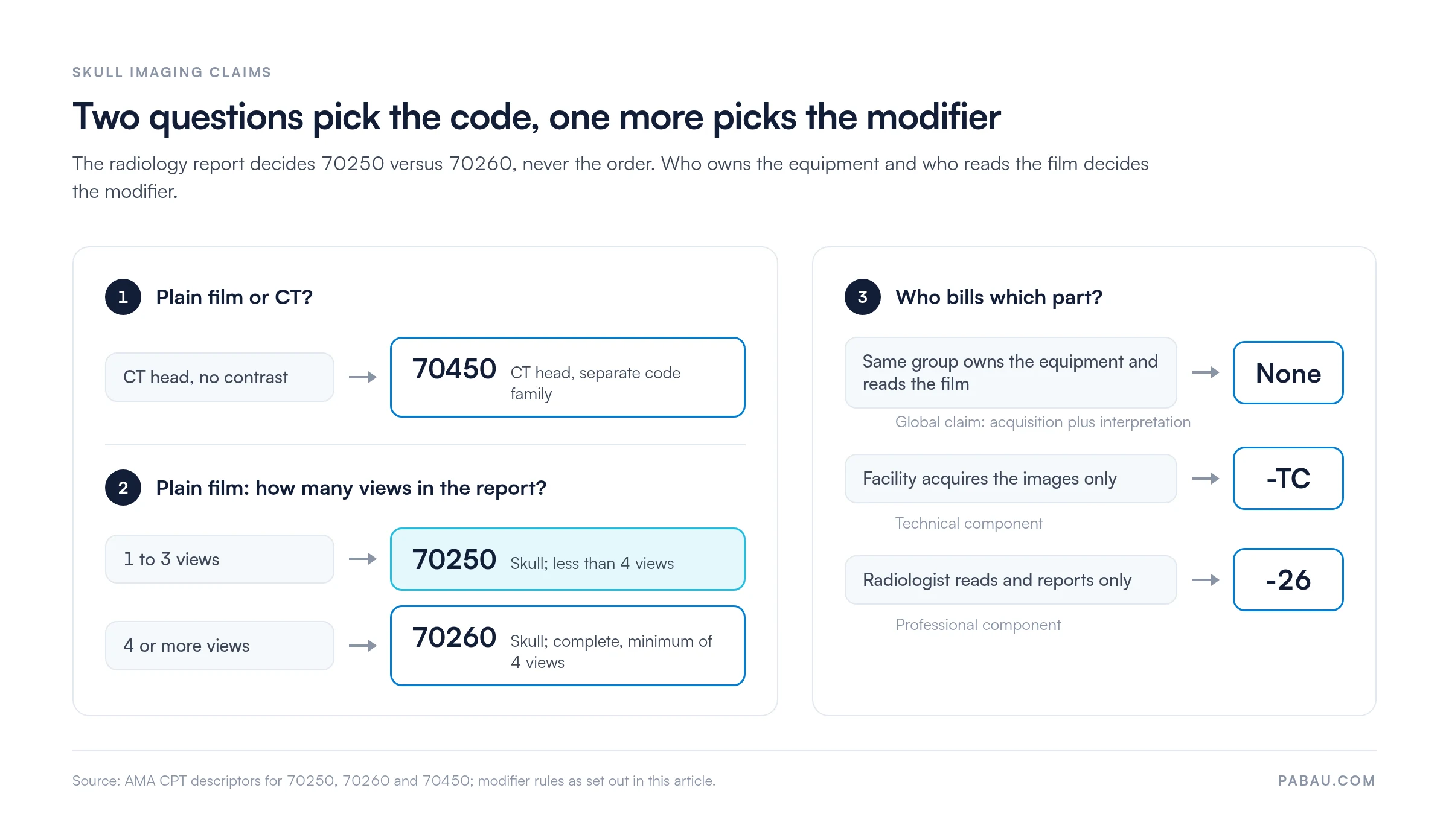
Modifier selection for CPT Code 70250 depends on who performs the technical work (image acquisition) and who provides the professional interpretation. A wrong or missing modifier is another frequent reason these claims come back denied.
Modifiers LT (left side) and RT (right side) don’t apply, because the skull is a midline structure billed as a single unit. Modifier 59 may override a bundling edit when 70250 is billed with another radiology code on the same date. The record must show that the studies were medically distinct.
Before billing 70250-TC or 70250-26, confirm whether a split-billing arrangement between the facility and the radiologist is documented in a contract. Missing contractual documentation is an audit red flag even when the modifier is clinically correct.
Medicare payment for CPT Code 70250 is determined annually by the Medicare Physician Fee Schedule (MPFS). Rates vary by geographic location through the Geographic Practice Cost Index (GPCI). The table below reflects national non-facility averages. Verify current amounts in the CMS Physician Fee Schedule lookup tool before submitting claims.
Commercial payer rates differ from Medicare and are usually higher. Use the FastRVU 2026 RVU lookup to retrieve current work, practice expense, and malpractice RVU values, which feed into commercial contract negotiations. Because of geographic adjustments, the same code pays differently in a high-cost city than in a rural area.
Plain-film skull radiographs generally carry a lower prior authorization burden than advanced imaging (CT, MRI). Under Medicare, the Appropriate Use Criteria (AUC) program set up by PAMA 2014 targets advanced diagnostic imaging. Plain skull films fall outside its main scope and typically need no AUC consultation.
Prior authorization rules still vary by payer. Complete insurance eligibility verification before the encounter to confirm whether the specific plan requires auth for outpatient radiology. Some commercial plans and Medicaid managed-care programs do require prior auth for skull imaging, particularly in non-emergency settings.
When authorization is required, have these documents ready:
For the claim itself, a radiology superbill must capture these elements:
A claim missing any of these won’t pass as clean. Review the components of submitting a clean claim before finalizing the billing workflow.
Skull radiograph claims are denied for predictable reasons, and a check before submission prevents each one.
A denial management workflow that tracks 70250 denial reasons by payer makes patterns visible quickly. For the codes payers attach to each rejection, see this reference on medical billing denial codes.
Run a monthly audit of 70250 denials, grouped by denial reason code. One reason showing up on 10 or more claims in a month points to a coding or documentation habit. Fix the workflow step behind it before appealing claims one by one.
Most 70250 denials start with a re-keying step. A biller copies the view count, diagnosis and modifier from the radiology report into a separate billing system. One of the three slips.
Pabau’s claims management software builds the CMS-1500 claim from the same patient record that holds the order and the report. Eligibility is checked before the visit, and the claim goes out through the Claim.MD clearinghouse.
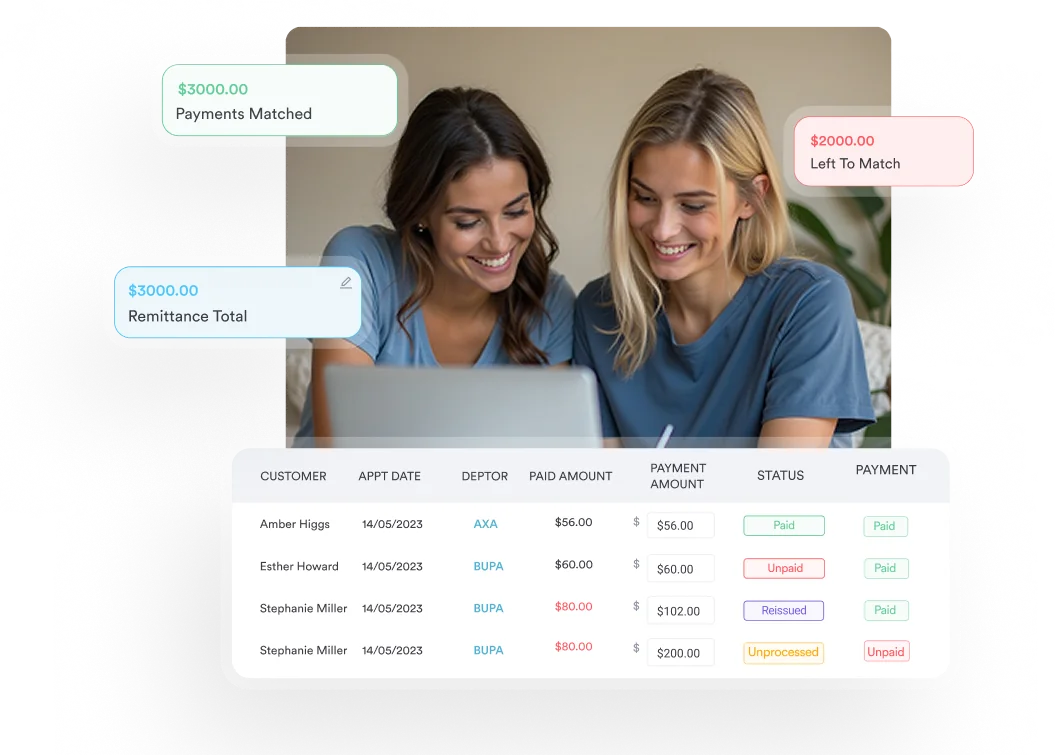
Electronic remittance advice comes back against that record too. A payer might reject a split TC claim or question the diagnosis. Your team sees it the day it lands and fixes it while the report is still fresh.

Pabau keeps the radiology report, the 70250 claim and the payer’s remittance on one patient record. Claims go out through the Claim.MD clearinghouse with eligibility checks before the visit.

Code 70250 from the radiology report, never from the order. The order says “skull x-ray,” and only the report says how many views were taken and who read them.
Building that habit costs a minute per claim. Skipping it costs an underpaid 70260, a bundled CT, or a split claim missing its TC modifier. Book a demo to see how Pabau keeps the radiology report and the claim on one record. Every 70250 then goes out coded from the report.

Need a plain-language overview of how medical billing works end to end? What is medical billing explains the full revenue cycle from encounter to payment.
Confused about what makes a claim clean before submission? Clean claim submission guidelines covers the documentation checklist every radiology biller needs.
Looking to understand how clearinghouses process radiology claims? Medical claims clearinghouse guide explains how EDI transactions reach payers and what happens when they fail.
CPT code 70250 is the billing code for a skull x-ray taken with fewer than 4 views. The AMA defines it in the Current Procedural Terminology code set. It covers plain-film imaging of the cranium. CPT 70260 requires a minimum of 4 views, and CPT 70450 is CT head without contrast.
CPT 70250 covers a limited skull series with fewer than 4 views, and CPT 70260 covers a complete series with at least 4 views. The view count documented in the radiology report decides the code, so confirm the report before coding.
Commonly accepted ICD-10-CM codes include S02.0XXA (fracture of vault of skull, initial encounter), S09.90XA (unspecified injury of head), and S00.00XA (unspecified superficial injury of scalp). Acceptable codes vary by payer LCD, so check the specific MAC’s coverage policy before submitting.
Under Medicare, plain skull films generally don’t need prior authorization, because CMS AUC requirements target advanced imaging. Commercial payers and some Medicaid managed-care plans may require it for outpatient radiology. Verify eligibility and plan rules before the encounter.
Modifier 26 (professional component) applies when the radiologist interprets the study without owning the equipment. Modifier TC (technical component) applies when the facility acquires the images without interpreting them. When one provider or group owns both components, bill globally with no modifier.
Only after a careful NCCI edit review, because CMS may bundle them on the same date. If the two studies were separate and medically distinct, modifier 59 may override the edit. The documentation must show why both were medically necessary in the same session.