

HCPCS Code L0472: Hyperextension TLSO billing guide
HCPCS code L0472: Official descriptor and device definition HCPCS code L0472 des...

Last Updated: Nov 5, 2026
69714 is the CPT code for implantation of an osseointegrated implant in the skull with a percutaneous attachment to an external speech processor. It reports a bone-anchored system, such as Baha Connect or Ponto, where an abutment through the skin couples the implant to the processor.
The code choice turns on how the processor attaches. A magnetic transcutaneous system is reported with 69716 or 69729 instead. The implant system itself is billed by the facility as HCPCS L8690.
Let Pabau's smart automation suggest the right codes, reduce claim denials, and keep your practice compliant—effortlessly.
Automate repetitive tasks and focus on what matters most—your patients.
Reduce coding errors and ensure compliance with the latest regulations.
Clean claims, fewer denials, and faster reimbursements.
Powerful insights and reporting to help your practice thrive.
HIPAA compliant SOC 2 certified GDPR-compliant Trusted by 4,000+ clinics worldwide

CPT code 69714 reports implantation of an osseointegrated skull implant with a percutaneous attachment to an external speech processor.
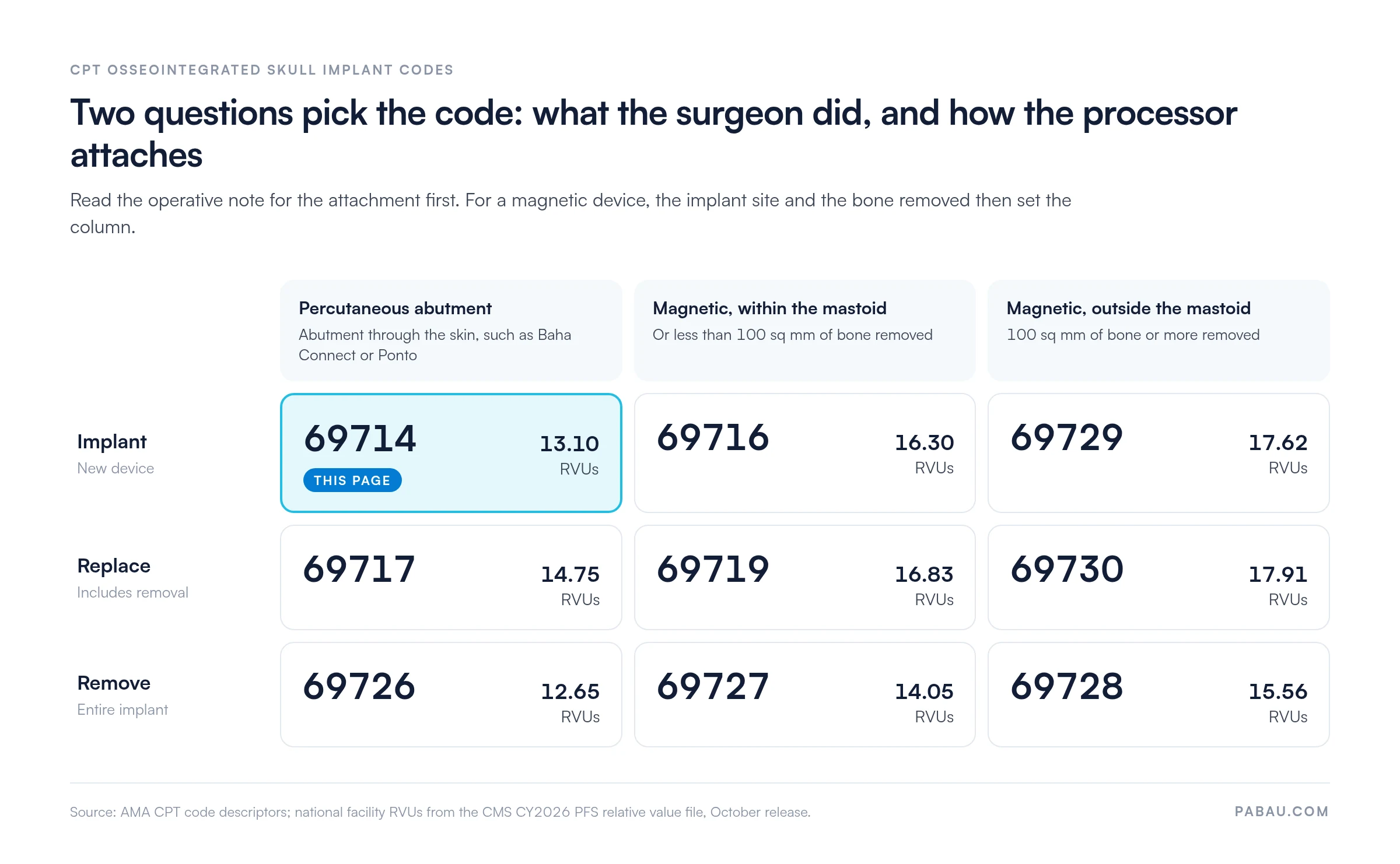
The choice between 69714 and 69716 turns on how the processor attaches: a skin-penetrating abutment (69714) or a magnet under intact skin (69716).
Replacement is 69717 or 69719 and removal is 69726 or 69727, while 69728-69730 cover magnetic implants outside the mastoid with larger bone removal.
The implant system is HCPCS L8690, not L8614, which is the cochlear implant code, and it belongs on the facility claim.
The CY2026 national Medicare amount for 69714 is $439.73 (13.10 facility RVUs at $33.5675), with a 90-day global period.
CPT code 69714 is the American Medical Association (AMA) code for a percutaneous osseointegrated skull implant. Its full descriptor is “Implantation, osseointegrated implant, skull; with percutaneous attachment to external speech processor”. The surgeon anchors a titanium implant in the skull behind the ear. An abutment then passes through the skin and couples the implant to the sound processor.
Percutaneous systems include the Cochlear Baha Connect and the Ponto system. The procedure treats conductive hearing loss, mixed hearing loss, and single-sided deafness when a conventional air-conduction hearing aid is not an option.
The abutment is not a separate coding decision. It is the percutaneous attachment that the descriptor names, so a case where the implant and abutment go in together is still 69714. What moves a case to another code is a magnetic transcutaneous attachment, a replacement, or a removal.
Knowing the boundary of 69714 keeps the professional claim, the facility claim, and the audiology claims from overlapping. Settle it before the operative note is coded.
Included in 69714:
Not included in 69714:
The family splits on two questions. How does the processor attach to the implant? For a magnetic device, where does the implant sit and how much bone comes out?
National facility RVUs below come from the CY2026 Physician Fee Schedule relative value file.
CPT 2022 deleted 69715 and 69718, and revised 69714 and 69717. CPT 2023 added 69728 through 69730 for magnetic implants outside the mastoid.
Read the operative note for the attachment. An abutment through the skin means 69714 for a new implant, or 69717 for a replacement. A magnet under intact skin, as with Baha Attract or Osia, sends the case to the magnetic codes by location and bone surface.
HCPCS L8614 is “Cochlear device, includes all internal and external components.” It describes a cochlear implant system and has no place on a 69714 case. The osseointegrated system is L8690, with separate codes for replacement parts.
Who bills L8690 depends on where the surgery happens. The surgeon reports 69714 on the professional claim in every setting below.
Never put L8690 on the surgeon’s professional claim for a facility case. The facility already reports the device, so a second line reads as a duplicate charge. Check current device rules in the CMS HCPCS files.
Medicare covers auditory osseointegrated implants as prosthetic devices, not as excluded hearing aids. CMS proposed treating them as hearing aids in 2014. It declined to finalize that proposal in the CY2015 DMEPOS final rule.
No national coverage determination sets candidacy rules for these devices. Check your Medicare Administrative Contractor (MAC) for any local policy, and document medical necessity in full. Medicare Advantage and commercial plans apply their own medical policies, and many follow BCBSA policy 7.01.03.
Premera policy 7.01.547, effective May 1, 2026, is a typical example of those criteria:
The direction of that threshold matters. A lower dB HL number means better cochlear hearing, so the patient must score at or below the ceiling. A bone-conduction average of 50 dB HL fails the 45 dB ceiling for a standard processor.
Run insurance eligibility verification before the case is scheduled. Medicare Advantage plans often add prior authorization that original Medicare does not require.
Many commercial and Medicare Advantage plans require prior authorization for 69714. Requirements vary by plan, so check each policy. A complete request usually carries:
Submit early and track the approval dates. An authorization that lapses before the surgery date is a common denial, and retro-authorization is rarely granted for elective surgery.
The operative note is the document an auditor reads first on a 69714 claim. It must show the attachment type, because that is what separates this code from 69716.
Every operative note supporting a 69714 claim should contain:
The 90-day global period covers routine postoperative care, so those visits are not billed separately. Flag the post-op dates before you submit a clean claim. Modifier 24 applies only to an unrelated evaluation and management service within the global period.
Use the most specific code the record supports, including laterality. A bilateral case usually codes to H90.0 for conductive loss or H90.6 for mixed loss. The codes below are common examples, not a payer coverage list.
Single-sided deafness codes are accepted under many commercial policies when the hearing ear meets the 20 dB HL criterion. Confirm the payer accepts them before you submit.
Medicare pays the surgeon for 69714 under the CMS Physician Fee Schedule. The values below are national, from the CY2026 relative value file, October 2026 release.
CY2026 uses two conversion factors. Clinicians who qualify through an advanced alternative payment model get the higher one. Your local amount also applies the geographic practice cost indices for your payment locality.
The hospital or ASC is paid separately under its own payment system, and that payment generally covers the device. Commercial payers negotiate their own rates, often as a percentage of the Medicare amount.
Pull 69714 values from the CMS relative value file or the PFS lookup tool for your locality and year. Then apply the conversion factor that matches the billing clinician’s APM status. National figures can sit well away from your local amount.
The PFS indicators for 69714 decide which modifiers Medicare pays. The table reflects the CY2026 file; commercial payers may differ.
Most 69714 denials trace back to a small set of root causes. Strong denial management catches each one before the claim leaves the practice.
Review denial codes in medical billing after each claim cycle. A monthly denial report filtered to 69714 shows whether authorization, coding, or documentation is driving the losses.
An osseointegrated implant case passes through audiology, scheduling, surgery, and billing before it is paid. Pabau, practice software that runs scheduling and billing side by side, keeps the patient record, the appointments, and the claim in one place.
Pabau’s claims software for surgeons turns invoices into electronic CMS-1500 claims, and the Claim.MD integration sends them to thousands of US payers. Coverage is confirmed with eligibility checks through Claim.MD before the visit, so an inactive plan surfaces before the case is booked.
Claim statuses update from the payer, and electronic remittance advice comes back into Pabau matched to the claims it settles. A claim that comes back rejected is flagged Needs action with the reason shown, so your team can correct and resubmit it. Your coders still read the operative note and choose the code.

Pabau’s claims management runs eligibility checks through Claim.MD before the visit, sends CMS-1500 claims, and matches remittances to each claim. Your team spots rejected claims early and reworks them from one patient record.

Let the attachment the operative note records decide the code. A skin-penetrating abutment is 69714, and a magnet under intact skin belongs to the magnetic codes. Document that clearly and most audit risk on these cases disappears.
Then keep the device on the facility claim as L8690, and check the payer’s threshold criteria before you schedule. Medicare will not pay co-surgeons or an assistant on this code, so plan staffing and billing to match. Book a demo to see how Pabau tracks eligibility, claims, and remittances for ENT practices.

Need a denial resolution framework for your practice? Denial management in healthcare covers root-cause analysis and appeal workflows for high-volume surgical specialties.
Looking to understand clearinghouse submission for US payers? Claim.MD clearinghouse guide explains how 837P electronic claims reach payers and return ERA/835 remittance data.
Want to reduce administrative time on eligibility checks? Insurance eligibility verification outlines verification workflows that confirm coverage before the surgery date.
Coding the diagnosis for a bilateral case? ICD-10 code H90.0 covers bilateral conductive hearing loss and the documentation that supports it.
Billing the candidacy workup? CPT code 92626 explains how the auditory function evaluation behind candidacy is billed.
CPT code 69714 covers implantation of an osseointegrated implant in the skull with a percutaneous attachment to an external speech processor. The abutment that passes through the skin is part of the code. The device itself is HCPCS L8690 on the facility claim, and processor programming is billed separately.
The difference is how the processor attaches. CPT 69714 reports a percutaneous attachment, with an abutment through the skin. CPT 69716 reports a magnetic transcutaneous attachment under intact skin, within the mastoid and/or removing less than 100 sq mm of bone. Whether an abutment was placed is not a separate code choice.
The most common are missing or lapsed prior authorization and a code that does not match the documented attachment. Others include a diagnosis outside the payer’s criteria and L8614 reported in place of L8690. A device billed by both surgeon and facility, and routine post-op visits billed inside the 90-day global, also deny.
Use CPT 69717, which reports replacement, including removal of the existing device, with a percutaneous attachment. The older replacement code 69718 was deleted in the CPT 2022 code set, along with 69715. Removal of the entire implant without replacement is CPT 69726.



