

HCPCS Code L0472: Hyperextension TLSO billing guide
HCPCS code L0472: Official descriptor and device definition HCPCS code L0472 des...

Last Updated: Nov 5, 2026
68200 is the CPT code for subconjunctival injection. It covers injecting a drug into the space between the conjunctiva and the sclera, outside the globe. The drug itself is billed separately with its own HCPCS J-code.
Ophthalmology practices use 68200 mainly for steroid and antibiotic injections that treat inflammation and infection at the front of the eye. A frequent coding error is confusing 68200 with CPT 67028 (intravitreal injection), because the injection sites differ anatomically.
Let Pabau's smart automation suggest the right codes, reduce claim denials, and keep your practice compliant—effortlessly.
Automate repetitive tasks and focus on what matters most—your patients.
Reduce coding errors and ensure compliance with the latest regulations.
Clean claims, fewer denials, and faster reimbursements.
Powerful insights and reporting to help your practice thrive.
HIPAA compliant SOC 2 certified GDPR-compliant Trusted by 4,000+ clinics worldwide

CPT Code 68200 covers the subconjunctival injection itself, and the drug is billed separately with its own HCPCS J-code on the same claim.
Medicare lists a bilateral indicator of 1 for 68200, so injecting both eyes on one date pays 150% of the single-eye amount.
68200 and 67028 are different procedures at different depths in the eye, so one code must never be substituted for the other.
NCCI edits bundle 68200 into cataract and intraocular surgery codes 66820-66986, and a modifier can unbundle it only for a distinct, documented service.
Pabau, the practice management platform we build, scrubs each claim for missing or invalid details and flags it before submission.
CPT Code 68200 is the AMA code for subconjunctival injection, which places a drug in the loose tissue between the bulbar conjunctiva and the sclera. It sits within the Eye and Ocular Adnexa section (65091-68899) of Surgery, in the Conjunctiva subsection.
One unit of service equals one injection event per eye. The code pays for the injection only. The drug is billed separately on the same claim with its HCPCS Level II J-code, under standard Medicare Part B drug rules.
Don’t be thrown by the CMS fee schedule files, which give 68200 the short descriptor “Treat eyelid by injection.” The procedure targets the conjunctiva, not the eyelid, and the AMA descriptor is the one to code from.
A subconjunctival injection places medication in the loose tissue beneath the conjunctiva. From there the drug diffuses into the front of the eye and, to a lesser extent, the back. The physician instills a topical anesthetic first, then injects at the limbus or in the inferior fornix with a fine-gauge needle.
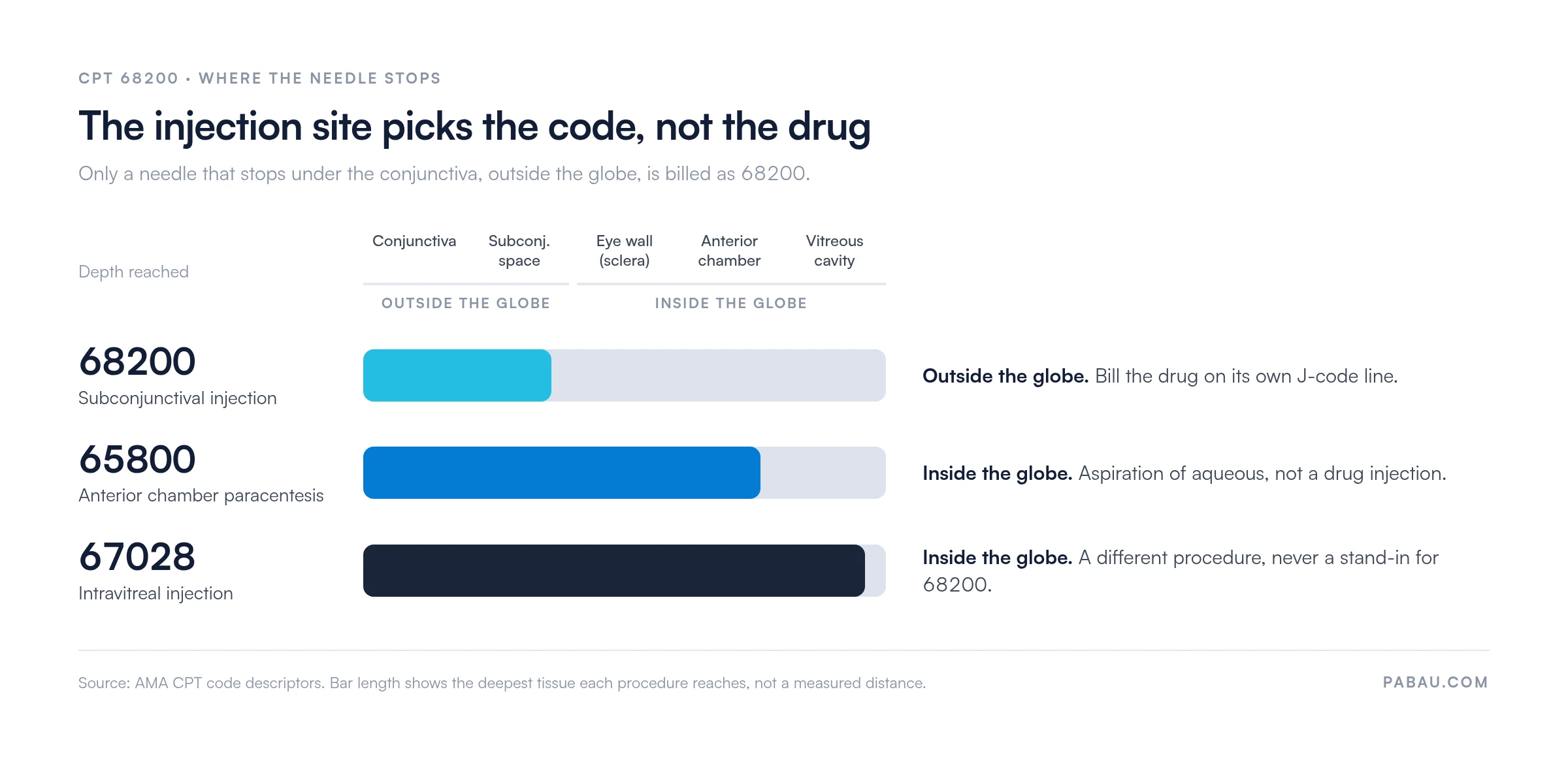
The anatomy decides the code. The subconjunctival space sits above the sclera, entirely outside the globe. In CPT 67028 the needle enters the vitreous cavity inside the eye instead. Billing 67028 for a drug delivered subconjunctivally, or the reverse, misstates the procedure on the claim. The diagram below shows how far each eye procedure code reaches.
Commonly reported diagnoses include conjunctivitis (H10.xx), keratitis and corneal ulcer (H16.xx), and iridocyclitis or anterior uveitis (H20.xx). Coverage depends on the payer’s policy. For a planned post-operative injection, report the operative eye condition as the primary diagnosis.
Payers want a diagnosis that supports an injection, not one that only describes eye symptoms. Which diagnoses they accept depends on each payer’s policy. Cosmetic diagnoses, unexplained eye pain, and a diagnosis that doesn’t match the treated eye will draw a denial.
Modifiers on 68200 tell the payer which eye was treated and whether the injection stands apart from other same-day procedures. Each one below needs documentation that matches it, or it becomes a compliance risk.
CPT Code 68200 carries a bilateral surgery indicator of 1 in the CY2026 Medicare Physician Fee Schedule. When both eyes are injected on the same date, Medicare pays 150% of the single-eye amount rather than 200%.
How the claim lines look depends on your Medicare administrative contractor (MAC) and the payer:
Some commercial payers set their own bilateral format and payment rules. Sending two lines to a payer that expects -50 usually ends with one line paid and the other denied as a duplicate. Check the payer contract and build the format into your claim template before the first submission.
68200 pays for the injection, not the drug. Report the drug on its own line with the correct HCPCS Level II J-code, with units that match the dose given.
Triamcinolone is the easiest drug to get wrong on units. J3301 counts in 10 mg units, while the preservative-free J3300 counts every milligram. Pick the code from the vial in your stock, then calculate the units.
Medicare Part B lets you bill the unused part of a single-dose vial as wastage with the JW modifier on the drug line. Document the discarded amount and that it couldn’t be used for another patient. When nothing is discarded from a single-dose container, add the JZ modifier to the drug line instead.
Medicare routinely requests invoices for J3490 claims, so keep supplier invoices in your billing records.
Before billing J3490, check whether the drug now has a specific J-code. CMS updates HCPCS Level II codes each quarter. Using J3490 for a drug that has gained its own code invites a request for additional information and delays payment.
The National Correct Coding Initiative (NCCI) publishes procedure-to-procedure edits listing code pairs that Medicare won’t pay separately on the same date. Check the current edit table before combining 68200 with other same-day codes. The tables change every quarter, so a pair that paid last year may be bundled today.
The edit that catches most practices is surgical. NCCI bundles 68200 into cataract and intraocular surgery codes 66820 through 66986, including 66984. Those pairs carry a modifier indicator of 1, so a modifier can unbundle the injection only when it is a distinct, documented service.
Intravitreal injection, billed with 67028, is a separate procedure at a different depth. The two codes describe different services, so one must never be substituted for the other. Reporting 67028 for a drug placed under the conjunctiva misstates the service on the claim.
Anatomical location decides the correct code, not the drug used or the condition treated. Swapping 67028 and 68200 misreports the procedure, and payers don’t treat it as a clerical slip.
Medicare pays 68200 at different rates by place of service. The non-facility rate applies in the physician’s office. The lower facility rate applies in an ambulatory surgical center or hospital outpatient department, where the facility bills its own fee.
These figures come from the October 2026 CMS RVU file and are national amounts before geographic adjustment. Your MAC’s locality rate will differ, so confirm it in the CMS Physician Fee Schedule lookup tool before you quote a figure.
Medicare Part B pays for the drug at Average Sales Price (ASP) plus 6%, before the sequestration reduction. The rate comes from the most recent quarterly ASP file. For drugs billed under J3490, Medicare may ask for proof of the acquisition cost.
Run an insurance eligibility verification before the injection date to confirm the plan covers the drug under the patient’s medical benefit. That check matters most for high-cost agents that need prior authorization.
Commercial payer rates for 68200 vary widely from Medicare’s. Some payers pay a multiple of the Medicare rate, while others use their own relative value scales. Confirm 68200 reimbursement in your payer contract, then reconcile the remittance advice against it once payment posts.
Incomplete documentation is a frequent cause of 68200 denials. Build these five elements into the injection note template as structured fields, so coders can confirm each one before the claim leaves the practice.
A clean claim for 68200 passes three checks on its first submission:
Audit your last 25 68200 claims before your next payer audit request arrives. Check that every note carries all five elements above. Start with laterality and drug strength, because both have to match a field on the claim line.
Most 68200 denials are preventable, and each reason below has a fix at the front end. The remittance shows a claim adjustment reason code (CARC) for every denial. Our guide to medical billing denial codes explains what each one means.
Effective denial management workflows route each denial reason code to the right staff member and log the outcome. That record lets you fix root causes instead of working denials claim by claim.
The 68200 errors in this guide share one trait. Someone keyed a field by hand, such as the J-code units, the eye modifier, or the diagnosis, and nobody checked it until the denial arrived.
Pabau, the practice management and billing platform we build, checks that work before the claim leaves. Its claims management software scrubs each claim for missing or invalid details. Problem claims are marked “Needs action,” so your biller fixes them first.
Eligibility checks confirm the patient’s coverage before the appointment, so a lapsed plan shows up before the drug is drawn. Claims then go out through Claim.MD, our clearinghouse partner, which connects Pabau to thousands of US payers.
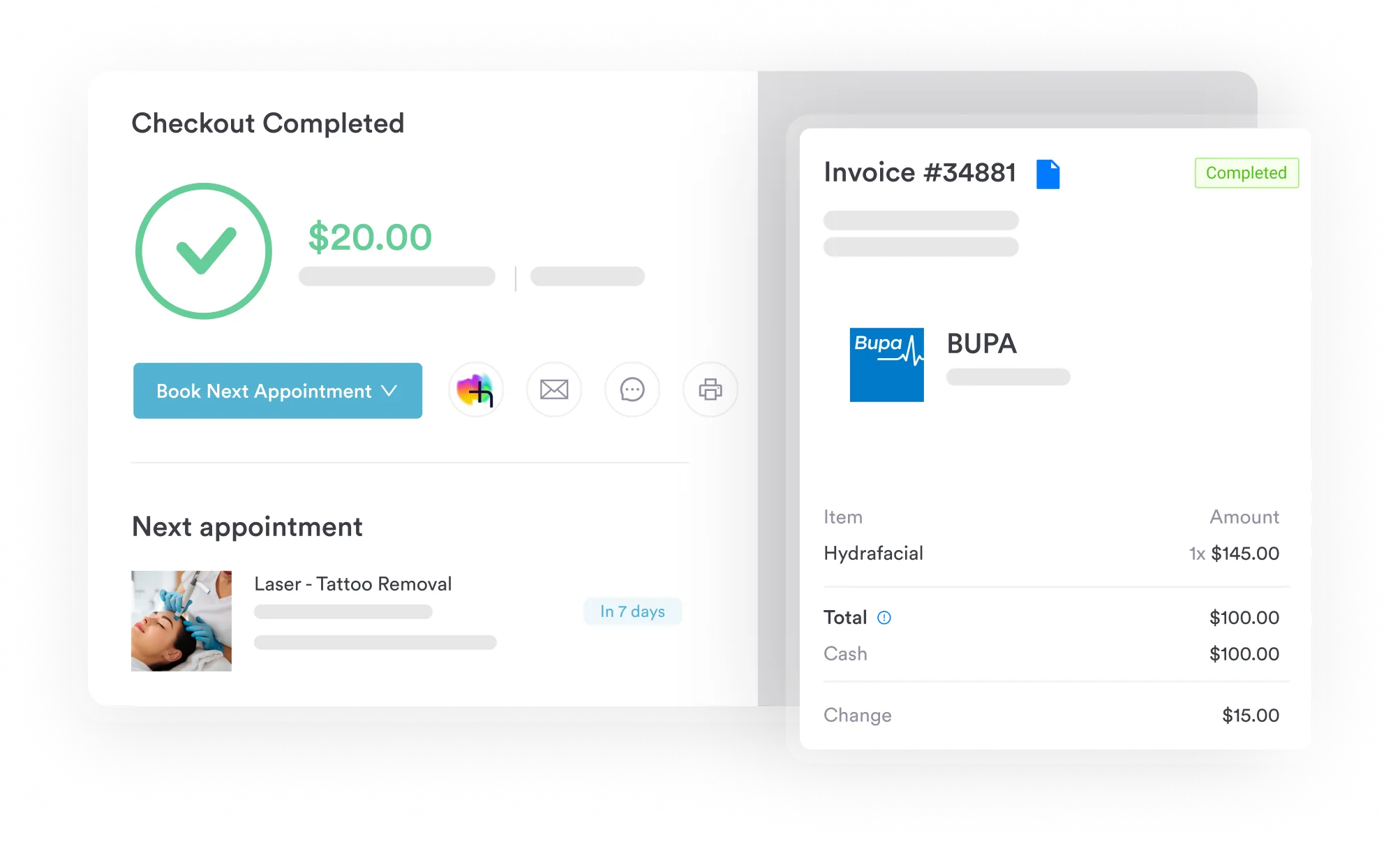

Pabau’s claims management scrubs each claim for missing or invalid details and flags it before it goes out. Your team fixes the claim once, before the payer sees it.

Billing 68200 cleanly starts with the note, not the claim form. When the note names the subconjunctival space, the eye, the drug and the dose, the code, the modifier and the J-code units follow from it.
The trade-off is an afternoon spent on the injection template and the claim template. That time pays back on every injection claim, because the denial reasons in this guide stop at the front desk.
Book a demo to see how Pabau’s claim scrubbing flags missing or invalid details on your injection claims before they reach the payer.

Need to understand how clearinghouse submission works for ophthalmology codes? Pabau’s Claim.MD clearinghouse guide explains how electronic claim routing, real-time eligibility, and ERA processing work together to reduce denials.
Looking for a primer on the ERA process after payment posts? Electronic remittance advice explained covers how to read ERA files, reconcile payments, and identify denial reason codes from CARC descriptions.
Want to reduce denial backlogs across your ophthalmology billing team? Denial codes in medical billing provides a reference guide to common CARC and RARC denial codes with resolution steps.
Injecting preservative-free triamcinolone? HCPCS code J3300 covers the per-milligram code and how to count its units.
Using methylprednisolone acetate for the injection? HCPCS code J1040 covers the 80 mg drug code billed alongside 68200.
CPT Code 68200 covers a subconjunctival injection, which places a therapeutic agent in the space beneath the conjunctiva. It captures the injection only. The drug is billed separately on the same claim with a HCPCS Level II J-code, with units that match the dose given.
Yes. Medicare Part B covers 68200 for medically necessary subconjunctival injections supported by an appropriate ICD-10-CM diagnosis code. The drug is paid separately at Average Sales Price plus 6%, before the sequestration reduction. Medicare Advantage plans may add prior authorization rules depending on the drug.
Medicare lists a bilateral indicator of 1 for 68200, so both eyes on one date pay 150% of the single-eye amount. Many MACs want one line with modifier 50 and 1 unit, while others accept 68200-RT and 68200-LT on two lines. Check your MAC and each commercial payer before submitting.
CPT 67028 describes intravitreal injection, where the drug goes into the vitreous cavity inside the eye. CPT 68200 describes subconjunctival injection, where the drug goes into the tissue under the conjunctiva, outside the globe. The injection site, not the drug, decides the code. The two are different procedures, so never substitute one for the other.
The note needs a medical necessity statement, the drug name and dose, and the eye treated. Add post-injection monitoring and a consent note where the payer or state requires one. The ICD-10-CM code on the claim must match the indication documented in the note.



