

CCSD code G5100: Bypass of duodenum billing guide
CCSD code G5100 bills a bypass that leaves the duodenum in place CCSD code G5100...

Last Updated: Oct 16, 2026
66183 is the CPT code for insertion of anterior segment aqueous drainage device, without extraocular reservoir, external approach. It covers glaucoma mini-shunts such as the Ex-PRESS device, placed from outside the eye with no plate sutured to the sclera.
Coders often confuse it with 66989 and 66991, which pair cataract surgery with a drainage device placed from inside the eye. The operative report's description of the approach and the device decides which code applies.
Let Pabau's smart automation suggest the right codes, reduce claim denials, and keep your practice compliant—effortlessly.
Automate repetitive tasks and focus on what matters most—your patients.
Reduce coding errors and ensure compliance with the latest regulations.
Clean claims, fewer denials, and faster reimbursements.
Powerful insights and reporting to help your practice thrive.
HIPAA compliant SOC 2 certified GDPR-compliant Trusted by 4,000+ clinics worldwide

CPT code 66183 covers ab-externo insertion of a drainage device without an extraocular reservoir, such as the Ex-PRESS shunt. Plate-based tube shunts are 66179 or 66180.
A 90-day global surgical period applies, so post-operative visits in that window are bundled unless a modifier applies.
Laterality modifiers RT or LT are required on every claim. Omitting them commonly causes denials for this code.
Pabau’s claims management software submits and tracks claims electronically through Claim.MD.
According to the American Medical Association’s CPT code set, CPT code 66183 describes: Insertion of anterior segment aqueous drainage device, without extraocular reservoir, external approach. Two phrases decide the code.
“External approach” (ab-externo) means the surgeon opens the conjunctiva and passes the device into the anterior chamber from outside the eye. It goes in under a scleral flap or through a needle track. “Without extraocular reservoir” means no plate is sutured to the sclera, so aqueous drains straight into a subconjunctival bleb. Ab-interno devices placed through a corneal incision during cataract surgery are coded 66989 or 66991 instead.
Devices coded under 66183 include the Ex-PRESS glaucoma filtration device and the XEN gel stent when it is implanted ab-externo. Plate-reservoir tube shunts such as the Ahmed Glaucoma Valve, Baerveldt implant, and Molteno implant are reported with 66179 (without graft) or 66180 (with graft). The iStent and Hydrus Microstent go in ab-interno with cataract surgery, so they fall under 66989 or 66991.
Ab-externo insertion of a reservoir-free drainage device follows a consistent surgical sequence. Each step should appear in the operative report to support the 66183 claim.
A 66183 procedure has no reservoir plate and no patch graft. If the operative note describes a plate sutured to the sclera 8-10 mm behind the limbus, the case belongs to 66179. If it also describes a patch graft over the tube, the code is 66180.
The 66183 global package bundles most intraoperative services. Separately billable services require supporting documentation and, in some cases, a modifier to override an NCCI edit.
The National Correct Coding Initiative (NCCI) updates its edits every quarter. Check the current table before treating any code pair as permanently bundled or unbundled.
Payers require a linked ICD-10-CM diagnosis that establishes medical necessity. The H40 series (glaucoma) covers most 66183 claims. The diagnosis must reflect the glaucoma stage, plus laterality where the code carries it.
Never code H40.9 as the primary diagnosis on a surgical claim. Payers treat unspecified codes as lacking medical necessity documentation and will deny the claim or request records.
Two facts in the operative note decide between these codes: the approach (ab-externo or ab-interno) and the device type (no reservoir, a plate reservoir, or no device). The four questions below settle the code.
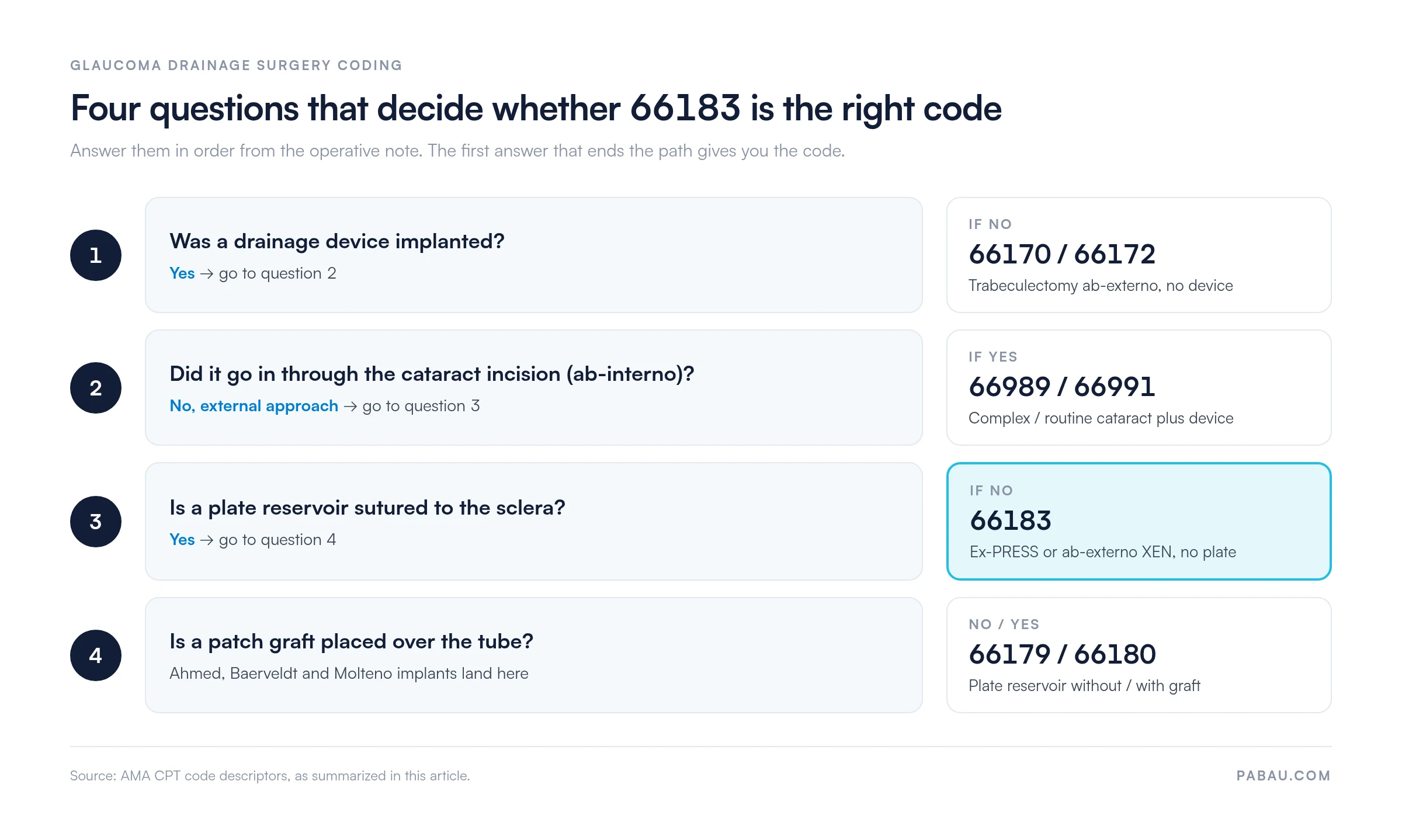
The table adds revision codes and no-device alternatives; each has an entry in our procedure codes library.
The operative note must state the approach, the device, and any plate reservoir explicitly. “Glaucoma shunt placed” is not enough. If any is missing, query the surgeon before submitting.
Medicare pays CPT code 66183 through the Physician Fee Schedule (PFS). The PFS rate is the same in both settings, because the facility and non-facility total RVUs are identical at 26.39. When surgery happens in an ambulatory surgery center (ASC) or hospital outpatient department, the facility bills its own technical fee separately. Use the CMS Physician Fee Schedule lookup tool to confirm current-year rates by locality before submitting claims.
These RVUs come from the CMS CY2026 Physician Fee Schedule file and change every January. Commercial payer rates vary widely. Negotiate contract rates separately, and never assume Medicare rates apply to a commercial contract.
Medicare generally does not require prior authorization for CPT 66183, though policies may change with CMS updates. Verify coverage through insurance eligibility verification before scheduling surgery. Commercial payers are stricter. Most require prior authorization, and their criteria are specific.
Typical commercial payer prior authorization criteria for 66183:
Submit the PA request with IOP readings, current medication list, and the ophthalmologist’s clinical summary. Retroactive authorization is rarely granted. A missing PA number is one of the most common reasons commercial payers deny 66183 claims.
Place of service (POS) codes and modifiers must match the clinical reality of the procedure. Mismatches trigger automatic denials or reimbursement adjustments.
Review medical billing compliance standards before you rely on modifier -59 or -XS. Either one needs documented, distinct clinical circumstances to hold up on audit.
Auditors reviewing 66183 claims look for a specific set of documentation elements. Each missing item maps to a denial or recoupment risk.
A clean claim for 66183 depends on having these elements in the chart before the claim goes out. Assembling them once an auditor asks is too late, so build a pre-submission checklist into your workflow.
Run a pre-submission audit on every 66183 claim. Confirm the operative note states ‘ab-externo’ and the laterality modifier (RT or LT) is present. Check that the ICD-10 code carries the correct 7th character for glaucoma stage, and that any required PA number is on file.
Most 66183 denials fall into a small number of categories. Knowing the pattern lets you build preventive workflow steps rather than appeals queues.
Strong denial management workflows track each denial reason by code and payer and identify the highest-volume causes. They then route corrective actions to the right team member before the payer’s appeal deadline.
Ophthalmology practices billing CPT 66183 work with a narrow margin for error. One missing modifier, one unspecified ICD-10 code, or one absent PA number can turn a high-RVU claim into a denial.
Pabau, the practice management platform we build, includes claims management software for this step. It submits and tracks claims electronically through Claim.MD, so your billing team follows each 66183 claim from submission to payment without leaving the patient record.
Practices using Pabau can also build superbill templates for surgical encounters. The ICD-10 code, POS, device lot number, and laterality modifier are then captured at the point of care. Nobody has to reconstruct them from an operative report days later.

Submit and track 66183 claims through Claim.MD, with superbills, forms and patient records in the same system.

Before a 66183 claim goes out, read the operative note for three facts: an external approach, no plate reservoir, and the eye operated on. If one is missing, query the surgeon first. A correction before submission costs far less than an appeal after a denial.
Give the diagnosis and the authorization the same check. Pair the claim with a staged H40 code rather than H40.9, and confirm any commercial PA number is on file before surgery.
Pabau’s claims management software submits and tracks those claims electronically through Claim.MD. Book a demo to see how Pabau keeps your glaucoma surgery claims moving from submission to payment.

Need a reference for glaucoma billing workflows? Revenue cycle management overview covers the full claim lifecycle from eligibility through payment posting.
Submitting claims electronically for the first time? Claim.MD clearinghouse guide explains how electronic claim submission works for US physician practices.
Dealing with repeated payer denials? Denial codes in medical billing breaks down the most common CARC/RARC reason codes and what each one means for your appeal strategy.
CPT code 66183 covers ab-externo insertion of an anterior segment aqueous drainage device without an extraocular reservoir. Examples are the Ex-PRESS shunt and a XEN gel stent placed from outside the eye. Plate-based tube shunts such as the Ahmed, Baerveldt, and Molteno implants are reported with 66179 or 66180 instead.
Medicare reimbursement for CPT 66183 varies by location and changes annually with the Physician Fee Schedule update. Use the CMS fee schedule lookup tool to confirm the current-year rate for your locality. The PFS rate is the same in facility and non-facility settings, with a total of 26.39 RVUs in both. The facility bills its own technical fee separately.
Medicare generally does not require prior authorization for CPT 66183, though payer policies can change. Most commercial payers do require prior authorization, with criteria including documented failed maximum tolerated medical therapy, failed laser trabeculoplasty, and severity documentation. Always verify before the date of service.
Yes, when cataract surgery and an ab-externo mini-shunt insertion are both medically necessary on the same eye in the same session. Append modifier -59 (or -XS) to override the NCCI bundling edit, and document each procedure and its indication separately. If the device went in through the cataract incision instead, report 66989 or 66991 rather than 66183 plus 66984.



