CPT Code 19361: Latissimus dorsi flap breast reconstruction
CPT code 19361: Official descriptor and payment basics CPT code 19361 is the Cat...

Last Updated: Nov 18, 2026
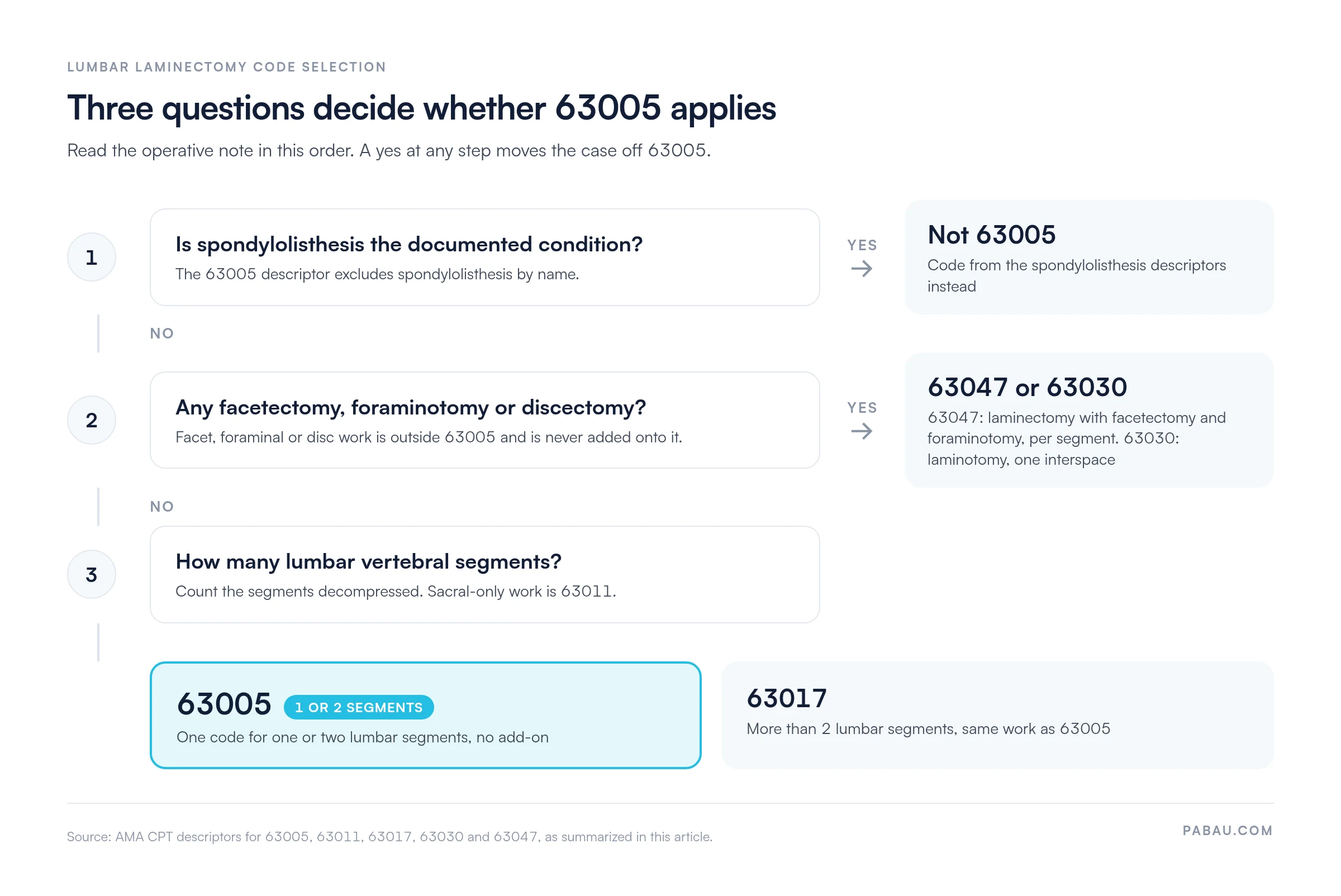
63005 is the CPT code for a laminectomy with exploration and/or decompression of the spinal cord and/or cauda equina, without facetectomy, foraminotomy or discectomy. It covers 1 or 2 lumbar vertebral segments, with spinal stenosis as the typical indication, and excludes spondylolisthesis.
Coding turns on the operative note. Facet, foraminal or disc work moves the case to 63047 or 63030, and a third lumbar segment moves it to 63017.
Let Pabau's smart automation suggest the right codes, reduce claim denials, and keep your practice compliant—effortlessly.
Automate repetitive tasks and focus on what matters most—your patients.
Reduce coding errors and ensure compliance with the latest regulations.
Clean claims, fewer denials, and faster reimbursements.
Powerful insights and reporting to help your practice thrive.
HIPAA compliant SOC 2 certified GDPR-compliant Trusted by 4,000+ clinics worldwide

CPT Code 63005 covers a lumbar laminectomy at 1 or 2 vertebral segments, without facetectomy, foraminotomy or discectomy, and excludes spondylolisthesis cases.
If the op note documents facet, foraminal or disc work, the code shifts to 63047 or 63030, and 3 or more lumbar segments take 63017.
The 90-day global surgical period means routine post-op visits in that window are part of the surgical payment, not billed separately.
Missing prior authorization is a leading denial reason for 63005, because most commercial payers require pre-auth for elective lumbar spine surgery.
Pabau, the practice software we build, tracks prior authorization on each surgical case and warns before a claim goes out without an auth code.
CPT Code 63005 is the code for a lumbar laminectomy that decompresses the spinal cord or cauda equina at 1 or 2 vertebral segments. The code belongs to the AMA’s CPT code set, in the Spine and Spinal Cord subsection (62263-63746) of the Surgery section. It sits among the laminectomy codes starting at 63001, which Pabau’s CPT code library lists by family.
The official descriptor reads:
Laminectomy with exploration and/or decompression of spinal cord and/or cauda equina, without facetectomy, foraminotomy or discectomy (eg, spinal stenosis), 1 or 2 vertebral segments; lumbar, except for spondylolisthesis.
In practice, 63005 applies when the surgeon removes the lamina at one or two lumbar vertebral segments to decompress the spinal cord or cauda equina. In other words, no facet resection, foramen widening or disc removal happens at those levels. A two-segment laminectomy is still a single 63005. Three or more lumbar segments are reported with 63017 instead, and the same work in the sacral region with 63011.
Overall, the scope limit of 63005 decides most lumbar laminectomy coding. The code also covers bone removal, ligamentum flavum resection, and spinal cord or cauda equina decompression achieved through that exposure.
Included in 63005:
Excluded from 63005 (triggers a code change):
So, the op note decides the code. Suppose the surgeon’s note says “medial facetectomy was performed to allow adequate nerve root visualization.” CPT Code 63005 is then wrong, whatever the coder assumed from the procedure name. Train surgeons to document the absence of facetectomy explicitly when it was not performed.
As a result, those exclusions reduce code selection to three questions, asked in order.
These two codes describe procedures that look similar on the surface but differ in what extra work is permitted and how levels are counted. Mixing them up is thus a common upcoding and downcoding error in lumbar decompression billing.
The key differentiator is the work done beyond the bone removal. 63005 decompresses the canal at 1 or 2 segments with no facet, foraminal or disc work. In contrast, CPT 63030 decompresses nerve roots at one interspace and includes partial facet removal, foramen widening or disc excision. When an op note describes “laminectomy at L4 and L5 for stenosis, without facet resection, foraminotomy or discectomy,” 63005 is the correct code.
When the surgeon adds medial facetectomy or foraminotomy to the laminectomy, the correct code is 63047, not CPT Code 63005. This is a bright-line rule based on operative technique. The distinction also appears repeatedly in AMA CPT guidelines.
A practical scenario: The surgeon’s note reads “L4 laminectomy performed; medial facetectomy and foraminotomy were carried out bilaterally to decompress the L4 nerve roots.” That language moves the code from CPT Code 63005 to 63047, with 63048 for each additional level where the same technique was applied. Billing 63005 here would thus create an undercoding error that payers may flag on audit.
Laminectomy codes span the cervical, thoracic, lumbar and sacral regions, and the family also runs well past 63048. Knowing where CPT Code 63005 fits helps coders choose correctly when the operative report describes multi-region or multi-technique procedures.
However, 63005 has no add-on code the way 63047 pairs with 63048. For example, one or two lumbar segments without facet, foramen or disc work are a single 63005, and a third segment moves the case to 63017. Similarly, the cervical counterpart, 63001, follows the same 1-or-2-segment pattern.
Applying the right modifier to CPT Code 63005 also affects both payment and audit risk. These are the four modifiers coders encounter most often with lumbar laminectomy.
Medical necessity for CPT Code 63005 must be established through one or more ICD-10-CM diagnosis codes. Payers, including Medicare Administrative Contractors, then cross-reference the diagnosis code against Local Coverage Determinations for lumbar spine surgery. For this reason, sending a diagnosis that does not appear on the payer’s covered-condition list is a leading cause of medical necessity denials.
Spondylolisthesis (M43.16) is not a 63005 pairing, because the 63005 descriptor excludes spondylolisthesis cases. Instead, a decompression for spondylolisthesis is reported with another code. When the note documents radiculopathy, switch from M47.816 to M47.26 rather than reusing the without-radiculopathy code.
Confirm that each ICD-10-CM code you use is valid for the current fiscal year before sending. Codes can change each year, and sending a retired code, such as M54.5, gets the claim rejected. Also, the CDC/NCHS ICD-10-CM web tool provides the yearly code list.
In fact, most post-submission audits trace back to the operative report. A note that does not describe the steps that justify CPT Code 63005, and rule out the steps that justify another code, invites one. So, these documentation elements must be present.
Op note must confirm:
Pre-operative documentation must include:
Run a four-point checklist before submitting any 63005 claim. The op note states that no facet, foramen or disc work was done. Imaging correlation is present and inside the payer’s recency window. Conservative care failure is documented. The level(s) are named, and there are no more than two. Claims that tick all four points hold up far better in lumbar decompression audits.
Prior authorization for CPT Code 63005 is required by nearly all commercial payers and many Medicare Advantage plans for elective lumbar laminectomy. However, original Medicare (fee-for-service) does not require prior authorization for most spinal surgery procedures. Medicare Administrative Contractors still apply LCD rules during claims review, so in practice the clinical bar is the same.
Standard commercial payer PA criteria typically include:
PA criteria change each year, so verify current rules directly with the payer before submission. In addition, a missing PA, or one obtained for another procedure code, is a leading cause of 63005 denials at neurosurgery and orthopedic surgery practices. Run the PA check before the case is scheduled, not at the time of billing.
Medicare payment for CPT Code 63005 starts from the Relative Value Units (RVUs) in the CMS Physician Fee Schedule. Those RVUs are then multiplied by the yearly conversion factor. Finally, the result is adjusted for your local area through the Geographic Practice Cost Index (GPCI). Because GPCI varies by area, national average figures are starting points, not final payment amounts.
Instead, use the CMS Physician Fee Schedule lookup tool to find the current year’s facility and non-facility rates for 63005 in your area. The tool also confirms the global period (90 days), the bilateral surgery indicator, and whether a co-surgeon or assistant surgeon is payable.
Key payment-structure facts for 63005:
Denials for CPT Code 63005 cluster around a handful of root causes. Each one is preventable with workflow checks before the claim goes out.
Clearinghouse submission gives eligibility checks and CARC denial reason codes on remittances, so patterns surface quickly. Your denial management workflow for surgical codes should also include a 72-hour follow-up on any denied claim.
For a medical necessity denial, build the appeal around the op note, the pre-op imaging report, and office notes documenting failed conservative care. Then add a surgeon’s letter citing the LCD rules. Finally, treat each denial as input for your revenue cycle management checklist.
A 63005 denial usually starts before the claim exists. An authorization was obtained for 63047, an auth code never reached the case, or nobody checked the op note against the descriptor. Billing teams tend to find out only when the denial comes back.
Pabau also records the prior authorization code, dates and approved sessions on the surgical case. Its claims management software warns when an auth code is missing, so the claim stops at your desk instead of at the payer.
Claims then go out through Claim.MD, with eligibility checks before the date of service. Then ERA remittances bring the CARC codes back to the case. A denied 63005 arrives with its reason attached, and the appeal starts from the right document.

Pabau tracks prior authorization on each surgical case and warns when an auth code is missing. Claims go out through Claim.MD with eligibility checks, and ERA remittances bring denial codes back to the case.

CPT Code 63005 is narrow by design. In short, it covers 1 or 2 lumbar segments with no facet, foraminal or disc work, and it excludes spondylolisthesis. Each of those limits has to be visible in the op note, because the note decides the code.
Checking the note against the descriptor before submission pays back quickly. A claim coded to the right boundary, with an authorization for the same code, skips the cycle of denial, recode and appeal. Still, the cost is only a few minutes of coder review on each lumbar decompression.
Book a demo to see how Pabau tracks prior authorization on each spine case and keeps denial codes on the record.

Billing a laminectomy with facet work instead? CPT code 63047 covers laminectomy with facetectomy and foraminotomy at a single lumbar segment.
Need a clean-claim checklist for surgical billing? Clean claim requirements in medical billing outlines the data elements that must be present for first-pass acceptance.
Confused about how ERA remittance codes map to denial reasons? Electronic remittance advice explained covers how to read ERA files and act on CARC codes.
Want to understand the clearinghouse role in surgical claim submission? Medical claims clearinghouse guide explains how clearinghouses validate and route claims before they reach payers.
CPT Code 63005 is the AMA procedure code for a lumbar laminectomy with exploration or decompression of the spinal cord or cauda equina. It applies without facetectomy, foraminotomy or discectomy, at 1 or 2 vertebral segments, lumbar, except for spondylolisthesis. The surgeon removes lumbar laminae to decompress neural elements with no additional facet, foraminal or disc work.
CPT 63005 describes a laminectomy at 1 or 2 lumbar vertebral segments with no facetectomy, foraminotomy or discectomy. CPT 63030 describes a laminotomy (hemilaminectomy) with nerve root decompression at one lumbar interspace. It includes partial facetectomy, foraminotomy and/or herniated disc excision. The key distinction is whether facet, foraminal or disc work was performed, and how many levels were treated.
CPT 63047 applies when the lumbar laminectomy also includes medial facetectomy and/or foraminotomy. If the operative note documents either step, 63005 is incorrect and 63047 is the right code. 63048 is the add-on for each additional level.
Four modifiers come up most often. Modifier 50 applies only where the payer allows bilateral reporting, so check the bilateral indicator first. Modifier 51 applies when 63005 is a secondary procedure on the same day. Modifier 59 or XS unbundles it from same-session codes subject to NCCI edits, and Modifier 22 reports significantly increased complexity.