

ICD-10 Code R63.4: Abnormal weight loss
ICD-10 code R63.4: Definition, billability and code structure ICD-10 code R63.4 ...

Last Updated: Nov 13, 2026
Billable Code Specific Code
I62.00 is the billable ICD-10-CM code for nontraumatic subdural hemorrhage, unspecified. It covers a spontaneous bleed between the dura and the arachnoid when the provider hasn't documented whether it is acute, subacute or chronic.
Assign it only after the record and a provider query leave the acuity open. A documented time course moves the claim to I62.01, I62.02 or I62.03, and a traumatic bleed codes to S06.5X instead.
Let Pabau's smart automation suggest the right codes, reduce claim denials, and keep your practice compliant—effortlessly.
Automate repetitive tasks and focus on what matters most—your patients.
Reduce coding errors and ensure compliance with the latest regulations.
Clean claims, fewer denials, and faster reimbursements.
Powerful insights and reporting to help your practice thrive.
HIPAA compliant SOC 2 certified GDPR-compliant Trusted by 4,000+ clinics worldwide

I62.00 covers nontraumatic subdural hemorrhage only, and traumatic bleeds code to S06.5X (traumatic subdural), never I62.00.
Unspecified acuity fits only when the record is silent on acute, subacute or chronic, so query the provider before defaulting to I62.00.
The tabular asks for an NIHSS score code (R29.7-) at I62, and for documented alcohol, tobacco and hypertension codes at block I60-I69.
An anticoagulant-related bleed adds T45.515A under the adverse-effect guidelines, plus D68.32 when the provider documents a drug-induced coagulopathy.
Pabau’s claims management pre-fills claims from the patient record, offers ICD-10-CM lookup and checks required claim fields before you send.
ICD-10 code I62.00 is the billable diagnosis code for a nontraumatic subdural hemorrhage whose acuity the provider hasn’t documented. It stays valid in CMS’s 2027 ICD-10-CM files, which apply to encounters from October 1, 2026, through September 30, 2027.
On a well-documented chart, I62.00 should be rare. It’s correct only when the record and a provider query both leave the time course open. The table below is the quick reference, and the sections after it show how to reach a more specific code.
Nontraumatic subdural hemorrhage is bleeding into the space between the dura mater and the arachnoid membrane with no identifiable injury behind it. Common causes include bridging veins that tear as the brain shrinks with age, anticoagulant or antiplatelet therapy, hypertension, coagulopathies and vascular malformations.
With no injury to start the bleed, onset is often gradual. Symptoms such as headache, confusion or a focal deficit can be vague, so suspicion runs highest in older and anticoagulated patients. A focal deficit that resolves with no bleed on imaging points instead to a transient ischemic attack, coded ICD-10-CM code G45.9 when unspecified.
The “unspecified” in I62.00 refers to acuity only. The bleed is confirmed as nontraumatic and subdural, but the record doesn’t say whether it’s acute, subacute or chronic. When the provider documents a time course, use the acuity-specific code instead.
I62.00 inherits notes from two levels: category I62 and the I60-I69 block above it. Reading the wrong level is a common source of coding errors and denials.
Guideline-based codes sit on top of those notes. When the bleed is an adverse effect of a correctly prescribed anticoagulant, the adverse-effect guidelines sequence I62.00 first and T45.515A after it. Add D68.32 when the provider documents a drug-induced coagulopathy, and Z79.01 for long-term anticoagulant use.
Every subdural claim runs through the same four questions, and I62.00 sits at the end of them. The path below shows where each answer sends the claim.
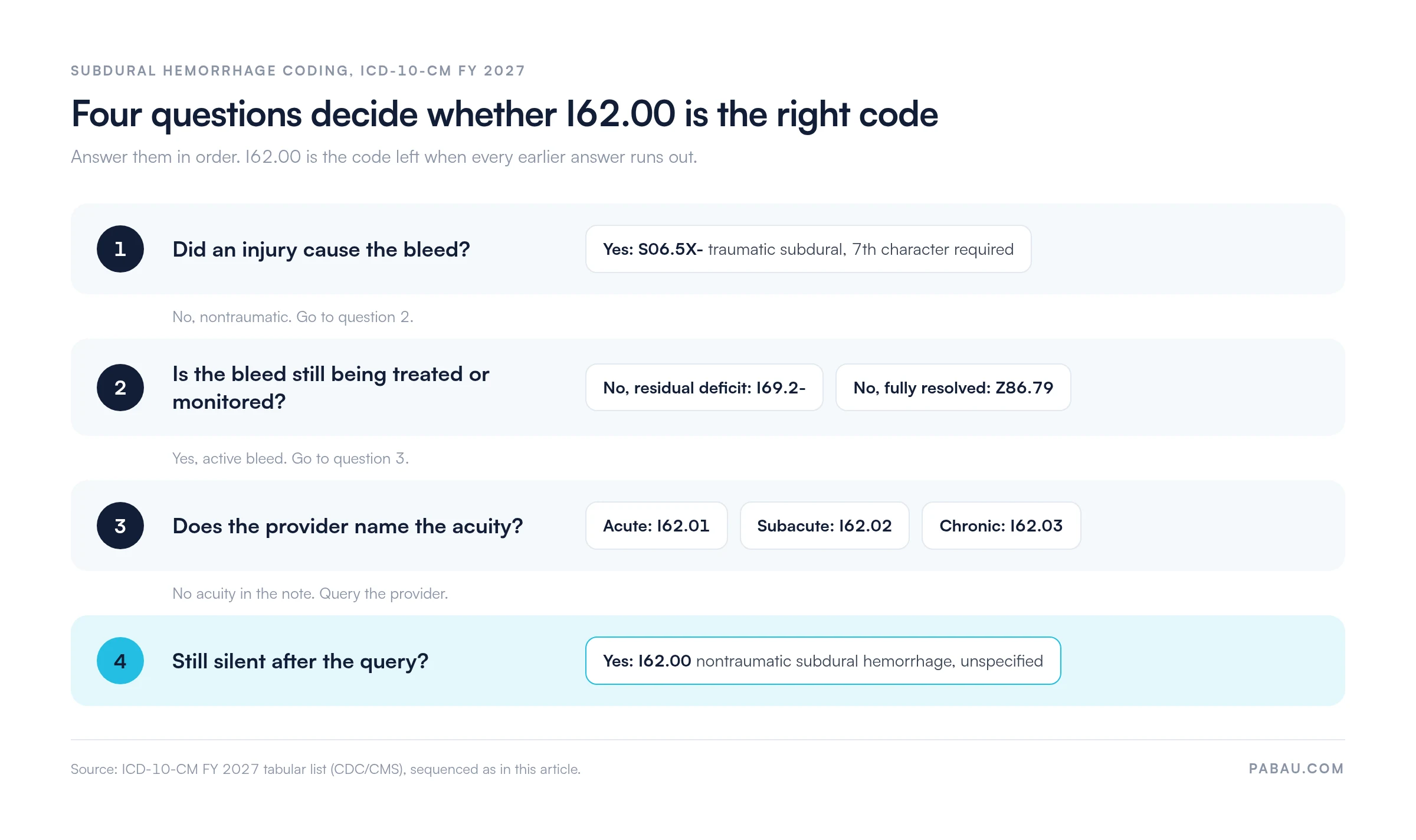
The acuity step is where most unspecified codes slip through. The table maps each code to the usual clinical window and the documentation that supports it.
Radiology wording like “subacute-to-chronic” or “mixed density” isn’t enough on its own. Query the attending or neurosurgery team for the dominant acuity, because code assignment rests on the treating provider’s documentation, not the imaging report.
Before defaulting to I62.00, read the history of present illness for duration clues. A headache “for the past month” points toward a chronic bleed, so query the provider about I62.03. Record the query and the answer in your coding audit trail.
Etiology is the most consequential call in subdural coding. The two code families sit in separate chapters, and an Excludes1 note keeps them apart. Coding a traumatic bleed as I62.00, or the reverse, creates a conflict that payers reject.
S06.4X is epidural hemorrhage, so it never stands in for a subdural bleed. S06.5X needs a 7th character, while I62.00 takes none. A missing 7th character on an S06 code fails the clearinghouse edit straight away.
Watch the noun, too. In the ICD-10-CM index, “hemorrhage, subdural” defaults to I62.00, but an unqualified “subdural hematoma” points to the injury codes. A note that says only “subdural hematoma” needs the provider to state nontraumatic before I62.0- applies.
I62.00 sits in a family of intracranial hemorrhage codes that coders and hospitalists often need alongside it. Codes from the other chapters are in our ICD-10-CM codes library.
Accurate use of ICD-10 code I62.00 depends on the provider note containing five elements. Without them, the code is unsupported in a payer audit. Good medical billing compliance starts with knowing what the code needs.
On an inpatient claim, I62.00 as principal diagnosis groups to MS-DRGs 064, 065 and 066 for medical management, by CC/MCC. A burr hole or craniotomy moves the stay into a surgical DRG instead. Check the grouping against the current IPPS final rule before you submit.
On the professional side, the neurologist or neurosurgeon reports I62.00 on the CMS-1500 next to their own E/M or procedure codes. Either way, a clean claim depends on the documentation above being in the record before release.
Prior authorization rules vary by plan and procedure. Elective or semi-elective surgery, such as a planned burr hole, usually needs it, so check with your MAC and the patient’s plan. Run through this list before each I62.00 claim goes out:
When a claim still comes back, the table lists the usual denial reasons and the fix for each.
Pabau, the practice management platform we build, submits US claims through Claim.MD, with eligibility checks, ERA remittances and claim-status tracking. For a step-by-step way to work rejections, see our guide to denial management.
Once the bleed has resolved, I62.00 no longer applies. ICD-10-CM separates active, sequela and history encounters, and each takes a different code.
Unspecified codes like I62.00 usually start upstream in the medical billing workflow. The coder sees the chart after the provider has moved on, and each query adds days before the claim can go.
In Pabau’s claims management software, claims pre-fill from the patient record, so the diagnosis on the encounter is the one on the claim. Built-in ICD-10-CM and CPT/HCPCS lookup libraries let you find I62.01, I62.02 or I62.03 by name, without working from memory.
Before you send, Pabau checks that every field the claim needs is filled in. US claims then reach the payer through Claim.MD, and ERA remittances post back against the same claim. That keeps revenue cycle management next to the clinical record your coders already work from.

Pabau pre-fills claims from the patient record, gives your team ICD-10-CM lookup and checks required fields before you send. US claims go out through Claim.MD.

Reach I62.00 last. When your team runs the four questions in order and queries before defaulting, the code appears only where the record supports nothing more specific.
The trade-off is time. A query can hold a claim for a few days. An I62.00 claim that comes back for recoding costs a second round of work and invites audit attention. Build the query into the step before release, so it never waits for a denial.
Book a demo to see how Pabau pre-fills subdural hemorrhage claims from the patient record and checks them before they reach the payer.

Need a step-by-step approach to working ICD-10 claim rejections? Denial management in healthcare covers the full workflow from remittance review to appeal submission.
Want to understand what happens after a clean claim is submitted? Electronic remittance advice explains how 835 ERA files communicate payer decisions back to your billing team.
Want fewer subdural claims bounced at the first pass? What makes a clean claim sets out the data checks a claim has to pass before a payer accepts it.
Only when the provider documents it as nontraumatic. In the ICD-10-CM index, an unqualified subdural hematoma points to the injury codes, while “subdural hemorrhage” defaults to I62.00. Query when the note doesn’t say.
No. Code assignment rests on the treating provider’s documentation. A radiologist’s finding supports a query, but the provider must confirm the diagnosis and its cause in the record.
Yes. I62.00 isn’t on the FY 2027 POA-exempt list, so inpatient claims report Y, N, U or W for it. A bleed that starts after admission is reported as N.
Add the R29.7- code for the documented score after I62.00. The guidelines let the score come from another clinician, such as a nurse, once the provider has documented the bleed.
Not I62.00. The index sends a newborn subdural hemorrhage to P52.8 and a birth-injury subdural bleed to P10.0. A spinal subdural hemorrhage codes to G95.19.



