



CCSD code G5100: Bypass of duodenum billing guide
CCSD code G5100 bills a bypass that leaves the duodenum in place CCSD code G5100...

Last Updated: Oct 16, 2026

CPT Code 59426 covers antepartum care only when 7 or more prenatal visits are provided, without delivery or postpartum care.
It pairs with sister code 59425 for 4 to 6 visits, and replaces global package code 59400 when care is split between providers.
Miscounting qualifying visits is the leading denial reason. Every visit must document blood pressure, weight, fundal height, and fetal heart tones.
Practice management software like Pabau tracks antepartum visit counts and flags incomplete documentation before submission, which cuts 59426 denials.
CPT Code 59426 is a billable code for antepartum care only, covering 7 or more prenatal visits. The billing provider performs the prenatal visits but not the delivery or postpartum care.
Two facts decide whether the claim pays. The first is how many visits met the documentation standard. The second is who performed the delivery. This guide covers the official descriptor, the code comparisons, ICD-10 pairings, Medicare rates, and the errors that send 59426 claims back.
CPT Code 59426, as defined by the American Medical Association (AMA), describes antepartum care only when 7 or more prenatal visits are provided.
The billing provider performs and documents the antepartum visits but does not perform the delivery or postpartum care. That single distinction separates 59426 from the global obstetric package.
It sits within the obstetric care section of the AMA CPT codebook. Bill it as a package covering all qualifying antepartum visits, never on a per-visit basis.
Three codes dominate antepartum billing decisions. The visit count threshold determines which antepartum-only code applies. The global package applies when the same provider handles the entire episode of care.
The 59426 vs 59425 decision comes down to a single count. Reach 7 qualifying visits under one billing provider and 59426 applies. Six or fewer, and 59425 is correct. Never use either alongside 59400 for the same patient encounter, because that creates an unbundling violation.
Work the choice as two questions in order. Who performs the delivery decides whether you are inside the global package at all, and only then does the visit count matter.
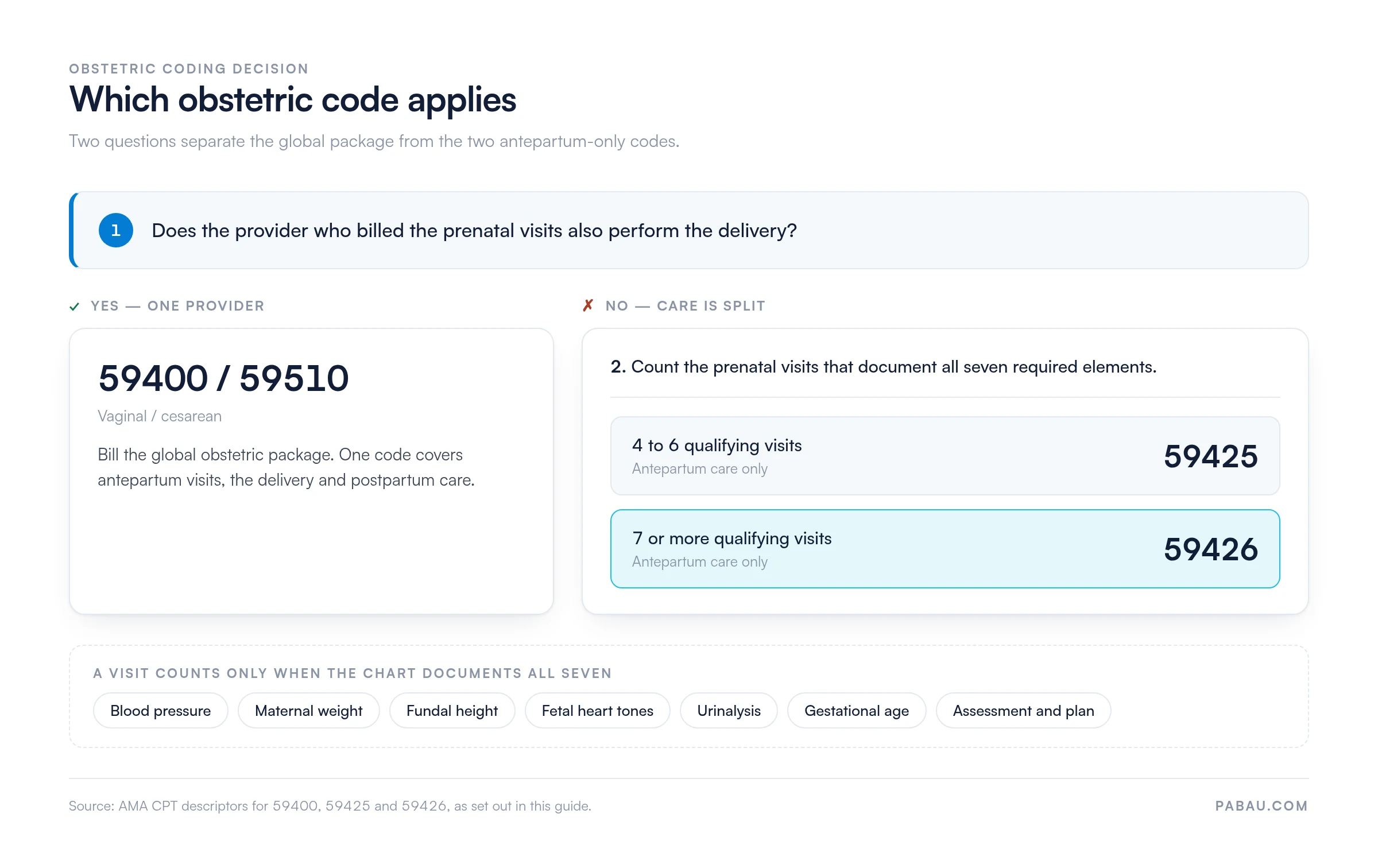
The global obstetric package bundles three phases of care under one code. Those phases are the antepartum visits, the delivery service, and postpartum care. A vaginal delivery bills under 59400 and a cesarean under 59510.
Antepartum-only codes like CPT Code 59426 exist because one provider does not always deliver the whole episode. Split care arrangements are the most common trigger for 59426.
They occur when a patient transfers to a different OB provider, moves practices mid-pregnancy, or when a group practice assigns delivery to another physician. In each case the provider who performed the antepartum visits bills 59426 or 59425. The delivering provider bills the appropriate delivery-only code.
Cervical ripening follows the same split care logic. If the antepartum provider places a dilator and another physician delivers, CPT Code 59200 is generally payable separately. Different provider NPIs keep it out of the delivering physician’s global package.
Payers reviewing a 59426 claim look for two things. The first is evidence that 7 or more visits occurred. The second is proof that each visit captured the required clinical elements. Missing either one creates denial exposure.
For a prenatal visit to count toward the 7-visit threshold, the chart note must document all of the following at that encounter:
A visit that documents only a blood pressure check and fetal heart tones is unlikely to pass payer audit as a qualifying antepartum encounter. Incomplete documentation is one of the three leading causes of 59426 claim denials.
Use this structure to confirm each visit qualifies before the claim goes out. Billing staff can copy it into the patient record or into a pre-submission checklist.
CPT Code 59426 requires a paired ICD-10-CM diagnosis code to support medical necessity. The Z34 category covers supervision of normal pregnancy. Complication codes from the O-chapter apply when the pregnancy involves a monitored condition. Verify all codes against the current-year ICD-10-CM tabular list, as codes update annually.
Select the most specific ICD-10-CM code that reflects the patient’s clinical status during the antepartum episode. Using Z34.00 for a patient with documented gestational diabetes is under-coding. It may trigger a medical necessity review.
Medicare covers antepartum care under the Physician Fee Schedule. Reimbursement for CPT Code 59426 varies by geographic payment locality and changes annually with CMS updates.
Always verify current rates through the CMS Physician Fee Schedule lookup tool before quoting expected reimbursement. For RVU-based calculations, FastRVU’s 2026 RVU lookup lists current Work, PE, and MP values for 59426.
Key rate considerations for 59426 billing:
Verification before the first antepartum visit protects the whole episode. Practice management software like Pabau connects to the Claim.MD clearinghouse, where real-time eligibility checks reach over 400 US payers. Those checks confirm coverage, deductible status, and any prior authorization requirement for obstetric services.
Most 59426 claims submit without a modifier. Certain billing scenarios require one. Using a modifier incorrectly, or omitting one when required, can reduce or deny the claim. Review payer policies before applying any modifier, as requirements vary.
Modifier guidance is general in nature, so always verify current payer-specific requirements before billing. Incorrect modifier use is an audit risk. Some payers flag modifier 22 on antepartum codes for additional documentation review.
Commercial payers and state Medicaid programs apply their own coverage rules on top of Medicare guidance. Verify payer policy before each episode of antepartum-only billing. Checking at the start of the pregnancy surfaces these requirements early, before the practice has invested in 7 or more visits of care.
State Medicaid programs also run enhanced prenatal services for at-risk patients under separate HCPCS H-series codes. A follow-up home visit falls under H1004, which carries its own state enrollment and authorization rules.
Antepartum-only claims fail for a predictable set of reasons. Most denials are preventable with a pre-submission review process.
Match every rejection against the denial codes that carry it. Obstetric claims can then be appealed as a pattern rather than one at a time.
Run a pre-flight check before you submit a 59426 claim. Count the documented qualifying visits and confirm each one carries all seven clinical elements. Check that a different provider performed the delivery. Match the ICD-10 code to the patient’s current pregnancy status, then confirm the payer’s obstetric billing policy. Five minutes of review prevents weeks of rework.
OB/GYN practices billing CPT Code 59426 carry a documentation burden that generic billing tools miss. Every qualifying visit has to meet a defined clinical element threshold. The visit count has to be accurate to the encounter, not estimated.
Pabau’s claims management software is built for this kind of structured clinical billing. Billing teams track antepartum visit counts across the patient record. Visits that lack a required clinical component are flagged before they reach the claim queue.
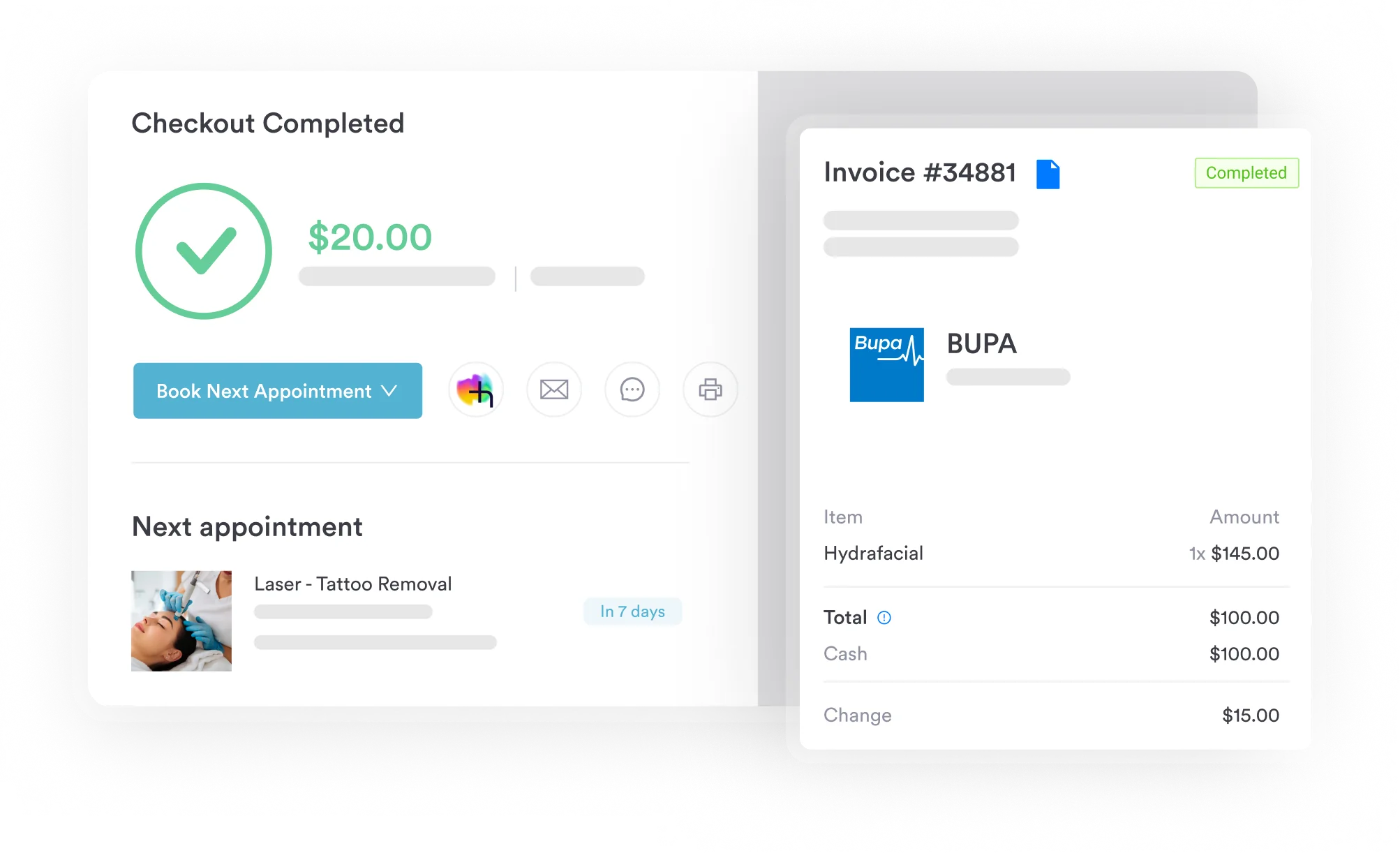
Claims go out through the Claim.MD clearinghouse, which reaches thousands of US payers. Payer edits get caught before submission rather than after denial, so a short visit count never turns into a 59426 rework cycle.
Split care needs one more safeguard. Where one physician manages the prenatal visits and another performs the delivery, Pabau attributes the antepartum visits to the billing provider’s NPI. That attribution is a common source of 59426 submission errors in multi-physician OB practices.

Pabau helps OB/GYN practices track antepartum visit counts, automate pre-claim documentation checks, and submit clean 59426 claims. See how Pabau reduces antepartum billing denials.

Antepartum-only billing is a counting discipline more than a coding one. The 7-visit threshold for CPT Code 59426 is clear. The work sits in proving that each visit qualified and that the delivery belonged to another provider.
Build the visit log from the first prenatal appointment rather than reconstructing it at submission. Practices that do this catch a short count while there is still time to document properly. Rework then stops eating into revenue the episode has already earned.
To see how Pabau tracks antepartum visit counts and validates obstetric claims before they leave the practice, book a demo with the team.

Billing a cesarean episode? CPT code 59510 sets out the global cesarean package and what it bundles.
Need the charge capture right first? What is a superbill explains how each antepartum visit becomes a billable line.
Building a denial prevention workflow? Denial management in healthcare walks through reducing and appealing claim rejections systematically.
Want coverage confirmed at visit one? Insurance eligibility verification explains how real-time checks surface coverage limits before they become denials.
CPT Code 59426 bills antepartum care only, for 7 or more qualifying prenatal visits. The billing provider does not perform the delivery or postpartum care. It applies when obstetric care is split between providers. A patient may transfer practices mid-pregnancy, or a group practice may assign the delivery to a different physician.
CPT 59425 covers antepartum care only for 4 to 6 qualifying prenatal visits. CPT 59426 covers 7 or more. Both apply when the billing provider does not perform the delivery. The visit count documented in the patient’s chart decides which one is correct.
No. Billing CPT 59426 with a global delivery code such as 59400 or 59510 for the same patient is an unbundling violation. The global package already includes antepartum care. Use 59426 only when a different provider performs the delivery and bills that component separately.
The most common pairings are the Z34 supervision of normal pregnancy codes, which run from Z34.00 through Z34.93. Use O09.xx for high-risk pregnancies, O10.xx for pre-existing hypertension, and O24.xx for gestational diabetes. Select the most specific code for the patient’s clinical status. Verify it against the current-year ICD-10-CM tabular list, because codes update annually.
The national average Medicare reimbursement for CPT 59426 is roughly $214 to $240 in a non-facility setting. The figure depends on geographic locality and the current year’s Physician Fee Schedule. Rates change annually, so verify the rate for your GPCI area using the CMS lookup tool.
Each qualifying visit must document blood pressure, maternal weight, fundal height, fetal heart tones, urinalysis, gestational age, and an assessment and plan. The aggregate record must confirm 7 or more visits meeting all components. Keep a running visit log in the patient chart to support payer audit and pre-submission review.
The provider who performed the antepartum visits bills CPT 59425 or 59426, depending on the visit count. The delivering provider bills the appropriate delivery-only code. Each submits a separate claim for their portion of care. Combined reimbursement should not exceed what the global package would have paid.



