

CCSD code XR940: Radiology billing guide for UK private practice
CCSD code XR940 is a UK private healthcare radiology procedure code used to bill...

Last Updated: Nov 26, 2026
58554 is the CPT code for laparoscopy, surgical, with vaginal hysterectomy, for uterus greater than 250 g; with removal of tube(s) and/or ovary(s). It describes a laparoscopically assisted vaginal hysterectomy (LAVH) in which at least one tube or ovary is also removed.
Two facts in the record decide the claim: The pathology weight of the uterus and which tubes or ovaries came out. At 250 g or less with a tube or ovary removed, the code is 58552. Over 250 g without adnexal removal, it is 58553. The descriptor includes no lymph node sampling.
Let Pabau's smart automation suggest the right codes, reduce claim denials, and keep your practice compliant—effortlessly.
Automate repetitive tasks and focus on what matters most—your patients.
Reduce coding errors and ensure compliance with the latest regulations.
Clean claims, fewer denials, and faster reimbursements.
Powerful insights and reporting to help your practice thrive.
HIPAA compliant SOC 2 certified GDPR-compliant Trusted by 4,000+ clinics worldwide

CPT code 58554 is an LAVH for a uterus greater than 250 g with removal of one or more tubes or ovaries.
Both conditions must be met. Over 250 g with no tube or ovary removed, the code is 58553. At 250 g or less with one removed, it is 58552.
Code from the pathology weight, and record in the operative note which tubes or ovaries came out and on which side.
Tube and ovary removal is part of 58554, so 58661 is never billed beside it for the same session.
The 58554 descriptor has no lymph node component, so any node work is coded and edit-checked on its own.
Pabau, a practice management platform with built-in insurance billing, scrubs every claim for missing or invalid details before it leaves the practice.
CPT code 58554 describes a laparoscopically assisted vaginal hysterectomy (LAVH) for a uterus over 250 g, with removal of a tube or ovary. The wording comes from the AMA’s CPT Editorial Panel, which maintains the CPT code set. The AMA CPT descriptor reads “Laparoscopy, surgical, with vaginal hysterectomy, for uterus greater than 250 g; with removal of tube(s) and/or ovary(s).”
Both conditions must be met for 58554 to apply: The uterus weighs over 250 g, and at least one tube or ovary is removed. Removing a single tube qualifies, and so does a bilateral salpingo-oophorectomy. With the tubes and ovaries left in place, the same LAVH is coded 58553. The descriptor contains no lymph node sampling.
Opportunistic salpingectomy is where this rule pays off. When the surgeon removes both tubes to lower ovarian cancer risk and leaves the ovaries, the case still meets the 58554 descriptor. Coders who read 58554 as an ovary-removal code bill 58553 instead and under-report the surgery.
LAVH is a hybrid procedure. The surgeon uses laparoscopic instruments to mobilize the uterus, free the tubes and ovaries, and control the upper vascular pedicles. Part of the hysterectomy itself, such as the colpotomy or the cuff closure, is then completed through the vagina.
When the surgeon secures the vessels, detaches the uterus and closes the cuff laparoscopically, the case is a total laparoscopic hysterectomy (TLH) instead. Delivering the uterus through the vagina does not turn a TLH into an LAVH.
A TLH with tube or ovary removal on a uterus over 250 g is coded 58573. A laparoscopic radical hysterectomy for cancer, with pelvic lymphadenectomy, sits outside both families as 58548.
The laparoscopic hysterectomy codes split into two families. Laparoscopically assisted vaginal hysterectomy uses 58550, 58552, 58553 and 58554, and total laparoscopic hysterectomy uses 58570 to 58573. Within each family, two questions pick the code: Does the uterus weigh more than 250 g, and was a tube or ovary removed?
Every LAVH code answers the same two questions, and the grid below shows that 58554 is the only one where both answers are yes.
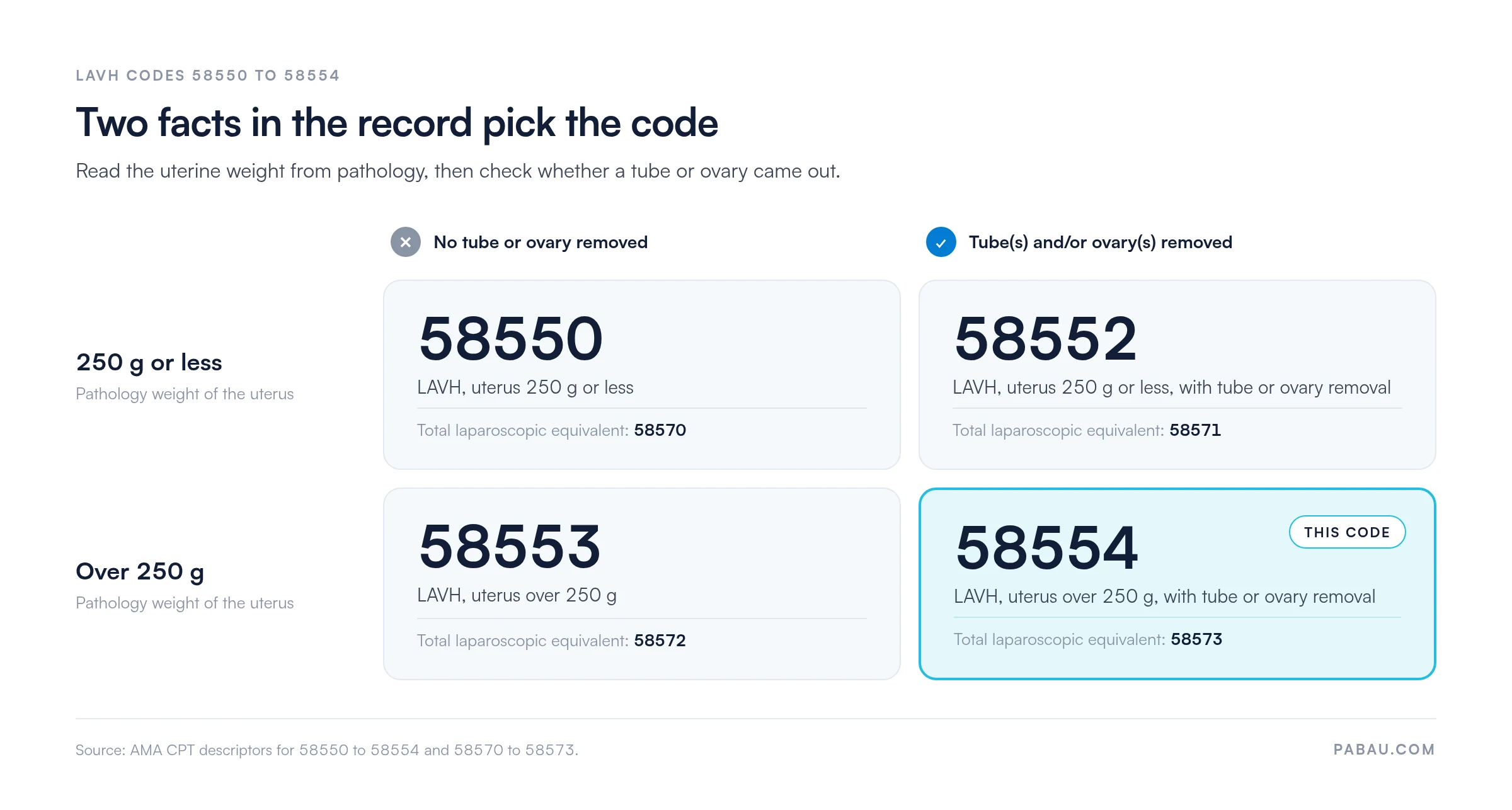
Choosing between 58553 and 58554 turns on adnexal removal alone, because both cover a uterus over 250 g. Choosing between 58552 and 58554 turns on weight alone, because both include tube or ovary removal.
The 250 g line comes from the AMA descriptor. A uterus of exactly 250 g sits in the “250 g or less” band, so with a tube or ovary removed it is 58552. At 251 g, the same surgery is 58554. Fibroids most often push a uterus past 250 g, sometimes well past it.
The pathology report is the record to code from. If the operative note estimates more than 250 g but pathology weighs the specimen at 240 g, correct the claim to 58552 before submission. If pathology lists no tube or ovary specimen, the claim belongs with 58553.
Every clean claim submission for CPT code 58554 depends on the operative note and the pathology report showing four elements. Missing any one of them gives the payer grounds to deny or downcode the claim.
Close every hysterectomy operative note with a two-line coding summary. List the pathology-confirmed uterine weight, then each tube or ovary removed and its side. The coder can then choose between 58550, 58552, 58553 and 58554 without querying the surgeon.
Every 58554 claim needs an ICD-10-CM diagnosis code that states why the hysterectomy was done. Payers check that pairing, and a mismatch is a frequent cause of medical necessity denials. Fibroid cases take a D25 code, and D25.9 fits only when pathology does not say where the fibroids sit.
MAC Local Coverage Determinations (LCDs) may specify which ICD-10-CM codes establish medical necessity for hysterectomy procedures in a given jurisdiction. Always check the applicable MAC LCD before submission, as codes accepted by one contractor may require additional documentation under another.
CPT code 58554 carries a 90-day global surgical package under Medicare. The payment covers pre-operative visits on the day before or day of surgery, the operation itself, and routine post-operative care for 90 days. Related visits in that window are not billed separately, and an unrelated E/M visit needs modifier 24.
Medicare sets the 2026 rate through the Physician Fee Schedule (MPFS) final rule. The RVUs below come from the CMS 2026 relative value file, as listed in FastRVU’s 2026 RVU lookup. Multiplied by the 2026 conversion factor of $33.4009, they give a national facility amount of about $1,161.68 before geographic adjustment.
Always verify the current rate for your MAC locality in the CMS Physician Fee Schedule lookup tool before you submit. In Pabau, US claims go out through Claim.MD, which adds an eligibility check before surgery and posts the remittance once the payer pays.
FastRVU also converts these RVUs into a locality-adjusted amount for your practice location.
Modifier errors on CPT code 58554 draw payer and audit attention, modifier 22 above all. The table below summarizes the modifiers that apply to 58554 and when each one fits.
LAVH claims carry several interacting criteria: Approach, uterine weight, adnexal removal, diagnosis linkage, and bundling rules. Each one is a separate failure point. The remittance shows which one failed, and reading payer denial codes is how your team traces the fix to the right record.
Working through the denial management in healthcare workflow systematically reduces rework. Here are the most common denial causes for 58554 and the fix for each.
Several codes that might look reportable on the same date as CPT code 58554 are bundled under NCCI policy. Payers apply these edits during adjudication, deny the column 2 code and pay only 58554. Catch the pair before submission, in-house or through a medical claims clearinghouse, and the denial never reaches the remittance.
Laparoscopic removal of adnexal structures (58661) is bundled, because the 58554 descriptor already covers tube and ovary removal. Diagnostic laparoscopy (49320) and lysis of adhesions (58660) done as part of the approach are bundled too. Use the AAPC Codify CPT lookup to review current column 2 pairings for 58554 before each claim.
Lymph node sampling is not part of 58554 at all. When the surgeon also performs node work, it is reported with its own code. That code pair then goes through the same NCCI check before submission.
Before billing 58554 with any companion code, run both codes against current NCCI edit tables. The CMS NCCI edit files are updated quarterly. A code that passed bundling checks last quarter may be added to the edit list in the next release. Checking at submission time, not just at the time of coding setup, prevents the most avoidable denials.
CPT code 58554 rests on two facts that reach the record at different times. The surgeon documents the tube or ovary removal in the operative note, and pathology reports the uterine weight days later. When billing works from the operative note alone, the code is picked before both facts are on file.
Pabau keeps the operative note, the pathology result and the claim in one patient record, so the code is chosen with both facts on file. Within Pabau’s accurate claims management, claim validation scrubs every claim for missing or invalid details before it leaves Pabau.
The 90-day global period still needs a human check. Before any post-operative visit is billed, your medical billing team should confirm whether modifier 24 or 79 applies. With the surgical detail already in the record, you spend less time on corrected claims and on rebuilding the case for a payer.

Pabau keeps the operative note, pathology result and claim in one patient record. It scrubs every claim for missing or invalid details before it goes out. See how gynecology practices cut rework on complex surgical claims.

CPT code 58554 is the LAVH code for a uterus over 250 g with removal of at least one tube or ovary. Bill it only when the pathology weight and the operative note confirm both facts. Otherwise the claim belongs with 58550, 58552 or 58553, and a payer audit will reach the same answer.
The easiest 58554 denials to prevent come from a code chosen before pathology reported the weight, or a bundled service billed beside it. Wait for the weight, check the specimens, and never bill 58661 beside the LAVH. Are repeat denials on complex surgical codes eating your team’s week? Book a demo to see Pabau keep the note, pathology and claim in one record.

Need to understand how claims move through a clearinghouse? Claim.MD clearinghouse integration explains how Pabau sends electronic claims and posts payer remittances back to the record.
Looking for a walkthrough of the full billing cycle? Revenue cycle management guide covers every stage from charge capture through payment posting.
Want to reduce denials across your surgical coding workflow? Medical billing compliance guide details the documentation and audit practices that protect surgical practices from OIG scrutiny.
CPT code 58554 describes a laparoscopically assisted vaginal hysterectomy (LAVH) for a uterus over 250 g. It also requires removal of one or more tubes or ovaries. Both conditions must be met. The descriptor has no lymph node sampling component.
All three are LAVH codes, separated by uterine weight and tube or ovary removal. CPT 58552 is an LAVH with tube or ovary removal for a uterus of 250 g or less. CPT 58553 is an LAVH for a uterus over 250 g with the tubes and ovaries left in place. CPT 58554 combines both: A uterus over 250 g and removal of at least one tube or ovary.
No. The 58554 descriptor covers the hysterectomy and the tube or ovary removal, with no lymph node component. If the surgeon also samples lymph nodes, that work is reported with its own code and checked against NCCI edits. A laparoscopic radical hysterectomy with pelvic lymphadenectomy is a different code, 58548.
Modifier 22 applies when the procedure is substantially harder than typical, and the operative note must describe the added difficulty. Modifier 51 marks a separately identifiable secondary procedure on the same date. Modifier 59 marks a distinct service that is not part of the LAVH. Modifier 62 covers co-surgery, 80 and 82 cover an assistant surgeon, and AS covers a PA or NP who assists. Modifier 22 draws close payer review, so document it thoroughly.
Most commercial payers and many Medicare Advantage plans require prior authorization for LAVH procedures, including CPT 58554. Traditional Medicare generally does not require it for 58554, but some MACs publish Local Coverage Determinations with documentation requirements. Requirements vary by plan year and payer, so verify with the payer at scheduling, not at billing.
The most common cause is a code that does not match the record. Billing 58554 when no tube or ovary was removed calls for 58553, and a pathology weight of 250 g or less calls for 58552. A missing uterine weight, a bundled code such as 58661, and missing prior authorization also cause denials. So do a diagnosis that fails the MAC LCD and global period visits billed without a modifier.
No, not for the same surgery. CPT 58661 is laparoscopic removal of adnexal structures, and that removal is already part of the 58554 descriptor. Billing both for one session triggers an NCCI bundling denial. Report 58554 alone for tubes or ovaries removed during the LAVH.



