CPT Code 25210: Excision of a single carpal bone
CPT Code 25210: Official descriptor and quick-reference data CPT Code 25210 is a...

Last Updated: Nov 26, 2026
58353 is the CPT code for endometrial ablation, thermal, without hysteroscopic guidance. It covers global ablation devices such as NovaSure and Minerva, placed through the cervix to treat heavy menstrual bleeding.
The approach is the fact that matters most. If a hysteroscope is used at any point, the claim belongs under 58563, and mixing up the two codes is a frequent source of denials. This reference covers ICD-10 pairings, the 10-day global period, Medicare payment, prior authorization, denial triggers and a pre-submission checklist.
Let Pabau's smart automation suggest the right codes, reduce claim denials, and keep your practice compliant—effortlessly.
Automate repetitive tasks and focus on what matters most—your patients.
Reduce coding errors and ensure compliance with the latest regulations.
Clean claims, fewer denials, and faster reimbursements.
Powerful insights and reporting to help your practice thrive.
HIPAA compliant SOC 2 certified GDPR-compliant Trusted by 4,000+ clinics worldwide

CPT code 58353 covers thermal endometrial ablation done without a hysteroscope, while hysteroscopic ablation goes to 58563 and cryoablation to 58356.
NovaSure and Minerva map to 58353 because neither needs a hysteroscope, so the operative report must confirm the transcervical approach.
58353 carries a 10-day global period, and many commercial and Medicare Advantage plans require prior authorization before the procedure.
Place of service drives payment, with a 2026 national office rate of about $890.80 against $203.75 for the physician in a facility.
Pabau’s EMR and claims management software help practices document ablation procedures accurately and submit cleaner 58353 claims.
CPT code 58353 is the code for endometrial ablation, thermal, without hysteroscopic guidance. Aetna’s endometrial ablation policy lists it beside 58563, the hysteroscopic version, and 58356, cryoablation with ultrasonic guidance.
The code covers destroying the uterine lining with a transcervical device that delivers heat or radiofrequency energy, with no direct hysteroscopic view.
The descriptor turns on three words, “without hysteroscopic guidance.” Any ablation done with a hysteroscope belongs under 58563, whatever energy the device uses. The two codes aren’t interchangeable, so the operative report has to state the approach. The American Medical Association’s CPT code set defines these descriptors.
The procedure begins with uterine sounding to measure cavity depth, followed by transcervical insertion of the ablation device. The device then delivers controlled energy to destroy the endometrial lining, radiofrequency for NovaSure and plasma energy for Minerva. No hysteroscope is inserted at any point.
For a clean CPT code 58353 claim, the operative report should document:
An op note that skips the approach or the device name hands the payer an easy reason to deny at review. Mirror the descriptor’s “without hysteroscopic guidance” wording in the note, verbatim or close to it.
Endometrial ablation is medically necessary when abnormal uterine bleeding (AUB) doesn’t respond to conservative treatment and the patient can’t have, or declines, a hysterectomy.
Before they approve CPT code 58353, many payers and Medicare Administrative Contractors (MACs) want records of failed hormonal or medical therapy. That trial often runs three to six months.
Clinical indications most payers recognize:
Payers treat these findings as contraindications that rule out medical necessity and trigger a denial:
The diagnosis linked to CPT code 58353 has to support medical necessity. A code that suggests malignancy or infection, rather than benign AUB, can send the claim to medical review or straight to denial.
N92.0, heavy menstruation with a regular cycle, is the pairing payers accept most widely. Accepted lists still vary by contractor, so check your MAC’s Local Coverage Determination (LCD) before you rely on any of them. The CMS Physician Fee Schedule lookup tool shows the code’s payment indicators for your locality.
CPT 58353 and 58563 describe the same clinical outcome, a destroyed endometrium, by completely different routes. Picking the wrong one is a leading cause of initial denials on endometrial ablation claims.
The operative report settles it. If the surgeon inserted a hysteroscope for any part of the procedure, 58563 applies. If the whole procedure ran transcervically without a scope, 58353 is correct.
Here’s how that plays out on two notes. “NovaSure device placed transcervically after sounding, no hysteroscopy performed” codes cleanly to 58353. Add “hysteroscope inserted to inspect the cavity” and the claim moves to 58563. When the note is vague, query the physician before you bill.
Cryoablation under ultrasound guidance is a third route with its own code, 58356. Check the energy type as well as the approach before you settle on 58353.
Several gynecologic procedure codes are billed alongside, or confused with, CPT code 58353. National Correct Coding Initiative (NCCI) edits decide which combinations are allowed.
An endometrial biopsy, 58100, is bundled into 58353 on the same day but billable on a separate date. Neighboring gynecologic codes sit in our CPT codes library if you need to compare descriptors.
Check current NCCI edit tables via the AAPC Codify CPT lookup before billing any combination. NCCI edits update quarterly, and an edit that allowed unbundling last year may not apply today.
CPT code 58353 carries a 10-day global period, listed as 010 in the 2026 Medicare fee schedule. Routine postoperative care in those 10 days, such as a visit to check expected recovery, is part of the surgical fee. An unrelated visit in that window can be billed with modifier 24.
Place of service (POS) decides what each party bills, and at what rate:
The non-facility rate is far higher because it carries the practice expense a facility would otherwise absorb, supplies included. The chart below puts the 2026 national figures side by side.
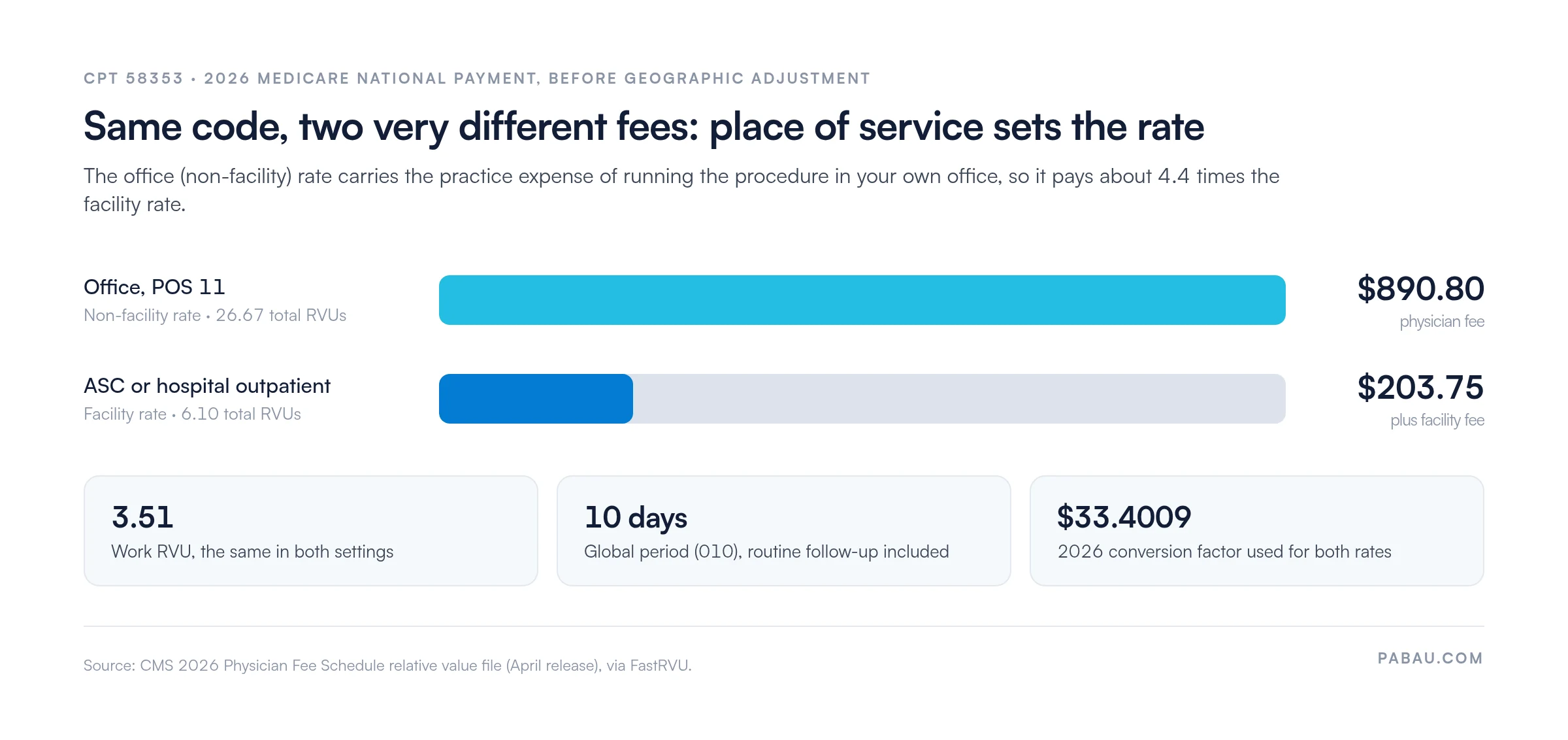
That spread is why the POS code matters so much. Billing the facility rate for an in-office ablation underpays you, and the shortfall can run for months before anyone spots it.
Medicare sets payment for CPT code 58353 each year in the Medicare Physician Fee Schedule (MPFS). The 2026 work RVU is approximately 3.5, which you can confirm in the FastRVU 2026 RVU lookup tool. The final amount then varies by geographic adjustment and place of service.
Commercial rates are set by contract and change at renewal, so audit your fee schedule against the MPFS once a year. Medicare has no national coverage determination (NCD) for endometrial ablation. Coverage policy rests with the MACs instead, and it varies by region.
Many commercial payers require prior authorization for CPT code 58353 before the procedure, and Medicare Advantage plans often do too. Traditional Medicare generally doesn’t, though a MAC can still review medical necessity after payment.
A typical prior authorization request includes:
Verifying insurance eligibility before you schedule tells you whether this patient’s plan needs authorization. The same insurer may require it on one product line and not another. A claim sent without a required auth number is denied at the edit level, and fixing it takes a corrected claim or a formal appeal.
An approved authorization doesn’t remove the risk, either. A payer can approve the request and later decide the records didn’t meet medical necessity criteria at the time. That’s why the auth request and the op note need to tell the same story.
Denials on CPT code 58353 cluster around a predictable set of coding and documentation errors. Good denial management workflows catch each one while the claim is being prepared, before a denial ever arrives.
Each modifier needs specific documentation behind it. Used incorrectly, a modifier is a denial trigger and an audit flag in its own right.
Modifier 22 on CPT code 58353 needs a written narrative attached to the claim. It has to explain why the procedure was substantially harder than the typical case. Payers rarely accept modifier 22 on endometrial ablation without it, and it triggers additional review even when approved. Reserve it for cases with documented prior uterine surgery, severe cervical stenosis, or other objective complicating factors.
This checklist covers the documentation slips behind most 58353 denials, so run it before every submission. Consistent clean claim submission keeps you out of the appeals and resubmissions that slow down payment.
In many gynecology practices, the auth number lives in a spreadsheet, the op note in the EMR and the claim in a clearinghouse portal. Each handoff is another chance for 58353 to go out with the wrong POS or no auth reference.
Pabau, a practice management platform with built-in insurance billing, keeps those steps on one patient record. Its claims management software tracks the prior auth code, dates and sessions on the case, and warns you when one is missing.
US claims go out as CMS-1500/837P claims through Claim.MD to thousands of US payers, with eligibility checks before the visit. ERA remittances come back into Pabau, so you can spot a short payment or a denial without a separate portal login.
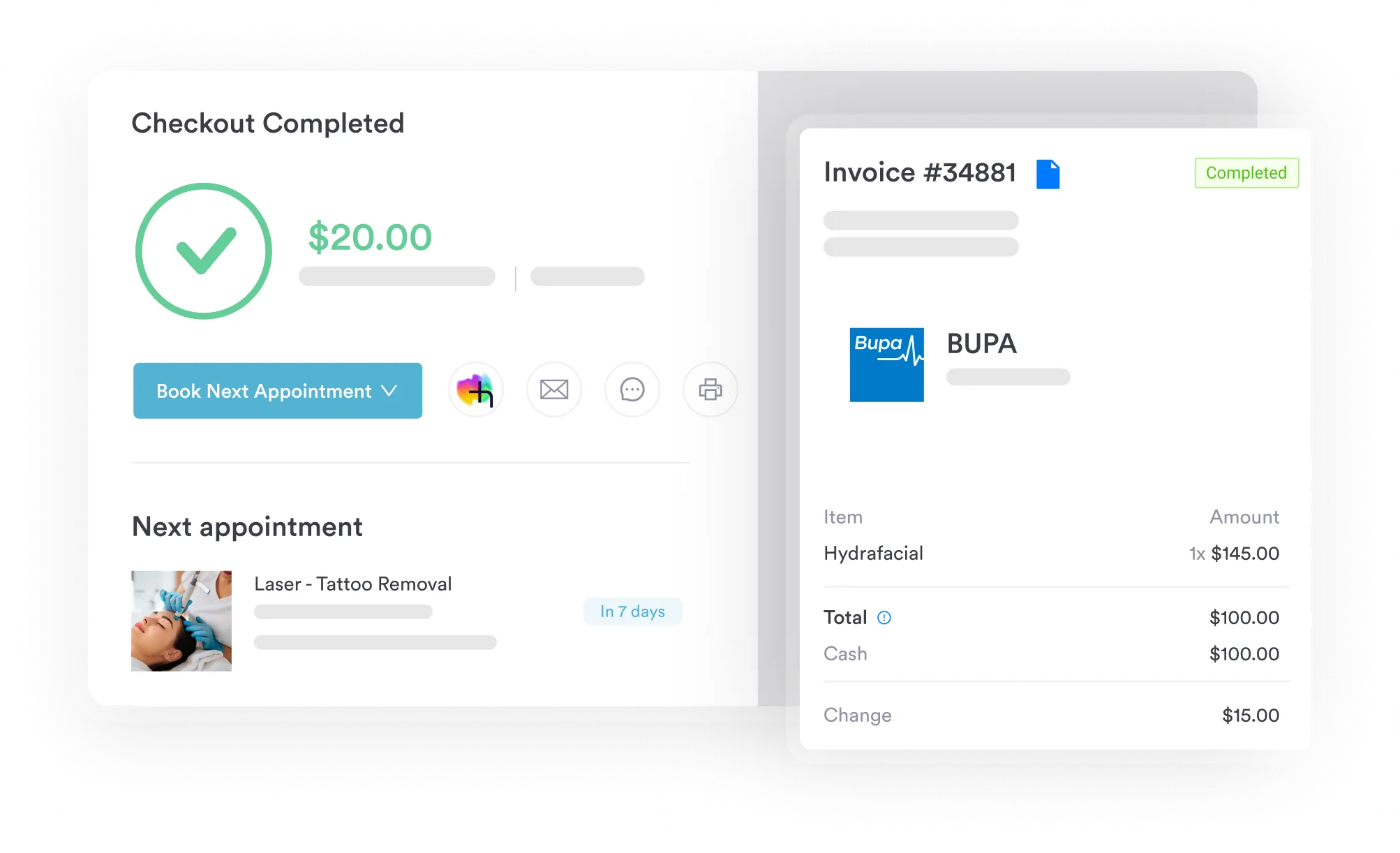

Pabau’s EMR and claims management software track prior authorizations, check eligibility and send 58353 claims through Claim.MD from the same patient record.

The 58353 claims that get paid share one habit. Someone confirms the approach and the energy type before the code goes on the claim. A hysteroscope means 58563, ultrasound-guided cryoablation means 58356, and a transcervical thermal device means 58353.
Get that call right, then match POS 11 to in-office work and the auth number to box 23. Those three checks stop the denials and underpayments this code is known for, and the office rate is too large to leave on the table.
Book a demo to see how Pabau keeps the op note, prior auth and 58353 claim together, so fewer ablation claims come back unpaid.

Need a deeper look at how claims flow through a clearinghouse? Pabau’s Claim.MD clearinghouse guide explains how electronic claim submission works and what happens between filing and payment.
Seeing recurring denials across your gynecologic procedure codes? Denial codes in medical billing breaks down the most common CARC codes and what each one means for your revenue cycle.
Want to understand how superbills connect to claim submission? The superbill guide covers what belongs on a superbill and how it feeds your clearinghouse submission workflow.
Ordering saline infusion sonography before the ablation? CPT code 58340 covers the catheterization and saline introduction that images the cavity.
Bleeding pattern doesn’t fit N92.0? ICD-10 code N93.9 explains when unspecified abnormal uterine bleeding is the right diagnosis.
CPT 58353 has a 10-day global period, indicator 010 in the 2026 Medicare fee schedule. Routine follow-up in those 10 days is included in the fee. Bill an unrelated visit in that window with modifier 24.
The 2026 work RVU is 3.51. Total RVUs are 26.67 in the office and 6.10 in a facility. Nationally, that works out to about $890.80 and $203.75 before geographic adjustment.
Report cryoablation with CPT 58356, endometrial cryoablation with ultrasonic guidance, including curettage when performed. Keep 58353 for thermal devices placed without a hysteroscope, such as NovaSure or Minerva.
Yes. Report it with place of service 11, and Medicare pays the non-facility rate. That rate includes the practice expense of the procedure, supplies included, so it pays far more than the facility rate.
Traditional Medicare generally doesn’t, although a MAC can review medical necessity after payment. Many Medicare Advantage and commercial plans do require it. Check the patient’s specific plan when you verify eligibility.