HCPCS code J3471: Hyaluronidase ovine injection billing guide
HCPCS code J3471: Descriptor, code type, and quick-reference data HCPCS code J34...

Last Updated: Oct 14, 2026
58100 is the CPT code for endometrial sampling (biopsy) with or without endocervical sampling (biopsy), without cervical dilation, any method. It covers an office biopsy taken with a Pipelle or similar sampler, and it carries a 0-day global period.
Two errors drive most denials on this code. The first is a diagnosis that does not clearly support medical necessity. The second is a missing modifier 25 on an E&M service billed the same day. Coders also confuse 58100 with 58558, which requires hysteroscopic visualization, and with the surgical D&C codes.
Let Pabau's smart automation suggest the right codes, reduce claim denials, and keep your practice compliant—effortlessly.
Automate repetitive tasks and focus on what matters most—your patients.
Reduce coding errors and ensure compliance with the latest regulations.
Clean claims, fewer denials, and faster reimbursements.
Powerful insights and reporting to help your practice thrive.
HIPAA compliant SOC 2 certified GDPR-compliant Trusted by 4,000+ clinics worldwide

CPT Code 58100 covers office-based endometrial sampling performed without hysteroscopy and without cervical dilation.
Cervical dilation is billed separately with modifier 59 when cervical stenosis makes it clinically necessary.
Modifier 25 is required any time an E&M service is billed on the same date as 58100 to prevent automatic bundling denial.
58100 carries a 0-day global period, meaning follow-up services are separately billable from the same date of service onward.
Pabau’s integrated claims management flags NCCI edit conflicts and modifier prompts before a claim is submitted, reducing preventable denials for codes like 58100.
CPT Code 58100 is defined by the American Medical Association as: Endometrial sampling (biopsy) with or without endocervical sampling (biopsy), without cervical dilation, any method. The physician passes a thin sampling instrument transcervically into the uterine cavity and draws endometrial tissue for histological analysis. A Pipelle aspirator or a Novak curette is the usual instrument.
Clinical indications that commonly support medical necessity for 58100 include abnormal uterine bleeding, postmenopausal bleeding, endometrial thickening on ultrasound, infertility workup, and endometrial cancer surveillance. The procedure is performed in-office, requires no anesthesia beyond a paracervical block in most cases, and does not use a hysteroscope for direct visualization.
CPT 58100 bundles the sampling procedure itself and the physician’s work of introducing the instrument and obtaining the specimen. Routine endocervical sampling performed at the same session is bundled too. What it does not bundle are services that represent distinct clinical encounters or separate diagnostic procedures.
The cervical dilation question is where many coders hesitate. When stenosis or anatomy require dilation before the sampler can pass, that dilation is a distinct service. The 58100 descriptor does not include it. Document the dilation separately in the operative note and apply modifier 59 or XU to avoid NCCI edit bundling. Minor manipulation to introduce the Pipelle, however, is not separately billable dilation.
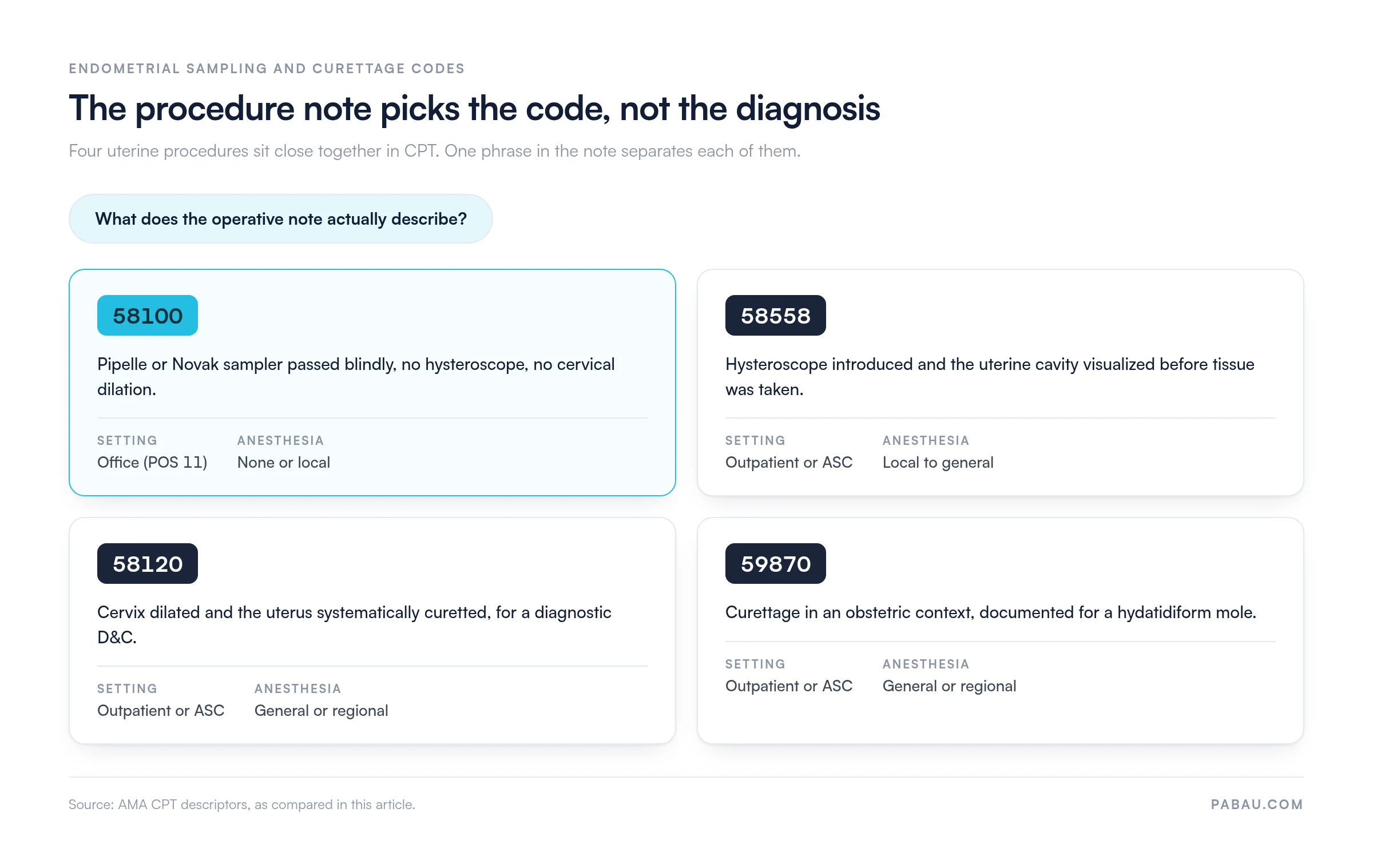
58558 (hysteroscopy with endometrial sampling/biopsy) is the code most frequently confused with 58100. Submitting 58558 for an office-only Pipelle biopsy creates upcoding exposure. Billing a hysteroscopic biopsy as 58100 gives away the difference in reimbursement.
The operative or procedure note is the deciding document. If the note mentions a hysteroscope being introduced and the uterine cavity being visualized before tissue was taken, 58558 is correct. If the note describes a Pipelle or similar sampler passed blindly into the cavity, 58100 applies. Upgrading to 58558 without documented hysteroscopic visualization is upcoding and creates audit exposure under CMS National Correct Coding Initiative (NCCI) edits.
Dilation and curettage (D&C) shares uterine procedural territory with endometrial biopsy, but the codes serve entirely different clinical scenarios. Confusing them is one of the most cited OB-GYN billing errors across AAPC coding guidance and payer audit targets.
The operative note determines the correct code, and each of these four codes turns on a different phrase in it. If anesthesia beyond a local block was administered, and the note documents cervical dilation and systematic uterine curettage, you are in D&C territory (58120). Submitting 58100 for a procedure performed in a surgical suite under general anesthesia is a place-of-service mismatch and will trigger denials.
Several CPT codes commonly appear on the same claim as 58100. Understanding their bundling relationships prevents both under-billing and NCCI edit rejections. The codes below all sit in the female genital system range, and they are the ones billers most often pair with an endometrial biopsy.
The 58300 (IUD insertion) bundling scenario is clinically plausible, but whether it is billable depends on the current NCCI edit version. Verify against the live CMS NCCI tables before billing these together on the same date of service. NCCI edits update quarterly, so a combination that was payable in Q1 may be bundled in Q3.
Office sampling performed with a Vabra aspirator also adds a supply line to the same claim. The device itself is reported under HCPCS code A4480, and that pairing needs its own NCCI edit check before the claim goes out.
The ICD-10-CM diagnosis code on the claim must support medical necessity for the biopsy. Payers run diagnosis-to-procedure crosswalks to confirm that the listed diagnosis is a recognized indication for endometrial sampling. Listing the wrong or overly broad code is the second-most common denial driver for 58100. Abnormal uterine bleeding is the indication that appears most often, and N93.9 carries it when the documentation supports no narrower code.
These pairings reflect commonly accepted indications. They are guidance, not coverage guarantees. Individual payer Local Coverage Determinations (LCDs) govern which diagnoses support coverage for 58100, and MAC-specific policies vary. Coders should verify against the applicable MAC’s LCD.
Specificity decides the rest. A nonspecific symptom code, such as R10.9 for unspecified abdominal pain, is a documentation deficiency when a more precise code is available. Payers read it as a prompt for medical review. Use the most granular code the note supports.
A complete procedure note for 58100 protects the claim from medical necessity review and supports the selected ICD-10 diagnosis. Incomplete notes are the leading internal audit finding for endometrial biopsy claims. Six elements belong in every one of them.
When no tissue is obtained, the claim is not automatically billable. Some payers allow CPT 58100 with modifier 52, for reduced services, when the attempt yielded no specimen. Cervical stenosis and patient intolerance are the usual reasons. Others deny outright. Verify with the individual payer before submitting 58100 in a no-tissue scenario, and document clearly that the attempt was made and the reason for failure.
Modifier selection is where 58100 claims most frequently break down. Each modifier serves a specific function and attaches to 58100 in predictable clinical scenarios.
Modifier 25 attaches to the E&M code, not to 58100. The 58100 line item is submitted without a modifier in most clean-claim scenarios. The E&M documentation must clearly show that the evaluation was substantial and distinct from pre- and post-service work bundled into 58100.
The 2026 Medicare Physician Fee Schedule assigns CPT 58100 a reimbursement rate that differs by place of service. Office-setting (POS 11) rates are higher than facility rates. The practice expense component reflects the cost of supplies and staff in the physician’s own office.
Use the CMS Physician Fee Schedule lookup tool to verify the exact non-facility and facility rates for your area. Rates carry location-specific conversion factors, so they move with both the locality and the fiscal year. For RVU values, FastRVU’s 2026 RVU lookup returns work, practice expense, and malpractice RVUs for 58100 by locality.
Commercial payer rates for 58100 typically range from approximately 100% to 130% of the Medicare rate, though some payers reimburse below Medicare. Rate variation by plan type and geographic region is substantial. The global period for CPT 58100 is 0 days. No follow-up visit is bundled into the procedure payment, so services rendered after the procedure date are separately billable.
Practice management software like Pabau tracks that 0-day global period against the encounter date, so billers do not inadvertently bundle post-procedure E&M services. Pabau’s claims management software applies the rule at the claim-scrub stage, before the claim is transmitted.
Verify your 58100 reimbursement rate quarterly. CMS updates the Medicare Physician Fee Schedule annually in January, and some commercial payers update their fee schedules mid-year. A rate that was accurate in Q1 may be incorrect by Q3. Build a quarterly verification step into your revenue cycle calendar.
The 0-day global period for CPT 58100 means the procedure carries no bundled post-operative follow-up. Any visit the physician has with the patient on the day of the biopsy, for a different and distinct issue, can be billed separately. Modifier 25 goes on the E&M code. Any visit after the date of service is separately billable, with no modifier required for the global period. That is a straightforward billing advantage over 10-day or 90-day global codes.
Prior authorization requirements for CPT 58100 vary significantly by payer. Medicare does not require prior authorization for 58100 in an office setting. Commercial payers including Aetna, UHC, Cigna, and BCBS generally do not require pre-auth for an office-based endometrial biopsy, though individual plan designs may differ.
Some Medicaid managed care plans do require prior authorization, particularly in states with aggressive utilization management. Verify with the patient’s specific plan before scheduling when Medicaid is the payer. Check the payer’s current policy for that plan rather than assuming pre-auth is unnecessary.
Most 58100 denials are preventable. They cluster around a handful of recurring errors, and each one can be caught by a rule in the claim scrubber. Here are the six most common 58100 denial reasons and the step that stops each of them.
Each of those denials comes back with a CARC code on the remittance advice. Reading the CARC first is faster than reopening the claim, and our reference on medical billing denial codes explains what each one signals.
Every denial reason listed above can be caught by a scrubbing rule before the claim leaves the practice. Working the same denial after the remittance arrives costs staff time, a resubmission, and several weeks of delayed payment.
Pabau integrates documentation, coding prompts, and claims submission in one workflow. When a coder selects 58100, the system flags any same-date E&M that carries no modifier 25. It also prompts for the companion pathology code, 88305, and surfaces the patient’s active payer for prior authorization verification.
Claims then route through an integrated clearinghouse, which validates CPT and ICD-10 combinations against current NCCI edit tables before transmission. Electronic remittance advice returns denial reason codes straight into the billing workflow. Your team reads the exact CARC code within hours, instead of waiting on a paper explanation of benefits.
Some practices bill 58100 alongside IUD insertions, colposcopy, or infertility workups. The multi-code scrubbing layer catches the modifier 59 and XU requirements that manual review misses on a busy day. Book a demo to see how Pabau handles OB-GYN billing workflows end to end.

Pabau’s integrated billing workflow flags NCCI edit conflicts, missing modifiers, and POS mismatches for codes like CPT 58100 before a claim is submitted. See how it works for your OB-GYN practice.

CPT Code 58100 is a high-volume OB-GYN code, and most of its denials trace back to two or three preventable errors. The usual causes are a diagnosis that does not support medical necessity, a missing modifier 25, or a code that should have been 58558. Reading the procedure note before the code is selected catches all three.
Reducing 58100 denials is a claim-scrub job more than an appeals job. Build the modifier 25 check, the 88305 pairing, and the LCD diagnosis check into the claim before it goes out. Book a demo to see how Pabau runs those checks on every OB-GYN claim you submit.

Need to verify an endometrial biopsy claim before it goes out? Clean claim checklist walks through every field that payers audit before processing a gynecology procedure claim.
Handling denials that come back on 58100? Electronic remittance advice guide explains how to read ERA/835 denial codes and build an efficient appeal workflow.
Want to understand how 58100 sits within the broader revenue cycle? Revenue cycle management overview covers the end-to-end process from patient scheduling through payment posting.
CPT Code 58100 covers an endometrial biopsy or sampling performed without cervical dilation, using any method. That includes a Pipelle aspirator, a Novak curette, or a similar device used in the office without hysteroscopic visualization. It includes concurrent endocervical sampling when performed but does not include cervical dilation, hysteroscopy, or pathology processing.
CPT 58100 covers a blind or guided office biopsy without a hysteroscope; CPT 58558 covers hysteroscopy with directed endometrial biopsy under direct visualization. The key differentiator is whether a hysteroscope was introduced and the uterine cavity visualized before tissue was taken. Submitting 58558 for a Pipelle biopsy is upcoding.
Yes, Medicare covers CPT 58100 when billed with a diagnosis code that supports medical necessity per the applicable MAC Local Coverage Determination. No prior authorization is required for Medicare in an office setting. Verify the LCD for your MAC to confirm covered indications before billing.
Yes, an E&M service can be billed on the same date as CPT 58100. The evaluation must be significant and separately identifiable from the pre- and post-service work bundled into the procedure. Modifier 25 must be appended to the E&M code; without it, the claim will be automatically denied as bundled.
CPT 58100 carries a 0-day global period. No post-operative follow-up visits are bundled into the procedure payment. Services after the date of the biopsy are separately billable, with no global period restriction.
No. The 58100 descriptor explicitly states “without cervical dilation.” When dilation is required due to cervical stenosis to pass the sampling instrument, it may be billed separately with modifier 59 or XU applied. Minor manipulation to introduce the Pipelle does not constitute billable dilation.