



CCSD code G5100: Bypass of duodenum billing guide
CCSD code G5100 bills a bypass that leaves the duodenum in place CCSD code G5100...

Last Updated: Oct 16, 2026

CPT code 58340 covers catheterization and introduction of saline or contrast material for saline infusion sonohysterography (SIS) or hysterosalpingography (HSG). The imaging component is billed separately.
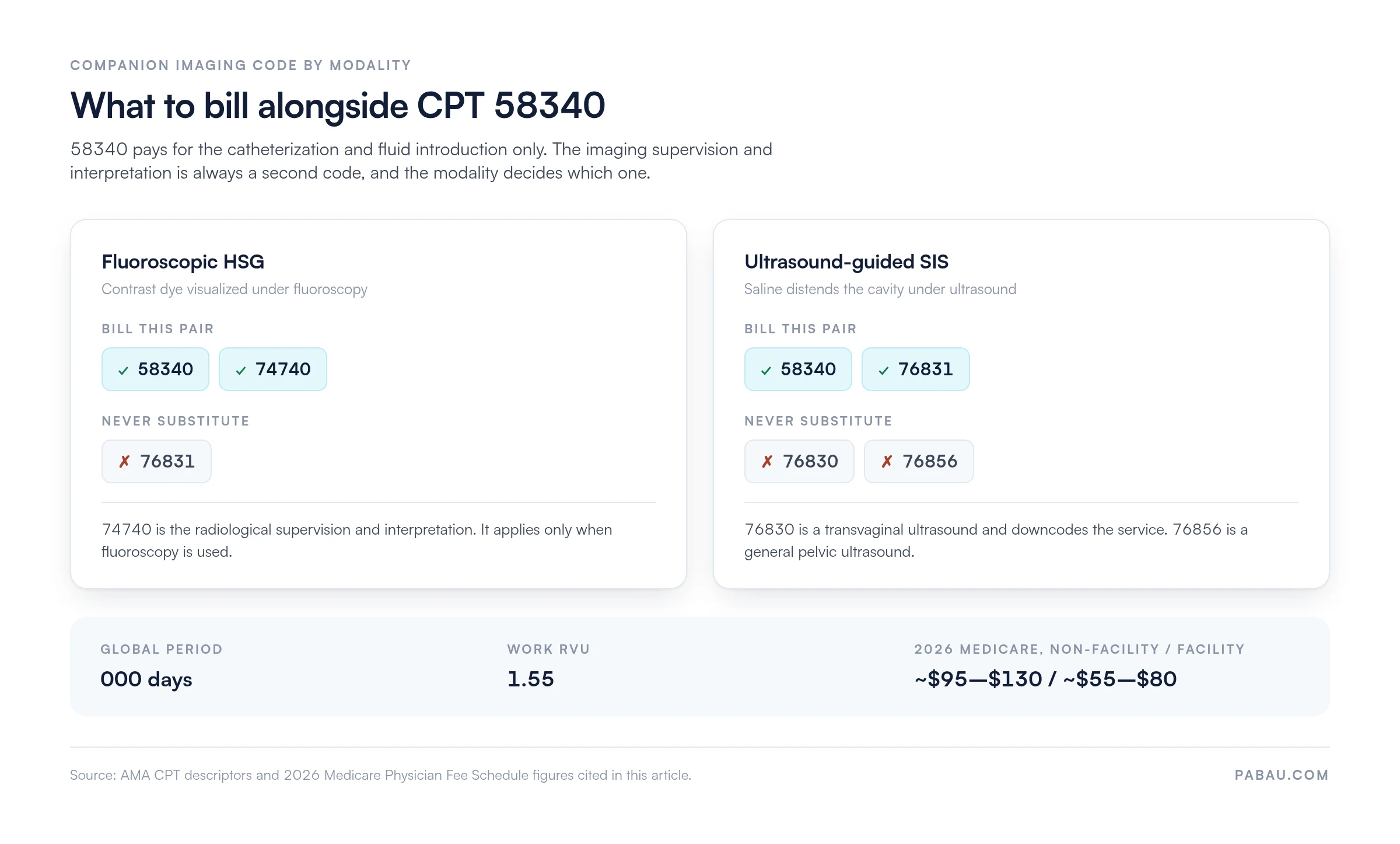
For fluoroscopic HSG, pair 58340 with CPT 74740. For ultrasound-guided SIS, pair it with CPT 76831. Using 76830 or 76856 instead of 76831 in SIS workflows is the most common coding error.
The global period for CPT 58340 is 000 days, so no pre- or post-operative services are bundled. Modifier -26 applies when only the professional component is performed.
Pabau’s claims management software supports OB/GYN and fertility billing workflows, helping practices apply correct code pairs and modifier logic before claims reach the payer.
CPT code 58340 covers catheterization and introduction of saline or contrast material for saline infusion sonohysterography (SIS) or hysterosalpingography (HSG). That wording is the official descriptor from the American Medical Association (AMA), which maintains the CPT code set. The code sits in the Introduction Procedures on the Corpus Uteri subsection.
Clinically, 58340 captures the work of placing a catheter through the cervix. The catheter then introduces either sterile saline (for SIS) or iodinated contrast dye (for HSG). It is ordered to evaluate the uterine cavity and fallopian tubes. The usual contexts are an infertility workup, assessment of uterine abnormalities, or investigation of recurrent pregnancy loss.
Two points decide whether the claim pays. First, 58340 covers both SIS and HSG catheterization under a single descriptor. Second, the imaging supervision and interpretation used to visualize the results is always a separate CPT code.
Knowing the scope of 58340 prevents the two most common billing mistakes. One is unbundling work the code already includes. The other is leaving out companion codes that are legitimately billable.
What 58340 includes:
What 58340 does NOT include:
The code is not limited to infertility indications. Uterine anomaly evaluation and abnormal uterine bleeding workups are equally valid clinical contexts. The supporting ICD-10 still has to match the documented indication. When the bleeding workup finds a submucosal fibroid, the hysteroscopic myomectomy that follows carries its own code, 58561.
The single most important coding decision for 58340 is selecting the correct companion imaging code. The procedure runs under two different modalities, and each has its own supervision and interpretation CPT. The wrong pairing produces a claim edit or a denial.
Substituting 76856 (complete pelvic ultrasound) for 76831 does not describe the SIS imaging protocol, so it is not an appropriate pairing with 58340. Substitutions of this kind are among the most audited errors in fertility billing. The card below sets out both pairings, plus the codes that should never stand in for them.
Sometimes a radiologist provides only the imaging interpretation while the OB/GYN performs the catheterization in a separate setting. In that split, modifier -26 applies to 74740 for the professional component. The practice billing the catheterization in its own facility reports 58340 with no modifier on the professional side.
Modifier selection for 58340 depends on who owns the equipment, who performs each component, and whether separate procedures occur on the same date of service. Incorrect modifier usage is a leading cause of audits for fertility and OB/GYN practices.
Modifier -59 carries the highest audit risk of the three. The CMS National Correct Coding Initiative (NCCI) edits govern which code pairs require separation documentation. Practices should verify current NCCI edits before applying -59 to any 58340 claim. Documentation must unambiguously support a distinct procedural service.
Before applying modifier -59 to a 58340 claim, check the current NCCI edit table for the companion code. If the edit pair does not list -59 as an allowed override, the modifier will cause a denial rather than fix one. Run a quarterly review of your NCCI edit report for the 58340 code pair combinations your practice bills most frequently.
Medicare reimbursement for CPT 58340 varies by place of service and geographic locality. The figures below reflect 2026 Medicare Physician Fee Schedule (MPFS) data. Verify them with your Medicare Administrative Contractor (MAC) for your locality before using them in financial planning.
Rates also differ between facility and non-facility settings. Practice expense (PE) RVUs change based on who absorbs the overhead costs.
On a drug claim, place of service can decide whether the drug is paid separately at all. For J1120, that depends on the ASC payment indicator CMS currently assigns it.
*Payment ranges are estimates based on publicly available 2026 MPFS data. Verify exact rates using the CMS Physician Fee Schedule lookup tool for your MAC and locality. Geographic adjustment factors (GAFs) can shift total payment significantly between high-cost urban markets and rural localities.
The global period for CPT 58340 is 000 days. This means no pre-operative or post-operative services are bundled into the code. Visits on the day before and the day of the procedure can be billed separately. So can follow-up visits for complications, as long as they are documented as distinct encounters.
For practices using RVU-based compensation models, the work RVU of 1.55 reflects moderate physician effort for catheter placement and contrast introduction. Total RVU value adds wRVU, PE RVU, and malpractice RVU together. You can look that figure up in the FastRVU 2026 lookup tool, filtered by CPT 58340 and your locality.
Every 58340 claim requires a supporting ICD-10 diagnosis code that establishes medical necessity. Payers review the diagnosis to confirm the procedure is clinically appropriate for the stated indication. Infertility-related claims receive additional scrutiny because commercial payer coverage for fertility services varies widely.
Practices can cross-reference applicable diagnosis codes using the AAPC CPT-to-ICD-10 crosswalk for 58340. Our ICD-10-CM code index covers the diagnosis families that carry medical necessity for pelvic imaging. The diagnosis has to reflect the documented clinical indication in the chart. Assigning a more favorable ICD-10 to ease prior authorization is a compliance risk.
For practices managing IVF CPT codes alongside 58340, Z31.41 is frequently used for the pre-IVF fertility evaluation encounter. Confirm that the payer’s fertility policy covers diagnostic procedures under the same benefit as treatment. Some plans cover HSG and SIS separately from IVF.
Substitution errors around 58340 cluster around two problems. Coders reach for the wrong imaging companion code, or they conflate the catheterization with a diagnostic hysteroscopy. The comparison below shows the distinctions coders need to apply correctly.
The 58340 versus 58558 distinction matters most for practices that perform both procedures. CPT 58558 (hysteroscopy with biopsy) involves direct endoscopic visualization of the uterine cavity. That is a different technique from the catheterization-based approach in 58340. Billing 58558 for what was documented as an SIS or HSG is upcoding.
Neither SIS nor HSG returns tissue for pathology. When the imaging raises a hyperplasia question, the endometrial biopsy that follows is reported with CPT 58100.
For practices handling insurance claims at volume, code pair rules built into the billing system keep substitution errors away from the payer. Practice management software like Pabau ships those rules inside its claims management software, which validates each claim against built-in CPT catalogs before submission. Mismatched pairs get flagged at that step, well before a denial arrives.
Medicare covers HSG and SIS coded with 58340 when the documented indication supports medical necessity. Commercial payer coverage is considerably less consistent, particularly when the procedure is ordered for infertility evaluation.
Key payer coverage considerations:
Checking eligibility before the procedure date is the most reliable way to find coverage limits early. Pabau runs real-time eligibility checks through its clearinghouse connection, reading patient benefits and authorization rules against the payer’s current policy. Doing that ahead of the appointment keeps day-of-service surprises off fertility cases.
Run eligibility verification for all scheduled HSG and SIS patients 48 hours before the appointment. Fertility-related claims are more frequently subject to prior authorization holds than diagnostic imaging claims. Spotting a missing authorization two days out gives the practice time to reschedule or secure approval rather than absorbing the claim as a write-off.
OB/GYN and fertility practices billing 58340 keep hitting the same three workflow problems.
Software built for clinical billing, rather than general scheduling, handles each of these at the system level. That takes the load off individual coder recall.
Fertility practices code both the diagnostic side (58340) and the treatment side, including IVF and embryo transfer. One system has to carry both workflows without a manual handoff in the middle. Practices running separate billing software and EMR see claim lag and code pair errors at exactly that handoff.
The revenue effect of systematic code pair errors compounds across volume. Take a mid-size fertility practice running 20 HSG or SIS procedures a week.
Mismatching the imaging companion code puts denials on claims worth roughly $95 to $130 each at non-facility Medicare rates. Rework time and delayed cash collection sit on top of that, and both scale with the same volume.

Pabau’s claims management software supports code pair rules, modifier logic, and fee schedule updates so your team submits cleaner 58340 claims from the start.

Coding 58340 well comes down to one decision, made the same way every time. Match the companion imaging code to the modality used, then support the claim with a diagnosis the chart already documents.
Coder recall alone does not hold up at volume, so the rule belongs in the system rather than in someone’s memory. Set the code pair and modifier logic once and every 58340 claim inherits it. Book a demo to see how Pabau keeps fertility and OB/GYN claims clean before they reach the payer.

Managing IVF billing alongside HSG claims? IVF CPT codes covers the full ART procedure code set for fertility practices billing both diagnostic and treatment services.
Need to verify eligibility before fertility appointments? Insurance eligibility verification explains how real-time checks surface prior authorization requirements before the patient arrives.
Want fewer edits on your 58340 claims? What is a clean claim in medical billing? walks through the validation steps that catch code pair errors before submission.
Already working a denial queue? Denial management in healthcare sets out the process for reworking denials and stopping the same edit from repeating.
CPT code 58340 is the catheterization and introduction of saline or contrast material for saline infusion sonohysterography (SIS) or hysterosalpingography (HSG). It covers only the catheterization and fluid introduction component of the procedure. The imaging supervision and interpretation are billed separately using companion codes 76831 (for SIS) or 74740 (for fluoroscopic HSG).
CPT 58340 covers both. The AMA descriptor explicitly includes both saline infusion sonohysterography (SIS) and hysterosalpingography (HSG) under the same code. The distinction that matters for billing is the companion imaging code: 76831 for SIS and 74740 for fluoroscopic HSG.
For fluoroscopic HSG, pair CPT 58340 with CPT 74740 (hysterosalpingography, radiological supervision and interpretation). CPT 74740 captures the imaging interpretation work when contrast dye is visualized under fluoroscopy. This pair is confirmed by ASRM’s 2026 fertility coding guidance.
CPT 76831 (saline infusion sonohysterography imaging) is the correct companion for 58340 in SIS procedures. CPT 76830 is a general transvaginal ultrasound and does not describe the SIS-specific imaging protocol. Using 76830 instead of 76831 is a downcoding error. CPT 76856 (complete pelvic ultrasound) is also not an appropriate substitute for 76831 in SIS coding.
The global period for CPT 58340 is 000 days. No pre-operative or post-operative services are bundled into the code. Separate office visits on the day before, the day of, or after the procedure can be billed independently when documented as distinct clinical encounters.
The 2026 Medicare reimbursement for CPT 58340 is approximately $95-$130 in a non-facility setting and $55-$80 in a facility setting, based on current MPFS data. Exact rates vary by MAC and geographic locality. Verify your specific rate using the CMS Physician Fee Schedule lookup tool before using these figures for financial planning.
CPT 58558 (hysteroscopy with biopsy) requires direct endoscopic visualization of the uterine cavity via a hysteroscope. CPT 58340 involves catheterization and fluid introduction without direct visualization. The two codes describe fundamentally different techniques and cannot be used interchangeably. Billing 58558 for a procedure documented as SIS or HSG is upcoding.



