

CCSD code G5100: Bypass of duodenum billing guide
CCSD code G5100 bills a bypass that leaves the duodenum in place CCSD code G5100...

Last Updated: Oct 16, 2026
Billable Code Specific Code
56620 is the CPT code for vulvectomy, simple; partial. It covers surgical removal of less than 80% of the vulvar area, limited to skin and superficial subcutaneous tissue.
Removing 80% or more moves the claim to CPT 56625, and deeper excision belongs in the radical codes 56630-56640. The code carries a 90-day global period, so routine post-op visits are bundled into its payment.
Let Pabau's smart automation suggest the right codes, reduce claim denials, and keep your practice compliant—effortlessly.
Automate repetitive tasks and focus on what matters most—your patients.
Reduce coding errors and ensure compliance with the latest regulations.
Clean claims, fewer denials, and faster reimbursements.
Powerful insights and reporting to help your practice thrive.
HIPAA compliant SOC 2 certified GDPR-compliant Trusted by 4,000+ clinics worldwide

CPT 56620 covers simple partial vulvectomy: Excision of less than 80% of the vulvar area, limited to skin and superficial subcutaneous tissue.
Valid indications include VIN (N90.0-N90.3), lichen sclerosus (L90.0), condyloma (A63.0), and benign vulvar tumors. The ICD-10 code must support medical necessity.
The 90-day global surgery period bundles routine post-op E/M visits. Modifiers 24, 58, and 79 are required to bill separately during the global window.
Claims management software like Pabau tracks 56620 claims through submission, remittance posting, and denial follow-up for ob-gyn practices.
CPT code 56620 is defined by the American Medical Association as “Vulvectomy, simple; partial.” For billing purposes, “simple” means the excision is limited to skin and superficial subcutaneous tissue. “Partial” means less than 80% of the vulvar area is removed. Both conditions must be documented in the operative report for the code to hold up under payer audit.
The code sits in the Female Genital System section of CPT (codes 56405-58999), specifically within the vulva, perineum, and introitus subsection. It is a surgical code, not an evaluation or biopsy code, so it carries a 90-day global surgery period and requires full operative documentation.
CPT code 56620 is appropriate when a benign or premalignant vulvar condition has not responded to conservative management. The lesion must also need surgical excision of a defined region rather than the full vulva. Medical necessity is the gating criterion: The operative note and claim must pair a supported ICD-10 diagnosis with documented failure of alternative treatments where applicable.
The most common clinical indications accepted by Medicare and commercial payers include:
Malignant vulvar carcinoma requiring deep tissue removal or lymphadenectomy belongs in the radical vulvectomy codes (56630, 56640), not in 56620. Coding a malignancy to 56620 without clinical justification is a common medical necessity denial trigger.
Payer auditors look for four specific elements in the operative report before approving a CPT 56620 claim. Missing any one of them is sufficient grounds for denial or downcoding.
The CMS Physician Fee Schedule lookup classifies 56620 as a major surgery, so documentation standards are the same as any 90-day global procedure. Preoperative notes, consent forms, and the formal operative report all feed the claim file during a retrospective audit.
CPT 56625 is the code for simple complete vulvectomy, defined as removal of 80% or more of the vulvar area. The 80% threshold is the single deciding factor between these two codes. Some op notes document bilateral labia majora and minora excision with perineal involvement. That extent typically meets the 56625 threshold, so applying 56620 there is undercoding.
When the operative note is ambiguous about the percentage of vulva excised, query the surgeon before submitting the claim. Submitting 56620 when the actual extent was 80% or more is undercoding. Submitting 56625 for a focal excision is overcoding, which carries audit and recoupment risk. The decision path below shows how tissue depth and extent route a vulvectomy to its code.
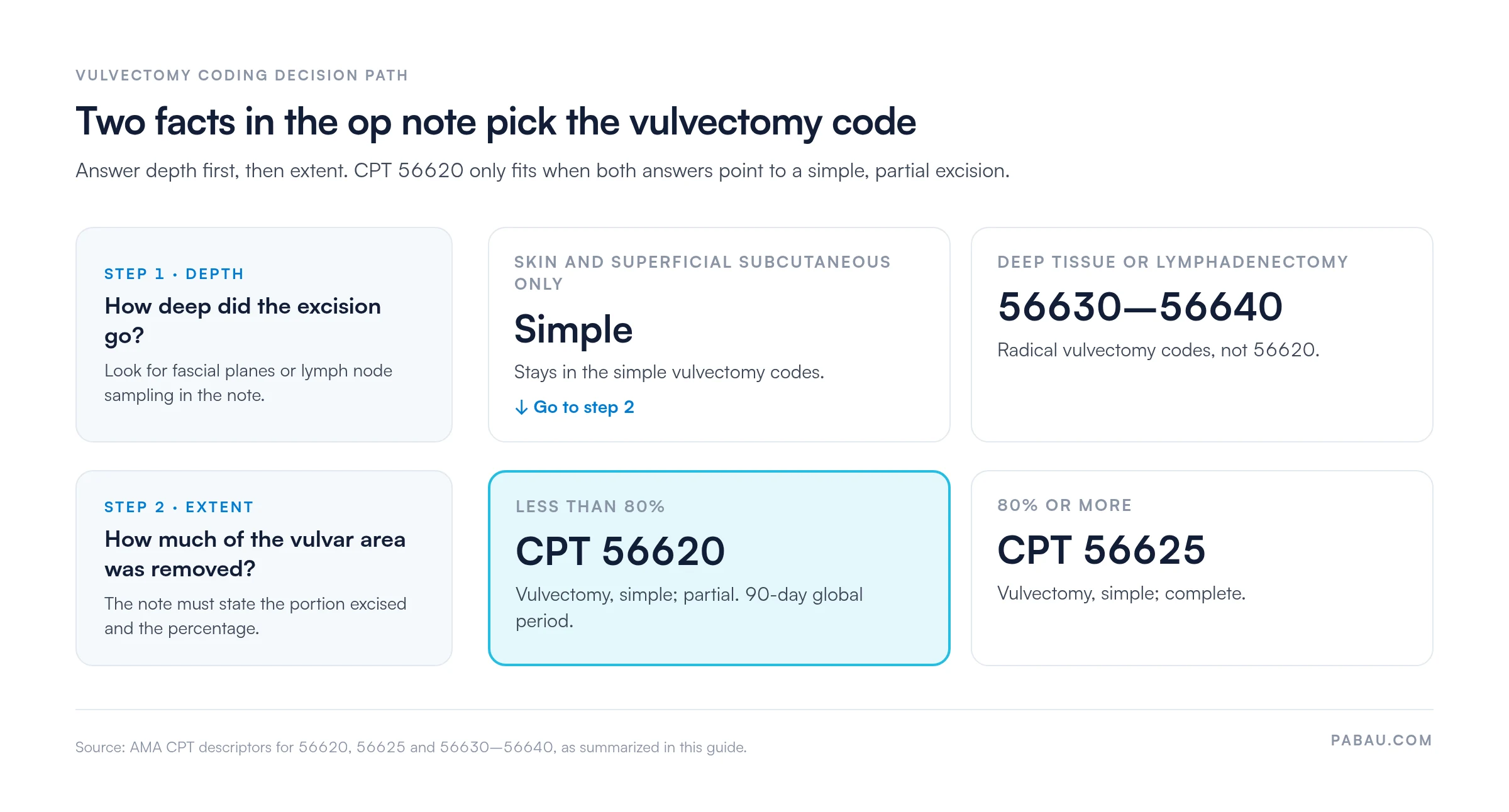
CPT 56620 sits within a five-code family for vulvar excision procedures. Understanding where each code begins and ends prevents unbundling errors and NCCI edit violations.
The CMS National Correct Coding Initiative (NCCI) edits bundle the vulvar biopsy code CPT 56605 into CPT 56620 on the same date of service. Billing both without modifier 59 or XS will trigger an automatic payer rejection. Modifier 59 is appropriate only when the biopsy was performed on a separate anatomical site from the vulvectomy. The operative note must document that separation.
The ICD-10 diagnosis paired on the claim must clinically justify a partial vulvectomy. Payers cross-reference the diagnosis against the procedure to determine medical necessity. Pairing 56620 with a diagnosis that typically resolves with topical treatment, without documentation of treatment failure, is a frequent denial trigger for ob-gyn practices.
Using N90.9 (noninflammatory disorder of vulva, unspecified) as the primary diagnosis without a more specific code will frequently trigger a medical necessity denial. Code to the highest specificity supported by the pathology report and pre-operative documentation.
CPT code 56620 reimbursement under the Medicare Physician Fee Schedule varies by geographic region (GPCI adjustment) and by place of service. Non-facility rates (office-based procedures) are higher than facility rates (hospital or ASC). In an office, the practice bears overhead costs that Medicare reimburses separately in facility settings.
Verify current-year payment rates directly through the CMS Physician Fee Schedule lookup tool. Rates update on January 1 annually. The figures below are provided as a reference framework; always confirm the current-year values before submitting claims. Practices that bill through claims software for gynecology can automate fee schedule checks and flag payments that fall below the expected rate.
After claim adjudication, review the electronic remittance advice (ERA) to confirm payment posted at the expected rate. Variances of more than 10% from expected reimbursement warrant a review of place-of-service coding and modifier application. A complete gynecologic superbill that captures the correct place of service and every relevant modifier cuts ERA discrepancies at reconciliation.
Run a post-payment audit on CPT 56620 claims quarterly. Pull all paid claims and compare the allowed amount against the current CMS fee schedule for your locality. Geographic practice cost index (GPCI) adjustments vary by Medicare Administrative Contractor (MAC) jurisdiction. They can account for a 15-25% rate difference between rural and urban practices.
CPT code 56620 carries a 90-day major surgery global period, consistent with CMS global surgery designation for vulvectomy procedures. All routine postoperative care provided within 90 days of the procedure date is bundled into the surgical payment and cannot be billed separately.
Three modifiers allow separate billing during the global window. Each requires specific documentation in the medical record:
Routine wound checks, suture removal, and post-op counseling within 90 days are bundled. Billing these without a modifier will result in automatic payer rejection. An integrated clearinghouse flags post-op claims that lack a modifier at the scrubbing stage, before they reach the payer.
Beyond the global period modifiers, three additional modifiers apply specifically to the vulvectomy procedure itself at the time of service.
Modifier 22 is the most frequently misused. Appending it without a supporting letter and detailed operative documentation will result in denial or payment at the base rate. Many payers require submission of the operative report with the initial claim when modifier 22 is present, rather than waiting for a records request.
CPT code 56620 reimbursement denials cluster around six root causes. Most are preventable with correct pre-claim documentation review. A clean claim for this procedure means confirming all six before it leaves the practice.
A denial management workflow built around vulvar procedure codes catches these patterns before they become write-offs. Track denials by root cause as well as by payer, so the fix lands on the missing documentation instead of one denied claim. Our guide to medical billing denial codes decodes the claim adjustment reason codes (CARCs) and remark codes (RARCs) on rejected 56620 remittances.
Prior authorization requirements for CPT 56620 vary significantly by payer type. Medicare does not require prior authorization for most vulvectomy procedures, but Medicare Advantage plans operate under their own utilization management rules and may require it. Always verify at the payer level, not the insurance-type level.
Checking insurance eligibility at scheduling surfaces prior auth requirements early enough to prevent day-of-surgery delays. A typical prior auth request for CPT 56620 includes three clinical documents:
For elective gynecologic procedures, build auth verification into the pre-surgical workflow rather than leaving it to the day before surgery.
When an emergent case makes prior auth clinically impossible, document the emergent nature clearly in the medical record. Then notify the payer within its post-service notification window, typically 24-72 hours. Most payers have a retroactive auth process for emergent procedures that prevents denial when properly documented.
Most ob-gyn billing teams check vulvectomy claims by hand. A coder reads the op note, keys the codes into a separate billing tool, and waits for the remittance to find out what went wrong.
Practice management software like Pabau keeps the operative documentation, the ICD-10 pairing, and the claim in one patient record. Claims run through NCCI edit checks via the Claim.MD integration before submission, and ERA data posts back to the patient account.
Your team sees a missing modifier 59 or an unsupported diagnosis before the payer does. It also sees exactly where 56620 revenue is leaking once payments come back.

Pabau connects operative notes, ICD-10 coding, claim submission, and ERA reconciliation in one workflow. Ob-gyn practices spend less time chasing denials and more time on patient care.

Coding 56620 correctly comes down to two facts in the operative note: How deep the excision went, and how much of the vulva was removed. When both are written down, the choice between 56620, 56625, and the radical codes is settled before the claim is built.
Make that check part of every pre-submission review. Confirm the percentage, pair the most specific ICD-10 code, and decide whether a same-day biopsy needs modifier 59 or XS. That review takes minutes, while appealing a denied 90-day global procedure takes weeks.
Book a demo to see how Pabau keeps vulvectomy claims tied to the operative note from charge capture to payment.

Need to verify IVF and reproductive surgery codes alongside vulvectomy claims? IVF CPT codes covers the full reproductive surgery code set used by ob-gyn and REI practices.
Want the full billing picture behind a gynecologic claim? Revenue cycle management explains the end-to-end billing process from charge capture to payment posting.
Looking for a complete billing setup for your ob-gyn practice? Best medical billing software compares the leading US billing platforms by specialty workflow.
Tired of reworking rejected vulvectomy claims? Clean claims in medical billing shows what a claim needs to pass payer edits on the first submission.
Seeing the same denials month after month? Denial management in healthcare sets out a workflow for tracking, appealing, and preventing denials by root cause.
CPT code 56620 covers simple partial vulvectomy: Surgical excision of less than 80% of the vulvar area, limited to skin and superficial subcutaneous tissue. It involves no radical lymph node dissection. It applies to procedures for premalignant or benign vulvar conditions such as VIN, lichen sclerosus, and condyloma acuminata.
CPT 56620 is simple partial vulvectomy, covering less than 80% of the vulvar area. CPT 56625 is simple complete vulvectomy, covering 80% or more of the vulvar area. Both codes involve the same tissue depth (skin and superficial subcutaneous). The anatomical extent documented in the operative report determines which code applies.
CPT 56620 carries a 90-day major surgery global period. All routine post-operative E/M visits, wound checks, and suture removal within 90 days are bundled into the surgical payment. Separate billing during the global period requires modifier 24 (unrelated condition), modifier 58 (staged procedure), or modifier 79 (unrelated procedure).
The most commonly paired ICD-10 codes are N90.0-N90.3 (VIN grades I-III), L90.0 (lichen sclerosus), and A63.0 (condyloma acuminata). D28.0 (benign neoplasm of vulva) and N90.6 (hypertrophy of vulva) also pair with it. Each diagnosis needs documented medical necessity. Avoid the unspecified code N90.9 as a primary diagnosis.
Not without modifier 59 or XS. NCCI edits bundle CPT 56605 (vulvar biopsy) into CPT 56620 when both occur on the same date of service. Modifier 59 or XS is required only when the biopsy was performed on a separate, distinct anatomical site from the vulvectomy. The operative note must document that separation explicitly.
The top denial reasons are the wrong code level (56620 vs 56625) and operative notes missing the extent percentage or tissue depth. Non-covered ICD-10 diagnoses and NCCI bundling with 56605 without modifier 59 follow. Missing prior authorization and post-op visits billed in the 90-day global period without the correct modifier complete the list.



