CPT code 37229: Tibial/peroneal atherectomy
CPT code 37229 was deleted in 2026: use 37288 or 37290 instead CPT code 37229 is...

Last Updated: Oct 21, 2026
56501 is the CPT code for destruction of lesion(s), vulva; simple (eg, laser surgery, electrosurgery, cryosurgery, chemosurgery, surgical curettement). It covers in-office destruction of discrete vulvar lesions by any one of those five methods.
Claims for this code are frequently denied when the note supports extensive destruction (56515) instead, or when the ICD-10 linkage is missing. Condyloma acuminatum is the most common indication, and vulvar intraepithelial neoplasia (VIN) and benign vulvar lesions also qualify, each with its own ICD-10 pairing.
Let Pabau's smart automation suggest the right codes, reduce claim denials, and keep your practice compliant—effortlessly.
Automate repetitive tasks and focus on what matters most—your patients.
Reduce coding errors and ensure compliance with the latest regulations.
Clean claims, fewer denials, and faster reimbursements.
Powerful insights and reporting to help your practice thrive.
HIPAA compliant SOC 2 certified GDPR-compliant Trusted by 4,000+ clinics worldwide

CPT code 56501 covers simple destruction of vulvar lesions, and 56515 is the companion code for extensive destruction.
The code is modality-neutral: laser, electrosurgery, cryosurgery, chemosurgery, and curettement all qualify, but the operative note must name which modality was used.
Missing ICD-10 medical necessity linkage and misclassifying simple vs. extensive destruction are two frequent denial drivers for 56501 claims.
Medicare assigns 56501 a 10-day global period, so routine follow-up care in that window is not billed separately.
Pabau, the practice platform we build, stores the procedure note and diagnosis, and Claim.MD submits and tracks the 56501 claim.
CPT code 56501 is defined by the American Medical Association (AMA) as: Destruction of lesion(s), vulva; simple (eg, laser surgery, electrosurgery, cryosurgery, chemosurgery, surgical curettement). The anatomical site is the vulva and vaginal vestibule. “Simple” refers to the clinical complexity and extent of tissue involvement, not the number of lesions treated in a single session.
The parenthetical examples in the descriptor are illustrative, not exhaustive. If a modality is clinically appropriate and the procedure note documents it, the code applies. The key documentation elements are the site (vulva), the classification (simple), and the specific modality used.
This code sits within the Vulva, Perineum, and Introitus subsection (56405-56821) of the female genital system section in the AMA CPT code book. It is a minor surgical code with a 10-day global surgery period.
CPT code 56501 recognizes five destruction modalities. Any of them qualifies, provided the operative note documents the method. The clinical picture must also support “simple” rather than “extensive” destruction.
Billing note: only the in-office, provider-administered procedure qualifies. Patient-applied topical chemotherapy (e.g. imiquimod prescribed for home use) is not billable under CPT code 56501.
CPT 56515 describes extensive destruction of vulvar lesions. Payers look closely at the simple/extensive call on vulvar destruction claims. Choosing the wrong code costs you either way. Billing 56501 when 56515 was warranted means underpayment, and billing 56501 that the note can’t support brings a denial and a records request.
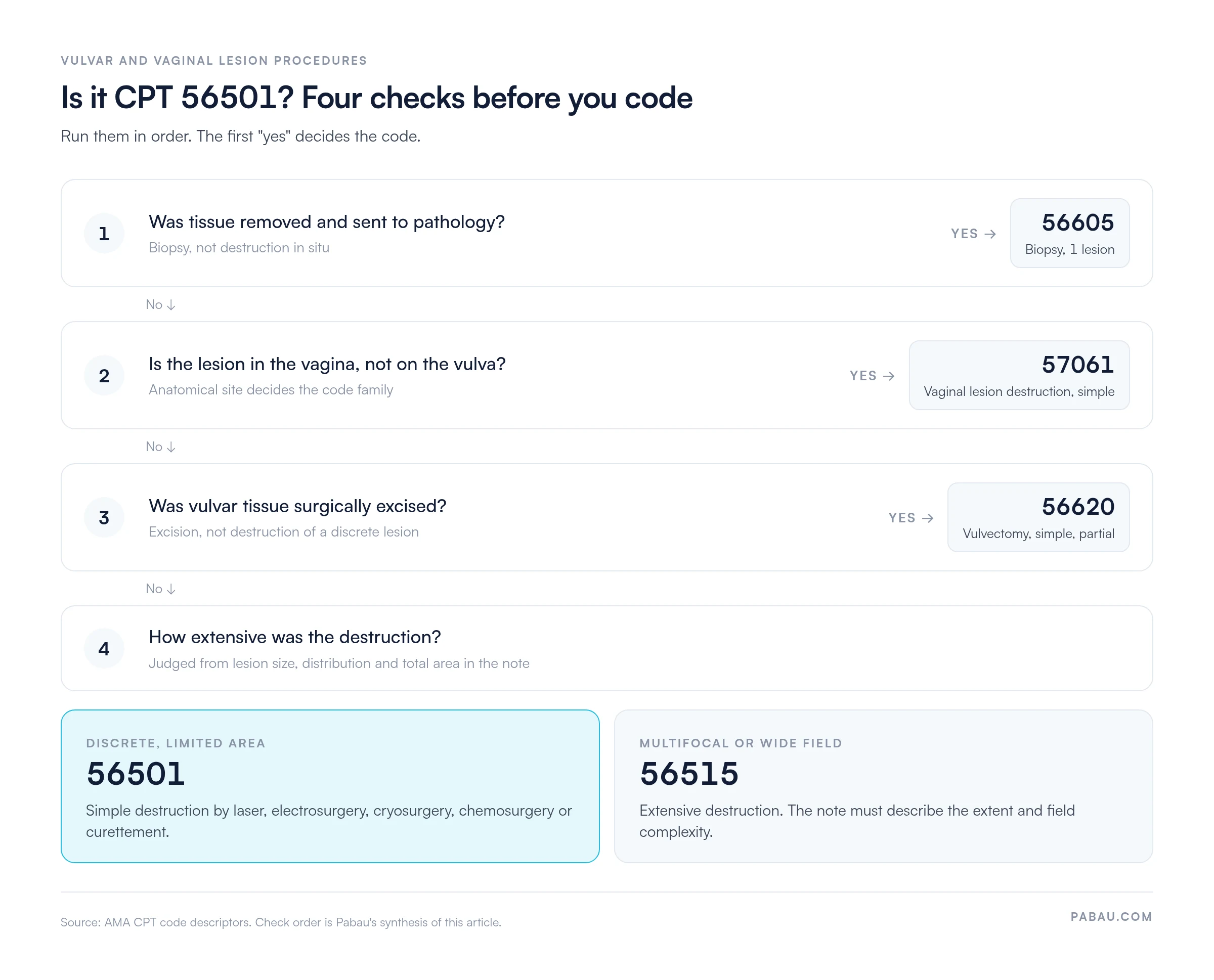
The AMA does not define “simple” by a specific lesion count or millimeter threshold. The clinical narrative in the operative note determines which code applies. Document the lesion size, distribution, and the total area treated so the medical record supports whichever code is selected.
Several codes in the 56xxx and 57xxx ranges are frequently confused with CPT code 56501. Knowing the key differentiator for each prevents wrong-site coding and unbundling violations.
The biopsy/destruction distinction trips up coders regularly. If the procedure removes tissue and sends it to pathology, it is a biopsy, coded as 56605. If the tissue is destroyed in situ with no specimen, it is 56501. Billing both on the same day for the same lesion creates an NCCI bundling violation.
The checks below run these distinctions in the order a coder meets them, ending with the simple/extensive call.
Every CPT 56501 claim requires an ICD-10-CM diagnosis code that establishes medical necessity. The diagnosis must link logically to the destruction procedure. Payer local coverage determinations (LCDs) vary, so verify coverage for less common diagnoses with the specific payer before submitting.
Medical necessity note: the diagnosis code alone is not sufficient. The clinical note must explain why destruction (rather than observation or topical therapy) was the chosen treatment at this visit.
Medicare reimburses CPT code 56501 under the CMS Physician Fee Schedule. The figures below are 2026 CMS PFS values, paid at the $33.4009 conversion factor for clinicians who aren’t qualifying APM participants. Before locality adjustment, that comes to about $185.04 in the office and $119.91 in a facility. Rates vary by locality and update each January, so check the CMS fee schedule file and your locality GPCI before submitting.
Use the FastRVU lookup tool to pull the current work, practice expense, and malpractice RVU values with your locality GPCI applied. CMS reviews RVUs every year, so recheck these 2026 values against the CMS file each January.
Always check the facility vs. non-facility distinction before submitting. If the procedure is performed in a hospital outpatient department (POS 22), the practice expense RVU drops significantly because the facility bills separately for overhead. Bill the non-facility rate only when the procedure is performed in your own office.
Insufficient documentation to support “simple” destruction is a frequent denial reason for 56501 claims. A clean claim submission for this code requires the following elements in the procedure note.
A procedure note that reads only “destroyed vulvar condyloma with cryotherapy” will not survive a records request. Add the lesion count, size range, freeze-thaw cycle details, and why this visit triggered intervention rather than continued surveillance. Those four additions are what separate a defensible note from one that gets clawed back on audit.
CPT code 56501 carries specific bundling and modifier rules that affect how the claim is built. Errors here trigger automatic NCCI edit denials before a human reviewer sees the claim. Pabau’s claims management software keeps the procedure note and diagnosis next to the claim, but your coder still makes the modifier calls below.
For the fundamentals behind these rules, see our medical billing guide.
Medicare generally does not require prior authorization for CPT code 56501. The procedure is a minor surgical service with well-established medical necessity criteria for the covered diagnoses. CMS does not list it in its prior authorization program for Medicare fee-for-service.
Commercial payers are less consistent. Authorization patterns by payer type:
Prior authorization policies change often. Verify the requirement for each payer and plan before the patient’s appointment. Submitting without a required authorization is among the fastest routes to a non-covered denial that is difficult to overturn on appeal.
Most CPT 56501 denials fall into five categories, and the category decides the corrective action. A denial management workflow tracks patterns, so recurring issues get fixed at the root instead of appealed one claim at a time.
The table pairs each category with the denial codes payers typically send and the fix for each.
Build a 56501 denial tracker in your practice management system. Log each denial by reason code, diagnosis, and payer. After 30 days, patterns become clear. If most denials are CO-97 from one payer, the fix is a modifier 25 protocol for that payer instead of case-by-case appeals.
In many gynecology practices, the procedure note lives in one system and the claim is keyed into another at the end of the day. Lesion size, count, and modality get retyped from memory, and that is where 56501 claims lose their support.
Pabau stores the procedure note and the diagnosis in the same patient record the claim is built from. In the US, Pabau’s Claim.MD clearinghouse integration submits the claim and tracks its status through to payment or denial.
The coder checking simple versus extensive reads the same note the clinician wrote. When a payer asks for records, the note is already in the patient record, not in a paper chart down the hall.

Pabau keeps the procedure note and diagnosis in the patient record, and Claim.MD submits and tracks the claim. Book a demo to see the workflow for gynecology practices.

CPT code 56501 turns on two judgment calls: simple versus extensive destruction, and the ICD-10 link. Both get settled in the procedure note, long before the claim reaches the clearinghouse.
So write the note for the coder as well as the clinician. Lesion count, size, total area, and modality recorded at the visit let the code choice stand up to a records request. Leave them out and even a correct 56501 claim is hard to defend.
Pabau keeps that note and the diagnosis in one patient record, and Claim.MD clearinghouse workflows submit and track the claim from there. Book a demo to see how gynecology practices bill vulvar procedures from the same record.

Need to understand denial codes that appear on 56501 remittances? Denial codes in medical billing explains each CARC and RARC code used by payers when rejecting minor surgical procedure claims.
Want a structured approach to reducing claim rejections across all procedure codes? Denial management in healthcare covers root-cause analysis frameworks and appeal workflows for billing teams.
Submitting claims electronically for the first time? Medical claims clearinghouse guide explains how 837P files, ERA responses, and eligibility verification work together in a US billing workflow.
Sent tissue to pathology instead? CPT code 56605 covers biopsy of the vulva or perineum and how it bundles with destruction.
Did the procedure excise vulvar tissue? CPT code 56620 explains how to bill a partial simple vulvectomy.
CPT code 56501 is a billable procedure code for simple destruction of vulvar lesion(s) using laser surgery, electrosurgery, cryosurgery, chemosurgery, or surgical curettement. It is most commonly billed for condyloma acuminatum (A63.0), vulvar intraepithelial neoplasia (VIN), and benign vulvar lesions in gynecology and women’s health practices.
CPT 56501 covers five modalities: laser surgery, electrosurgery, cryosurgery, chemosurgery, and surgical curettement. The code is modality-neutral; any one of these qualifies. The operative note must name the specific modality used.
The most common pairings are A63.0 (condyloma acuminatum), N90.0-N90.1 (VIN I and II), D07.1 (VIN III/carcinoma in situ), and N90.4 (leukoplakia of vulva). The specific diagnosis must be supported by the clinical record and must meet the payer’s medical necessity criteria for destructive treatment.
No prior authorization is required for traditional Medicare. Commercial and Medicare Advantage plans vary: most do not require auth for condyloma destruction, but some require it for VIN diagnoses or facility-based procedures. Verify with each specific payer and plan before scheduling the procedure.
Yes, but modifier 25 must be appended to the E&M code. The evaluation and management service must be a significant, separately identifiable service beyond the pre-procedure assessment. Without modifier 25, payers will bundle and deny the E&M as included in the surgical code.