HCPCS Code E0215: Electric heating pad (non-moist) billing guide
HCPCS Code E0215: Official description and device definition HCPCS Code E0215 is...

Last Updated: Nov 16, 2026
56440 is the CPT code for marsupialization of a Bartholin gland cyst. The surgeon opens the cyst, everts its wall, and sutures the edges to the surrounding vulvar skin to create a permanent drainage opening.
Coders who confuse this code with CPT 56420 (incision and drainage of a Bartholin gland abscess) risk denials. 56440 applies only when the operative note documents that eversion and suturing. Abscess drainage, repeat cyst aspiration, or catheter placement all fall outside its scope.
Let Pabau's smart automation suggest the right codes, reduce claim denials, and keep your practice compliant—effortlessly.
Automate repetitive tasks and focus on what matters most—your patients.
Reduce coding errors and ensure compliance with the latest regulations.
Clean claims, fewer denials, and faster reimbursements.
Powerful insights and reporting to help your practice thrive.
HIPAA compliant SOC 2 certified GDPR-compliant Trusted by 4,000+ clinics worldwide

CPT Code 56440 describes marsupialization of a Bartholin gland cyst, a different procedure from incision and drainage (CPT 56420).
ICD-10-CM N75.0 (cyst of Bartholin’s gland) is the primary supporting diagnosis, and N75.1 applies when an abscess component is documented.
The code carries a 10-day global surgery period, so related services in that window are bundled unless a modifier applies.
The operative note must confirm the cyst wall was everted and sutured to the skin, or payers can deny or downcode the claim.
Pabau’s claims management tools capture the code pairing at the encounter and submit claims electronically through Claim.MD.
CPT Code 56440 reports marsupialization of a Bartholin gland cyst, a procedure that creates a permanent drainage opening in the cyst wall.
The AMA’s CPT code set places it in the Female Genital System surgery section, within the Vulva, Perineum, and Introitus subsection, under Incision (codes 56405-56442). The official descriptor reads: Marsupialization of Bartholin gland cyst.
Marsupialization goes further than incision and drainage. The surgeon opens the cyst, everts its wall outward, and permanently sutures the edges to the surrounding vulvar skin. That creates a new duct orifice that allows continuous drainage and prevents recurrence.
That surgical endpoint is what separates 56440 from every other code in its neighborhood. If the operative note describes Word catheter insertion, simple aspiration, or incision without suturing, 56440 does not apply. The Bartholin glands are paired and sit at the posterior introitus, so the operative report must name the side treated.
Marsupialization is typically performed in an office procedure room or outpatient surgery center under local anesthesia. Some patients need regional or general anesthesia, depending on cyst size and tolerance. For the claim to pass payer review, the operative note must reflect each of these elements.
OB/GYN practice managers should build a documentation checklist that maps to these elements. If the note leaves out the eversion and suturing, a payer has grounds to deny on medical necessity or downcode the claim to 56420.
The 56440 vs 56420 confusion is a frequent source of miscoding on Bartholin gland claims. The clinical distinction is clear once you know what to look for. Payers do not always say which code they received, though, so a practice can face a denial with no explanation.
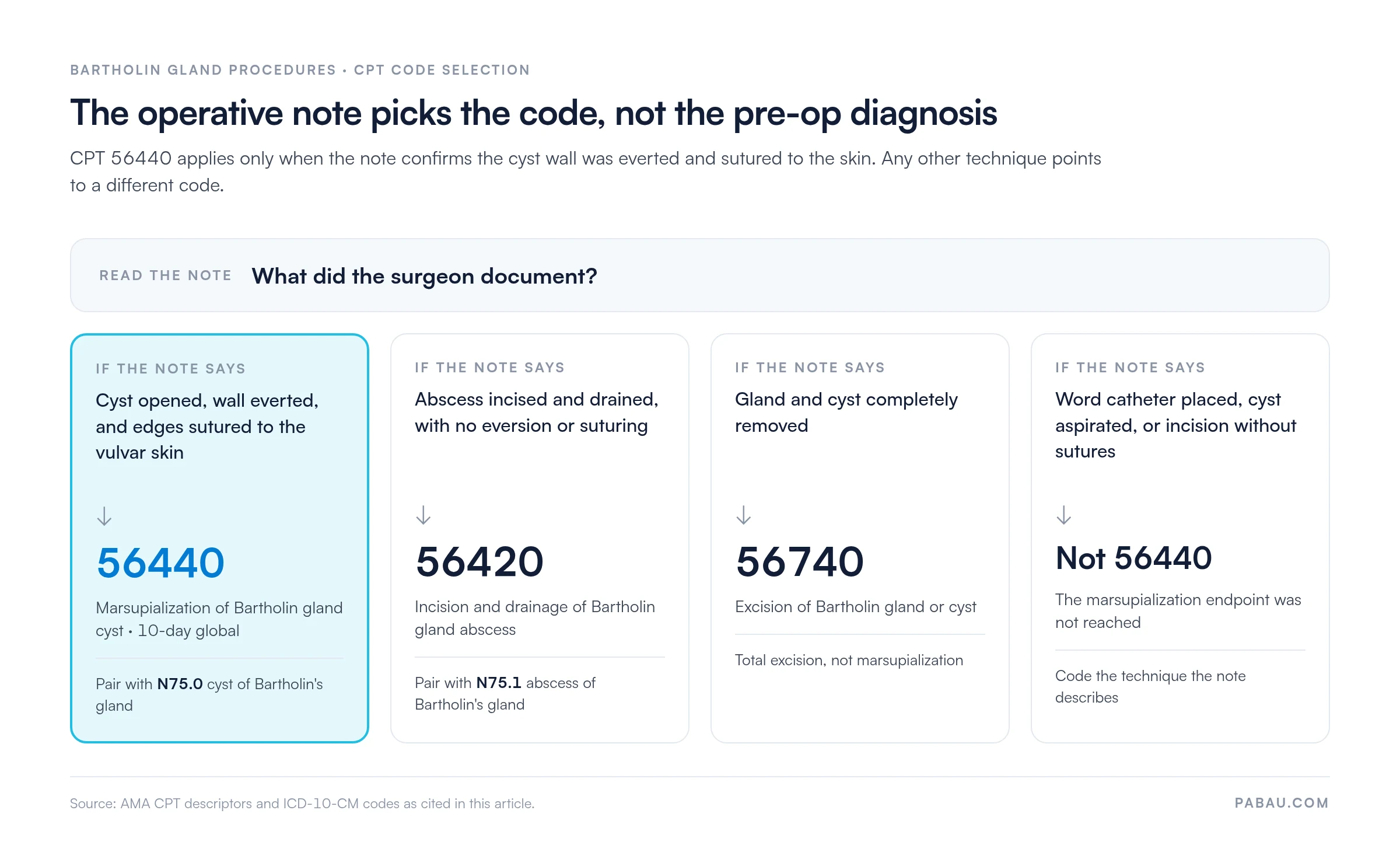
The operative report decides the code. If it confirms eversion of the cyst wall with sutures placed to the skin, bill 56440. If it describes incision and drainage with no suturing, bill 56420. If the gland and cyst were completely removed, bill 56740. Submitting 56440 when 56420 applies is upcoding, and billing 56420 for a completed marsupialization is undercoding that leaves revenue unpaid. The chart below sets the four outcomes side by side.
Every CPT 56440 claim needs a supporting ICD-10-CM diagnosis code that establishes medical necessity. Payers cross-reference the diagnosis against the procedure before paying. An unsupported or mismatched diagnosis is one of the fastest paths to an automatic denial.
N75.0 is the preferred and most defensible pairing for a standard marsupialization. N75.1 applies when the operative note documents acute infection within the cyst. Billing N75.9 alone raises a medical necessity flag with many payers, because the unspecified code does not clearly justify surgery. Code to the highest level of specificity the documentation supports.
Before submitting a CPT 56440 claim, check that the ICD-10 code on file matches the pathology in the operative note, not only the pre-operative diagnosis. Surgeons sometimes find an abscess where imaging showed a cyst, or the reverse. A mismatched ICD-10 code is an avoidable denial.
Medicare reimbursement for CPT Code 56440 varies by place of service. The CMS Physician Fee Schedule assigns separate non-facility (office) and facility (hospital outpatient or ASC) rates, because the practice expense component differs. National rates adjust every year, and geographic adjustment factors (GPCIs) change the final payment by locality. Check the exact 2026 figures in the FastRVU 2026 RVU lookup tool before billing.
OB/GYN practices that perform marsupialization in the office receive the higher non-facility rate, because the practice bears the cost of supplies, equipment, and staff. In an ASC or hospital outpatient setting, the physician receives the lower facility rate for the professional service. Submit the correct place-of-service code, or the payment split will be wrong however accurately the procedure is coded.
CPT Code 56440 carries a 10-day global surgery period under the Medicare Physician Fee Schedule. Related evaluation and management visits, wound checks, and minor surgical services in those 10 days are bundled into the original payment. They cannot be billed separately.
CPT 56440 has a Medicare bilateral surgery indicator of 0, so modifier 50 does not apply and will not increase payment. Its MUE is 1 unit per day. For cysts on both sides in one session, report 56440 once. If treating the second side took substantially more work, consider modifier 22, documented in the operative note. Some commercial payers accept RT and LT on separate lines, but Medicare pays no more than one side’s fee schedule amount. Check the payer’s policy first.
Medicare does not require prior authorization for CPT Code 56440 as a standard rule, but some commercial payers do. Requirements vary by plan, so verify authorization status before scheduling. Medical billing compliance for gynecologic surgery means confirming prior authorization before the procedure rather than after a denial arrives.
Medicare Administrative Contractors (MACs) publish Local Coverage Determinations (LCDs) that define coverage criteria for gynecologic procedures in their jurisdiction. Check the MAC for your practice’s area before submitting. Criteria differ between regions, and the regional LCD governs what that contractor pays.
Most denials on CPT Code 56440 claims fall into a small number of repeating patterns. Identifying the root cause of each one is the first step in a denial management workflow that stops them from recurring.
Reviewing the claim adjustment reason codes (CARCs) on denied 56440 remittances shows which of these patterns is active at your practice. Submitting a clean claim the first time means every element is verified before submission.
Run a quarterly audit of the CPT 56440 claims filed in the prior three months. Compare the operative note language against the code billed, check the ICD-10 pairing, and confirm the global period was tracked. When one denial pattern keeps recurring, fix the documentation step that produces it.
The denials above start before the claim is built. An operative note misses the suturing detail, a pre-op diagnosis is carried onto the claim, or nobody requests the authorization. Pabau, the practice management platform we build, keeps the note, the codes, and the authorization in one patient record.
Pabau integrates with Claim.MD to send electronic claims to thousands of US payers. Eligibility is checked before the patient arrives, and ERA remittances are matched after the claim settles. With OB/GYN claims management in Pabau, the place-of-service code is captured at scheduling instead of corrected after a denial.
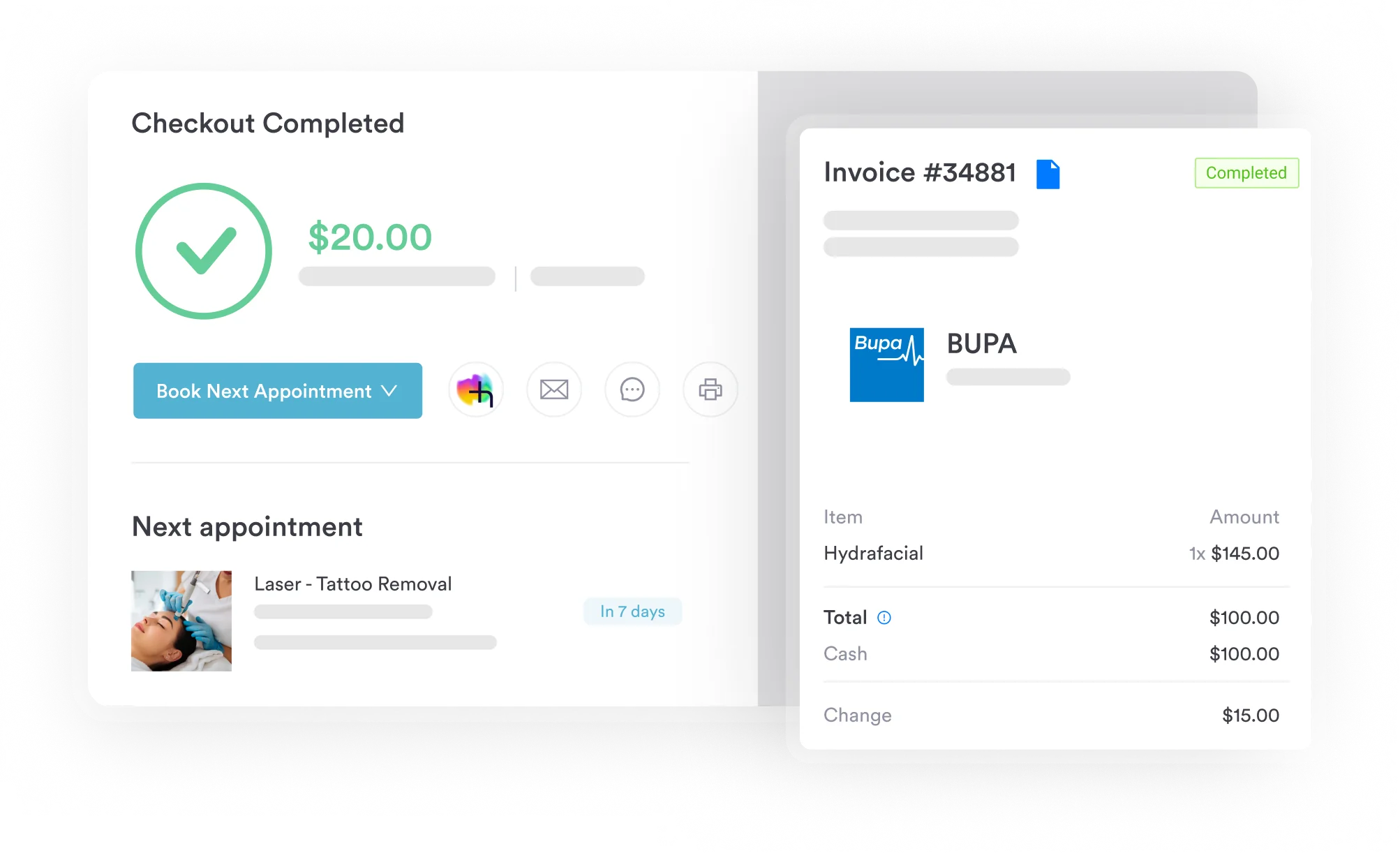
Each encounter’s superbill carries the CPT and ICD-10 pairing into the claim, so 56440 and N75.0 travel together from the procedure room to the payer.

Pabau connects scheduling, clinical notes, and claim submission in one workflow. Capture the CPT-ICD-10 pairing at the encounter, verify eligibility in real time, and submit clean claims electronically without switching systems.

CPT 56440 is a documentation code before it is a billing code. A note that names the side treated and states the wall was everted and sutured holds up against a 56420 downcode.
The practical step is to fix the note template first and the coding second. Add the eversion and suturing line, the N75.0 or N75.1 finding, and the global period end date to every Bartholin procedure note. Denials then become rare exceptions you can trace to one missing line.
The trade-off is a slightly longer operative note in exchange for fewer appeals. Book a demo to see how Pabau carries a documented 56440 procedure from the operative note to a paid claim.

Need a broader overview of how claims move from submission to payment? Revenue cycle management fundamentals covers the end-to-end process from eligibility through ERA posting.
Confused about which denial codes payers use and what they mean? Denial codes in medical billing explains the most common CARC and RARC codes that appear on remittance advice.
Want to understand how the 837 electronic claim format works? 837 file structure and submission breaks down the EDI format payers require for electronic claim submission.
CPT Code 56440 is the correct code for marsupialization of a Bartholin gland cyst. It applies when the surgeon opens the cyst, everts its wall, and sutures the edges to the vulvar skin. Use CPT 56420 instead for incision and drainage of a Bartholin gland abscess without suturing of the cyst wall.
CPT 56420 is incision and drainage of a Bartholin gland abscess, a temporary drainage procedure with no suturing. CPT 56440 is marsupialization, where the cyst wall is everted and permanently sutured to the skin to prevent recurrence. The operative note must explicitly confirm suturing of the cyst lining for 56440 to apply; without that documentation, payers will downcode or deny to 56420.
No. CPT 56440 does not apply to Gartner’s duct cyst procedures. Gartner’s duct cysts sit in the lateral vaginal wall, a different anatomical site from the Bartholin glands at the posterior introitus. Using 56440 for a Gartner’s duct procedure is a miscoding error that payers are likely to flag on audit. No AMA CPT code maps directly to Gartner’s duct marsupialization. Consult your MAC or a certified coder for the most defensible code in that scenario.
The primary ICD-10-CM code is N75.0 (Cyst of Bartholin’s gland) for a standard marsupialization. Use N75.1 (Abscess of Bartholin’s gland) when the operative findings document an infected or abscess component. N75.8 covers other specified Bartholin gland diseases. Avoid N75.9 (unspecified) as a primary code if the documentation supports a more specific diagnosis, since unspecified codes invite medical necessity reviews.
CPT Code 56440 carries a 10-day global surgery period under the Medicare Physician Fee Schedule. Routine post-operative care, wound checks, suture removal, and related office visits in those 10 days are bundled into the procedure payment. Services unrelated to the marsupialization may still be billed during the global period. Use modifier 24 for an E&M visit or modifier 79 for a procedure, with documentation confirming the separate indication.
Yes, in limited circumstances. A separately identifiable evaluation and management service on the same date may be billed with modifier 25 appended. The E&M must be documented as distinct from the pre-operative assessment and address a separate clinical problem. Many payers scrutinize same-day E&M and procedure claims closely, so the chart note must reflect the separate decision-making.
The most common trigger is billing 56440 when the operative note describes 56420-level incision and drainage. Other frequent causes are an ICD-10 and CPT mismatch, a missing operative report, or global-period services billed without a modifier. A place-of-service mismatch with the facility’s billing also triggers denials. A quarterly audit of 56440 claims and their remittance CARC codes shows which pattern recurs at your practice.