CPT code 41115: Lingual frenectomy billing and denial guide
CPT code 41115 covers removal of the lingual frenum CPT code 41115 is the Americ...

Last Updated: Oct 20, 2026
54162 is the CPT code for lysis or excision of penile post-circumcision adhesions. It covers releasing fibrous bands that form between the glans and the inner foreskin after a previous circumcision.
The code applies when the adhesions are released with surgical instruments or under general anesthesia. Manual separation without instruments or anesthesia doesn't qualify. Common denial triggers include missing medical necessity documentation, undocumented instrumentation, and missing prior authorization.
Let Pabau's smart automation suggest the right codes, reduce claim denials, and keep your practice compliant—effortlessly.
Automate repetitive tasks and focus on what matters most—your patients.
Reduce coding errors and ensure compliance with the latest regulations.
Clean claims, fewer denials, and faster reimbursements.
Powerful insights and reporting to help your practice thrive.
HIPAA compliant SOC 2 certified GDPR-compliant Trusted by 4,000+ clinics worldwide

CPT code 54162 covers lysis or excision of penile post-circumcision adhesions when the release needs instruments or general anesthesia.
CPT 54161 is a primary circumcision for patients older than 28 days, while 54162 treats adhesions after a previous circumcision.
N47.5 (adhesions of prepuce and glans penis) is the closest-fit diagnosis, and a mismatched diagnosis can trigger a medical necessity denial.
The 10-day global period bundles related follow-up care, so a visit for an unrelated problem in that window needs modifier 24.
Pabau, the practice management platform we build, sends claims to US payers through Claim.MD and returns claim status and remittance advice.
CPT code 54162 is defined by the American Medical Association’s CPT code set as Lysis or excision of penile post-circumcision adhesions. The code applies when the adhesions are released with surgical instruments or under general anesthesia.
In contrast, when a urologist separates adhesions by hand at the bedside without instruments or anesthesia, the work doesn’t meet this code’s level.
In practice, the procedure addresses fibrous attachments that form between the glans and the inner prepuce after circumcision. These adhesions can trap epithelial debris, cause discomfort, restrict movement, and sometimes lead to phimosis. As a result, severity and patient tolerance decide whether office care without instruments is enough, or whether the release needs 54162.
The procedure varies by patient age and adhesion extent. For example, in younger children, general anesthesia is standard. Still, in cooperative older patients, local or topical anesthesia may suffice when instruments are still needed.
For this reason, documentation must reflect the instruments used and the anesthesia type. For instance, a note stating only “adhesions released” gives an auditor nothing to anchor the code to 54162 rather than a non-coded office visit.
Likewise, the line between instrumented lysis and manual separation decides whether a 54162 claim survives an audit. The operative note must name at least one instrument. Also, when general anesthesia was given, the anesthesia record must be in the chart.
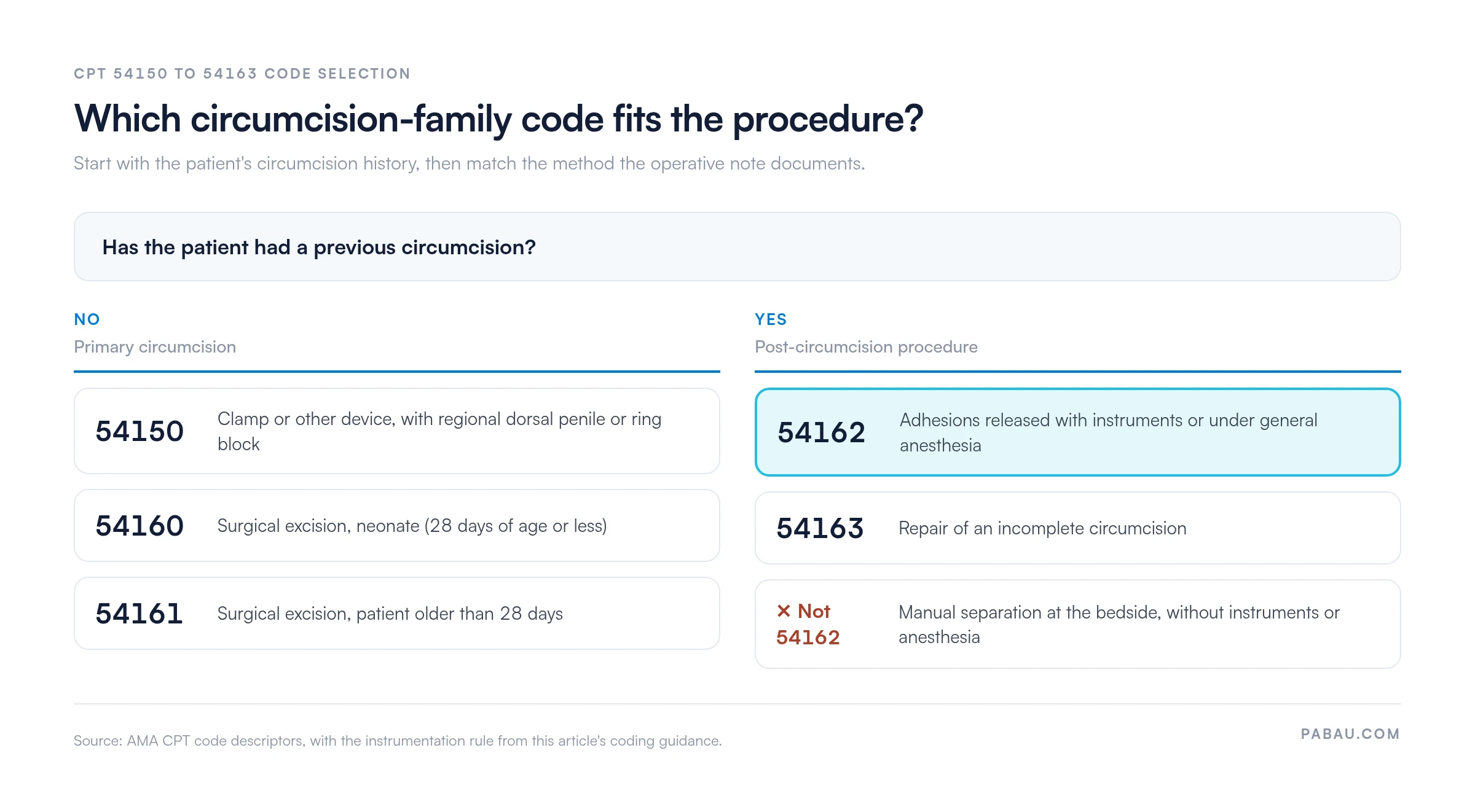
CPT 54161 covers circumcision by surgical excision other than a clamp, device, or dorsal slit, for patients older than 28 days. In contrast, CPT 54162 is a secondary procedure that releases adhesions after a previous circumcision. For example, a mix-up between the two can occur when the operative note doesn’t state the patient’s circumcision history.
Still, payer policies on circumcision and adhesion procedures can vary. So, before you submit an edge case, check the payer’s medical policy, or the Medicare local coverage determination (LCD) where one applies.
CPT code 54162 sits within the excision procedures on the penis (54100-54164), alongside the circumcision codes. Knowing the full family, from 54150 to 54163, helps coders avoid upcoding or undercoding.
In short, two facts settle the choice: whether the patient was circumcised before, and how the operative note says the work was done.
Medical necessity for CPT code 54162 must be established through the diagnosis code. Also, payers expect the ICD-10-CM code to document the clinical condition driving the procedure. Indeed, a mismatch between the diagnosis and the procedure is one of the faster paths to denial.
N47.5 (adhesions of prepuce and glans penis) is the closest-fit primary diagnosis for CPT code 54162. Meanwhile, N47.1 applies when the adhesions have caused phimosis. Also, when paraphimosis (N47.2) is present, document its acute nature, because some payers treat it as an emergency and waive prior authorization.
Medicare reimbursement for CPT code 54162 is determined by the CMS Physician Fee Schedule. Also, payment rates change annually and vary by location through the Geographic Practice Cost Index (GPCI). So, always verify current-year rates directly in the CMS fee schedule lookup rather than relying on static published figures.
Verify CPT 54162 payment rates in the CMS Physician Fee Schedule each January. The conversion factor changes annually, so prior-year RVU-to-dollar math will produce wrong estimates. The error is largest in high-cost localities, where the GPCI adjustment is significant.
CPT code 54162 carries a 10-day global surgical period. Routine follow-up care related to the procedure during those 10 days is included in the code payment. As a result, billing a separate E/M visit for adhesion-related care within the global period without a supporting modifier is a denial trigger.
NCCI (National Correct Coding Initiative) edits may bundle 54162 with certain same-session codes. So, before submitting multiple codes from the 54000-55899 range on the same date, run an NCCI edit check. Otherwise, claiming two codes that NCCI bundles, without a valid modifier to override the edit, produces an automatic denial.
Thin documentation can sink a CPT code 54162 claim even when the procedure was justified. Above all, the operative note must support both the procedure and the code descriptor. Good medical billing compliance starts with what the surgeon dictates right after the case, rather than what the biller assumes from a charge entry.
A superbill that prompts surgeons to confirm these elements at charge entry cuts down on later appeals. When captured at the point of care, the indication, instruments, and anesthesia record are on the claim before it reaches the clearinghouse.
Prior authorization requirements for CPT code 54162 are not uniform. Original Medicare does not usually require prior auth for this code, but Medicare Advantage plans, large commercial payers, and managed Medicaid plans often do. Still, skipping authorization when a plan requires it produces a non-payable claim regardless of how complete the documentation is.
So, check authorization requirements before you schedule the procedure, because approval after the fact is hard to get.
CPT code 54162 denials follow clear patterns, and each denial reason maps to a specific fix. Tracking them across your urology claims shows where the fix belongs. In Pabau’s claims management software, claim status and remittance advice sit in one dashboard, so repeat denial reasons surface early.
Also, good denial management tracks these patterns across your full claim volume, beyond single denials. As a result, knowing which reason recurs for CPT code 54162 in your practice tells you where the fix belongs. For example, it may be a documentation protocol, a workflow change, or a coder education session.
Clean claim standards mean running each claim through edit checks before it reaches the payer. A missing modifier or mismatched diagnosis caught at that stage takes minutes to fix. But when caught after a denial, it costs staff time and puts the timely filing limit at risk.
Our guide to denial codes explains the Claim Adjustment Reason Code (CARC) values that accompany 54162 denials. Each CARC maps to a specific denial type, so the code tells the biller what documentation or correction the appeal needs.
Build a 54162-specific audit checklist for billing staff to run before submitting. It confirms instruments, anesthesia type, post-circumcision history, and prior auth. It also clears the global period and checks the ICD-10 code against the current N47.x family. A short pre-submission review costs far less time than an appeal.
Without a built-in clearinghouse, a billing team keys each 54162 claim into a separate portal. Then it checks payer sites one by one for status and payment.
Pabau connects to the Claim.MD clearinghouse, which builds CMS-1500 claims from your Pabau invoices and submits them to US payers. Also, it runs real-time 271 eligibility checks before the visit, then returns claim status and remittance advice.
Code selection stays with your coder, but each claim’s progress is visible from submission to payment. A rejected claim shows up while the operative note is still fresh, so the fix and resubmission happen in days rather than weeks.

Pabau sends your 54162 claims to US payers through Claim.MD and runs real-time eligibility checks before the procedure. Claim status and remittance advice come back to one dashboard.

A CPT code 54162 claim holds up when the operative note proves three points. The patient was circumcised before, the adhesions were released with instruments or under general anesthesia, and a diagnosis such as N47.5 matches the procedure.
If any of the three is missing, fix the note before the claim goes out. In fact, an addendum written now is far cheaper than an appeal written after the denial. And a manual release at the bedside stays an office service, however long it took.
Pabau’s Claim.MD integration builds CMS-1500 claims from your invoices, checks eligibility in real time, and returns claim status and remittance advice. Book a demo to see how it shortens the billing cycle for your urology procedures.

Want a clearinghouse built into your practice software? How Claim.MD clearinghouse works with Pabau explains how claims, eligibility checks, and remittances flow through the integration.
Trying to reduce overall claim denial volume across your practice? Revenue cycle management for medical practices covers the end-to-end process from eligibility through payment posting.
Reconciling ERA and 835 remittances? Electronic remittance advice explained breaks down how to read and reconcile ERA files against CPT-level payment data.
CPT code 54162 covers lysis or excision of penile post-circumcision adhesions when the procedure requires instrumentation or general anesthesia. It does not apply when adhesions are manually separated at the bedside without instruments or anesthesia.
CPT 54161 is a primary circumcision code for patients older than 28 days using surgical excision. CPT 54162 is specifically for lysis of adhesions that form after a prior circumcision, and requires instrumentation or general anesthesia. The key distinction is whether the procedure is an original circumcision (54161) or a secondary adhesion release post-circumcision (54162).
CPT 54162 carries a 10-day global surgical period. Follow-up care related to the procedure during those 10 days is included in the procedure payment. A visit for an unrelated problem needs modifier -24, and a staged procedure needs modifier -58.
Denials can occur when the wrong code is selected (54161 instead of 54162), prior authorization is missing, or medical necessity isn’t documented. They can also occur when the operative note doesn’t name the instruments used. A related follow-up visit billed in the 10-day global period can be denied too. Each denial reason has a specific appeal pathway tied to the missing documentation element.