HCPCS Code G0163: Skilled nursing observation and assessment
What is HCPCS Code G0163? HCPCS Code G0163 is a deleted Level II code for skille...

Last Updated: Oct 15, 2026
CPT code 54150 covers circumcision using a clamp or other device with a regional dorsal penile or ring block. The code is defined by technique, not by the patient's age. Its official descriptor sets no age limit, so it fits newborns, older infants, children, and adults alike.
Coders often read the 54150, 54160, and 54161 family as age-driven, and a technique mismatch denial follows. Age separates only CPT 54160 from CPT 54161, the two surgical-excision codes. Same-day billing with CPT 99460 raises a second question, and the sections below settle both.
Let Pabau's smart automation suggest the right codes, reduce claim denials, and keep your practice compliant—effortlessly.
Automate repetitive tasks and focus on what matters most—your patients.
Reduce coding errors and ensure compliance with the latest regulations.
Clean claims, fewer denials, and faster reimbursements.
Powerful insights and reporting to help your practice thrive.
HIPAA compliant SOC 2 certified GDPR-compliant Trusted by 4,000+ clinics worldwide

CPT 54150 describes circumcision by clamp or device with a regional dorsal penile or ring block. Its official descriptor carries no age limit.
Age separates only CPT 54160 (neonate, 28 days of age or less) from CPT 54161 (older than 28 days). Both are surgical-excision codes, not clamp codes.
Z41.2 (Encounter for routine and ritual male circumcision) is the standard ICD-10 pairing. Medically indicated cases use a condition code such as N47.1 for phimosis.
At CY2026 RVUs and a conversion factor of $33.4009, CPT 54150 pays roughly $151.97 non-facility and $84.17 facility. The code carries a 000 global period.
Pabau, practice management software, submits and tracks 54150 claims through Claim.MD. Eligibility checks run before the visit, and denial reasons come back with the remittance.
The American Medical Association defines CPT code 54150 as Circumcision, using clamp or other device with regional dorsal penile or ring block. The descriptor has two required elements. A clamp or equivalent device must be the technique used. A regional dorsal penile nerve block or ring block must be given at the time of the procedure.
The descriptor names no age at all. Before CPT 2007, a separate code 54152 covered the clamp technique in patients other than newborns. The AMA deleted 54152 that year and stripped the newborn wording out of 54150. Since then, a clamp circumcision is reported as 54150 for an infant, a child, or an adult.
Devices that satisfy the clamp or other device wording include the Gomco clamp, the Plastibell, and the Mogen clamp. Each crushes or ligates the prepuce instead of cutting it free by hand. Where the surgeon excises the prepuce surgically, the code moves to 54160 or 54161.
The regional block is code-defining too. A CPT parenthetical covers the case where no block is given. Report 54150 with modifier 52 for reduced services instead of reaching for a different circumcision code. Most newborn circumcisions in a hospital nursery use a local dorsal penile block, which satisfies the descriptor as written.
Technique picks the code first. A clamp or device sends the claim to 54150 at any age. Surgical excision sends it to 54160 or 54161, and only at that point does the patient’s age in days decide anything. The diagram below runs that decision from the operative note down to the code.
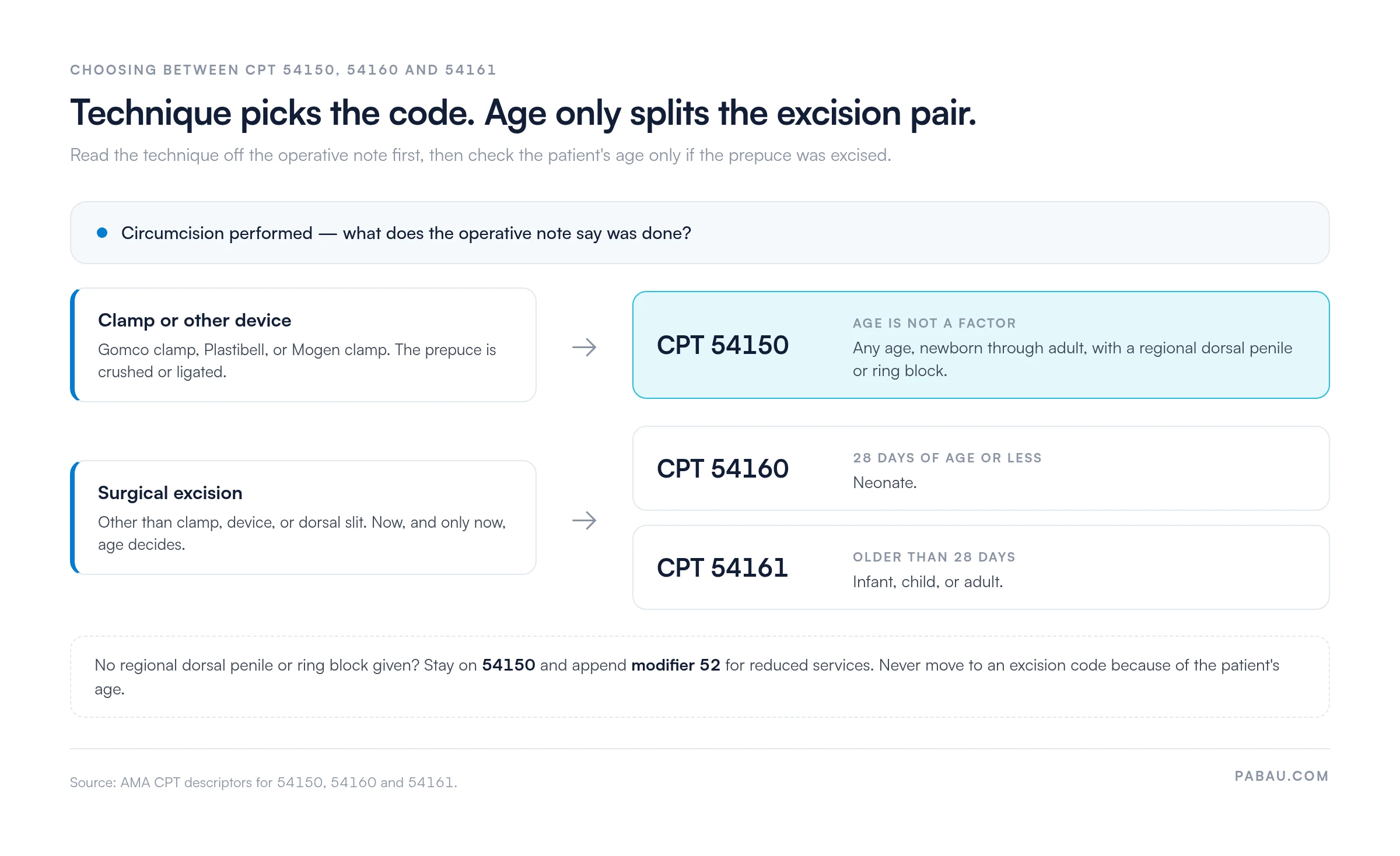
The 28-day threshold belongs to the 54160 and 54161 pair alone. A Gomco circumcision on a three-month-old is still 54150. Coding it 54161 would report a surgical excision that never took place, so the error misstates the technique rather than the age.
Payers can still apply their own age-based medical necessity rules to 54150. That is plan policy, and it does not change which CPT code describes the work performed. Record the device and the block in the note, so the claim matches the procedure the surgeon carried out.
Every CPT 54150 claim needs a supporting ICD-10-CM diagnosis code. Selection depends on whether the circumcision is elective or clinically indicated. Each code below has its own entry in the ICD-10-CM code reference, with the chapter and category it sits in.
Z41.2 fits most elective circumcisions. Medicare does not cover elective circumcision, so Z41.2 claims sent to Medicare are denied as not medically necessary. Where a clinical indication exists, use the condition code and record the findings in the chart. Medicaid coverage for routine circumcision varies by state, so check the state manual before billing.
Payment for CPT 54150 comes from relative value units multiplied by the Medicare conversion factor. The CMS Physician Fee Schedule lookup tool holds the authoritative rates by locality. The figures below are CY2026 national averages, before any geographic practice cost index adjustment.
Multiply total RVUs by the CY2026 conversion factor of $33.4009 to reproduce those dollar figures. Non-facility rates apply when the circumcision is performed in an office or practice setting. Facility rates apply to hospital-based circumcisions, which is the usual setting for newborns.
Run a fee schedule check for CPT 54150 in your own Medicare Administrative Contractor jurisdiction before you set contracted rates. The facility rate sits around 45% below the non-facility rate at CY2026 values, and that split decides what a hospital-based pediatric service collects.
Coverage for CPT 54150 turns on medical necessity rather than on the code itself. Because 54150 is usually billed with Z41.2 for a routine or ritual circumcision, Medicare routinely denies it as a non-covered benefit. Telling the family which part of the bill their plan will not pay is far easier before the procedure than after it.
Every CPT 54150 claim rests on an operative note carrying a specific set of elements. A missing element is a common trigger for record audits and post-payment recoupment. Capturing all six at the point of care is what keeps the claim clean.
Elapsed time is not among those six elements, because 54150 is billed as one unit per procedure. Time-based codes need the minutes instead, so HCPCS code G0108 is billed in 30-minute units supported by documented start and stop times. A partial increment never rounds up, and 75 minutes of training still bills as two units.
Modifier use on CPT 54150 is limited to a few scenarios, one of which is built into the code itself.
CPT 54150 carries a 000 global period. No post-operative days are packaged into the payment, so a related visit on a later date is billed on its own. A same-day evaluation and management service still needs modifier 25 where it was separately identifiable.
CPT 54150 denials cluster around a small set of predictable errors. Most of them can be caught at the front desk or in the coding review, before the claim is ever submitted.
CPT 99460 covers initial hospital or birthing center care, per day, for the evaluation and management of a normal newborn. It is often performed on the same date as CPT 54150, which is where the bundling question starts.
Under National Correct Coding Initiative edits, 54150 and 99460 may be billed on the same date when both are performed and separately documented. The circumcision is a distinct surgical service from the newborn evaluation. The record has to show that each service was separately rendered and clinically appropriate.
Check your MAC’s NCCI edit tables each quarter. Edits for the circumcision codes are updated periodically, so a bundling rule that did not exist last year may apply now. A pre-submission check on every circumcision claim with a same-day E/M takes seconds and prevents a predictable denial.
An accurate CPT 54150 claim starts in the operative note, and it stays accurate only if it reaches the payer intact. Pabau, practice management software for healthcare practices, handles that second half with claims management built in.
Claims are submitted electronically through Claim.MD, Pabau’s US clearinghouse partner, which reaches thousands of US payers. Eligibility checks run before the visit, so the front desk knows what the plan covers before a circumcision is scheduled.
Once a claim is out, electronic remittance advice comes back into the same dashboard. Denials arrive with their reason codes attached and are queued for rework, so a technique mismatch does not sit unnoticed for weeks.
Coding decisions stay with your coders. Pabau submits and tracks the claim rather than choosing the CPT code or checking the diagnosis pairing for you.

Pabau submits claims through the Claim.MD clearinghouse, checks eligibility before the visit, and returns remittance advice and denial reasons to one dashboard. Rework starts the day a denial lands, not the month after.

CPT code 54150 is chosen by technique. A clamp or device with a regional dorsal penile or ring block is 54150, whatever the patient’s age. Surgical excision is 54160 for a neonate and 54161 after 28 days. Denials on this code usually trace back to a note that never named the device or the block.
Write the operative note so the technique is unmistakable, and pair it with a diagnosis the payer accepts. Check the plan’s age policy before the visit. Pabau’s claims management software then submits, tracks, and reconciles the claim through Claim.MD. To see that workflow running on your own billing, book a demo.

Billing the surgical-excision technique instead of a clamp? CPT code 54161 covers circumcision by surgical excision in a patient older than 28 days, with its own RVUs and denial patterns.
Want the full CARC/RARC picture behind a denied claim? Denial codes in medical billing maps the top 20 codes payers return and how to correct each one.
Need to document why a circumcision was medically indicated? Medical necessity letter template gives the format payers expect when Z41.2 alone will not support coverage.
CPT code 54150 covers circumcision performed with a clamp or other device, together with a regional dorsal penile or ring block. Qualifying devices include the Gomco clamp, the Plastibell, and the Mogen clamp. The official descriptor sets no age limit, so the code applies to newborns, older infants, children, and adults. Age separates only CPT 54160 from CPT 54161.
Yes, in most cases, provided both services are separately documented on the same date. CPT 99460 covers the initial evaluation of the newborn and CPT 54150 covers the circumcision, which is a distinct surgical service. Many payers require modifier 25 on the 99460 to confirm the E/M was separately identifiable. Check the current NCCI edit table and the payer’s own policy first.
CPT 54150 carries a 000 global period. No post-operative days are packaged into the payment, so a related visit on a later date can be billed on its own. A same-day evaluation and management service still needs modifier 25 where it was separately identifiable.
Five reasons account for most denials. The first is a technique mismatch, where a clamp procedure is billed as 54161 or a surgical excision is billed as 54150. The second is an elective service billed to Medicare with Z41.2 and no Advance Beneficiary Notice. The third is an operative note that names neither the device nor the block. The fourth is an ICD-10 code that fails the payer’s medical necessity policy. The fifth is bundling with CPT 99460 when the E/M is not separately documented.