



HCPCS code E0198: Water pressure pad billing guide
HCPCS code E0198 is a water pad for a standard mattress HCPCS code E0198 is the ...

Last Updated: Oct 13, 2026

CPT code 14040 covers adjacent tissue transfer for defects of 10 sq cm or less. The covered sites are the forehead, cheeks, chin, mouth, neck, axillae, genitalia, hands, and feet.
The area you code is the primary defect plus the secondary defect the flap creates, so measure both before you pick between 14040 and 14041.
A missing defect size in square centimeters is the leading cause of 14040 denials, and the operative note is where that number belongs.
The code carries a 90-day global period, and modifiers -59 and -22 are the two most often needed on a 14040 claim.
Practice management software like Pabau links CPT codes to ICD-10 diagnoses at charge capture, so plastic surgery and dermatology practices submit cleaner claims.
CPT Code 14040 is a surgical procedure code for adjacent tissue transfer or rearrangement. The surgeon moves nearby skin and subcutaneous tissue to close a defect, rather than importing tissue from a distant site. It applies to defects of 10 square centimeters or less on the forehead, cheeks, chin, mouth, neck, axillae, genitalia, hands, and feet.
The code sits in the Integumentary System section of the American Medical Association’s CPT code set, under the subsection “Adjacent Tissue Transfer or Rearrangement.” It is a billable, non-bundled surgical code with a 90-day global period.
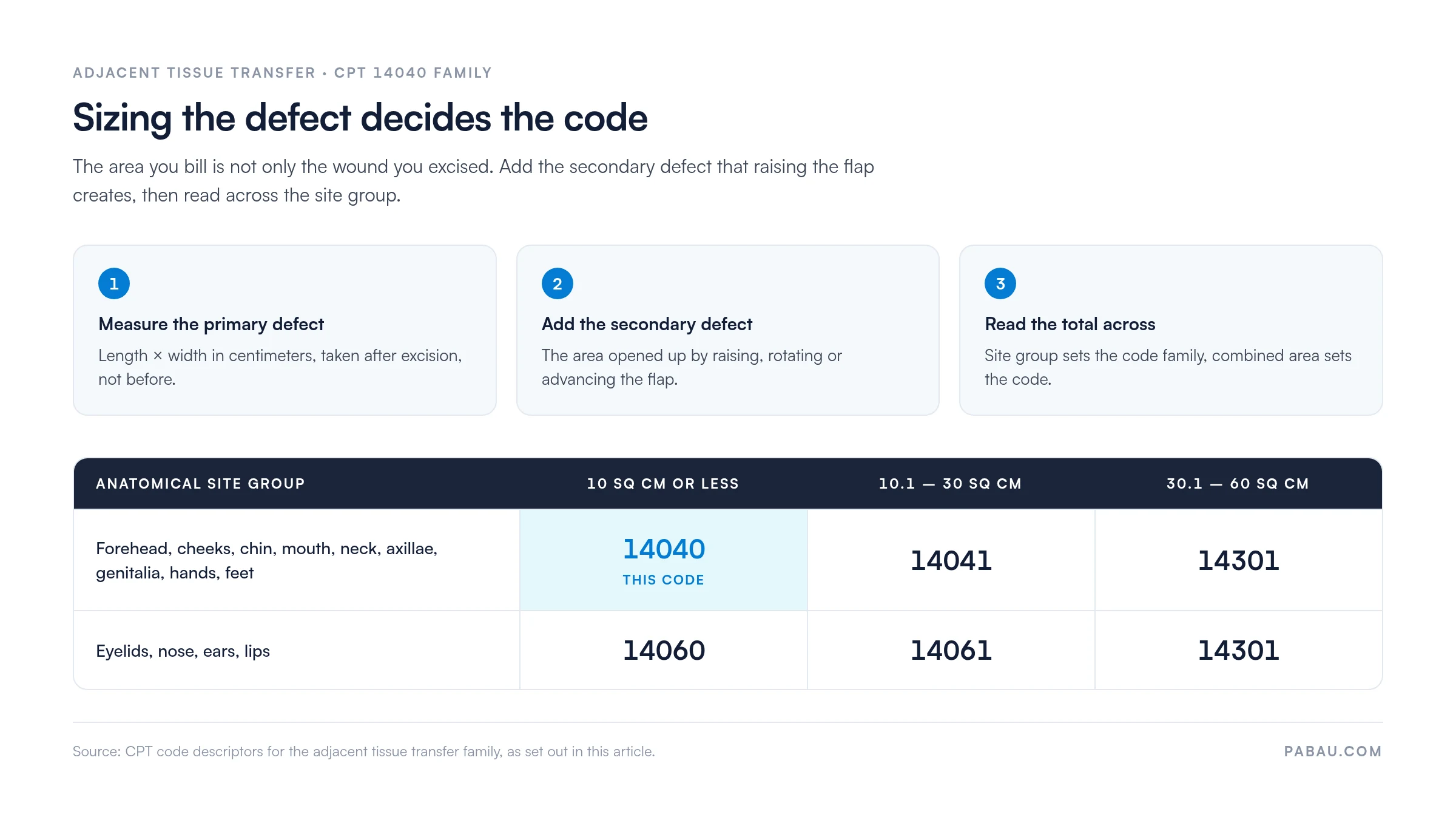
One sizing rule decides which code you bill, and it catches out most coders new to this family. The area is the wound left after excision plus the secondary defect that raising the flap creates. Add the two together before you choose between 14040 and 14041.
Surgeons bill CPT 14040 when they close a skin defect at one of the covered sites with local tissue, after excision, trauma, or burn injury. The donor tissue has to be adjacent to the defect. It is raised, rotated or advanced, and inset into the wound while it keeps its blood supply.
Common clinical scenarios that support a 14040 charge include:
CPT 14040 does not apply to the eyelids, nose, ears, or lips. Those sites fall under 14060 and 14061. Defects larger than 10 sq cm at the covered sites move to 14041, which runs from 10.1 to 30 sq cm.
The adjacent tissue transfer family is organized by two variables, anatomical site and defect size. Getting either one wrong triggers an automatic denial or a downcoded payment. Use this table to confirm code selection before you submit.
Key distinction from skin grafts: in adjacent tissue transfer, the flap keeps a pedicle connection to its blood supply while it is moved. In a skin graft, the tissue is completely detached. A surgeon who raises and rotates a rhomboid flap is billing adjacent tissue transfer, whatever the operative note calls it colloquially.
Each sibling code has its own descriptor, its own size band, and its own payment. Check the one you land on against the rest of the CPT code library before the claim goes out.
Payers audit this code at higher rates because defect size governs code selection. An operative note that says “a flap was raised and the wound was closed” will almost certainly be denied or downcoded. The note has to carry specific measurable data.
Start with the measurement, because it decides the rest. Record the primary defect after excision, then record the secondary defect the flap opens up, then add them. A 3.2 cm x 2.8 cm excision is 8.96 sq cm on its own. A modest transposition flap can push the total past the 10 sq cm line, and into 14041.
Required documentation elements:
Each claim for CPT 14040 carries an ICD-10 diagnosis code that establishes why the reconstruction was medically necessary. The diagnosis code does not guarantee coverage on its own. Payer-specific LCD and NCD policies govern the coverage decision, and the codes below are simply the pairings that come up most often.
Always select the most specific ICD-10 code available. A C44 code should name both the histologic type, basal cell or squamous cell, and the anatomical subsite. Payers deny claims coded to broad options like C44.90 when the record supports something more precise.
Modifier selection for CPT 14040 decides whether a claim processes correctly or trips a bundling edit. Check modifier requirements against payer-specific policies too, since commercial payers sometimes differ from CMS guidance on -51 and -59.
Check NCCI (National Correct Coding Initiative) edits before submitting 14040 alongside excision codes in the 11400-11646 series. CMS bundles certain excision codes with adjacent tissue transfer, because the flap closure is treated as inherent to the excision in many scenarios. Appending modifier -59 without documentation of a separate, distinct service may be flagged in a payer audit.
Medicare reimbursement for CPT 14040 is calculated with the CMS Physician Fee Schedule lookup tool, which publishes facility and non-facility rates each year. Geographic Practice Cost Indices, known as GPCI, adjust the payment by locality. A practice in Manhattan is paid a different rate than one in rural Mississippi.
The figures below are 2026 national averages. Verify them against your own Medicare Administrative Contractor, or MAC, locality before you build a reimbursement projection.
Note: the RVU figures come from the 2026 CMS Physician Fee Schedule data. The payment figures apply the 2026 conversion factor and are national averages before any locality adjustment. Check exact rates with the FastRVU 2026 lookup tool or the CMS fee schedule lookup. Commercial payers typically reimburse reconstructive surgery codes above the Medicare rate.
CPT 14040 carries a 90-day global surgery period, in line with the other major surgical codes in the integumentary system. Routine post-operative care is bundled into the procedure payment for that window. Knowing what the global period includes stops a practice billing for services the payer will deny as duplicative.
Included in the global period, so not separately billable:
Separately billable during the global period, with the correct modifier:
Most 14040 denials are preventable. They trace back to documentation failures or code selection errors rather than genuine coverage exclusions. Solid denial management processes start by tracking which denial codes show up most often on 14040 remittances, so the cause can be fixed upstream.
Common denial triggers:
Appeal strategy: for denials based on medical necessity or bundling, send a written appeal. Include the operative report, the pre- and post-operative photographs, the ICD-10 coding rationale, and a physician letter of medical necessity. Name the payer’s LCD or NCD policy in the letter. Most 14040 appeals with a complete documentation package are overturned at the first level.
Run a monthly denial audit filtered to CPT 14040 and sort it by denial reason code (CARC). Watch for CO-4 (procedure inconsistent with modifier) and CO-97 (procedure included in another billed procedure). If either keeps appearing, review your operative note template rather than appealing claim by claim. Fixing the template once removes the source of the denial.
Most 14040 denials surface weeks after the procedure, long after the easy window for correcting documentation has closed. Practices that build CPT selection into the clinical workflow capture the code at the point of care instead of reconstructing it later. Here is how a 14040 case moves through practice management software like Pabau, from the operating room to the remittance.
Pabau’s end-to-end claims management keeps that whole path in one record, so the time between the procedure date and a submitted claim shrinks. For a plastic surgery or dermatology practice billing several reconstructive codes a week, that shows up directly in cash flow. Real-time eligibility verification runs before the procedure date too, so inactive coverage is caught in advance rather than on the remittance.

Pabau connects charge capture, ICD-10 linkage, and clearinghouse submission in one workflow. Plastic surgery and dermatology practices use it to submit cleaner claims and track reimbursement without juggling separate coding tools.

CPT 14040 is simple in principle and still produces a disproportionate share of preventable denials. Almost all of them come back to one missing number, the measured defect size in square centimeters.
So change the operative note template rather than the appeal process. Make the surgeon enter the primary and the secondary defect before signing. Code selection, medical necessity, and the appeal work downstream all get easier at once.
The trade-off is a few seconds in the operating room against a claim that pays on the first pass. Book a demo to see how Pabau links the code to the diagnosis at charge capture, then tracks the remittance that comes back.

Need a guide to managing claim denials across your practice? Denial codes in medical billing covers the most common CARC codes and appeal strategies for integumentary system claims.
Want to understand how clearinghouse submission works? Medical claims clearinghouse explains how 837P files reach payers and what validation happens before adjudication.
Want more claims to pay on the first pass? What a clean claim is sets out the checks a payer runs and how to clear them before you submit.
Building the paperwork that sits behind the claim? Superbill walks through the fields a superbill needs and how a practice generates one.
Worried about an audit on a high-scrutiny code? Medical billing compliance covers the rules on documentation, modifiers, and record retention.
CPT Code 14040 is used for adjacent tissue transfer or rearrangement, where the defect is 10 square centimeters or less. The covered sites are the forehead, cheeks, chin, mouth, neck, axillae, genitalia, hands, and feet. Common uses include post-Mohs reconstruction, traumatic wound closure, scar revision, and closure after skin lesion excision. The techniques it covers include rotation flaps, transposition flaps, and Z-plasty.
The 2026 Medicare non-facility rate for CPT 14040 is roughly $767 and the facility rate is roughly $546. Those figures come from total RVUs of 22.97 non-facility and 16.35 facility, applied to the 2026 CMS conversion factor. Geographic adjustments then apply through GPCI locality multipliers. Verify your exact MAC rate with the CMS Physician Fee Schedule lookup tool.
CPT 14040 and CPT 14041 cover identical anatomical sites and the same adjacent tissue transfer techniques. The only difference is defect size. 14040 applies to defects of 10 square centimeters or less, and 14041 applies to defects from 10.1 to 30 square centimeters. Measure the primary defect and the secondary defect the flap creates, then add them before choosing.
The modifiers used most often with CPT 14040 are -59, -51, and -22. Use -59 for a distinct procedural service, -51 for multiple procedures on the same date, and -22 for increased complexity. Laterality modifiers -RT and -LT apply to paired sites such as the hands or axillae, and -50 covers bilateral work. During the 90-day global period, use -24, -78, -79, or -58 as appropriate.
Yes, CPT 14040 is often called a skin flap code, because the procedure raises a flap of adjacent skin and subcutaneous tissue. The distinction that matters is the blood supply. In adjacent tissue transfer the flap keeps its pedicle connection while it is moved. In a skin graft the harvested tissue is completely detached from its donor site before it is placed.
Billing CPT 14040 requires an operative note with the defect size in square centimeters, measured after excision and including the secondary defect. The note also needs the exact anatomical site, the flap technique, the clinical indication for not closing primarily, pre- and post-operative photographs, and surgeon attestation. The defect size measurement is the single most audited element on this code.
Commonly paired ICD-10 codes include the C44 skin carcinoma codes for a covered site. One example is C44.319, basal cell carcinoma of other parts of the face. Others are L57.0 for actinic keratosis, L90.5 for scar conditions, D22 codes for melanocytic nevi, and site-specific laceration codes such as S01.411A. Always select the most specific code the record supports.



