CCSD code F4810: Open salivary gland biopsy billing guide
CCSD code F4810 is an open biopsy of a salivary gland lesion CCSD code F4810 is ...

Last Updated: Oct 5, 2026
CPT code 54161 bills a circumcision done by surgical excision on a patient older than 28 days. Technique matters as much as age here. If a clamp, a Plastibell, or a dorsal slit was used, 54161 is the wrong code. Medicare’s 2026 national payment is $181.03, and that figure holds in an office or a hospital.
Miss the age threshold and the claim stops at an automated edit before a human ever reads it. The rest of this page covers the descriptor, diagnosis pairings, modifiers, the global period, and the denials worth heading off.

CPT code 54161 reports circumcision by surgical excision in a patient older than 28 days, and it rules out clamp, device, and dorsal-slit techniques.
The 28-day line is the only thing separating 54161 from CPT 54160, so date of birth against date of service decides the code.
Medicare’s 2026 national payment is $181.03, and the office and facility rates match because CMS flags the non-facility practice expense as NA.
Routine and ritual circumcision is not covered by Medicare, so Z41.2 on its own will be denied.
Practice management software like Pabau builds the claim from the visit record and checks required fields before it lets you send.
CPT code 54161 is an active, separately billable code. It covers a circumcision performed by surgical excision on a patient older than 28 days.
Two conditions have to be true at once. The technique has to be surgical excision, and the patient has to be over 28 days old on the date of service. Miss either one and a different code applies.
So a Gomco clamp, a Mogen clamp, or a Plastibell sends you to 54150 at any age. A patient of 28 days or younger sends you to 54160 instead.
The code lives in the excision procedures on the penis range, inside the male genital system chapter of the AMA CPT code set.
Age on the date of service is the only thing separating the two codes. CPT 54160 covers a neonate of 28 days or younger, and 54161 covers everyone older. Both require surgical excision, so neither one fits a clamp or Plastibell case.
Pediatricians, family physicians, urologists, and general surgeons all report these codes. Which specialty bills depends mostly on where the patient turns up.
A 35-day-old billed as 54160 never reaches a claims examiner. The age edit fires first, at the clearinghouse or the payer. Check date of birth against date of service before you pick the code.
Five codes cover circumcision and its aftermath. Technique and age split the first three. The other two handle what happens when a circumcision leaves adhesions or is left incomplete.
One thing to watch on 54150. The word newborn came out of that descriptor, so a clamp case is 54150 whatever the patient’s age. AAPC’s Codify lookup is a quick way to confirm a descriptor before you submit.
Every 54161 claim needs a diagnosis that explains why the surgery happened. The payer reads that diagnosis before it reads the procedure code. A clinical condition gets paid, and a preference does not.
Recurrent infection needs more than a code. Record how many episodes there were, what treatment was tried, and how the patient responded. Payers use that history to judge whether surgery was the right next step.
Keep an ICD-10-CM code library open while you work, because the N47 and N48 ranges carry several close neighbors.
Medicare’s 2026 national payment for CPT 54161 is $181.03. That is the same number in an office, a hospital outpatient department, and an ambulatory surgery center.
Most surgical codes pay more in the office, because the practice absorbs the supplies, the staff time, and the room. CMS flags the non-facility practice expense on 54161 as NA. In plain terms, the facility rate applies everywhere.
That makes 54161 unusual inside its own family, as the chart below shows.
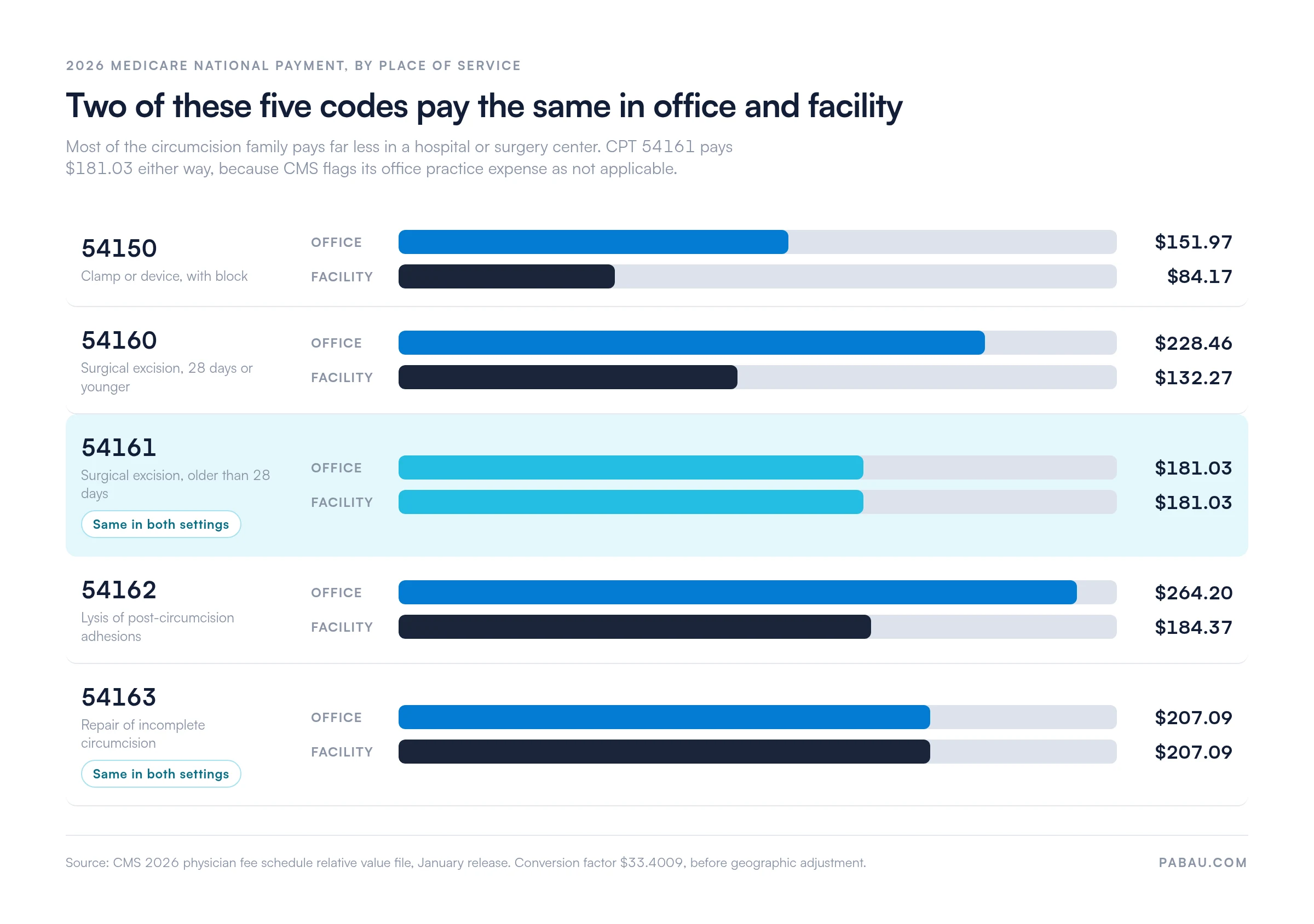
Locality still moves the number. Geographic practice cost indices push payment above the national figure in San Francisco or New York. Much of the rural Midwest sits below it. The CMS physician fee schedule lookup tool gives the rate for your own payment locality.
Medicare multiplies total relative value units, known as RVUs, by an annual conversion factor. For 2026 that factor is $33.4009 outside an advanced payment model. CPT 54161 carries 5.42 total RVUs, which is where $181.03 comes from.
Practices that qualify under an advanced payment model use a slightly higher conversion factor of $33.5675. On this code that works out to $181.94. Pull fresh numbers from the CMS relative value files each January.
Carrying last year’s fee schedule forward is the quiet way to under-collect. CMS republishes the relative value file several times a year, and the conversion factor changes every January. Rebuild your 54161 expected-payment figure from the current file, then compare it against the remittance on your next few cases.
A modifier tells the payer why this case differed from the descriptor. On a surgical code it is also the quickest route to a denial.
Modifier 22 needs paperwork attached to the claim. Dense scarring or a badly retracted foreskin qualifies. A long operating time on its own does not.
Several modifiers will not pay on this code at all. CMS gives 54161 an assistant-at-surgery indicator of 1, which is a statutory restriction. Modifiers 80, 81, 82, and AS are denied here regardless of what the note says.
The co-surgery indicator is 0 as well, so modifier 62 is off the table. Bilateral surgery is coded 0, so modifier 50 does not raise the payment.
CPT 54161 carries a 10-day global period, which makes it a minor surgical procedure under CMS rules. The day of surgery and the 10 days after it are already paid for.
CMS splits the payment three ways: 10% pre-operative, 80% intra-operative, and 10% post-operative. That last slice pays for routine follow-up. Billing a wound check inside the window is billing for it twice.
Four place of service codes fit CPT 54161:
The setting changes the patient’s cost share. It does not change what Medicare pays you.
An operative note that misses one element cannot defend the claim behind it. Six items do most of the work.
Write the technique in plain words. A note that says only circumcision performed tells an auditor nothing useful. Circumcision by surgical excision, no clamp or device used, answers the question before anyone asks it.
The path is short, and two points on it swallow most of the denials.
Steps three and four are where the money goes missing. Both of them are settled back at step one.
No two payer types treat this code the same way. Checking coverage before the patient is on the schedule is far easier than appealing afterward.
Prior authorization rules for elective cases are set plan by plan, so they cannot be assumed. Building that check into your revenue cycle management process, before the case is booked, is what protects the payment.
The qualifying criteria are narrow, so the same four errors turn up again and again.
Run a short check before the claim leaves the practice:
Audit your 54161 claims once a quarter. Pull every paid and denied claim on the code, then read the technique in each operative note against the code you billed. If a clamp case was billed as 54161, start a voluntary refund and retrain the documentation step straight away.
Most of what goes wrong with a 54161 claim goes wrong long before anyone opens the billing screen. The age sits in the patient record, the technique sits in the note, and the diagnosis sits somewhere else again.
Practice management software like Pabau keeps them in one place. Pabau is built for claims management without retyping, so the claim form is assembled from the visit record itself. The CPT code attached to the service lands on the charge line, and the ICD-10 slots are seeded from the patient’s recorded problem list.
Built-in ICD-10-CM and CPT lookup libraries sit behind a search icon on the claim, so a coder can confirm N47.1 without leaving the screen. Required fields are checked before the send button unlocks, which catches a missing authorization code while the case is still fresh.
For US practices, Pabau submits through the Claim.MD clearinghouse and brings eligibility checks, claim status, and electronic remittance back into the same record. So you learn that $181.03 landed without chasing a paper statement.
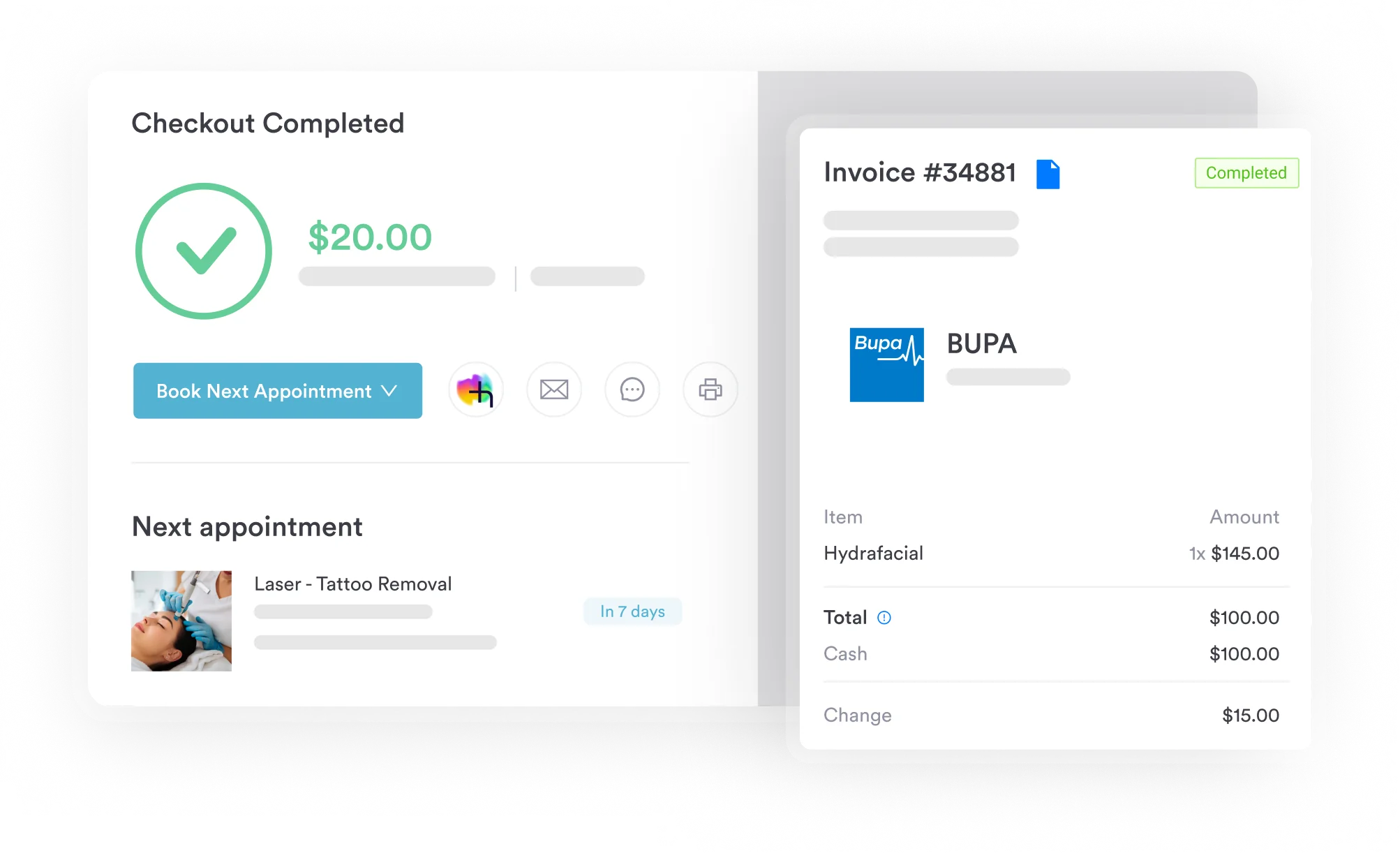

Pabau assembles the claim form from the visit record. ICD-10 and CPT lookup libraries stay a click away, and required fields are checked before you send. So a 54161 claim leaves the practice complete the first time.

Two facts decide whether a 54161 claim gets paid. The technique has to be surgical excision, and the patient has to be older than 28 days. A clinical diagnosis has to sit behind both.
The payment is worth knowing as well. At $181.03 in either setting, a case that can safely be done in the office loses no revenue by staying there. The choice of venue is a clinical call, and the fee schedule stays out of it.
Fix the documentation habit once and these denials stop being a monthly chore. Want to see how a surgical claim builds itself from the visit record? Book a demo and we will walk through the workflow.

Want to know what happens after you hit send? How medical claims clearinghouses work follows a surgical claim through submission and validation.
Trying to get more claims paid first time? What makes a clean claim breaks down the fields payers check before a claim reaches an examiner.
Dealing with a pile of denials already? Denial management in healthcare shows how to spot the pattern behind repeat rejections and fix it at the source.
Wondering how automated edits catch errors early? Pabau’s Claim.MD clearinghouse integration explains where claim edits run before a denial can happen.
Not billing this payer yet? Getting credentialed with insurance companies covers the steps a surgical practice completes before it can bill at all.
Yes, when an anesthesia provider is involved. CPT 54161 pays for the surgery only. Local anesthetic given by the surgeon is part of the procedure. An anesthesiologist or CRNA reports their own anesthesia code, with their own time units.
No. CMS gives 54161 a bilateral surgery indicator of 0, so the 150% bilateral adjustment never applies. Reporting it with modifier 50, or with RT and LT together, will not raise the payment.
Not for payment purposes. The co-surgery indicator on 54161 is 0, so Medicare does not recognize modifier 62 here. An assistant surgeon is restricted too, because the assistant-at-surgery indicator is 1.
Standard multiple-procedure rules apply, since 54161 carries a multiple-procedure indicator of 2. The payer ranks the procedures by fee schedule amount. The highest one pays in full, and 54161 pays at 50% if it ranks second.
State scope of practice decides the clinical side, and payer enrollment decides the rest. When a PA or nurse practitioner bills Medicare under their own NPI, the allowed amount is 85% of the fee schedule. On this code that is roughly $154.